
Quick answer: the code engraved under the nasal alignment mark identifies the lens design and refractive index. Type it below to get the brand, design and index back. One honest limit up front, because it decides whether this tool can help you at all: it only works for manufacturers who engrave letters and numbers. ZEISS, Nikon, Pentax and American Optical do. Essilor, Hoya, Shamir, Rodenstock and Seiko engrave symbols, which cannot be typed into any search box. For those, you match the shape visually against the manufacturer’s chart, and no lookup tool can change that.
If you need to find the engravings on the lens first, the guide to progressive lens markings covers the light-and-black-background technique and how to restore the full ink layout once you have located them.
What the Two Engravings Encode
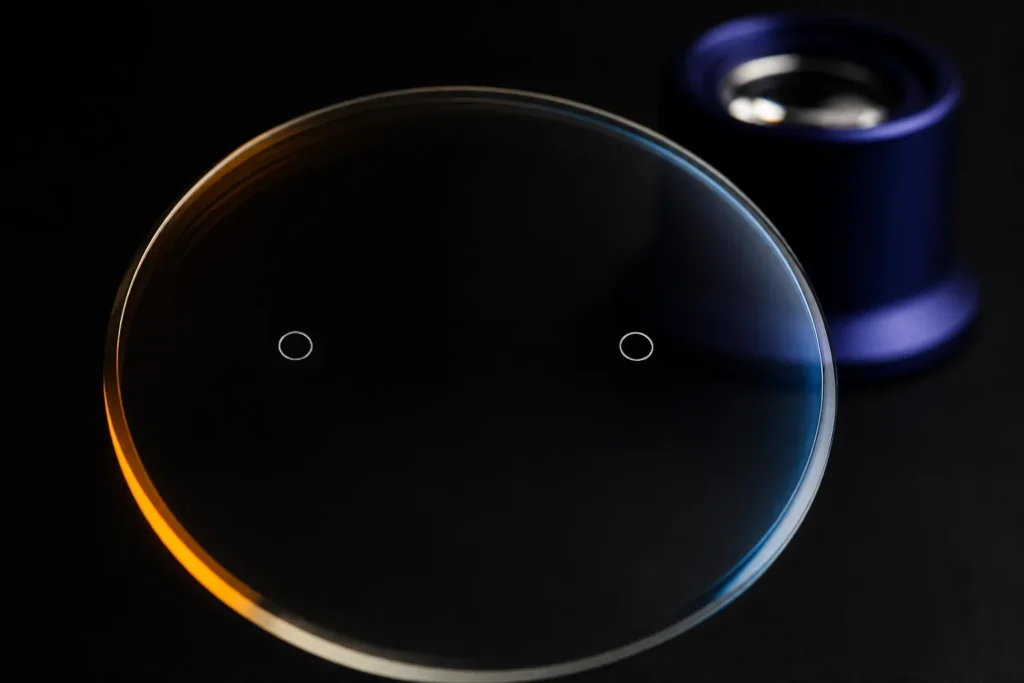
Every progressive carries two permanent alignment marks 34 mm apart, and the data sits directly beneath them:
- Temporal side (ear): the add power.
- Nasal side (nose): the design name and the refractive index. This is the code this tool searches.
That split is the convention described in the ABDO reference on hidden markings: “A typical set of product identification marks show a temporal engraving, which identifies the addition and a nasal engraving, which identifies the product design and the refractive index.”
Why Some Brands Cannot Be Looked Up by Typing
This is the part every “lens identifier” tool glosses over, and it is worth being direct about.
Engravings are not standardised as text. Some manufacturers chose alphanumeric codes: ZEISS engraves DSI67 for DriveSafe Individual at 1.67, and the scheme is systematic enough that you can almost read it. Others chose pictorial glyphs: a stylised mark, a logo fragment, a geometric symbol that identifies the design by shape.
A search box can only ever serve the first group. Typing is not a possible interaction for a symbol you cannot name. This is why this tool covers four manufacturers rather than twenty, and why a blank result here is much more likely to mean “your lens is from a pictorial brand” than “your lens is unknown”.
Practical consequence: if you read a symbol rather than characters under the nasal mark, stop searching and pull that manufacturer’s identification chart instead. Essilor, Hoya and Shamir all publish one.
What This Tool Covers
| Manufacturer | Catalogued engravings | Engraving style |
|---|---|---|
| ZEISS | 156 | Alphanumeric |
| Nikon | 70 | Alphanumeric |
| American Optical | 14 | Alphanumeric |
| Pentax | 11 | Alphanumeric |
| Essilor (Varilux), Hoya, Shamir, Rodenstock, Seiko, BBGR, CZV, Jai Kudo | Not covered | Pictorial symbols |
251 entries in total, spanning progressives, occupational lenses, single vision, bifocals and trifocals.
Two caveats worth stating plainly. The source tables date from 2018, so designs launched since then are absent, and some catalogued lines have been discontinued. Absence from this catalogue is not evidence that a lens is counterfeit.
When One Code Means More Than One Lens
Twenty of the catalogued codes match more than one product, and this is a property of the engravings themselves, not a gap in the data.
ZEISS I260 is both Progressive Individual 2 & Sport at 1.60 and Progressive Individual 2 Mineral at 1.60. PS60 is Progressive Precision Superb and Progressive Precision Superb Mineral. The engraving identifies the design and the index; it does not distinguish the organic version from the mineral one.
The tool returns every match rather than choosing for you. When you get more than one, separate them by lens material or by the job ticket, not by the engraving.
Case is significant, and it is the easiest thing to get wrong at the bench. ZEISS p267 is Progressive Plus 2 Short & Sport at 1.67. PS67 is Progressive Precision Superb at 1.67. Same index, different lens, and under a loupe at an angle the difference between a lowercase and an uppercase letter is exactly the kind of detail that gets lost. If a result surprises you, re-read the case before ordering against it.
What to Do With the Answer
Identifying the lens is the first step, not the last. Once you know the design:
- Pull that design’s layout chart to rebuild the fitting cross, the 180 degree line and the prism reference point from the two alignment dots.
- Check the corridor length against the frame’s usable depth before assuming the lens can be reused in a new frame.
- If you are troubleshooting a complaint, confirm the segment height and mounting geometry against what the design actually requires. Identifying the lens frequently reveals that a short-corridor design was fitted into a frame that could not support it.
- If the identified design is not what the job ticket says was ordered, that is a supplier discrepancy, and it is worth logging as a remake cause rather than absorbing quietly.
Frequently Asked Questions
Where is the design code engraved on a progressive lens?
Directly below the nasal alignment reference mark, on the nose side of the lens. The two permanent alignment marks sit 34 mm apart, centred on the prism reference point. The mark under the temporal one, on the ear side, is the add power instead. Both are semi-visible engravings, best found by angling the lens under a strong light against a matte black background.
Why does the identifier return nothing for my Varilux lens?
Because Essilor engraves pictorial symbols rather than letters and numbers, so there is no code to type. The same applies to Hoya, Shamir, Rodenstock and Seiko. This is a property of how those manufacturers mark their lenses, not a gap that more data would close. For those brands, match the symbol visually against the manufacturer’s own identification chart.
Does the engraving tell me the add power?
Not the nasal one. The add power is engraved under the temporal alignment mark, on the ear side. The nasal engraving carries the design name and refractive index. If the lab compensated the fabricated prescription, a carat symbol may also appear to the temporal side of the add marking, flagging that the finished lens intentionally differs from the original order.
Can one engraving code belong to two different lenses?
Yes, and 20 of the catalogued codes do. ZEISS I260, for example, is used by both Progressive Individual 2 & Sport and Progressive Individual 2 Mineral at 1.60 index. The engraving identifies design and index but not the material variant. When a lookup returns more than one lens, distinguish them by material or by the job ticket.
My lens is not in the catalogue. Is it counterfeit?
Almost certainly not. The most likely explanations are that the brand engraves symbols instead of characters, or that the design launched after the 2018 reference tables were compiled. Absence from this catalogue is not evidence of a counterfeit. If authenticity is genuinely in question, most manufacturers also apply a separate hallmark engraving visible by reflection, and their technical support can confirm a code directly.
Why does capitalisation matter in the code?
Because some manufacturers use case to separate distinct products. ZEISS p267 is Progressive Plus 2 Short & Sport at 1.67, while PS67 is Progressive Precision Superb at 1.67: two different designs at the same index. Under magnification and at an angle, case is easy to misread, so re-check it whenever a result looks wrong for the job.
Sources
- ABDO, Hidden Markings on Progressive Power Lenses (2018)
- ABDO, Hidden Markings on Engraved Lenses: Zeiss
The engraving data in this tool is transcribed from the Association of British Dispensing Opticians reference tables. The ZEISS entries appear in both documents and were cross-checked against each other.