
Short Answer: To clean eyeglasses safely, rinse under lukewarm water, apply a small drop of lotion-free dish soap or a lens-specific spray, gently rub with a microfiber cloth using circular motions, and rinse again. Never dry-wipe, never use paper towels, and never use household cleaners containing ammonia, bleach, or vinegar — these permanently damage anti-reflective and other protective coatings.
What You Need Before You Start
Keep these three items within reach for daily and weekly cleaning:
- A clean microfiber cloth designated for lenses only (wash weekly in cool water, no fabric softener)
- Lotion-free dish soap or a spray specifically formulated for coated lenses
- A hard-shell case for storage when glasses are not in use
That’s it. Commercial lens cleaning kits (spray + cloth) from brands like Zeiss or Crizal work well and are confirmed safe for anti-reflective coatings.
Do’s and Don’ts Quick Reference
| Do | Don’t |
|---|---|
| Rinse under lukewarm water before wiping | Dry-wipe lenses — any dust on the surface will scratch the coating |
| Use a clean microfiber cloth | Use your shirt, tie, sleeve, or paper towels |
| Apply lotion-free dish soap or AR-safe lens cleaner | Use household glass cleaners, window spray, or all-purpose cleaners |
| Clean nose pads, hinges, and frame edges too | Use cleaners with ammonia, bleach, vinegar, or acetone |
| Store glasses in a hard case when not in use | Leave glasses lens-down on any surface |
| Wash microfiber cloths weekly (cool water, no softener) | Wash microfiber cloths in hot water or with fabric softener |
| Visit your optician annually for professional adjustment | Use paper towels or tissues — they contain wood fibers that abrade coatings |
| Handle glasses with both hands when putting them on | Use saliva to “clean” a smudge — it transfers bacteria and oils |
The American Academy of Ophthalmology confirms: “Don’t use ammonia, bleach, vinegar, or window cleaner, which can harm lenses and their coatings.”
Daily Cleaning: Step-by-Step
- Wash your hands with soap and dry them on a lint-free towel before touching the lenses.
- Rinse lenses under lukewarm running water. This dislodges dust and grit that would otherwise scratch the surface when you wipe. Avoid hot water — heat can degrade certain coatings.
- Apply one small drop of lotion-free dish soap to each lens, or spray an AR-safe lens cleaner on both sides.
- Gently rub with your fingertips using light circular motions on both sides of each lens. Include the nose pads, frame edges, and hinges — these collect oils and debris.
- Rinse again thoroughly until the soap is completely removed.
- Dry with a clean microfiber cloth, wiping in circular motions until streak-free.
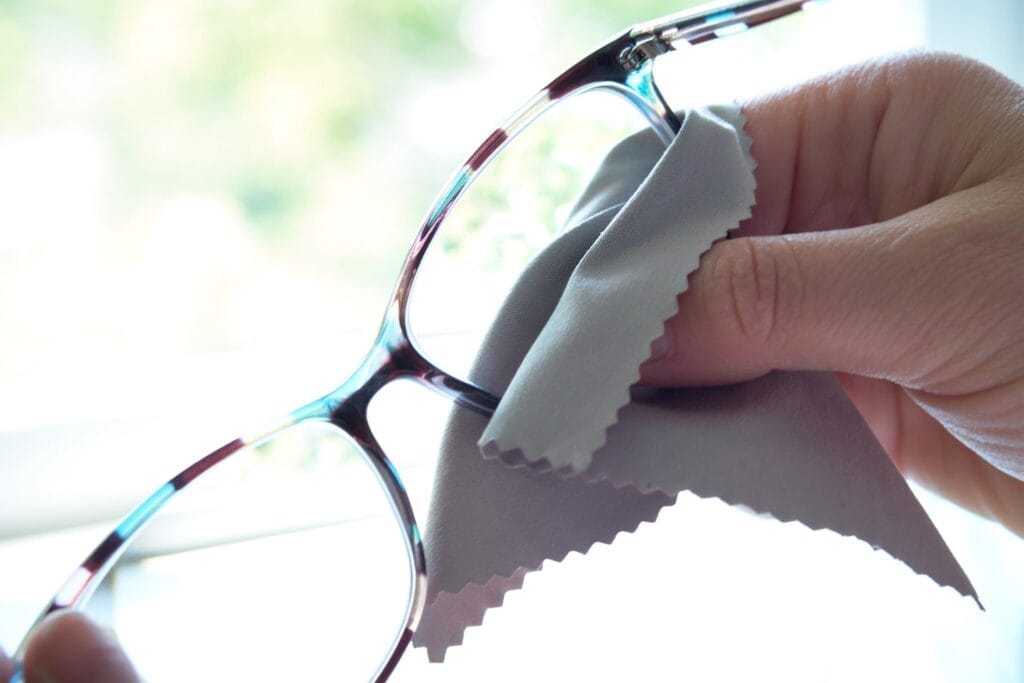
Northern Virginia Doctors of Optometry advises: “Before wiping your lenses, rinse them under lukewarm water to remove any debris or particles” and always “use a microfiber cloth when cleaning coated eyeglass lenses. These soft, lint-free cloths are gentle on the lens surface.”
Cleaning by Coating Type
Different lens coatings have specific vulnerabilities. Use this table as a reference for the glasses you dispense or wear.
| Coating Type | What It Does | Specific Care Notes |
|---|---|---|
| Anti-Reflective (AR) | Reduces glare from screens, lights, and oncoming headlights | Most sensitive coating. Never use alcohol above 30% concentration. Always rinse before wiping. Use AR-labeled cleaners. |
| Hydrophobic / CleanCoat | Repels water and reduces smudge adhesion | Still needs regular cleaning — ZEISS notes: “no coating will mean never having to clean lenses again.” Use standard microfiber + rinse method. |
| Blue Light Filter | Blocks high-energy visible light from screens and LEDs | Same care as AR. Avoid alcohol-based sprays. Use microfiber and a gentle, coating-safe solution. |
| Polarized | Filters horizontally reflected glare from water, roads, and snow | Contains a layered film. Avoid all solvents. Use only water + mild soap + microfiber. Never acetone. See our guide to polarized lenses for coating details. |
| UV Protection | Blocks UVA/UVB radiation | Typically applied as part of the lens material. Clean the same as standard lenses — mild soap and water. |
| Photochromic | Darkens automatically in UV light | Avoid leaving photochromic glasses in direct sunlight when not in use. Clean as AR lenses. See our photochromic lens guide for care by brand. |
For a full breakdown of prescription lens types and materials, including how each material affects care requirements, see our dedicated guide.
Common Cleaning Myths — Addressed
Myth 1: “My shirt is soft enough to wipe my lenses.”
False. Cotton and synthetic fibers contain microscopic abrasive particles. With repeated use, this creates a network of micro-scratches across the lens surface that scatter light and reduce clarity. Northern Virginia Doctors of Optometry confirms: “Steer clear of abrasive materials like rough fabrics or clothing when cleaning your eyeglasses.”
Myth 2: “Paper towels are fine if I’m gentle.”
False. Paper towels and tissues are made from wood pulp. Northern Virginia Doctors of Optometry states: “Tissues and paper towels may feel soft but can contain fibers that may scratch coated lenses.” The damage is cumulative and permanent.
Myth 3: “Dish soap will damage my lenses.”
False — with one important caveat. Plain, lotion-free dish soap diluted with water is one of the methods recommended by optometrists. The AOA recommends this method directly. However, dish soaps that contain added moisturizers, hand lotions, or antibacterial agents leave a film. Check the label.
Myth 4: “A little isopropyl alcohol is fine to disinfect lenses.”
Mostly false for coated lenses. Isopropyl alcohol at 70% concentration or higher breaks down AR coatings and can cause the coating to peel. Some AR-safe lens sprays contain very low concentrations (under 30%) and are formulated to be coating-safe — but household rubbing alcohol is not. Use it only on uncoated lenses and sparingly.
Myth 5: “Saliva works in a pinch.”
No. Saliva transfers bacteria and oils directly onto the lens surface and can accelerate coating degradation over time.
Frame Maintenance: Signs Your Frames Need Attention
Frames need regular checks beyond lens cleaning. Here are the signs to watch for:
Loose or wobbly temples (arms): The screw connecting the temple to the front frame loosens with daily use. A small eyeglass screwdriver (included in most travel kits) handles minor tightening. Do not over-tighten — stripped screws are harder to fix.
Nose pads sitting unevenly: If glasses consistently slide down or sit higher on one side, the nose pads have shifted. Visit your optician for realignment. Attempting this yourself on metal nose pad arms risks snapping them.
Temples that splay outward: This is the most common fit complaint. Glasses that have widened spread optical centers away from the pupils, reducing prescription accuracy and causing eye strain. An optician can re-bend the temples in under a minute.
Plastic frames that feel tight or have warped: Plastic expands with heat and can distort. An optician uses a frame heater to safely re-form the shape. Never try to bend cold plastic frames — they crack.
For guidance on choosing frames that fit correctly from the start, see our guide on choosing eyeglass frames.
Proper Storage to Prevent Damage
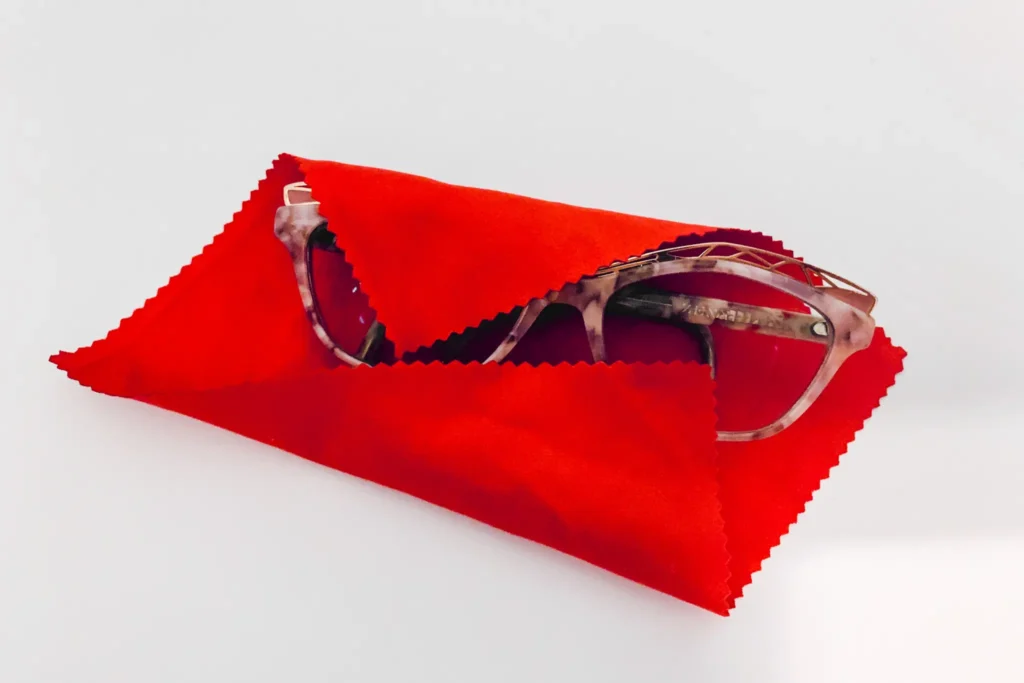
- Always use a hard-shell case when glasses are not on your face. Soft pouches prevent surface scratches but offer no protection against impact.
- Never leave glasses lens-down on any surface — even on a soft cloth.
- Avoid leaving glasses in a hot car. Dashboard temperatures in direct sun can exceed 70°C (158°F). This warps plastic frames, peels AR coatings, and can distort the lens shape.
- Extreme cold makes some plastics brittle and can cause condensation when moving to warmer air. Wipe away condensation with a microfiber cloth rather than letting it evaporate on the lens.
- Keep one microfiber cloth inside your case for quick on-the-go cleaning.
When to Replace Your Lenses
Scratched lenses are uncomfortable but not medically dangerous. The AAO clarifies: “Looking through a scratched lens may be annoying and could distract your eye’s gaze, but it won’t harm the eye’s optical system.” However, opticians recommend replacement when:
- Scratches fall within your direct line of sight and cause noticeable blur or glare
- You experience headaches or eye fatigue that improves when you remove your glasses
- The AR coating is visibly peeling, clouding, or showing iridescent crazing
- Your prescription has changed — even a minor shift can produce strain with the old lenses
- Frames no longer hold their adjustment after professional re-bending
Lenses do not have a fixed lifespan based on time alone. A well-maintained pair of AR-coated lenses can last two to three years. Poorly maintained lenses may need replacement within twelve months.
Maintenance Schedule
| Frequency | Task |
|---|---|
| Daily | Rinse and wipe with microfiber cloth. Inspect for visible smudges or debris before wearing. |
| Weekly | Thorough soap-and-water wash. Wash the microfiber cloth in cool water (no fabric softener). Check nose pads and temple fit. |
| Monthly | Inspect screws for looseness. Tighten gently with a precision screwdriver if needed. Check that frames sit level on your face. |
| Every 3–6 months | Bring to your optician for a professional cleaning (ultrasonic bath) and minor adjustments. |
| Annually | Full optician visit: frame alignment, nose pad replacement if needed, prescription check. |
FAQ
How often should I clean my glasses?
Rinse and wipe daily. A full soap-and-water cleaning once or twice a week is sufficient for most wearers. If you work in environments with grease, dust, or chemical vapors, clean more frequently.
Can I use hand sanitizer to clean my lenses?
No. Most hand sanitizers contain 60–70% isopropyl or ethyl alcohol, which is high enough to strip anti-reflective coatings. Use lens-specific cleaner or mild dish soap instead.
Why do my lenses still look greasy after cleaning?
Two common causes: the microfiber cloth itself is dirty (oils transfer back onto the lens), or you are wiping without rinsing first. Wash the cloth in cool water and always rinse lenses before wiping.
Is it safe to use commercial eyeglass wipes on daily basis?
Zeiss Lens Wipes are formulated for coated lenses and safe for daily use. Pre-moistened wipes from non-optical brands may contain alcohol or fragrances — check the label for coating compatibility before using.
How do I know if my anti-reflective coating is damaged?
Damaged AR coating appears as a milky haze, iridescent rainbow patterns, or visible peeling at the lens edge. Minor hazing can sometimes result from hot water or harsh chemicals. Once the coating peels, the lens needs replacement — there is no effective repair.
Can I clean polarized sunglasses the same way?
Yes, with one addition: avoid any solvents including acetone and high-percentage alcohol entirely. Polarized lenses use a laminated filter layer that solvents dissolve. Stick to water, mild soap, and a microfiber cloth. More on how polarized lenses work.
What should I keep in a travel glasses kit?
A hard-shell travel case, one clean microfiber cloth, a travel-size lens cleaner spray, and a mini precision screwdriver. This covers cleaning, minor hinge tightening, and safe transport.
When should I see an optician instead of fixing something myself?
If nose pad arms bend, a screw strips, a temple hinge cracks, or you cannot get the frames to sit level — stop and visit an optician. Most adjustments take fewer than five minutes in-store and are free or low-cost.
Sources
- American Academy of Ophthalmology — Cleaning Your Eyeglasses
- American Academy of Ophthalmology — Do Scratched Eyeglasses Have to Be Replaced?
- ZEISS Vision Care — Lens and Screen Cleaning
- ZEISS Vision Care — Lens Coatings: Anti-Reflective, Hard Layer, CleanCoat
- Northern Virginia Doctors of Optometry — Guidelines for Cleaning Coated Eyeglass Lenses
- All About Vision — Can Scratched Lenses Worsen Vision?

I am a seasoned software engineer with over two decades of experience and a deep-rooted background in the optical industry, thanks to a family business. Driven by a passion for developing impactful software solutions, I pride myself on being a dedicated problem solver who strives to transform challenges into opportunities for innovation.