
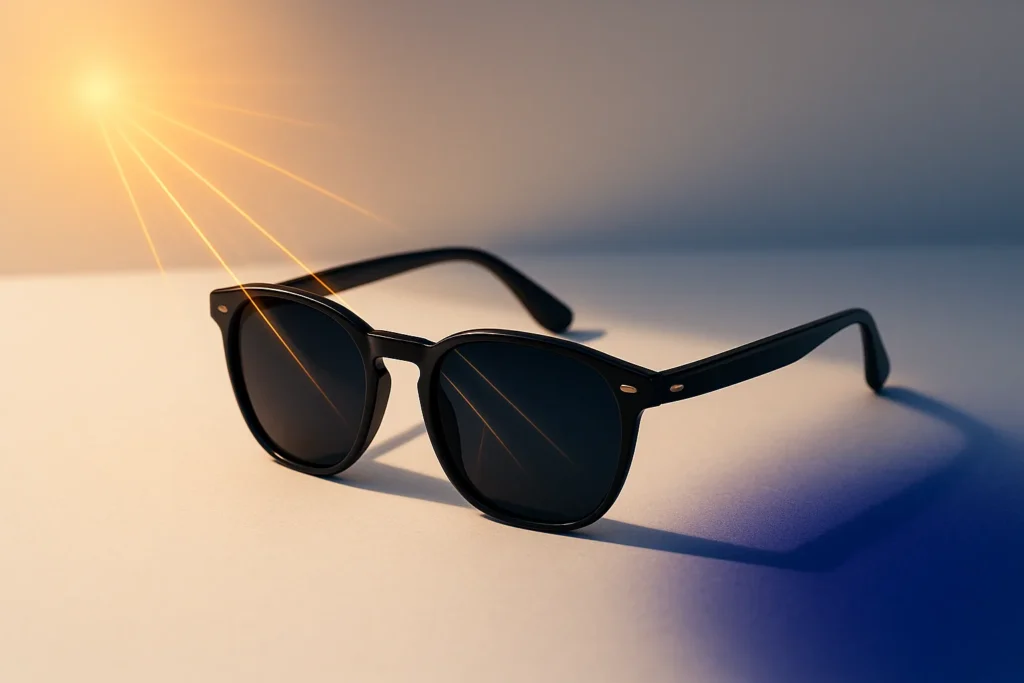
UV400 means a lens blocks all ultraviolet radiation from 100 nm up to 400 nanometers (nm), a range that covers both UVA radiation (315-400 nm) and UVB radiation (280-315 nm) as defined by the WHO and ICNIRP. Lenses carrying a UV400 or “100% UV protection” label block more than 99% of all UV radiation in that combined range. The single most important fact to understand before buying sunglasses: lens tint darkness has nothing to do with UV blocking. A heavily tinted lens without UV treatment can be worse than no sunglasses at all, because the dim visual environment causes your pupil to dilate, allowing more unfiltered UV to reach the retina. To confirm real protection, check for the UV400 or “100% UV protection” label, not the shade of the glass.
UV Radiation: What UVA and UVB Actually Are
The sun emits energy across the full electromagnetic spectrum. UV radiation sits just beyond visible violet light, from 100 nm to 400 nm. Of those wavelengths, only UVA and UVB reach Earth’s surface in meaningful amounts: UVC (100-280 nm) is almost entirely absorbed by the ozone layer and does not reach ground level under normal conditions.
- UVB (280-315 nm): Higher energy, partially absorbed by the atmosphere. UVB is the principal cause of sunburn and photokeratitis, a painful corneal sunburn from overexposure. UVB energy is high enough to cause direct cellular damage in exposed tissue.
- UVA (315-400 nm): Lower energy per photon but less filtered by the atmosphere. UVA penetrates more freely to the Earth’s surface and reaches deeper into the eye’s structure, including the crystalline lens.
UV400 protection closes the full spectrum: it blocks radiation at all wavelengths up to 400 nm, covering the entire UVA and UVB range. An older label of “UV380” leaves the last 20 nm of UVA unprotected, which is why UV400 has become the recognized benchmark.
Why Lens Tint and UV Protection Are Not the Same Thing
This is the central misconception in UV eyewear, and acting on it incorrectly can make things worse.
Lens tint controls how much visible light (roughly 380-780 nm) passes through the lens. UV-blocking chemistry addresses an entirely different segment of the spectrum. The two properties can be combined in a single lens, or they can exist completely independently. A clear polycarbonate lens can block UV completely. A very dark lens with no UV treatment can block almost none.
The FDA states plainly that “the darkness of the lens does not indicate its ability to shield your eyes from UV rays.” The American Academy of Ophthalmology (AAO) puts it equally directly: “Don’t be fooled into thinking the darker the lens, the more they’ll protect your eyes from the sun.”
The mechanism behind the added risk with dark, unprotected lenses is straightforward. When you wear any tinted lens, the visual environment appears dim and the pupil naturally dilates to admit more light. If that lens carries no UV filter, the dilated pupil admits a larger cross-section of unfiltered UV into the eye. The AAO notes that “dark glasses that do not filter UV light may actually put your eyes at greater risk because your pupils may remain larger, thus allowing more unfiltered UV rays to enter.”
| Common Belief | Fact |
|---|---|
| Darker lens = more UV protection | False. Tint controls glare, not UV blocking. |
| Light-tinted lenses cannot protect against UV | False. Clear, gray, or amber lenses can carry full UV400 protection. |
| Polarized lenses block UV | Not automatically. Polarization reduces reflected glare; UV protection is a separate property. |
| Expensive sunglasses always block UV | Not guaranteed. Always check for the UV400 or “100% UV protection” label. |
Lens Filter Categories: What the Numbers 0 to 4 Mean
Many sunglass frames or packaging display a filter category number from 0 to 4. This number comes from ISO 12312-1, the international standard for general-use sunglasses, which underlies both the European EN 1836 standard and the US ANSI Z80.3 standard. The category describes visible light transmittance (VLT), the percentage of visible light the lens allows through. It says nothing about UV.
| Filter Category | VLT (visible light through lens) | Typical Use |
|---|---|---|
| 0 | More than 80% | Fashion, indoor use, very overcast light |
| 1 | 43-80% | Overcast to partly cloudy conditions |
| 2 | 18-43% | Variable sunlight, general outdoor use |
| 3 | 8-18% | Bright sunlight, beach, road driving |
| 4 | 3-8% | Extreme glare: glaciers, high altitude, open ocean |
Category 4 is the darkest available for general eyewear. Because it transmits so little light, it is not suitable for driving: in tunnels, sudden shade, or overcast conditions, vision is impaired to an unsafe degree.
A Category 0 lens with a UV400 coating blocks all UV while allowing most visible light through. A Category 4 lens without UV treatment blocks extreme amounts of visible light but may block little UV. A lens that genuinely complies with ISO 12312-1 and carries a UV400 label delivers both: appropriate glare reduction for its category and full UV protection.
Clear Everyday Lenses Can Block UV Too
One underappreciated consequence of the tint-versus-UV distinction: your everyday clear prescription lenses can block UV as effectively as dedicated sunglasses.
Polycarbonate, the material used in most sports and children’s frames, absorbs UV from the polymer itself without any added coating. The AAO confirms that “Polycarbonate lenses block UV rays without an additional coating.” Standard CR-39 plastic and glass lenses do not share this inherent property and require a UV-blocking treatment applied during manufacturing. The AAO notes that “UV coatings on prescription clear lenses are as effective as those on sunglasses,” provided the coating covers the full UV400 range.
Photochromic lenses (sometimes called adaptive or transition lenses) darken in sunlight and lighten indoors. Most current photochromic products include UV400 protection as a standard feature; the darkening response and UV blocking are engineered separately, so patients should confirm both properties with their optician rather than assuming one implies the other.
For a different wavelength concern: blue-light filtering lenses target the 380-500 nm visible-spectrum range emitted by screens and LED sources. Blue-light filtration is a separate property from UV protection and the two should not be conflated.
UV Exposure and Eye Health: Brief Context
The eye accumulates UV exposure over a lifetime. The AAO states that “UV rays are involved in the development of cataracts, eye-surface problems like pterygia and pingueculae, and macular degeneration.” A pterygium (teh-RIJ-ee-um) is a growth of tissue on the conjunctiva that can extend onto the cornea; it appears most often in people with sustained outdoor UV exposure. Photokeratitis, essentially a corneal sunburn, can result from a single high-exposure day on snow, water, or highly reflective surfaces without adequate eye protection.
These are medical conditions. An ophthalmologist or optometrist should be consulted for evaluation and clinical advice. UV-protective lenses are a preventive measure, not a treatment.
How to Verify That Your Lenses Block UV
Check the label. Look for “UV400,” “100% UV protection,” or “blocks UV up to 400 nm” on the lens sticker, frame card, or original packaging. Either phrasing refers to the same performance level. CE-marked eyewear sold in Europe must satisfy UV requirements under ISO 12312-1. US non-prescription sunglasses should comply with ANSI Z80.3.
Ask your optician to meter the lens. A UV transmission meter measures the UV that passes through any finished lens in about thirty seconds. It works on existing pairs as well as new ones, and gives a direct reading rather than a label-based assumption. This is the most reliable check outside a controlled laboratory.
Be cautious with unlabeled lenses. Fashion sunglasses sold without certification marks frequently lack UV blocking regardless of how dark the tint appears. The FDA identifies the UV protection label as the only reliable consumer indicator.
Standards to recognize:
- ISO 12312-1: international standard for general-use sunglasses (referenced globally)
- ANSI Z80.3: US standard for non-prescription sunglasses
- CE mark with EN ISO 12312-1: European conformity marking for sunglasses
Frequently Asked Questions
What does UV400 mean on sunglasses?
UV400 indicates that the lens blocks all ultraviolet radiation with wavelengths up to 400 nanometers (nm), covering both UVA (315-400 nm) and UVB (280-315 nm). A UV400 lens blocks more than 99% of UV radiation across that entire range. It is the most comprehensive UV protection label available on consumer eyewear and is more thorough than older “UV380” claims, which leave the top 20 nm of UVA unprotected.
Does a darker lens mean more UV protection?
No. Lens tint and UV protection are independent. The FDA states that “the darkness of the lens does not indicate its ability to shield your eyes from UV rays.” A clear lens with a UV400 coating blocks UV completely, while a very dark lens without UV treatment may block little to none. Always check for a UV400 or “100% UV protection” label rather than judging protection by tint darkness.
Do polarized sunglasses protect against UV?
Not automatically. Polarization is a separate optical property that reduces glare from horizontal reflective surfaces such as water, snow, and wet pavement. It does not inherently block UV radiation. Many polarized lenses also include UV400 protection, but the two features are engineered independently. Check for both “polarized” and “UV400” or “100% UV” on the product label.
Can clear prescription lenses block UV?
Yes. Polycarbonate lenses block UV rays without any added coating, because the polymer itself absorbs UV. Other materials, including standard CR-39 plastic, require a UV-blocking treatment applied during manufacturing. The AAO confirms that UV coatings on clear prescription lenses are as effective as those on sunglasses when they cover the full UV400 range. Ask your optician whether your current lenses include UV protection.
What is a lens filter category and how does it relate to UV protection?
The filter category (0 through 4) describes how much visible light a lens transmits, per ISO 12312-1. It has nothing to do with UV protection. Category 3 (8-18% visible light transmittance) is the most common choice for bright sunlight and driving. Category 4 (3-8% VLT) is for extreme glare environments and is not suitable for driving. A lens in any category may or may not carry UV400 protection; check for the UV label separately.
How can I check if my existing sunglasses actually block UV?
An optician can test UV transmission with a handheld UV meter in about thirty seconds on any finished lens, including older pairs. If you have the original packaging or a sticker still on the lens, look for a UV400 or “100% UV protection” mark. Without either confirmation, the UV blocking level is unknown. Fashion sunglasses sold without certification marks often lack UV protection regardless of their appearance or price.

I grew up inside an optical shop. My mother likes to tell how, as a kid, I would watch eyeglasses being assembled, play with the tools, and draw on the back of service order slips. The family business taught me early what a precise measurement and work done right are worth.
I went on to spend more than twenty years as a software engineer, always keeping an eye on the optical world. Optogrid was born where the two meet: digital measurement technology (pupillary distance and fitting heights) built by someone who knows the dispensing counter from the inside.