
Short Answer: A complete prescription eyeglasses fitting involves six sequential steps: reading the Rx correctly, taking accurate PD and segment height measurements, selecting a frame that fits the face and accommodates the prescription, choosing the appropriate lens material, making professional frame adjustments (vertex distance, pantoscopic tilt, temple bend), and verifying optical center alignment before dispensing. Errors at any step — particularly in PD measurement — can cause eye strain, headaches, or failed progressive lens adaptation.
Step 1: Read the Prescription Before Touching a Frame
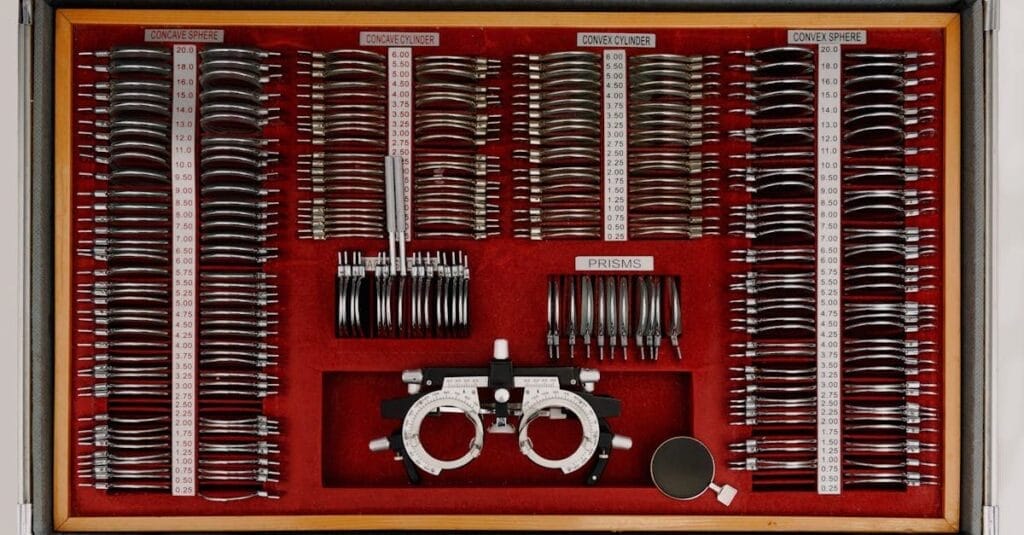
Before frame selection begins, the optician must fully understand what the prescription demands. According to the American Academy of Ophthalmology, the standard Rx contains the following fields:
| Field | What It Means |
|---|---|
| OD / OS | Oculus Dexter (right eye) / Oculus Sinister (left eye) |
| SPH (Sphere) | Lens power in diopters to correct myopia (−) or hyperopia (+) |
| CYL (Cylinder) | Amount of astigmatism correction; blank means no astigmatism |
| Axis | Orientation of astigmatism from 1 to 180 degrees |
| ADD | Additional magnifying power for multifocal lenses |
| PD | Pupillary distance in millimeters |
Why this step matters before frame selection: A high minus prescription (e.g., −6.00 D) requires minimum blank size planning. A high ADD value requires a frame with sufficient vertical depth for the progressive corridor. Reading the Rx first prevents recommending a frame the prescription cannot be fabricated in.
Red Flags to Catch Before Ordering
- High cylinder values (CYL > −2.00) require careful axis verification with the lab
- ADD values of +2.50 or higher restrict frame choices to those with at least 28mm of vertical lens height for progressive designs
- Significant anisometropia (difference of 2.00 D or more between eyes) may require specialized lens decentration planning
Step 2: Take Accurate PD and Segment Height Measurements
Measurement errors are the leading cause of prescription remakes. According to ANSI Z80.1 standards, segment height tolerance for multifocal lenses is ±1.0mm per lens, with no more than 1.0mm difference between lenses in a mounted pair. PD errors beyond this range introduce unwanted prismatic effects.
Pupillary Distance (PD)
Binocular PD is the total distance between pupil centers (e.g., 63mm). Monocular PD splits this into separate right and left measurements from each pupil to the center of the nose bridge (e.g., 31.5mm OD / 31.5mm OS).
Use monocular PD for:
- Prescriptions above ±4.00 D
- Progressive or bifocal lens wearers
- Patients with visible facial asymmetry
- Any patient where the binocular PD is not split evenly
Measurement accuracy by method:
| Method | Typical Accuracy | Best For |
|---|---|---|
| Millimeter ruler | ±2–3mm | Low prescriptions, binocular only |
| Manual pupillometer | ±1mm | Standard dispensing |
| Digital pupillometer | ±0.5mm | High prescriptions, progressives |
| Photo-based (e.g., Optogrid) | ±0.5mm | Remote measurement, PPE programs |
For remote fitting workflows, photo-based measurement tools like Optogrid allow accurate PD and SH capture from a patient photograph using a reference card for scale calibration. See how to measure PD with Optogrid for the step-by-step process.
Segment Height (SH) for Multifocal Lenses
Per iCare Labs professional guidance, for progressive lenses: “dot the center of the pupil” with the patient in natural posture, eyes in primary gaze, and the frame adjusted as it will be worn. Then “measure from the mark to the bottom edge of the lens, not the frame itself.”
A critical threshold: “at least 10mm of distance vision above the fitting cross in a progressive lens” must be preserved — less than this may result in inadequate distance vision and non-adaptation.
Common SH measurement errors to avoid:
- Frame not adjusted before measuring (it will shift after adjustment)
- Patient looking up or down during marking
- Measuring to frame bottom instead of lens bottom
- Not accounting for pantoscopic tilt when the frame is adjusted later
- Using center of the frame instead of pupil center for the fitting cross
Step 3: Select a Frame That Fits the Face and the Prescription
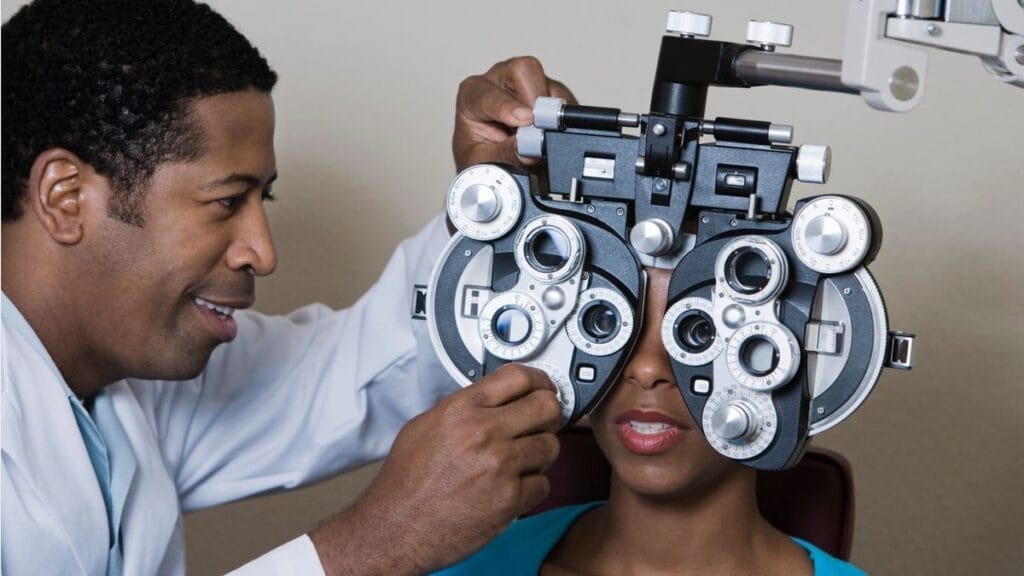
Frame selection involves two parallel criteria: optical compatibility with the prescription and physical fit on the patient’s face.
Optical Compatibility Checklist
- Minimum blank size: The uncut lens must cover the edging area. For decentered prescriptions, calculate blank size before ordering.
- Frame depth: Progressive lenses typically require a minimum of 28–30mm vertical lens height. Confirm with the specific lens design before recommending a frame.
- Wrap angle: Frames with significant wrap (base curve 6+) affect the effective power of the lenses and require prescription compensation.
- Vertex distance: Frames that sit far from the eye (vertex distance > 14mm) change the effective power at the corneal plane for prescriptions above ±4.00 D.
Physical Fit Parameters
A well-fitted frame before any adjustment should meet these conditions:
| Parameter | Correct Fit |
|---|---|
| Frame width | Matches face width; temples run parallel to the head |
| Bridge width | Sits comfortably without pinching; pupil centers over optical zone |
| Vertical position | Pupil sits at or above the geometric center of the lens |
| Temple length | Reaches the ear without pulling the frame forward |
For frame width reference, standard lens widths range from 42mm (narrow) to 50mm+ (wide). When in doubt, measure the patient’s head width at the temples before selecting.
Step 4: Select the Lens Material and Design

The American Academy of Ophthalmology’s EyeWiki outlines the main lens material categories available for ophthalmic use. Matching material to prescription and lifestyle is a clinical decision, not a cosmetic one.
Lens Material Comparison
| Material | Index | Impact Resistance | Best For |
|---|---|---|---|
| Standard plastic (CR-39) | 1.50 | Moderate | Low prescriptions, CR-39 tints well |
| Polycarbonate | 1.586 | High (ANSI Z87.1 compliant) | Children, sports, PPE |
| Trivex | 1.53 | High | Similar to poly, better optics |
| High-index (1.67) | 1.67 | Lower | Mid-to-high prescriptions |
| High-index (1.74) | 1.74 | Lowest | Highest prescriptions only |
Progressive Lens Frame Requirements
Not all frames accommodate progressive lenses. Highly curved frames (wrap > 6 base) introduce optical distortion in progressive designs unless the lens is manufactured with tilt-compensated calculations. For prescriptions stronger than ±4.00 D, most manufacturers limit progressive availability with high-wrap frames to prevent peripheral distortion.
Recommended coatings for all prescription lenses:
- Anti-reflective (AR) coating: reduces glare, particularly for night driving and screen use
- Scratch-resistant hard coat: extends lens lifespan
- UV 400 protection: blocks UV-A and UV-B (should be standard on all prescriptions)
Step 5: Make Professional Frame Adjustments
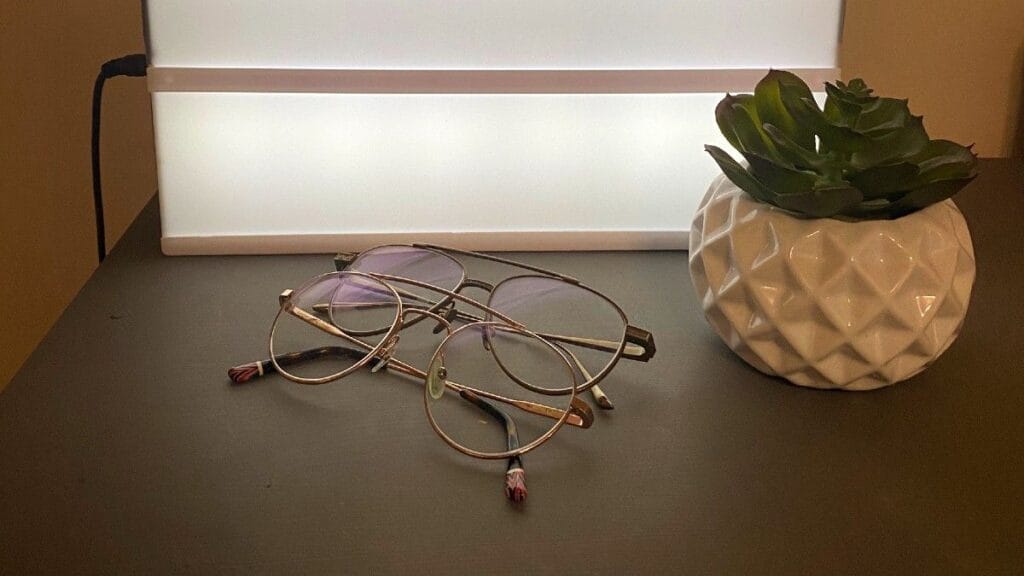
Professional frame adjustment — not frame selection — determines whether the optical centers align with the patient’s pupils. The Optician Online dispensing guide describes a systematic approach using the HELP framework: Head width, Ears (temple length), L (pantoscopic tilt/angle), and Pads (nose adjustment).
The Four Adjustment Parameters
1. Pantoscopic Tilt (6–10 degrees is standard)
Pantoscopic tilt is the vertical angle of the lens plane relative to the face. As confirmed by IOT Lenses, vertex distance, pantoscopic tilt, and wrap angle directly affect prescription accuracy. The optical center must shift down 0.5mm for every degree of pantoscopic tilt to keep the visual axis aligned. Adjust pantoscopic tilt before measuring or remeasuring segment height.
2. Vertex Distance (12–14mm is optimal)
Vertex distance is the distance from the back surface of the lens to the cornea. Values outside the 12–14mm range affect effective power at the eye, especially for prescriptions ±4.00 D or higher. Low vertex distance increases effective plus power; high vertex distance reduces it.
3. Temple Adjustment
The temple should contact the head only at the ear, not along the side of the skull. Per Optician Online: “The distance between the fully opened sides at the bends should correspond to the patient’s measured head width at the ears.” The temple bend should sit just past the top of the ear and curve naturally along the back of the ear without pressing on the skin.
4. Nose Pad Adjustment (metal frames)
Per the same dispensing guide: “The nose pads of metal frames should be adjusted to ensure that the frame sits at the correct height.” Nose pads should rest at the crest of the nose without digging in. For patients with flat bridges, adjust the splay angle so pads sit nearly parallel to the face.
Adjustment Sequence Matters
Always adjust in this order:
- Straighten the frame front (align the two temples to be level)
- Set pantoscopic tilt
- Adjust nose pads / bridge
- Set vertex distance
- Adjust temple length and bend
Adjusting temples before the front is level will compensate for a crooked frame with a crooked fit — visible when the patient looks in a mirror.
Step 6: Verify Optical Center Alignment Before Dispensing
The final step before handing over the glasses is verifying that the optical centers are positioned correctly relative to the patient’s pupils. This step catches lab errors and ensures the measurements translate into the finished product.
Verification Protocol
- Use a lensometer (focimeter) to locate and dot the optical center of each lens
- Have the patient put on the adjusted frame
- With the patient looking straight ahead, confirm the dots align with the pupil centers
- Check segment height on progressive lenses: the fitting cross should be at the pupil center
- Confirm there is at least 10mm of distance lens area above the fitting cross
When to Send Back to the Lab
Return lenses to the lab if:
- Optical centers are more than ±1mm from specified PD for progressive or high-index lenses
- Segment height differs more than ±1.0mm between lenses (per ANSI Z80.1)
- Lenses show visible chips, scratches, or coating defects
- Prescribed prism is absent or incorrect in direction
- Base curve does not match what was specified for wrap frames
When to Remeasure and Refit
Patients should return for refitting — not just a new prescription — in these situations:
- Frame has been bent, sat on, or significantly deformed
- Patient reports persistent headaches after 2 weeks of wear
- Progressive lens wearers report narrow reading zones or difficulty finding the corridor
- Visible red marks on nose or ears after one hour of wear
- Patient received a new prescription that changed significantly (±1.00 D or more)
- Frame was repaired and may have shifted vertex distance or pantoscopic tilt
For a comprehensive look at why measurement accuracy prevents remakes, see why accurate PD and SH measurements matter and the comparison of PD measurement methods.
Frequently Asked Questions
What is the correct vertex distance for prescription eyeglasses?
The optimal vertex distance is 12–14mm from the back surface of the lens to the cornea. Values outside this range affect the effective power delivered to the eye, particularly for prescriptions above ±4.00 D where even a 2mm difference in vertex distance produces a measurable change in effective lens power.
When should I measure monocular PD instead of binocular PD?
Use monocular PD for any patient with a prescription above ±4.00 D, any bifocal or progressive lens wearer, and any patient with visible facial asymmetry. Most adults have slight differences between their right and left monocular measurements. Monocular PD is more accurate because it accounts for facial asymmetry that binocular PD masks.
How far above the fitting cross should distance vision extend in a progressive lens?
At least 10mm. Progressive lenses require a minimum of 10mm of distance-zone area above the fitting cross for the patient to have usable distance vision. Frames with insufficient vertical depth — typically less than 28mm — cannot accommodate this requirement for most progressive designs.
Why does pantoscopic tilt need to be set before taking segment height?
The frame’s pantoscopic tilt changes the vertical position of the optical center relative to the eye. If segment height is measured on an unadjusted frame and the frame is then tilted forward during fitting, the fitting cross will shift lower than intended. Always adjust pantoscopic tilt first, then measure or confirm SH.
What are the ANSI Z80.1 tolerances for segment height?
According to ANSI Z80.1, the vertical segment height tolerance for multifocal lenses is ±1.0mm per lens, and the difference between segment heights in a mounted pair must not exceed 1.0mm. Fitting cross height for progressive lenses follows the same ±1.0mm per lens specification.
Can segment height be measured remotely or from a photo?
Yes, with the right tool. Photo-based systems like Optogrid measure both PD and segment height from a patient photograph taken with a calibration reference, achieving ±0.5mm accuracy comparable to in-person digital pupillometers. This is particularly practical for workplace PPE programs, remote eyewear orders, or patients who cannot visit the practice. See 5 ways optical retailers support online eyewear sales for more on remote fitting workflows.
What are the signs that a patient needs a refit rather than a new prescription?
If the patient reports discomfort or visual problems with lenses that were previously comfortable, refit first. Specific signs: frame visibly tilted on face, visible red marks after one hour, temples pressing against the skull instead of resting behind the ears, or segment height that looks misaligned when the patient looks in a mirror while wearing the glasses.
How does frame wrap angle affect the prescription?
Wrap angle introduces oblique astigmatism and shifts the effective power of the lens. For wrap angles above 10 degrees, the lens manufacturer should apply tilt-compensated calculations, which require providing the measured wrap angle and vertex distance to the lab. Standard prescription fabrication without tilt compensation on high-wrap frames will produce distortion in the peripheral vision zone.
Sources
- American Academy of Ophthalmology — How to Read an Eyeglasses Prescription
- ANSI Z80.1 Summary — OptiCampus
- iCare Labs — How to Take Proper Segment Height
- Optician Online — Adjustment and Fitting of Finished Spectacles
- IOT Lenses — How Vertex Distance, Pantoscopic Tilt, and Wrap Angle Affect Prescription Accuracy

I am a seasoned software engineer with over two decades of experience and a deep-rooted background in the optical industry, thanks to a family business. Driven by a passion for developing impactful software solutions, I pride myself on being a dedicated problem solver who strives to transform challenges into opportunities for innovation.