
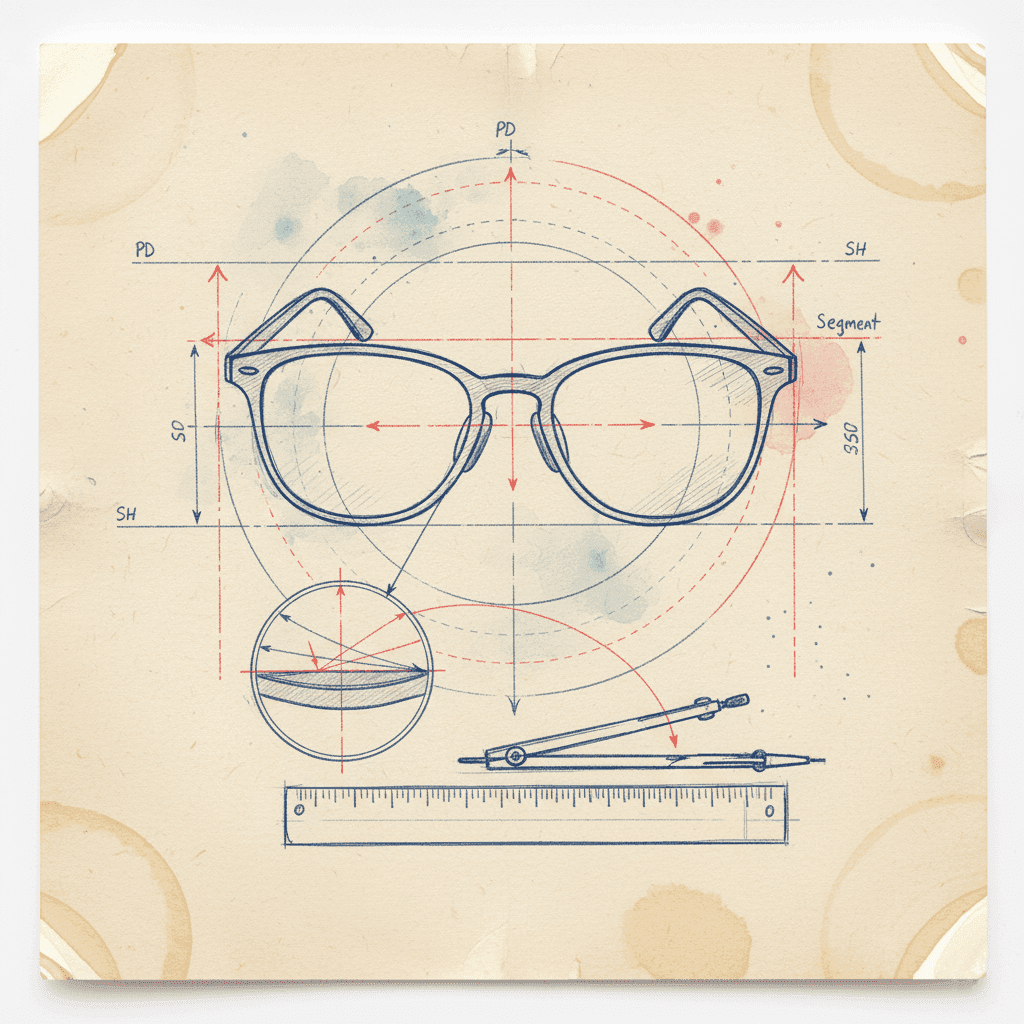
Short answer: Accurate online eyewear fitting depends on three measurements: pupillary distance (PD), segment height (SH), and frame dimensions. PD errors as small as 1mm can cause prismatic distortion in higher prescriptions; SH errors of 2-3mm in progressive lenses routinely cause non-adaptation. This guide explains each measurement, the tolerances that matter clinically, and where digital tools outperform paper rulers and self-measurement.
What Measurements Actually Determine Whether Glasses Fit
Online eyewear orders fail for predictable reasons: the prescription was transferred correctly, but the optical measurements were not. Three numbers govern whether a patient can comfortably wear what they ordered:
| Measurement | What It Controls | Tolerance (Progressive Lenses) |
|---|---|---|
| Pupillary Distance (PD) | Horizontal alignment of optical centers | ±1.0 mm monocular (ANSI Z80.1) |
| Segment Height (SH) | Vertical position of progressive corridor | ±1.0 mm each lens (ANSI Z80.1) |
| Frame dimensions | Whether the frame physically fits the face | Lens width, bridge, temple in mm |
Getting any of these wrong results in remakes, returns, or patients who adapt slowly and blame the prescription.
Pupillary Distance (PD): Binocular vs. Monocular
PD is the distance, in millimeters, between the centers of both pupils. It determines where the optical center of each lens sits in the frame.
When to Use Binocular vs. Monocular PD
A single binocular PD (e.g., 64 mm) works for low prescriptions with minimal facial asymmetry. For anything with higher power or progressive lenses, monocular measurements are necessary.
According to a clinical review published in Clinical and Experimental Optometry (PMC11141121): “Monocular PD is often recommended for greater accuracy in prescribing because most people have asymmetrical faces.” The same review notes that measuring only binocular PD on a patient with facial asymmetry “can result in wrong placement of the optical centre and induces prismatic distortion.”
Use monocular PD when the patient has:
- A prescription above ±3.00 D in any meridian
- Significant facial asymmetry (common, not rare)
- Progressive or bifocal lenses
- A previous history of adaptation complaints
What Happens When PD Is Wrong
The clinical consequence is unambiguous. Per the same PMC review: “If the optical centre is not correctly aligned, light rays that pass through the lens are refracted, or bent, which leads to blurred or distorted vision. This can cause the patient to experience eye strain, discomfort, and headaches.”
A 2mm binocular PD error — easily produced by a paper ruler or a poorly executed selfie — creates induced prism that scales with prescription power. In a -5.00 D lens, that 2mm error generates approximately 1 prism diopter of unwanted horizontal prism per eye. Most patients feel this as eye strain within 30 minutes of wear.
The ANSI Tolerance for PD in Progressive Lenses
ANSI Z80.1 sets the monocular PD tolerance for progressive lenses at ±1.0 mm from the specified monocular interpupillary distance. This is tighter than the binocular tolerance for single-vision lenses (±2.5 mm) because progressive corridors are position-critical. A lab delivering lenses within ANSI spec can still produce a suboptimal fit if the initial measurement was off.
PD Measurement Methods Compared
| Method | Typical Accuracy | Requires In-Person Visit? |
|---|---|---|
| Manual ruler (trained optician) | ±1–2 mm | Yes |
| Digital pupillometer | ±0.5–1 mm | Yes |
| Paper DIY ruler | ±2–3 mm | No |
| Photo-based digital tool (e.g., Optogrid) | ±0.5–1 mm | No |
For a detailed comparison of all four methods with cost and use-case analysis, see Comparing 4 PD Measurement Methods: Accuracy, Cost and Best Use Cases.
Segment Height (SH): The Measurement Most Often Missed
Segment height (SH) is the vertical distance in millimeters from the lowest edge of the lens to the fitting reference point — the pupil center for progressive lenses, the top of the lower eyelid for lined bifocals.
Why SH Errors Cause Non-Adaptation
ANSI Z80.1 tolerates ±1.0 mm per lens for vertical segment height. In practice, measurement errors at the dispensing stage routinely exceed this. According to iCare Labs: “Make sure there is at least 10mm of distance vision above the fitting cross in a progressive lens. Less than 10mm may not provide enough distance vision and could lead to non-adaptation.”
An SH measured 2-3mm too low pushes the progressive corridor downward. The patient has to raise their chin or tilt their head to access the reading zone — a posture they won’t sustain. An SH measured too high clips the distance zone, causing blur when the patient looks straight ahead.
SH by Lens Type: Reference Points
| Lens Type | Fitting Reference Point | Typical SH Range |
|---|---|---|
| Progressive | Center of pupil | 18–24 mm |
| Lined bifocal | Top of lower eyelid | 10–14 mm |
| Trifocal | Lower edge of pupil | Varies by frame |
Per iCare Labs: “Measure from the mark to the bottom edge of the lens, not the frame itself.” This distinction — lens edge, not frame edge — accounts for a consistent measurement error that produces SH values 1–2mm too high when frameless or rimless frames are involved.
Patient Posture Affects SH
iCare Labs also notes: “If they sit hunched over, you might want to raise the seg height by 1-2mm. If they’re very tall and hold their head back, consider lowering the seg height by 1-2mm.” Remote dispensing tools that capture a front-facing patient photograph in a natural standing posture can reproduce this condition accurately, provided the image protocol is followed.
For the full technical procedure on measuring SH using photo-based tools, see Using Optogrid for Accurate PD and SH Measurement.
Frame Dimensions: Reading the Three-Number System
Every eyewear frame has a size stamp on the inside of the temple arm. It follows a standardized three-number format. According to All About Vision: “Eyeglass frame size is indicated by three numbers stamped on the inside of your glasses” and “All three eyeglass and sunglass frame measurements are specified in millimeters (mm).”
What Each Number Means
Example: 50 □ 18 140
| Number | Name | What It Measures | Typical Range |
|---|---|---|---|
| 50 | Eye size (lens width) | Horizontal width of one lens | 40–60 mm |
| 18 | Bridge width | Distance between the two lenses | 14–24 mm |
| 140 | Temple length | Length from hinge to arm tip | 120–150 mm |
All About Vision states: “The bridge width of most eyeglass frames is 14 to 24 mm” and “Temple lengths generally range from 120 to 150 mm.”
Which Frame Dimension Matters Most for Online Orders
Bridge width is the dimension most responsible for fit complaints in online purchases. A bridge that is 2mm too wide allows the frame to slide down the nose, shifting both the PD alignment and the SH position simultaneously — invalidating the optical measurements even if they were correctly taken.
For patients ordering online, matching the bridge width of a current well-fitting frame is the single most reliable shortcut to frame comfort, assuming the prescription hasn’t changed significantly.
Lens Height and Its Relationship to SH
Lens height (the fourth measurement, sometimes stamped separately) sets the ceiling for possible SH values. A progressive lens requires a minimum lens height of approximately 28–30 mm to accommodate the full corridor from the distance zone through the intermediate to near. If the frame’s lens height is insufficient, the lab must place the fitting cross higher, compressing the near zone.
When selecting frames for progressive prescriptions online, verify the lens height before ordering. A frame listed as 50 □ 18 140 without a lens height dimension requires a follow-up to the retailer before finalizing the order.
When Remote Measurement Tools Work — and When They Don’t

Photo-based measurement tools like Optogrid can match the accuracy of digital pupillometers when the photograph meets specific quality conditions. They fail predictably when those conditions are not met.
Conditions Required for Accurate Photo-Based PD and SH
A valid measurement photograph requires:
- Patient standing upright, eyes at camera level
- Camera positioned at arm’s length, not angled
- Physical reference card visible in frame (credit card standard: 85.6 × 54 mm)
- Frontal face orientation, no head tilt
- Frame seated on the patient’s face as it would be worn
- Adequate lighting without strong reflections on lenses
When all conditions are met, photo-based tools resolve to ±0.5–1 mm — comparable to a trained optician with a ruler. When any condition is violated, errors compound. The reference card matters most: without it, the tool cannot calibrate scale, and measurements become unreliable regardless of algorithm quality.
What Remote Tools Cannot Replace
Remote tools do not substitute for in-person frame adjustment. Per the clinical review in Clinical and Experimental Optometry: “If the frame is too big or too small, or if it has been poorly adjusted, this can lead to misalignment of the optical centre, even when the pupillary distance has been measured correctly.”
This means that even a precisely measured PD and SH can be rendered useless by a frame that sits incorrectly on the patient’s nose or ears. Online dispensers who include a frame adjustment service (either through a local partner network or return-for-adjustment policy) consistently achieve lower remake rates than those who do not.
Practical Checklist for Online Eyewear Measurement
Before placing an online eyewear order, verify each of the following:
PD Measurement
- [ ] Binocular PD recorded (always required)
- [ ] Monocular PD recorded for prescriptions above ±3.00 D or progressive lenses
- [ ] Measurement method documented (ruler / digital tool / pupillometer)
- [ ] Measurement repeated at least twice to confirm consistency
Segment Height (Progressive and Bifocal Only)
- [ ] SH measured from bottom edge of lens (not frame)
- [ ] Patient in natural posture, frame on face as worn
- [ ] Fitting reference point confirmed (pupil center for progressive)
- [ ] Lab order specifies SH per lens, not a single shared value
Frame Selection
- [ ] Lens width within 2mm of current well-fitting frame
- [ ] Bridge width matches or is within 1mm of current frame
- [ ] Lens height sufficient for lens type (28mm minimum for progressive)
- [ ] Temple length appropriate for patient’s head width
For step-by-step instructions on how to perform these measurements using Optogrid’s photo-based system, see Remote Pupillary Distance Measurement: Technology and Business Impact.
Why PD and SH Accuracy Matters More Than Most Opticians Think
The clinical case for measurement precision is well-documented. According to a study published in PMC (PMC11141121): “It is therefore crucial for the optical centre to be correctly aligned with the wearer’s pupils, so they can see clearly, no matter which direction they look in.” The same study confirms: “If the pupillary distance is measured incorrectly, the optical centre will be incorrectly set within the spectacle frames, which can only be rectified by remeasuring the pupillary distance correctly, and remaking the spectacles.”
Remakes are expensive. A progressive lens remake typically costs the dispensary the full wholesale lens price. For high-index or specialty progressive designs, this ranges from $80–$300 per pair. A dispensary processing 20 progressive orders per month with a 10% remake rate attributable to measurement error spends roughly $1,600–$7,200 per year on avoidable remakes.
Digital measurement tools that document the measurement photograph, the reference card, and the calculated values create an audit trail. When a remake occurs, the record either confirms measurement accuracy (pointing to a lab error) or identifies the measurement failure — both of which reduce disputes and repeated costs.
For more on how accurate PD and SH measurements directly affect patient outcomes and lens performance, see Why Accurate PD and SH Measurements Are Crucial for Prescription Eyewear.
Frequently Asked Questions
What is the difference between binocular PD and monocular PD?
Binocular PD is the total distance between both pupil centers, typically 54–74 mm in adults. Monocular PD measures each eye separately from the nose bridge — left and right values that sum to the binocular PD. Monocular PD is required for progressive lenses, any prescription above ±3.00 D, and patients with facial asymmetry. Ordering progressive lenses with only a binocular PD forces the lab to split the value evenly, which is incorrect for most patients.
How much PD error is clinically significant?
For progressive lenses, ANSI Z80.1 allows ±1.0 mm per eye from the specified monocular PD. In practice, a 2mm total binocular error in a prescription of -4.00 D generates approximately 0.8 prism diopters of unwanted horizontal prism, which most patients perceive as discomfort or blur. Higher prescriptions are more sensitive; low prescriptions below ±2.00 D tolerate 2–3mm errors without significant symptoms.
What is segment height, and do online retailers always ask for it?
Segment height (SH) is the vertical distance from the bottom edge of the lens to the pupil center (for progressive lenses). Many online retailers omit SH for progressive orders and use a default fitting height — a practice that produces high non-adaptation rates. Always specify SH explicitly when ordering progressive lenses online, and confirm the retailer’s order form captures a per-eye value.
How do I read the size numbers on my current glasses?
Look on the inside of the temple arm. You’ll see three numbers, for example 52 □ 17 140. The first is the lens width (52 mm), the second is the bridge width (17 mm), and the third is the temple length (140 mm). These are all in millimeters. A fourth number, sometimes found on the lower part of the lens or a separate stamp, is the lens height.
Can a photo-based tool measure SH accurately enough for progressive lenses?
Yes, when the measurement photograph meets protocol requirements — upright posture, camera at eye level, physical reference card visible, frame seated on the face. Tools like Optogrid measure SH by locating the pupil center relative to the frame’s lower edge in the photograph, then converting pixels to millimeters using the reference card’s known dimensions. Accuracy is typically ±0.5–1 mm under good conditions, which meets ANSI Z80.1 tolerance for progressive lenses.
What frame dimensions matter most when ordering online?
Bridge width is the most commonly mismatched dimension in online orders. A bridge that is too wide causes the frame to slide down, shifting PD alignment and SH position simultaneously. Match the bridge width of a well-fitting current frame first, then confirm lens width and lens height. Temple length affects comfort but does not affect optical alignment.
When should I insist on in-person measurements rather than remote tools?
In-person measurement is preferable when the patient has a prescription above ±5.00 D, a history of adaptation difficulty with previous glasses, a high cylinder correction (above 2.00 D), or significant prismatic correction in the prescription. Remote tools are accurate for the measurement itself, but they cannot assess how a specific frame sits on a specific face — which in-person fitting and adjustment addresses directly.
Sources
- Prescribing and fitting spectacles: the role of pupillary distance and the optical centre — PMC / Clinical and Experimental Optometry
- ANSI Z80.1 Tolerance Summary — OptiCampus
- How to Take a Proper Segment Height — iCare Labs
- Eyeglass Frame Sizes Explained — All About Vision

I am a seasoned software engineer with over two decades of experience and a deep-rooted background in the optical industry, thanks to a family business. Driven by a passion for developing impactful software solutions, I pride myself on being a dedicated problem solver who strives to transform challenges into opportunities for innovation.