
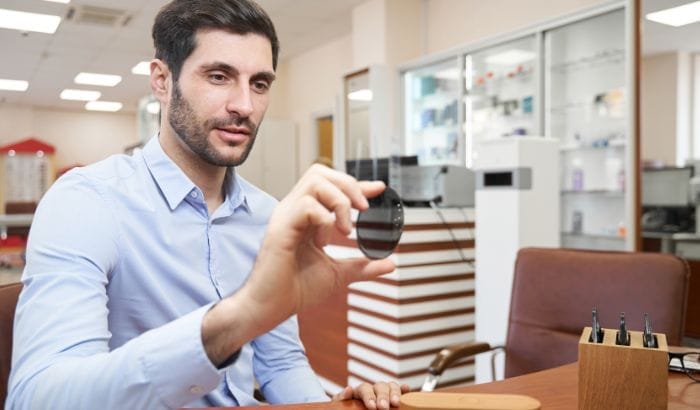
Photochromic lenses (also called photosensitive or light-adaptive lenses) darken automatically when exposed to UV radiation and return to clear indoors. The reaction relies on organic photochromic molecules, primarily naphthopyrans, that undergo a reversible ring-opening reaction when UV light breaks a carbon-oxygen bond. Most current models reach full darkening in 15 to 45 seconds and need 2 to 10 minutes to clear completely, depending on brand and ambient temperature.

What Photochromic Lenses Are and Who They Serve
Photochromic lenses are prescription lenses embedded with light-reactive compounds that adjust tint based on UV intensity. In direct sunlight they darken to sunglass levels. Indoors or at night, they return to near-clear transparency.
The technology works across all prescription lens types: single vision, bifocal, and progressive lenses. It is compatible with standard lens materials including CR-39, polycarbonate, Trivex, and high-index.
The core value proposition for patients is straightforward: one pair of glasses that functions as both everyday eyewear and sunglasses, eliminating the need to carry and switch between two pairs.
How the Photochromic Reaction Works
Two distinct chemical mechanisms produce the photochromic effect, depending on the lens material.
Silver Halide in Glass Lenses (Legacy Technology)
Glass photochromic lenses use silver halide microcrystals, typically silver chloride, embedded in the glass substrate. When UV-A radiation (320 to 400 nm) reaches the lens, electrons combine with silver ions to form elemental metallic silver. Because metallic silver absorbs visible light, the lens darkens.
The process reverses without UV: a copper chloride compound, also embedded in the glass, reclaims the electron from the metallic silver, returning the system to its transparent state.
This technology is limited to glass substrates and cannot be applied to plastic lenses.
Organic Photochromic Molecules in Plastic Lenses (Current Technology)
Modern plastic lenses use organic photochromic compounds, primarily from the naphthopyran family. Research published in Chemical Society Reviews describes the core mechanism: naphthopyrans “undergo a reversible 6-pi electrocyclic ring-opening reaction upon photoirradiation with UV light,” where “scission of the pyran C-O bond occurs to produce the colored merocyanine isomer.” In plain terms, UV light breaks a chemical bond within the molecule, causing it to adopt a new shape that absorbs visible light and darkens the lens.
The reaction is fully reversible. Without UV, thermal energy drives the molecules back to their original colorless configuration. This thermal dependence is the reason temperature affects lens performance significantly.
Why Temperature Changes Lens Behavior
The return to the clear state is a thermally driven process. A study published in Ophthalmic and Physiological Optics measured the effect directly: photochromic lenses were on average 11.5% darker at cold temperatures (6 degrees C) compared to warm temperatures (21 degrees C), and fading time to reach 80% transmittance was 6.4 times longer in cold conditions.
In practical terms: on hot summer days (above 35 degrees C), lenses reach less maximum darkness but clear faster. On cold days, they get noticeably darker but take considerably longer to return to clear. This is a critical point to communicate to patients before purchase.
Why Photochromic Lenses Stay Clear Inside Cars, and Which Models Solve This
This is one of the most common questions patients ask, and every optician should be prepared to answer it clearly.
The problem: Automotive windshields block over 99% of UV radiation. Since conventional photochromic lenses activate exclusively from UV, they remain clear or nearly clear behind the windshield, offering no glare reduction while driving.
The solution: Specific lens models were engineered with pigments that react to high-intensity visible light in addition to UV, enabling partial activation even behind windshield glass.
Transitions XTRActive is described by the manufacturer as “the darkest photochromic light intelligent lens in hot temperatures and in the car,” with polycarbonate and 1.5 grey lenses tested at 23 degrees C behind the windshield achieving between 18%T and 43%T, reaching category 2 darkness levels.
Hoya Sensity Dark also darkens behind the car window, according to the manufacturer’s product documentation.
Quick reference:
| Scenario | Standard Photochromic | Transitions XTRActive / Hoya Sensity Dark |
|---|---|---|
| Direct sunlight | Darkens (category 3) | Darkens (category 3) |
| Inside car (daytime) | Stays clear | Partially darkens (category 2) |
| Indoor lighting | Clear | Slight residual tint |
| Night | Clear | Clear |
Photochromic vs. Polarized: Two Different Technologies
Photochromic and polarized lenses solve different optical problems. Confusing them is a common source of patient dissatisfaction.
Photochromic lenses:
- Adjust tint darkness based on UV exposure
- Function as prescription eyewear and sunglasses in one pair
- Do not eliminate horizontal glare from surfaces like water, asphalt, or car hoods
- Performance varies with temperature and available UV
Polarized lenses:
- Contain a fixed directional filter that blocks horizontally reflected light
- Eliminate glare from reflective surfaces (water, roads, glass)
- Fixed tint that does not adapt to changing light conditions
- Best suited for driving, fishing, and water sports
Photochromic lenses adapt tint through a chemical reaction to UV. Polarized lenses block reflected glare through a directional filter. They are complementary technologies. Some products combine both (such as Transitions XTRActive Polarized), but the cost is significantly higher.
Dispensing guidance:
- Patient who frequently moves between indoor and outdoor environments: photochromic
- Patient who drives extensively or does water sports: polarized
- Patient with diagnosed photophobia or extreme light sensitivity: photochromic, with consideration for a combined option
Brand Comparison: Performance Side by Side
The four most widely available photochromic lens lines in the professional optical market are Transitions (Essilor), Zeiss PhotoFusion X, Hoya Sensity 2, and Hoya Sensity Dark. Each has distinct technical characteristics.
| Feature | Transitions Signature Gen 8 | Transitions XTRActive | Zeiss PhotoFusion X | Hoya Sensity 2 / Sensity Dark |
|---|---|---|---|---|
| Darkening speed | Category 3 in approx. 25 seconds | Category 3 in normal conditions | 15 seconds to effective glare protection | Category 3 (Sensity 2) |
| Clearing speed | Noticeably clear in approx. 2 minutes | 35% faster fadeback than previous gen | Up to 4.5x faster than most common photochromic brand | Fast clearing (Sensity Fast variant) |
| Indoor transmittance (clear) | Approx. 70% (23 degrees C) | Slight residual tint | High clarity indoors | High indoor transparency |
| Outdoor transmittance (dark) | Approx. 18% (23 degrees C) | Category 2 to 3 depending on temperature | Sunglass-level darkness | Category 3 (Sensity 2); darker (Sensity Dark) |
| Activates inside car | No (UV-only activation) | Yes, partial (category 2) | Limited (UV-dependent) | Sensity Dark: yes, partial |
| UV protection | 100% UVA and UVB | 100% UVA and UVB | Sunglass-level UV protection, always on | 100% UVA and UVB |
| Blue light filtering | Up to 26% indoors / 86% outdoors | Up to 45% indoors / 86% outdoors | Up to 50% indoors / 94% outdoors | Blue light reduction indoors and outdoors |
| Temperature sensitivity | High: reduced darkness in heat | High: reduced performance above 35 degrees C | Standard for photochromic tech | Sensity features Stabilight technology for climate adaptation |
Note: Transmittance values vary by lens color (grey, brown, green) and material. Always verify exact specifications from the manufacturer for the specific material and color being dispensed.
Clinical and Practical Benefits of Photochromic Lenses

Continuous UV Protection
The World Health Organization estimates that “15 million people are blind due to cataracts” worldwide, with “some 10% may be due to exposure to UVR.” A review by Roberts (2011) published in Eye & Contact Lens confirms that “both ultraviolet-A and UV-B induce cataract formation.”
The American Optometric Association recommends eyewear that blocks “100% of both UV-A and UV-B radiation.” All major photochromic lens brands meet this standard in both their clear and darkened states. This matters because many patients do not consistently wear sunglasses. Photochromic lenses provide continuous UV protection regardless of whether the wearer remembered to bring sunglasses.
Adaptive Visual Comfort
Automatic light reduction in bright environments decreases discomfort from glare and eases the visual transition when moving between indoor and outdoor settings. This benefit is particularly relevant for patients with photophobia or heightened light sensitivity.
Cost Efficiency for Patients
A single pair of photochromic glasses replaces two: indoor prescription eyewear plus a separate pair of prescription sunglasses. For patients who need corrective lenses and want sun protection, this consolidation reduces both cost and the inconvenience of managing multiple pairs.
Built-In Blue Light Filtering
Current-generation models offer meaningful blue light filtering even in their clear state. Transitions XTRActive filters up to 45% of blue-violet light indoors, and Zeiss PhotoFusion X filters up to 50% indoors. This complements protection for patients who spend significant time in front of screens.
Stocking Photochromic Lenses: What Optical Shop Owners Should Know
For optical shop owners evaluating photochromic lenses as a product category, the business case is clear, with specific caveats.
Why stock them:
- Higher average ticket price per sale compared to standard clear lenses
- Growing patient demand for convenience and all-in-one solutions
- Competitive differentiation over shops that only carry basic lens options
- High patient satisfaction when expectations are properly managed at point of sale
What your team must communicate before purchase:
- Photochromic lenses do not replace sunglasses in every scenario, especially inside vehicles (except XTRActive and Sensity Dark models)
- Performance changes with temperature: maximum darkness is lower on very hot days
- Clearing time varies by brand and model; set this expectation before the sale to prevent returns
- Photochromic lenses are not polarized lenses; they do not eliminate horizontal surface glare
Patient profiles with highest adoption and satisfaction:
- People who frequently alternate between indoor and outdoor environments throughout the day
- Patients with diagnosed photophobia or light sensitivity
- Patients who frequently forget or lose their sunglasses
- Progressive lens wearers who prefer a single all-purpose pair
Choosing suppliers: Transitions (EssilorLuxottica) has the widest brand recognition and market presence. Zeiss PhotoFusion X differentiates on clearing speed. Hoya Sensity offers specialized variants by use case: Sensity Fast for rapid clearing, Sensity Dark for frequent drivers. When selecting which brands to stock, consider lens thickness compatibility and your patient demographic’s primary needs.
Accurate measurements remain the foundation of any lens dispensing workflow. Whether fitting photochromic lenses into eyeglass frames or verifying prescriptions with a digital lensmeter, precision at the measurement stage prevents costly remakes regardless of lens technology.
Frequently Asked Questions
Do photochromic lenses darken inside a car?
Most photochromic lenses do not darken inside vehicles because automotive windshields block over 99% of UV radiation, which is the activation trigger. Two exceptions exist: Transitions XTRActive and Hoya Sensity Dark are engineered to respond to visible light in addition to UV, allowing them to reach category 2 darkness levels behind windshield glass.
How long do photochromic lenses take to darken and clear?
Darkening typically takes 15 to 45 seconds depending on the brand. Zeiss PhotoFusion X reaches effective glare protection in about 15 seconds. Clearing takes longer: Transitions Signature Gen 8 becomes noticeably clear in about 2 minutes, while Zeiss PhotoFusion X claims clearing speeds up to 4.5 times faster than the most common photochromic brand. Full return to the completely clear state can take 5 to 15 minutes for any brand.
What is the difference between photochromic and polarized lenses?
Photochromic lenses change tint darkness in response to UV light. Polarized lenses have a fixed directional filter that blocks horizontally reflected glare from surfaces such as water, roads, and glass. A photochromic lens does not eliminate surface glare. A polarized lens does not change its tint. Products that combine both technologies exist but cost significantly more.
Does temperature affect photochromic lens performance?
Yes. The clearing reaction is thermally driven. Research in Ophthalmic and Physiological Optics found that photochromic lenses are on average 11.5% darker at cold temperatures compared to warm temperatures, and clearing time can be 6.4 times longer in cold conditions. On very hot days, lenses reach less maximum darkness but return to clear faster. This is important to explain to patients before purchase.
Do photochromic lenses provide full UV protection?
All photochromic lenses from established brands (Transitions, Zeiss, Hoya) block 100% of UVA and UVB radiation in both their clear and darkened states. UV protection does not depend on how dark the lens appears. The American Optometric Association recommends eyewear that blocks 100% of both UV-A and UV-B radiation, and quality photochromic lenses meet this standard continuously.
Which photochromic lens brand is best for my patients?
It depends on the patient’s primary use case. Transitions Signature Gen 8 is a strong general-purpose option with fast darkening. Zeiss PhotoFusion X leads in clearing speed. Hoya Sensity 2 balances speed and maximum darkness. For patients who drive frequently, Transitions XTRActive or Hoya Sensity Dark are the recommended options because they activate behind car windshields.
Are photochromic lenses compatible with all frame types?
Yes. Photochromic lenses are available in CR-39, polycarbonate, Trivex, and high-index materials, making them compatible with virtually all frame styles. Check availability of specific brand and material combinations with your supplier before ordering.


I am a seasoned software engineer with over two decades of experience and a deep-rooted background in the optical industry, thanks to a family business. Driven by a passion for developing impactful software solutions, I pride myself on being a dedicated problem solver who strives to transform challenges into opportunities for innovation.