
Lens thickness is determined by two things: the sagitta of the lens surface (a function of prescription power and lens diameter) and the refractive index of the material. The sagitta formula from spherical geometry, combined with the lensmaker’s equation, lets you calculate thickness for any prescription and material. This article walks through every formula, worked example, and material property behind the Optogrid Lens Thickness Calculator.
The Science Behind Lens Thickness Calculation
This reference is written for opticians, optical lab technicians, dispensing students, and anyone who wants to understand — not just use — a lens thickness calculator. It covers:
- The sagitta formula and its derivation from spherical geometry
- How the lensmaker’s equation converts diopters to radius of curvature
- Why cylinder power creates a worst-case meridian that dominates thickness
- Complete material property tables (index, Abbe, density, impact resistance)
- The volume model behind weight estimation
- Known limitations and where professional lab software goes further
If you want the quick interactive version, use the free lens thickness calculator and come back here for the math.
What Determines Lens Thickness?
Two factors control how thick a lens becomes:
- Prescription power (in diopters). Higher absolute power means more curvature, which means more material at the edges (minus lenses) or center (plus lenses).
- Refractive index of the material. A higher index bends light more per millimeter of material, allowing a flatter curve — and therefore a thinner lens — for the same prescription.
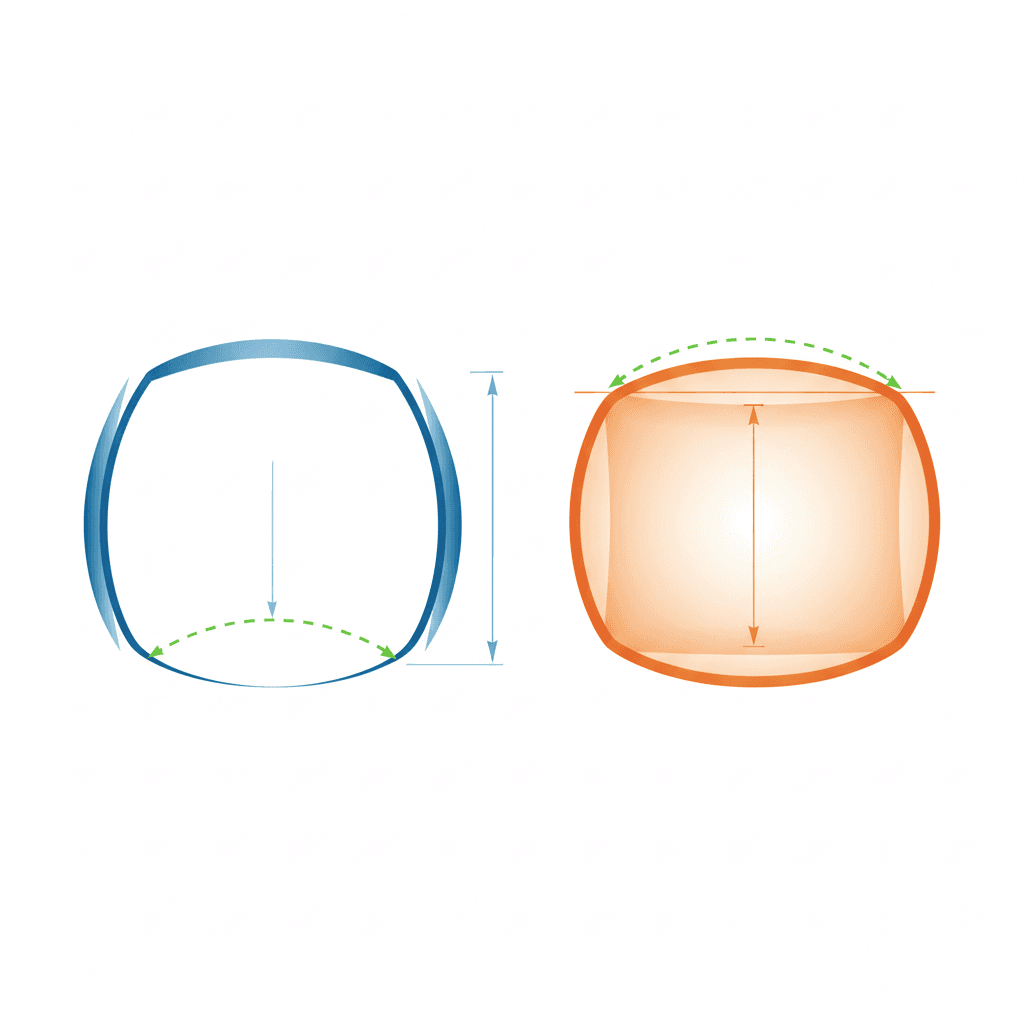
The interplay works through geometry. A minus lens (correcting myopia) is thin at the center and thick at the edges. A plus lens (correcting hyperopia) is the opposite — thick at the center, thin at the edges. The depth of the curved surface — the sagitta — is the quantity that links power to physical thickness.
The Sagitta Formula — From Geometry to Optics
Geometric Definition
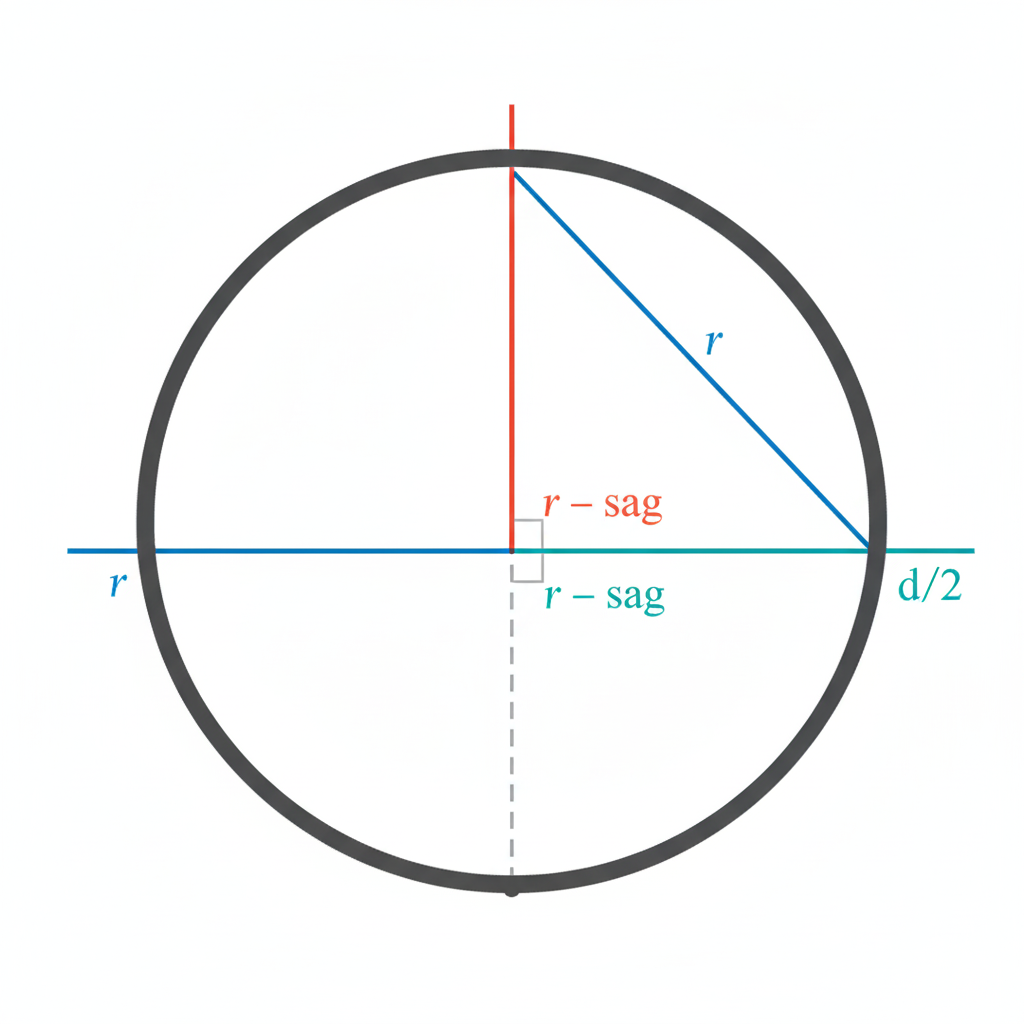
The sagitta (Latin for “arrow”) is the perpendicular distance from the midpoint of a chord to the arc of a circle. For a sphere of radius r, measured across a chord of length d:
sag = r - √(r² - (d/2)²)Where:
r= radius of curvature (mm)d= lens diameter at which sag is measured (mm) — typically the effective diameter (ED)sag= depth of curvature (mm)
This is a direct result of the Pythagorean theorem applied to a cross-section of the sphere. The term (d/2) is the half-chord (lens semi-diameter), and √(r² - (d/2)²) is the distance from the sphere’s center to the chord plane. Subtracting from r gives the sag.
The formula appears in ISO 13666:2019, §4.7 (Ophthalmic optics — Spectacle lenses — Vocabulary) as the standard definition for surface sagitta in ophthalmic lens specifications.
Linking Power to Curvature — The Lensmaker’s Equation
Optical power in diopters relates to the radius of curvature through the simplified lensmaker’s equation for a single refracting surface:
P = (n - 1) × 1000 / rWhere:
P= surface power in diopters (D)n= refractive index of the lens material (dimensionless)r= radius of curvature in millimeters (mm)- The factor of 1000 converts from meters (the diopter definition: D = 1/m) to millimeters
Rearranging to find the radius from a known prescription power:
r = (n - 1) × 1000 / |P|The absolute value of P is used because radius is always positive — the sign of the power tells us whether the surface is convex (plus) or concave (minus), but the geometric radius is the same.
Key insight: Higher refractive index produces a larger radius for the same power. A larger radius means a flatter curve, which means less sagitta, which means a thinner lens. This is the entire physical mechanism behind “high-index = thinner.”
Sources: Jalie, M., The Principles of Ophthalmic Lenses, 4th ed. (ABDO, 2016); Keating, M. P., Geometric, Physical, and Visual Optics, 2nd ed. (Butterworth-Heinemann, 2002).
Combined Formula — Worked Example
Putting both equations together, you can calculate lens thickness from a prescription in three steps.
Example: -5.00D prescription, CR-39 (n = 1.50), 65 mm effective diameter.
Step 1 — Radius of curvature:
r = (1.50 - 1) × 1000 / 5.00
r = 0.50 × 1000 / 5.00
r = 100.0 mm
Step 2 — Sagitta:
sag = 100.0 - √(100.0² - (65/2)²)
sag = 100.0 - √(10000 - 1056.25)
sag = 100.0 - √8943.75
sag = 100.0 - 94.57
sag = 5.43 mm
Step 3 — Edge thickness (minus lens):
Per ANSI Z80.1-2025, minimum center thickness for standard plastic is 2.0 mm:
edge_thickness = center_min + sag
edge_thickness = 2.0 + 5.43
edge_thickness = 7.43 mm
Now compare the same prescription in MR-7 (n = 1.67):
r = (1.67 - 1) × 1000 / 5.00 = 134.0 mm
sag = 134.0 - √(134.0² - 32.5²) = 134.0 - 130.04 = 3.96 mm
edge_thickness = 2.0 + 3.96 = 5.96 mm
The 1.67 lens is 1.47 mm thinner at the edge — a 19.8% reduction. Try this with your own values in the lens thickness calculator.
The Approximation and When It Fails
For lenses where the sag is small relative to the radius (i.e., low power or small diameter), the exact formula simplifies to:
sag ≈ d² / (8r)This paraxial approximation drops the square root and is computationally simpler. It’s accurate to within 1% when d/r < 0.3 — which covers most low-to-moderate prescriptions in standard frame sizes.
When it fails:
- High-power prescriptions (> ±8.00D): The sag becomes a significant fraction of the radius. The approximation can underestimate by 5–15%.
- Large-diameter blanks (> 70 mm): Even at moderate powers, the half-chord approaches the radius, breaking the small-angle assumption.
- Combination of both: A -10.00D lens at 70 mm ED in 1.50 index gives r = 50 mm and d/2 = 35 mm, making
d/r = 1.4. The approximation fails badly here — use the exact formula.
The Optogrid calculator always uses the exact formula to avoid these errors.
Cylinder Power and the Worst-Meridian Problem
Most real prescriptions include a cylinder (CYL) component for astigmatism correction. A cylinder adds power in one meridian only, creating a toric surface with two distinct principal meridians:
| Meridian | Power |
|---|---|
| At the cylinder axis | SPH only |
| 90° from the axis | SPH + CYL |
For a minus lens, the maximum edge thickness occurs at whichever meridian carries the highest absolute power. The calculator must use this worst-case meridian:
effective_power = max(|SPH|, |SPH + CYL|)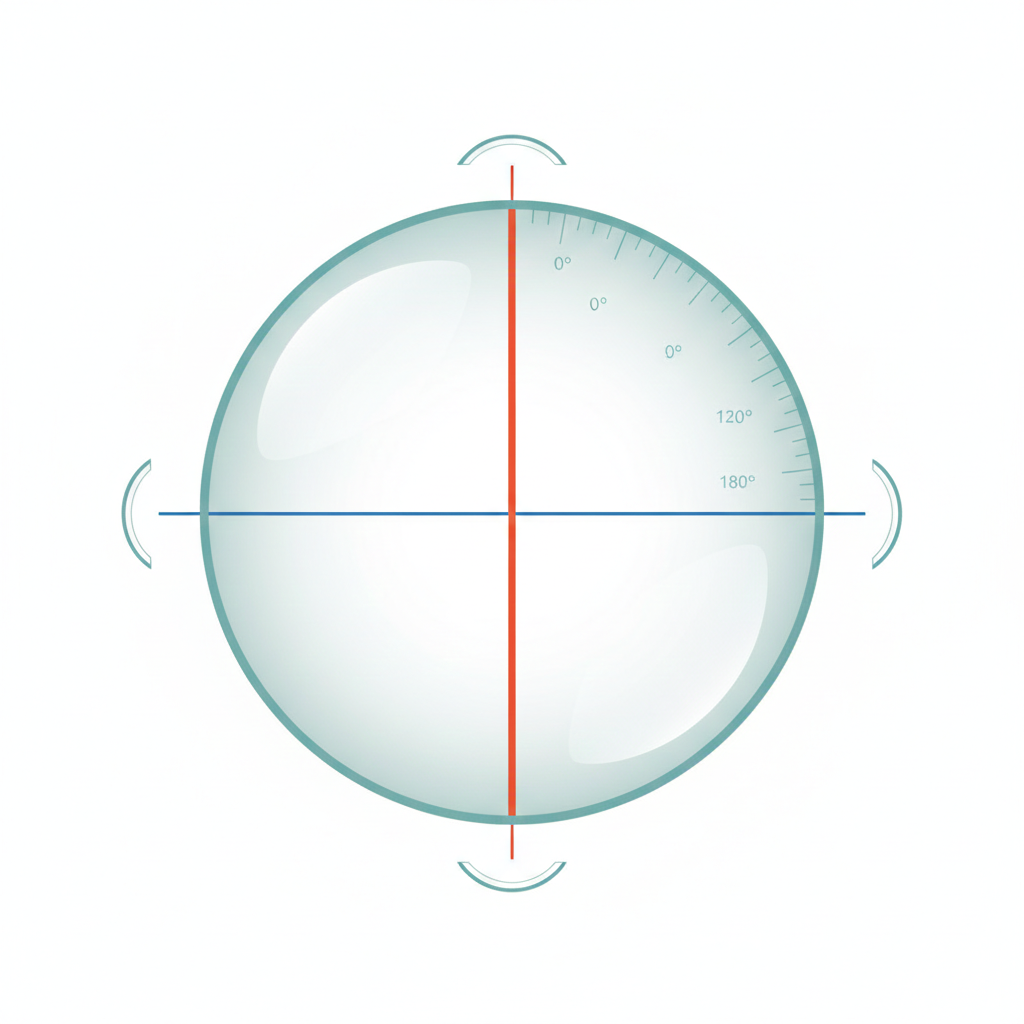
Worked Example
Prescription: -3.00 SPH / -2.00 CYL × 180°

Meridian 1 (at axis 180°):  -3.00D
Meridian 2 (at axis  90°):  -3.00 + (-2.00) = -5.00D

Effective power: max(|-3.00|, |-5.00|) = 5.00D
Using 1.50 CR-39 at 65 mm ED:
Without CYL:  r = 166.7 mm,  sag = 3.18 mm,  edge = 5.18 mm
With CYL:     r = 100.0 mm,  sag = 5.43 mm,  edge = 7.43 mm
Ignoring CYL underestimates the edge thickness by 2.25 mm — a 43% error. For any prescription with CYL above ±2.00D, the cylinder dominates the thickness result.
Sources: Brooks, C. W. & Borish, I. M., System for Ophthalmic Dispensing, 3rd ed. (Butterworth-Heinemann, 2007); Jalie, M., The Principles of Ophthalmic Lenses, 4th ed. (ABDO, 2016).
Lens Material Properties — Complete Reference
Seven materials cover the range of modern ophthalmic plastics. The table below lists exact values used in the calculator, cross-referenced from manufacturer data sheets and independent lab sources.
| Index | Material | Monomer | Abbe Value | Density (g/cm³) | Impact Resistance | Typical Use |
|---|---|---|---|---|---|---|
| 1.50 | CR-39 | PPG CR-39 | 58 | 1.32 | Low | Standard adult prescriptions |
| 1.53 | Trivex | PPG Trivex | 45 | 1.11 | Very High | Children, rimless, safety — lightest material |
| 1.56 | Mid-Index | KOC 55 | 36 | 1.27 | Low | Step up from CR-39 for mild Rx |
| 1.59 | Polycarbonate | Bisphenol-A | 30 | 1.20 | Very High | Safety eyewear, sports |
| 1.61 | High-Index | Mitsui MR-8 | 41 | 1.22 | Low | Moderate to high prescriptions |
| 1.67 | High-Index | Mitsui MR-7 | 32 | 1.35 | Low | High prescriptions |
| 1.74 | Ultra High-Index | Mitsui MR-174 | 33 | 1.47 | Low | Very high prescriptions |
Notes on monomer branding:
- Most lenses sold as “1.60” or “1.61” use the Mitsui MR-8 monomer (actual n ≈ 1.60). The density value (1.22 g/cm³) is from MR-8 specifications.
- “1.67” lenses typically use MR-7. Some labs use MR-10 (density 1.37 g/cm³, better thermal resistance); MR-7 (1.35 g/cm³) is more common.
- “1.74” lenses use MR-174 exclusively — there is no widely available alternative at this index.
The key trade-off: Higher index = thinner but lower Abbe value. Abbe number measures chromatic dispersion — how much the lens splits white light into colors. Lower Abbe means more color fringing, especially noticeable off-center. For prescriptions above ±4.00D, the thickness benefit generally outweighs the chromatic penalty for most wearers.
Density sources: POL Optic material specifications; Laramy-K Independent Optical Lab lens materials guide; Hoya Vision Care Polycarbonate vs. Trivex tech specifications.
Weight Estimation — The Geometry of Lens Volume
The Cylinder + Spherical Cap Model
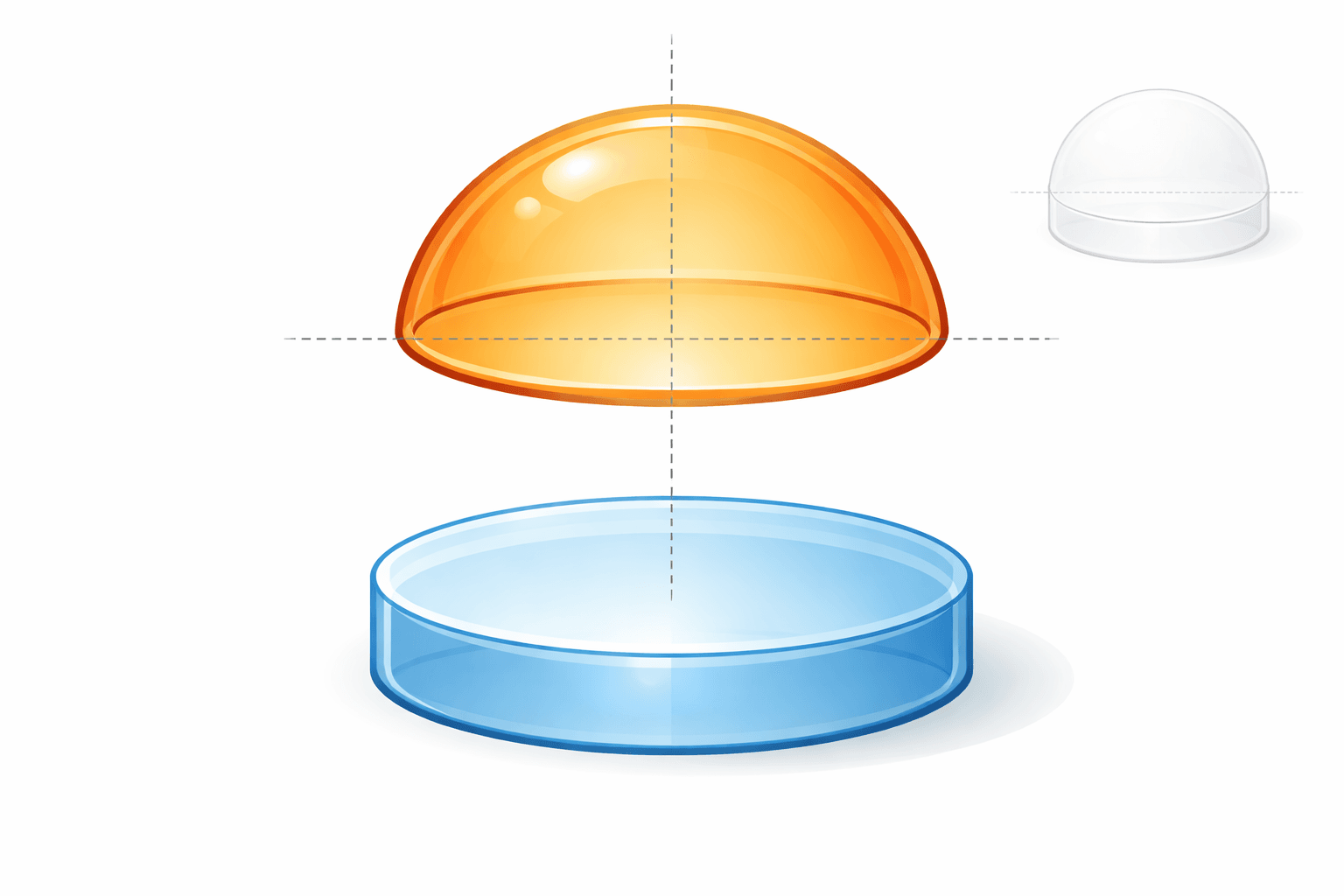
Weight = volume × density. The challenge is estimating volume for a curved lens without full ray-traced modeling of two surfaces. The calculator uses a single-surface model that splits the lens into two geometric parts:
- A flat cylinder — represents the minimum-thickness portion of the lens (the thin part)
- A spherical cap — represents the curved dome of extra material added by the prescription
V_total = V_cylinder + V_capCylinder volume (the flat base):
V_cylinder = π × R² × t_minSpherical cap volume (the curved dome):
V_cap = (π × sag / 6) × (3R² + sag²)Where:
R= lens semi-diameter = ED / 2 (mm)t_min= minimum thickness of the lens:- Minus lenses: center thickness = 2.0 mm (ANSI Z80.1-2025)
- Plus lenses: edge thickness = 1.5 mm (practical mounting minimum)
sag= sagitta from the prescription calculation
The spherical cap formula is a standard result from solid geometry — the exact volume of a cap of height h cut from a sphere, expressed in terms of the cap height and the base radius. See Weisstein, E. W., “Spherical Cap”, MathWorld (Wolfram Research).
Why this model over a flat-disc approximation?
A naive approach uses average thickness:
V_naive = π × R² × (t_center + t_edge) / 2This overestimates volume for minus lenses (where the taper follows a curve, not a straight line) and underestimates for high-power plus lenses. The cylinder + cap model respects the dome geometry and produces weight estimates closer to real lab-measured values — typically within 15–25% of actual edged lens weight.
Frame Shape Correction Factors
The volume model computes the weight of a full round uncut blank. Real lenses are edged to fit the frame, removing material. A shape correction factor adjusts the displayed weight:
displayed_weight = blank_weight × shape_factor| Shape | Correction Factor | Material Removed |
|---|---|---|
| Round | 1.00 | 0% |
| Oval | 0.79 | ~21% |
| Rectangle | 0.65 | ~35% |
| Aviator / Pilot | 0.84 | ~16% |
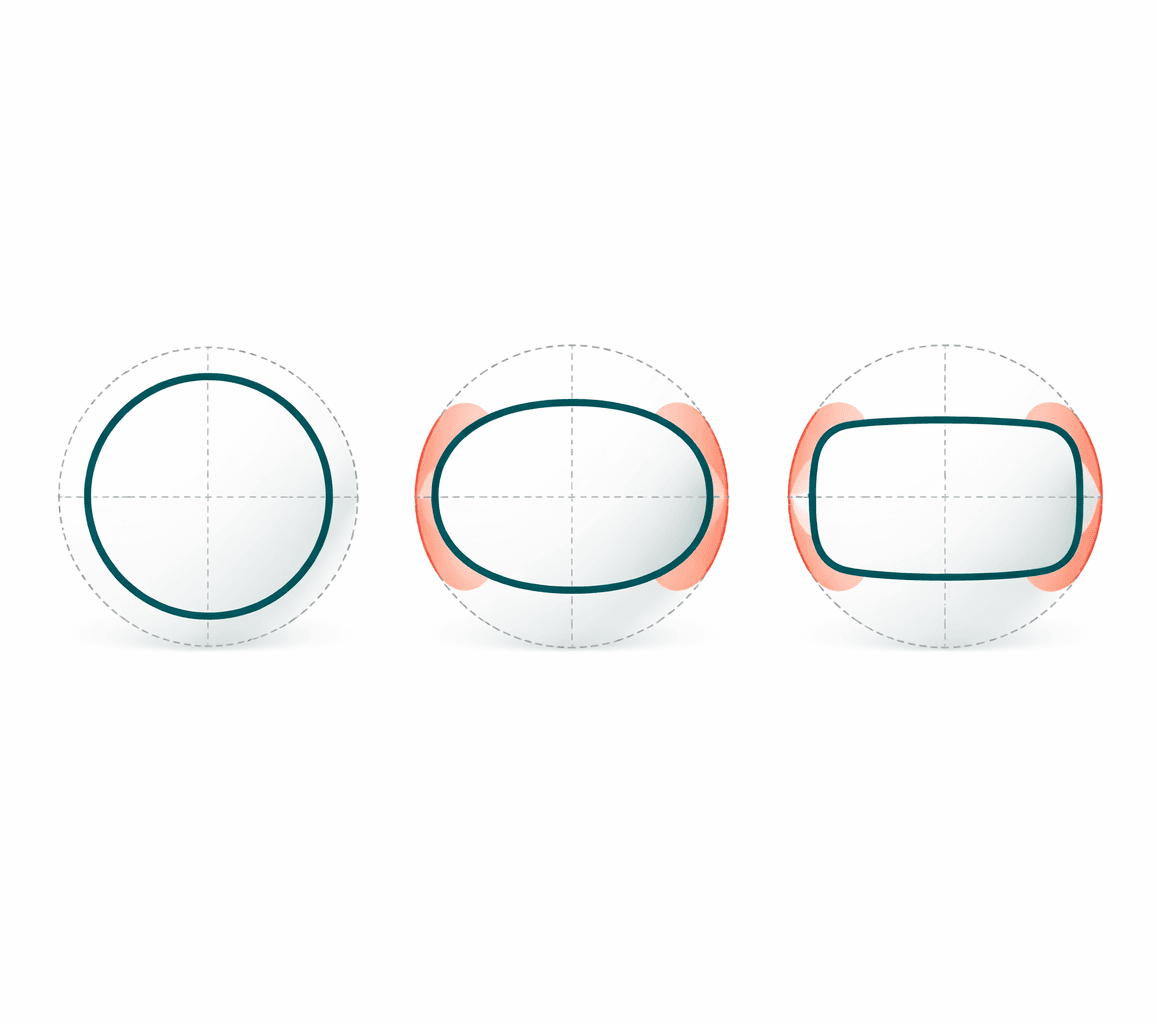
These are empirical values based on typical frame proportions. The round-frame case is exact (no material removed). For other shapes, the factor approximates the ratio of frame area to blank area, with a small correction for rounded corners.
Note: Frame shape affects weight but not maximum thickness. The thickest point is determined by the sagitta at the full ED radius. Edging cuts away material around the periphery but doesn’t change the maximum dimension that matters for cosmetics and frame fit.
Counterintuitive Weight Results
Three results that surprise practitioners using the calculator for the first time:
Trivex is lighter despite being thicker. At -3.00D / 60 mm ED, Trivex produces a thicker lens than CR-39 (because n = 1.53 < 1.50 gives a steeper curve). But Trivex’s density is 1.11 g/cm³ vs. CR-39’s 1.32 g/cm³ — the lowest of any ophthalmic material. The density advantage wins: Trivex comes in roughly 16% lighter by weight.
1.74 can weigh more than CR-39 at low prescriptions. At -2.00D / 60 mm ED, the volume reduction from 1.74’s higher index is small (the sag difference is only about 0.5 mm). But 1.74’s density is 1.47 g/cm³ — 11% higher than CR-39. The modest volume savings doesn’t offset the density penalty. The crossover point depends on prescription and diameter, but typically occurs around ±3.00D.
MR-8 (1.61) is lighter than Polycarbonate. Despite having a higher index (1.61 vs. 1.59), MR-8 is lighter per unit volume — density 1.22 vs. 1.20 g/cm³. The index advantage gives MR-8 less volume, and the density is nearly identical. In practice, MR-8 is one of the best weight-to-thinness compromises available: thinner than Polycarbonate with better optical quality (Abbe 41 vs. 30).
Known Limitations and Professional Guidance
This calculator models a single equivalent spherical surface. Real ophthalmic lenses have two surfaces, and professional lab software accounts for variables that this estimator intentionally omits:
- Base curve selection. The front curve of the lens affects how material distributes between the two surfaces. Steeper base curves increase center thickness in plus lenses. This calculator does not model base curve effects.
- Aspheric and atoric designs. Aspherics use a varying surface curvature that reduces peripheral thickness by 15–40% compared to the spherical geometry assumed here. Most high-index lenses sold today are aspheric — actual thickness will be lower than this calculator predicts.
- Decentration. Shifting the optical center away from the lens geometric center (to align with the patient’s PD) effectively increases the required blank diameter on one side. Each millimeter of decentration can add roughly 0.5 mm of edge thickness for a -5.00D lens. This calculator assumes centered optics.
- Progressive ADD power. The near addition in progressive lenses adds material in the lower portion. A +2.00 ADD increases effective plus power in the reading zone, thickening the lens beyond what a single-vision model predicts.
- Coatings. Anti-reflective, hard-coat, and photochromic treatments add negligible weight (< 0.1 g per surface) and are not modeled.
- Prism. Prescribed prism tilts the lens, making one edge thicker and the opposite thinner. Not modeled.
- Minimum thickness variations. This tool uses 2.0 mm center thickness per ANSI Z80.1-2025 conservative guidelines. Labs can produce Polycarbonate and Trivex at 1.0 mm center while meeting FDA impact standards, which would reduce the calculated values.
Professional Recommendations
- Frame size matters more than material for large differences. Reducing ED by 6 mm can cut edge thickness more than jumping one index step. For high-Rx patients, frame selection is the first conversation.
- Prioritize index upgrades above ±4.00D sphere or when decentration exceeds 3 mm.
- For CYL > ±2.00D, axis orientation relative to the frame matters. An axis at 180° in a wide frame exposes the thickest meridian along the longest frame dimension — cosmetically worse than the same CYL at 90°. This requires two-surface toric modeling beyond this calculator’s scope.
- Use this tool for comparative guidance, not lab specifications. Always verify actual thickness with the optical lab before ordering.
- Trivex vs. Polycarbonate: Both resist impact. Trivex has better optical clarity (Abbe 45 vs. 30) and better drill resistance for rimless frames. Polycarbonate is thinner (1.59 vs. 1.53) and preferred when maximum thinness at this tier matters.
- 1.56 is the underrated middle ground. For ±2.00–3.00D, it provides a meaningful thickness reduction over CR-39 without the cost premium of 1.61.
- Check weight, not just thickness. Higher index isn’t always lighter. The weight comparison reveals where density offsets the volume advantage — most commonly at low prescriptions with 1.74.
Standards and References
Industry Standards
| Standard | Title | Relevance |
|---|---|---|
| ANSI Z80.1-2025 | Prescription Ophthalmic Lenses — Recommendations | Minimum center thickness (2.0 mm), tolerance specifications |
| ISO 13666:2019 | Ophthalmic optics — Spectacle lenses — Vocabulary | Sagitta definition (§4.7), lens terminology |
| ISO 8980-1:2017 | Uncut finished spectacle lens — Specifications | Finished lens requirements, power tolerances |
Key Textbooks
- Jalie, M. The Principles of Ophthalmic Lenses, 4th ed. (ABDO, 2016). The definitive UK optometry reference — covers sagitta derivations, toric lenses, material properties, and thickness calculation in depth.
- Brooks, C. W. & Borish, I. M. System for Ophthalmic Dispensing, 3rd ed. (Butterworth-Heinemann, 2007). Standard US dispensing reference with chapters on lens power, thickness, material selection, and frame fitting.
- Keating, M. P. Geometric, Physical, and Visual Optics, 2nd ed. (Butterworth-Heinemann, 2002). Rigorous derivation of the lensmaker’s equation and vergence optics from first principles.
Online References
- Edmund Optics SAG Calculator — Independent sagitta calculator for verification.
- Wolfram MathWorld — Spherical Cap — Volume formula derivation.
- Mitsui Chemicals MR-Series — MR-8, MR-7, MR-174 monomer specifications.
- POL Optic Material Specifications — Density and Abbe value reference table.
Frequently Asked Questions
What is the sagitta formula for lens thickness?
The exact formula is sag = r - √(r² - (d/2)²), where r is the radius of curvature and d is the lens diameter. The radius comes from the lensmaker’s equation: r = (n - 1) × 1000 / |P|, where n is the refractive index and P is the prescription power in diopters. Add the sag to the minimum thickness (2.0 mm center for minus lenses) to get total edge thickness.
Why does higher refractive index make lenses thinner?
A higher refractive index bends light more per millimeter of material. This means the lens surface can have a larger radius (flatter curve) for the same optical power. A flatter curve produces less sagitta — less depth of curvature — and therefore less material at the edges (minus) or center (plus).
How do you calculate lens weight from thickness?
The calculator models the lens as a flat cylinder plus a spherical cap. The cylinder volume is π × R² × t_min. The cap volume is (π × sag / 6) × (3R² + sag²). Total weight equals total volume (converted to cm³) multiplied by the material’s density in g/cm³. A frame shape correction factor is then applied.
What is the worst-meridian problem in cylinder prescriptions?
A cylinder adds power in one meridian only. For a prescription like -3.00 SPH / -2.00 CYL × 180°, one meridian has -3.00D and the other has -5.00D. Maximum edge thickness occurs at the -5.00D meridian. Ignoring CYL and using only SPH underestimates thickness by 20–40%.
Why is Trivex lighter than CR-39 despite being thicker?
Trivex has a lower refractive index (1.53 vs. 1.50), producing slightly more sagitta — hence thicker. But Trivex’s density is 1.11 g/cm³, the lowest of any ophthalmic material, versus CR-39’s 1.32 g/cm³. The 16% density advantage more than compensates for the small volume increase.
How accurate is a single-surface thickness calculator?
For comparative material selection, highly reliable — the ranking of which material is thinnest or lightest holds true regardless of the simplification. For absolute values, expect the estimate to be within 15–25% of lab-measured edged lens weight. Real lenses use two surfaces, aspheric designs, and account for decentration, all of which reduce actual thickness below the single-surface estimate.
What ANSI standard governs minimum lens thickness?
ANSI Z80.1-2025 recommends a minimum center thickness of 2.0 mm for standard plastic (CR-39) lenses. Polycarbonate and Trivex can meet FDA drop-ball impact requirements at 1.0 mm center thickness, but 2.0 mm is the conservative baseline used in most estimation tools.
Try these formulas with your own prescription values in the free lens thickness calculator.

I am a seasoned software engineer with over two decades of experience and a deep-rooted background in the optical industry, thanks to a family business. Driven by a passion for developing impactful software solutions, I pride myself on being a dedicated problem solver who strives to transform challenges into opportunities for innovation.