

Lens thickness depends on three factors: prescription power, lens material (refractive index), and frame size. For prescriptions above +/-4.00D, upgrading from CR-39 (1.50 index) to 1.67 high-index cuts edge thickness by roughly 33%. At lower prescriptions, the difference is often less than 1 mm, making the upgrade hard to justify. Use the calculator below to compare all seven materials for your exact prescription and frame size.
Free Lens Thickness Calculator
Pick a refractive index, enter SPH, CYL, and your frame’s effective diameter, and the tool returns thickness, weight, and a side-by-side comparison for all seven materials. No account, no email, just results.

How to Use This Calculator
Enter Your Prescription (SPH and CYL)
Your prescription (Rx) lists SPH and CYL values for each eye. SPH corrects nearsightedness (negative values) or farsightedness (positive values). CYL corrects astigmatism. If you need help decoding your prescription, see our guide on how to read an eyeglasses prescription.
Where to find them: look at the “OD” (right eye) and “OS” (left eye) rows on your Rx. SPH is the first number; CYL is the second.
Why CYL matters: A cylinder adds power in one meridian only, creating a “worst-case” meridian that determines maximum thickness. The calculator uses the effective power, max(|SPH|, |SPH + CYL|), to find that worst case. Ignoring CYL underestimates edge thickness by 20-40% for prescriptions with CYL above +/-2.00D.
Example: A prescription of -3.00 SPH / -2.00 CYL has an effective power of 5.00D (not 3.00D), because the meridian 90 degrees from the axis carries -3.00 + (-2.00) = -5.00D.
Set Your Lens Diameter (ED)
The effective diameter (ED) is the largest diagonal measurement across the lens shape, the diameter of the smallest circle that fully contains the frame opening. ED is not the same as the frame’s eye size (the “A” measurement). For non-round frames, ED is always larger than A.
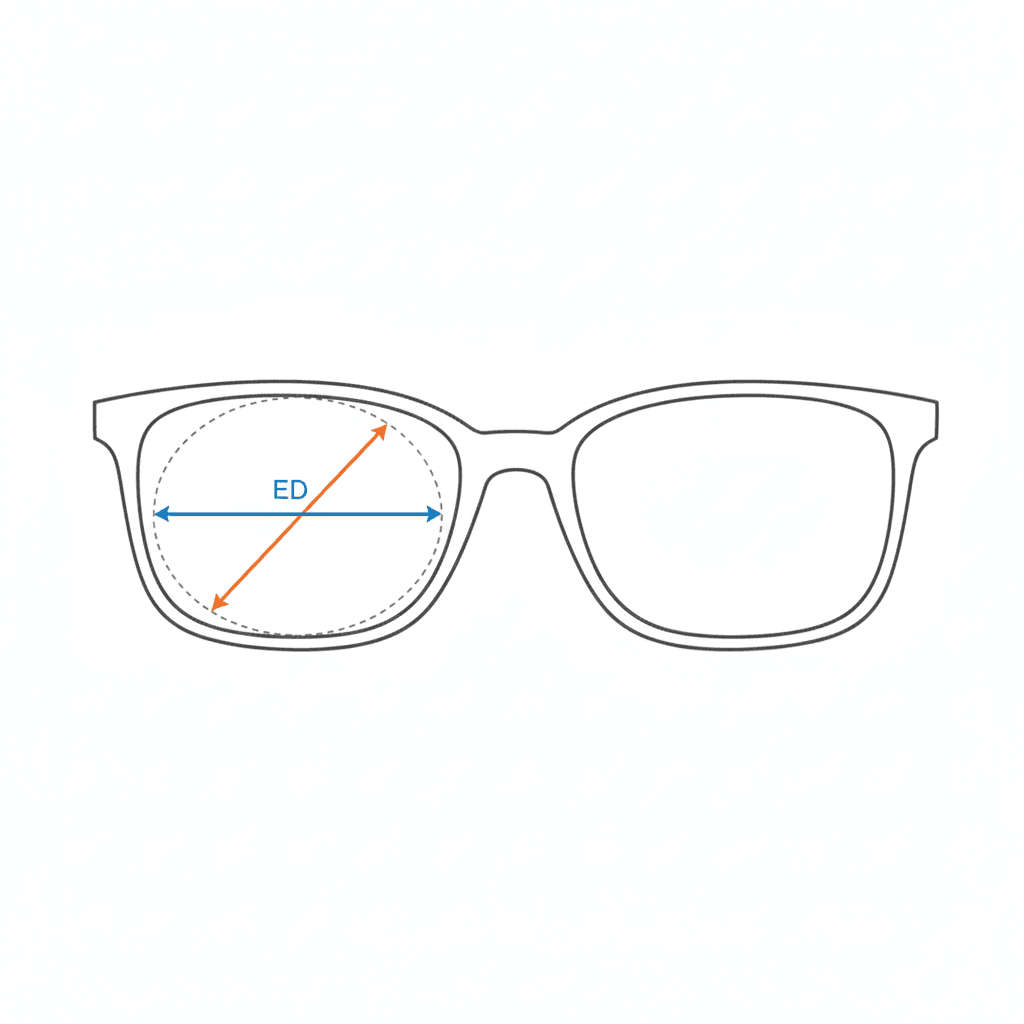
Typical range: 50-70 mm. Check your frame specifications or ask your lab for the exact ED. Optogrid’s digital measurement tools can also help determine accurate frame dimensions from a photograph. A larger ED means more material at the edges, so frame size has a major impact on final thickness, sometimes more than switching materials.
Choose a Refractive Index
The calculator compares seven materials. Higher refractive index bends light more per millimeter of glass, so the lens can be thinner for the same prescription.
| Index | Material | Best For |
|---|---|---|
| 1.50 | CR-39 (Standard Plastic) | Low Rx (< +/-2.00D), budget-conscious |
| 1.53 | Trivex | Children, rimless, safety: lightest material |
| 1.56 | Mid-Index (KOC 55) | Moderate Rx (+/-2.00-3.00D), cost-effective step up |
| 1.59 | Polycarbonate | Sports, safety, high impact resistance |
| 1.61 | MR-8 High-Index | Moderate-high Rx (+/-3.00-5.00D) |
| 1.67 | MR-7 High-Index | High Rx (+/-5.00-8.00D) |
| 1.74 | MR-174 Ultra-Thin | Very high Rx (> +/-8.00D) |
For prescriptions below +/-2.00D, the thickness difference between materials is minimal. Save the premium and stick with CR-39 or Trivex. Above +/-4.00D, upgrading to 1.61 or higher produces a visible, measurable reduction.
Select Frame Shape
Frame shape affects weight, not maximum thickness. Edging removes material from the round blank to fit the frame outline. A rectangle removes roughly 35% of the blank weight, while a round frame retains all of it. For more on how frame geometry affects lens fitting, see our minimum blank size guide.
| Shape | Approximate Weight Reduction |
|---|---|
| Round | 0% (full blank) |
| Oval | ~21% removed |
| Aviator / Pilot | ~16% removed |
| Rectangle | ~35% removed |
Estimated Edge Thickness by Prescription and Material
The table below shows approximate edge thickness in millimeters for four common minus prescriptions at 60 mm effective diameter. These values assume a spherical single-vision design with a 2.0 mm minimum center thickness per ANSI Z80.1-2025.
| Prescription (SPH) | CR-39 (1.50) | 1.61 (MR-8) | 1.67 (MR-7) | 1.74 (MR-174) |
|---|---|---|---|---|
| -2.00D | 3.6 mm | 3.0 mm | 2.8 mm | 2.6 mm |
| -4.00D | 5.2 mm | 4.1 mm | 3.7 mm | 3.3 mm |
| -6.00D | 6.9 mm | 5.2 mm | 4.6 mm | 4.1 mm |
| -8.00D | 8.5 mm | 6.3 mm | 5.5 mm | 4.8 mm |
At -2.00D, the difference between CR-39 and 1.74 is about 1 mm. At -8.00D, it is 3.7 mm. This is why material upgrades matter most for higher prescriptions. Enter your exact numbers in the calculator above for a personalized comparison including weight.
Understanding Your Results
Thickness Comparison
For minus (negative) lenses, the result shows edge thickness, the thickest point. For plus (positive) lenses, it shows center thickness. The percentage next to each material tells you how much thinner it is compared to standard 1.50 CR-39.
Weight Estimate
Thinner does not always mean lighter. Two counterintuitive cases every optician should know:
- Trivex paradox: Trivex (1.53) produces thicker lenses than CR-39, but weighs roughly 16% less because its density is the lowest of any ophthalmic material (1.11 g/cm3 vs. 1.32 g/cm3, per POL Optic material data). For rimless frames and children, weight matters more than edge thickness.
- 1.74 crossover: At low prescriptions (below +/-3.00D), 1.74 ultra-thin lenses can weigh more than CR-39. The modest volume reduction from the higher index does not offset 1.74’s high density (1.47 g/cm3). The weight comparison in this calculator shows exactly when that crossover happens.
Choosing the Right Lens Material: Practical Guidelines
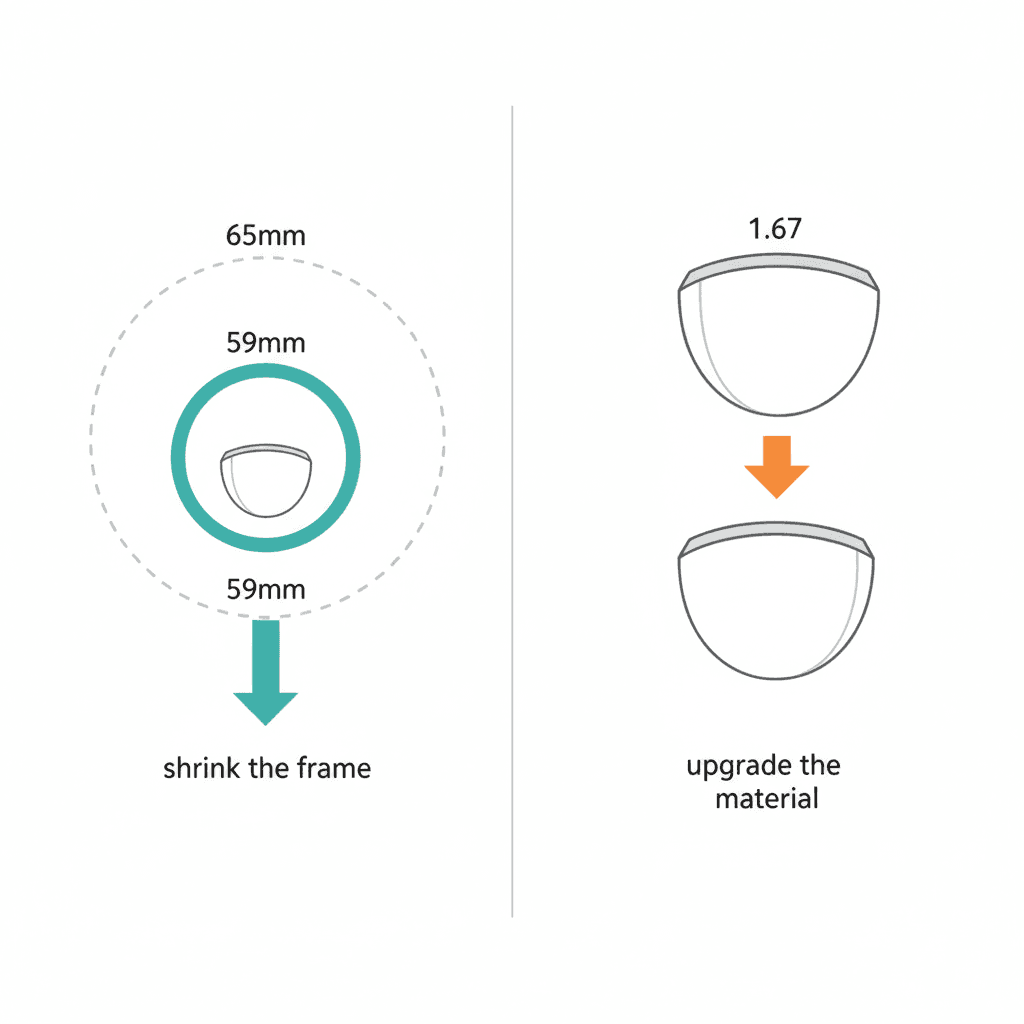
- Frame size often matters more than material. Reducing frame ED by 6 mm can cut edge thickness more than jumping from 1.61 to 1.67 index. Always consider a smaller frame first.
- Upgrade the index above +/-4.00D. Below that threshold, the thickness benefit is marginal. Above it, each index step produces visible, measurable improvement.
- Trivex over Polycarbonate for optical quality. Both resist impact. Trivex has a higher Abbe value (45 vs. 30), meaning sharper vision with less chromatic aberration. Choose Polycarbonate when maximum thinness at 1.59 index matters more, for example in sports wraps.
- 1.56 is the value pick for +/-2.00-3.00D. Meaningfully thinner than CR-39 without the price premium of 1.61. Often overlooked.
- Use the weight column, not just thickness. For patients sensitive to nose pressure, Trivex or MR-8 (1.61) are often lighter than higher-index alternatives at moderate prescriptions.
- Always verify with your lab. This calculator models a single spherical surface. Real lenses have base curves, aspheric designs, and decentration. Your lab’s ray-tracing software accounts for all of them.
How Accurate Is This Calculator?
This tool provides comparative estimates useful for material selection decisions, but not a replacement for lab calculations. Transparent limitations:
- Single-surface model. Real lenses have a front base curve and a back prescription curve. Lab software like Shamir Optimizer or Essilor Kappa uses full two-surface ray tracing.
- Spherical design assumed. Aspheric lens designs are 15-40% thinner than the spherical geometry modeled here.
- No decentration. Each millimeter of decentration increases the required blank size and adds edge thickness. This calculator assumes centered optics.
- Progressive ADD not modeled. The near addition in progressive lenses adds material that is not captured here.
- Conservative minimums. Center thickness uses the ANSI Z80.1-2025 standard minimum of 2.0 mm. Labs can go thinner with Polycarbonate and Trivex (down to 1.0 mm) while still meeting FDA impact standards.
The relative rankings, which material is thinner, which is lighter, remain reliable even when absolute values differ from lab results. For the full mathematical derivation and worked examples behind these calculations, see The Science Behind Lens Thickness: Formulas, Materials, and Standards Explained.
Frequently Asked Questions
How thick will my lenses be with a -6.00 prescription?
It depends on the lens diameter and material. In standard CR-39 (1.50 index) at 65 mm ED, a -6.00D lens has an edge thickness of roughly 7.5 mm. Switching to 1.67 MR-7 drops that to about 5.0 mm. Enter your exact numbers above for a precise comparison.
What is the thinnest lens material available?
MR-174 at 1.74 refractive index produces the thinnest lenses for any given prescription. However, it has a lower Abbe value (33) than CR-39 (58), which means more chromatic aberration. It also has the highest density (1.47 g/cm3), so it may not be the lightest option at moderate prescriptions.
Is 1.67 or 1.74 better for high prescriptions?
For prescriptions above +/-8.00D, 1.74 provides a noticeable thickness reduction over 1.67. Between +/-5.00D and +/-8.00D, the difference is smaller, and 1.67 is lighter (density 1.35 vs. 1.47 g/cm3). Use the calculator to compare the actual numbers for your Rx.
Does cylinder (CYL) affect lens thickness?
Yes, significantly. Cylinder creates a second power meridian. The worst-case meridian, whichever has the highest absolute power, determines maximum edge thickness. A -3.00 SPH / -2.00 CYL prescription is as thick at its worst point as a -5.00 SPH lens.
Why are my Trivex lenses thicker but lighter than CR-39?
Trivex has a lower refractive index (1.53 vs. 1.50 for CR-39), so lenses are slightly thicker. But Trivex has the lowest density of any ophthalmic material: 1.11 g/cm3 versus 1.32 g/cm3 for CR-39. The density advantage outweighs the thickness penalty, making Trivex roughly 16% lighter overall.
How does frame size affect lens thickness?
Larger frames require a larger effective diameter (ED), which increases the sagitta (the depth of lens curvature) and with it the edge thickness. A 6 mm reduction in ED can reduce edge thickness by as much as upgrading one full index step. Choosing a frame that fits well at a smaller size is one of the most effective ways to get thinner lenses.
Can this calculator predict my exact lens weight?
No. The weight estimate models a single spherical surface and applies a shape correction factor for frame type. Real-world weight depends on base curve selection, aspheric design, decentration, and exact frame dimensions. Expect estimates to fall within 15-25% of actual edged lens weight. The comparative ranking between materials is more reliable than absolute gram values.
About This Tool
This calculator applies the sagitta formula (ISO 13666:2019) and the lensmaker’s equation to compute lens thickness from prescription power and refractive index. Minimum thicknesses follow ANSI Z80.1-2025 recommendations. Weight estimation uses a cylinder-plus-spherical-cap volume model with material densities cross-referenced from manufacturer data sheets (POL Optic, Mitsui MR-Series). Frame shape correction factors are empirical values based on typical frame proportions.
Built by Optogrid, digital measurement tools for optical professionals. If you measure PD and segment height with photographs, see how Optogrid’s measurement platform works. For a full lens material comparison covering Abbe values, impact standards, and prescription range recommendations, that guide covers each material family in depth. The optical lab finishing process explains what happens to the blank after the material choice is made, and lens manufacturing technology covers the full pipeline from surfacing to coating.

I am a seasoned software engineer with over two decades of experience and a deep-rooted background in the optical industry, thanks to a family business. Driven by a passion for developing impactful software solutions, I pride myself on being a dedicated problem solver who strives to transform challenges into opportunities for innovation.