
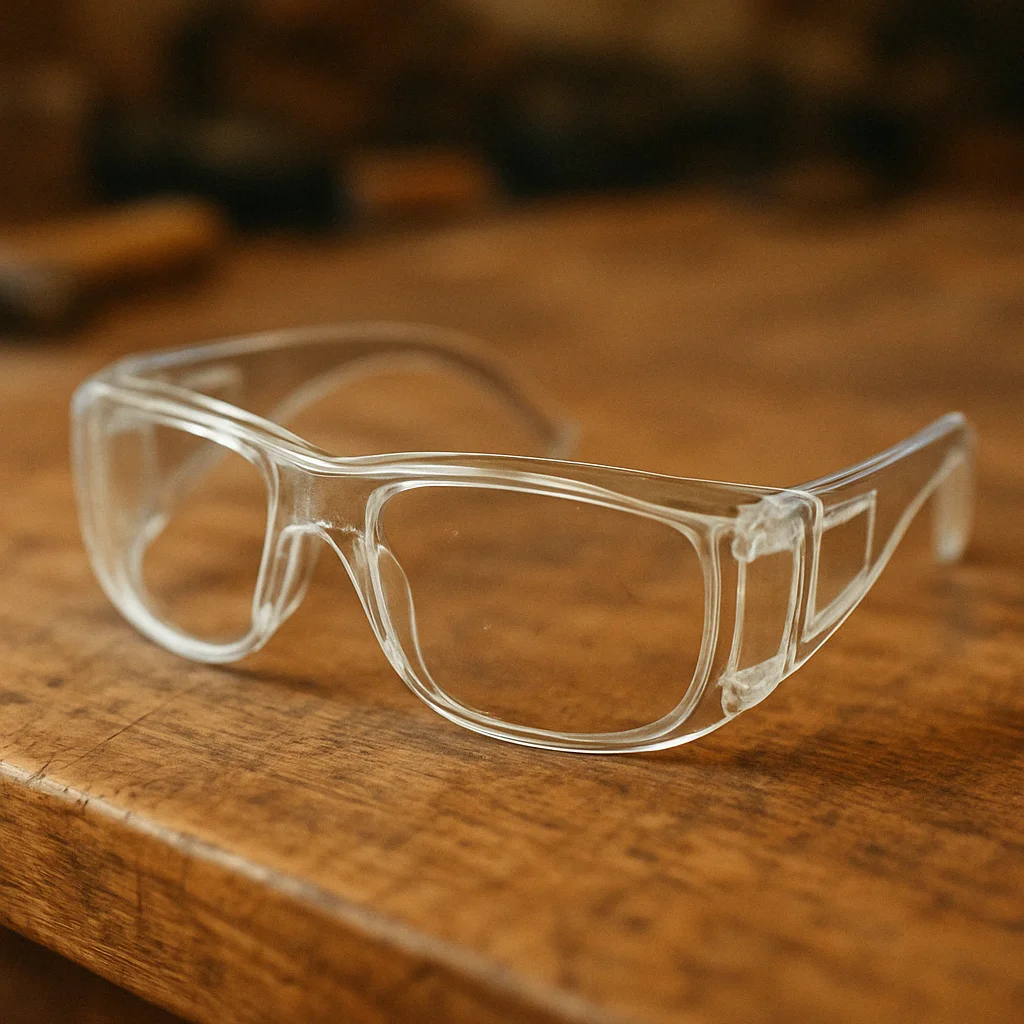
Short Answer: Prescription safety glasses must comply with the ANSI Z87.1 consensus standard for impact resistance while correcting vision. OSHA does not test or “approve” eyewear itself; it requires compliance with this standard. Under OSHA 29 CFR 1910.133, employers must provide compliant prescription PPE for workers exposed to eye hazards, and 1910.132(h)(2) exempts employers from paying for non-specialty eyewear employees can wear off-site. Minimum lens thickness is 2.0mm for polycarbonate or Trivex and 3.0mm for high-index materials. PD and SH measurements within +/-1mm are critical for optical performance and regulatory compliance.
The American Optometric Association reports ~2,000 U.S. workers sustain job-related eye injuries requiring medical treatment daily, and proper eye protection prevents 90% of them. OSHA cited 2,074 eye and face protection violations in FY 2023, ranking it 9th among the top 10 most-cited standards, and workplace eye injuries cost employers more than $924 million annually in workers’ compensation, plus nearly $4 billion in lost wages and productivity. This guide covers OSHA compliance, measurement accuracy, and workforce distribution logistics for a compliant, scalable program.
Key Takeaways for Safety Managers
- ANSI/ISEA Z87.1-2020 mandates impact resistance, optical quality, and permanent frame markings (Z87-2/Z87-2+); ANSI/ISEA Z87.1-2025, published January 2026, is now the current edition.
- PD and SH measurements within +/-1mm are required for ANSI optical center compliance.
- Remote measurement tools like Optogrid enable scalable programs for distributed workforces.
- Documented hazard assessments, training records, and OSHA records must be retained 5+ years.
Prescription PPE Requirements for Workplace Safety Programs
What Does OSHA Require for Prescription Eye Protection?
Under OSHA 29 CFR 1910.133(a)(3), “the employer shall ensure that each affected employee who wears prescription lenses while engaged in operations that involve eye hazards wears eye protection that incorporates the prescription in its design, or wears eye protection that can be worn over the prescription lenses without disturbing the proper position of the prescription lenses or the protective lenses.” In practice, that means either lenses with the prescription built in, or over-the-glasses (OTG) protection that does not shift the existing lenses.
Employer payment obligation, with a key exception: OSHA 1910.132(h) requires employers to pay for required PPE. However, 1910.132(h)(2) states that “the employer is not required to pay for non-specialty prescription safety eyewear, provided that the employer permits such items to be worn off the job-site.” For specialty eyewear (welding filter lenses, chemical splash goggles with prescription inserts), the payment obligation is unconditional. Consult legal counsel to determine classification for your program.
Employers bear full responsibility for hazard assessments, PPE selection, employee training, and compliance documentation. This includes prescription eyewear programs, which must meet or exceed the ANSI standard in effect at the time of manufacture.
Are Prescription Safety Glasses “OSHA Approved”?
No. OSHA does not test, certify, or “approve” eye protection products. Under OSHA 1910.133(b)(1), protective eyewear must instead comply with a consensus standard: ANSI/ISEA Z87.1-2010, Z87.1-2003, or Z87.1-1989 (R-1998), the editions the regulation names directly. Manufacturers self-certify and mark compliant frames Z87 or Z87-2. Eyewear “at least as effective” as devices built to these editions is also deemed compliant under 1910.133(b)(2), which is why frames certified to newer ANSI editions still satisfy OSHA.
The ANSI/ISEA committee has since moved on: ANSI/ISEA Z87.1-2025, published January 2026, supersedes the 2020 edition (2020-certified frames remain valid). The practical takeaway: check the Z87-2 or Z87-2+ marking on the frame itself, not a claim of “OSHA approval” that does not exist as a formal designation.
What Are the ANSI Z87.1 Requirements for Prescription Safety Lenses?
Minimum lens thickness is 2.0mm for polycarbonate or Trivex lenses and 3.0mm for high-index plastics. ANSI Z87.1 prescribes design, performance, and marking requirements beyond thickness alone, covering impact resistance, optical quality (prismatic power ≤0.25Δ, refractive power ±0.06D), permanent Z87-2/Z87-2+ marking, and side protection where a hazard assessment identifies flying-object risk. The verification table below is a procurement checklist for each requirement.
ANSI/ISEA Z87.1-2025, published January 2026, is now the current published edition; see “Are Prescription Safety Glasses OSHA Approved?” above for how the OSHA-cited editions differ from the current ANSI edition.
ANSI Z87.1 Prescription PPE Verification Table
When procuring prescription safety eyewear for your workforce, verify compliance using this checklist:
| Requirement | ANSI Z87.1 Standard | Verification Method |
|---|---|---|
| Impact resistance | High-velocity impact test (150 ft/sec). | Z87+ or Z87-2+ frame marking. |
| Basic impact protection | Basic impact test (1″ steel ball drop). | Z87 or Z87-2 frame marking. |
| Lens thickness | 2.0mm (polycarbonate/Trivex), 3.0mm (high-index). | Manufacturer specification sheet. |
| Optical quality | Prismatic power ≤0.25Δ, refractive power ±0.06D. | Laboratory certification. |
| Side protection | Required for flying object hazards. | Frame design or detachable shields. |
| PD accuracy | ±1.0mm from prescription. | Measurement documentation. |
| UV protection | Optional unless specified by hazard assessment. | Lens coating specification. |
| Anti-fog coating | Performance criteria defined (2020 revision). | Manufacturer certification. |
Note on prismatic power (≤0.25Δ): Δ denotes prism diopters, the unit measuring how much a lens deflects light. ANSI Z87.1 restricts prismatic imbalance to 0.25Δ vertically. Lenses mounted off-center from a worker’s pupils cause disorientation and eyestrain that drives PPE removal. Accurate PD measurement is the primary control keeping lenses within this limit.
How Does Prescription PPE Differ from Standard Safety Glasses?
Standard safety glasses protect against hazards through impact-resistant frames and lenses alone. Prescription PPE must accomplish hazard protection and accurate vision correction at once:
| Compliance Aspect | Standard PPE | Prescription PPE |
|---|---|---|
| ANSI Z87.1 Compliance | Z87 or Z87+ marking. | Z87-2 or Z87-2+ marking (prescription designation). |
| Impact Testing | Frame + plano lens tested. | Frame + actual Rx lens tested at specific power. |
| Measurement Requirements | Frame fit only (temple width, bridge fit). | PD +/-1mm, SH +/-1.5mm for optimal performance. |
| Documentation Needed | PPE provision record, training log. | PPE provision + Rx copy + measurement data + optical lab certification. |
| Fit Verification | Visual inspection, comfort check. | Measurement validation + wear test + optical centering verification. |
| Employee Cost | $0 (employer provides per OSHA). | $0 (employer provides per OSHA, a common misconception). |
Hazard-Specific Prescription PPE Requirements
Match prescription PPE type to the hazards identified in your workplace assessment:
| Hazard Type | Prescription PPE Required | Key Specification |
|---|---|---|
| Impact (flying particles, debris) | Wraparound safety glasses with side shields. | Z87-2+ rating, polycarbonate or Trivex lenses. |
| Chemical exposure | Sealed goggles with indirect ventilation, Rx inserts. | Chemical-resistant frames, anti-fog coatings. |
| Welding and radiation | Welding helmets with flip-up shields or Rx inserts. | Shade ratings per ANSI Z87.1 Section 9, UV/IR protection. |
| Multi-hazard environments | Interchangeable lens systems, combination protection. | Impact + chemical + UV; Rx inserts in full-face respirators when needed. |
Configurations That Fail ANSI Z87.1 Compliance
Many employers unknowingly provide non-compliant prescription eyewear. Common failure configurations:
- Personal prescription glasses with clip-on or magnetic side shields (not ANSI certified).
- Over-the-glasses (OTG) safety glasses that disturb prescription lens positioning.
- Outdated ANSI Z87.1-1989 or 2003 certified eyewear, OSHA’s cited compliance floor; ANSI/ISEA Z87.1-2025 is the current published edition.
- Prescription inserts in frames lacking Z87-2 or Z87-2+ permanent markings.
- Prescription lenses fabricated for standard optical frames, then mounted in safety frames certified only for plano (non-prescription) lenses.
Document any of these configurations in your hazard assessment and initiate corrective procurement.
Regional Safety Certifications for Global Operations
For multinational organizations or companies with international suppliers, prescription safety eyewear may need to meet the regional equivalent to ANSI Z87.1: EN 166 in the European Union or CSA Z94.3 in Canada. Maintain procurement records documenting which standard each shipment was verified against.
Ensuring Proper Fit for PPE Compliance and Worker Acceptance
Proper fit drives both regulatory compliance and worker adoption. Per research on spectacle prescribing, accurate PD and SH measurements are essential for optimal visual clarity; PD inaccuracies cause prismatic effects that lead to eyestrain, headaches, and reduced compliance.
Measurement accuracy and frame fit both matter:
- High prescriptions and astigmatism: Even +/-2mm PD error causes prismatic effects, including double vision, headaches, and PPE removal.
- Progressive lenses: Require monocular PD measurements for proper corridor alignment across task distances.
- Secure retention: Adjustable temple arms and nose pads prevent slippage during physical work or hard hat use.
- Wraparound coverage: Side protection shields meet ANSI requirements for flying particle hazards.
- Shift-length comfort: A soft nose bridge and cushioned temple tips reduce pressure points. In our conversations with shops fulfilling these orders, poorly fitted frames come up as the single most common reason workers stop wearing PPE.
- Side shield compatibility: Frame design must accommodate prescription lens thickness without displacing side shields.
See why accurate PD and SH measurements matter for the optical mechanics behind fit-driven compliance failures. For programs selecting a measurement method, a side-by-side comparison of PD measurement methods covers accuracy tolerances for rulers, pupillometers, and digital photography-based tools.
Remote Measurement for Distributed Workforces
Capturing accurate PD and SH measurements across distributed workforces is a major operational challenge. Multi-site operations lack consistent equipment, manual records are hard to centralize and audit, and coordinating appointments for hundreds of employees extends rollout by weeks.
How Does Remote Photo-Based PD and SH Measurement Work?
Optogrid addresses these challenges through smartphone-based measurement. Employees photograph themselves using a credit card as a reference object (already in every wallet, so there is no separate reference card to distribute or lose), and AI-driven computer vision calculates PD and SH to +/-0.5mm accuracy. Measurements are delivered digitally to safety coordinators and vendors, with automatic compliance documentation ready for OSHA records.
Benefits for Corporate PPE Programs
Remote measurement technology provides measurable advantages:
- Scalability: Measure 100+ employees simultaneously without on-site coordination.
- Cost reduction: Eliminate travel expenses and technician fees ($25-50 per employee).
- Faster deployment: Reduce program rollout from weeks to days.
- Improved accuracy: Consistent AI-driven methodology eliminates technician variability.
- ANSI compliance: Digital documentation satisfies OSHA record-keeping requirements.
- Worker convenience: Employees complete measurements during work hours without scheduling delays.
Optical dispensers and optometrists filling PPE orders can find workflow details and monocular PD requirements in how optical shops use Optogrid for prescription PPE fabrication.
Selecting the Right Lens Features

Occupation-Specific Lens Tint and Filter Requirements
Lens tint and filter selection must be driven by the hazard assessment, not personal preference. OSHA 29 CFR 1910.133 Table E-1 specifies minimum filter shade numbers for operations involving radiant energy:
Welding and cutting operations, minimum shade numbers:
| Operation | Amperage Range | Minimum Shade |
|---|---|---|
| Shielded metal arc welding (SMAW) | Under 60A / 60–160A / 160–250A / 250–550A. | Shade 7 / 8 / 10 / 11. |
| Gas metal arc / flux cored arc welding | 60–250A. | Shade 10. |
| Gas tungsten arc welding (GTAW/TIG) | 50–150A / 150–500A. | Shade 8 / 10. |
| Plasma arc welding | 100–400A. | Shade 10. |
| Carbon arc welding | All amperages. | Shade 14. |
| Torch brazing | N/A. | Shade 3-4. |
| Torch soldering | N/A. | Shade 2. |
Non-welding occupational environments:
- Outdoor construction and utility work: UV-400 lenses reduce cataract risk from solar exposure; gray or smoke tint cuts glare without distorting color.
- Chemical laboratories and splash hazards: Clear or lightly tinted lenses preserve color discrimination for reagent ID; splash-rated goggles take precedence over tint choice.
- Electronics and cleanroom assembly: Anti-static coatings prevent particulate attraction; clear lenses preserve color accuracy for inspection work.
- Cold storage and food processing: Clear lenses with anti-fog coating; fogged lenses get removed, eliminating protection entirely.
Lens Coatings and Materials
Match coatings to the documented workplace hazard, not convenience:
| Coating | Required For |
|---|---|
| Scratch-resistant | Manufacturing, construction, metalworking (flying debris). |
| Anti-fog | Cold storage, food processing, outdoor winter, humid environments. |
| Anti-static | Electronics manufacturing, cleanroom assembly. |
| Mirror/solar | Outdoor construction, utility, roofing (solar glare reduction). |
| Chemical-resistant | Laboratory, chemical processing, agriculture. |
Fogged lenses force workers to remove PPE, creating the very hazard the eyewear prevents, which is why the 2020 revision added specific anti-fog performance criteria. Factory-applied hard coatings outperform post-production spray treatments for durability.
Lens materials: Polycarbonate and Trivex meet ANSI Z87.1 impact requirements at 2.0mm minimum thickness and stay lightweight for 8-hour wear; Trivex has better optical clarity, which matters for precision inspection work. A lens material comparison covers index, impact ratings, and Abbe value. Nylon and TR-90 frames resist chemical exposure and temperature cycling better than metal in most industrial settings.
Prescription PPE Program Implementation


Per OSHA’s PPE guidance, a compliant program requires hazard assessments, appropriate PPE selection, employee training, and documentation.
What Are the Steps to Roll Out a Prescription PPE Program?
| Step | Process | Tools & Considerations | Timeline |
|---|---|---|---|
| 1. Hazard Assessment | Identify eye hazards per OSHA 1910.133. | Workplace inspection, job hazard analysis. | 1-2 weeks. |
| 2. Employee Identification | Determine who requires prescription PPE. | Safety audit, vision screening records. | 1 week. |
| 3. Prescription Collection | Gather current prescription documentation. | Employee portal, HR, telemedicine. | 2-4 weeks. |
| 4. Measurement Capture | Obtain PD, SH, and frame sizing data. | Remote measurement or on-site technician. | 1-2 weeks. |
| 5. Vendor Selection | Choose ANSI-certified eyewear supplier. | RFP, compliance verification. | 2-3 weeks. |
| 6. Order Processing | Submit prescriptions and measurements. | Digital integration with lab systems. | 1 week. |
| 7. Fulfillment & Distribution | Receive and distribute eyewear. | Inventory management, fit verification. | 2-3 weeks. |
| 8. Training & Documentation | Train on use/care, record provision. | LMS, compliance database. | Ongoing. |
| 9. Replacement & Maintenance | Set replacement cycles and damage procedures. | Tracking system, budget allocation. | Ongoing. |
Total initial deployment: 10-15 weeks for traditional programs, 6-8 weeks with remote measurement technologies.
Regulatory Compliance Documentation Requirements
Per OSHA documentation standards, records must be accessible during inspections and retained 5+ years: the written hazard assessment, employee training records, PPE provision records, measurement data (PD, SH, prescriptions), inspection logs, and vendor ANSI Z87.1 certification documents. The Employee Record Checklist below breaks these down per employee.
Common Prescription PPE Compliance Failures and Corrections
| Issue | Root Cause | Correction |
|---|---|---|
| Prescription collection delays | Employees lack current Rx or resist sharing health data. | Partner with telemedicine or on-site vision screening during work hours. |
| Personal glasses with clip-on side shields | Not ANSI Z87.1 certified; clip-ons give no integrated protection. | Prohibit in hazard areas. Provide Z87-2 certified Rx eyewear and post compliant-vs-noncompliant signage. |
| Incorrect PD/SH measurements causing non-use | Untrained manual ruler measurements produce +/-2-3mm errors, causing strain and removal. | Use validated methods (Optogrid or professional optical); standardize across sites; re-measure on discomfort reports. |
| Outdated prescriptions (2+ years) in active PPE | No systematic update program; employees do not report vision changes. | Track prescription dates. Run annual screenings. Remind employees the employer covers update costs. |
| Missing side protection on Rx safety frames | Employees select frames by style; vendors unfamiliar with hazard requirements. | Pre-qualify frames meeting hazard requirements and inspect deliveries before distribution. |
| Incomplete compliance documentation | Decentralized, paper-based procurement with incomplete data capture. | Centralize records digitally, standardize forms, retain 3-5 years, require vendor certs. |
| OTG eyewear disturbing Rx lens positioning | Cost-cutting; misunderstanding of 1910.133(a)(3) positioning requirements. | Permit OTG only when it does not shift Rx lens position; default to integrated Rx PPE. |
Cost Considerations for Corporate PPE Programs
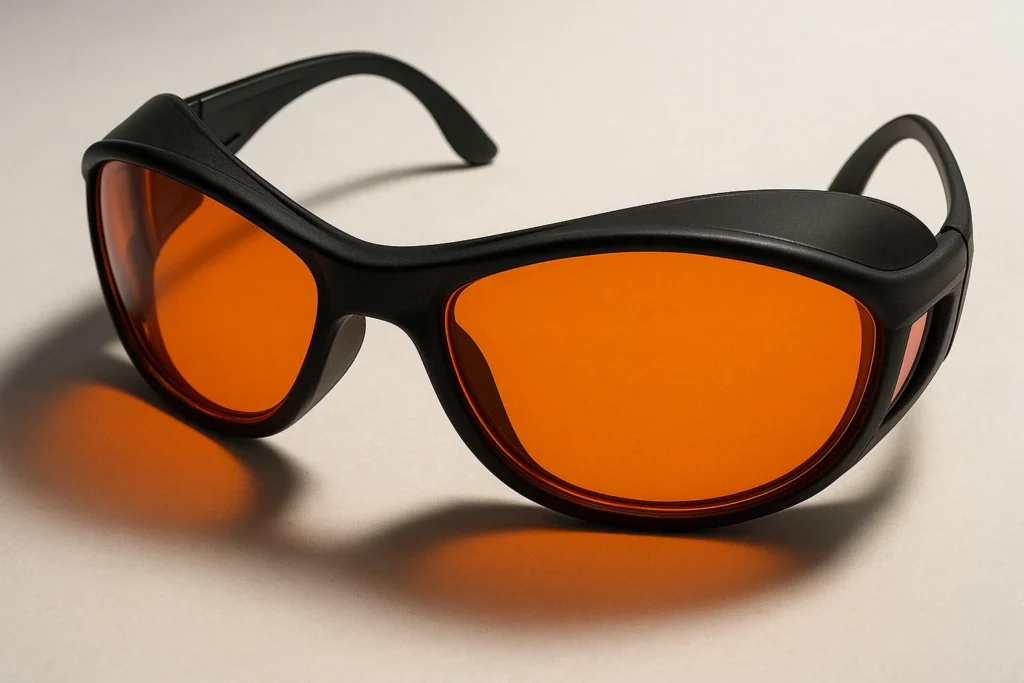
OSHA requires employers to cover this cost in nearly all cases; see “What Does OSHA Require for Prescription Eye Protection?” above for the narrow non-specialty, worn-off-site exemption at 1910.132(h)(2). Understanding the total cost of prescription PPE programs enables accurate budgeting and demonstrates ROI to executive leadership, without compromising compliance or safety.
How Much Does a Prescription PPE Program Cost Per Employee?
Typical cost structure for prescription safety eyewear programs:
| Cost Component | Traditional In-Person | Remote Measurement (Optogrid) |
|---|---|---|
| Prescription eyewear (ANSI Z87.1) | $150-300/employee. | $150-300/employee. |
| Measurement services | $25-50/employee. | $0 (included in platform). |
| Employee travel/time | $40-80/employee (2-3 hours). | $0 (measured during work). |
| Administrative coordination | $30-60/employee. | $10-15/employee. |
| Total initial cost | $245-490/employee | $160-315/employee |
| Cost savings | Baseline. | 35-40% reduction. |
Annual replacement costs: Budget $75-150 per employee annually for damage replacement, prescription changes, and normal wear (typically 30-40% of workforce requires replacement each year).
Beyond the sticker price, we consistently see the larger ROI driver is remake avoidance: accurate measurement cuts remake rates from an industry-typical 12-15% down to 3-5%, worth $18-45 per employee on top of the eliminated technician fee. For a 100-employee program, that is roughly $8,500-17,500 in direct measurement-related savings, before any workers’ compensation cost avoided from injuries prevented by protection workers actually keep on.
Budget Optimization Strategies
- Bulk ordering: Negotiate volume discounts for multi-site deployments (10-15% at 50+ units).
- Frame standardization: Offer 3-5 pre-approved ANSI-compliant styles to simplify inventory and reduce overhead.
- Lifecycle management: Base replacement on condition assessments rather than arbitrary schedules, extending PPE lifespan by 15-20%.
- Digital integration: Connect measurement, ordering, and inventory systems to eliminate manual processing errors.
Vendor Selection and Compliance Verification
When procuring prescription safety eyewear for corporate PPE programs, vendor selection directly impacts compliance, worker satisfaction, and program efficiency. Evaluate vendors on regulatory compliance, service capabilities, and digital integration, not just unit pricing.
Critical Vendor Selection Criteria
| Evaluation Area | Key Requirements |
|---|---|
| ANSI Z87.1 compliance | Certification documents, Z87-2/Z87-2+ markings on samples, current standard, accredited test lab. |
| Service capabilities | 10-15 day standard turnaround, remake policy, optician technical support, dedicated account rep for 100+ units. |
| Digital integration | Compatible with measurement platform (e.g., Optogrid), real-time tracking, digital compliance documentation. |
| Pricing structure | Transparent per-unit pricing, volume tiers, all-inclusive quotes, replacement part availability. |
Before issuing purchase orders, request sample products for marking verification and validate certifications against current ANSI standards.
Maintenance and Care for Longevity
PPE lifecycle management requires three practices:
- Clean lenses with microfiber cloths only. Paper towels and work rags create micro-scratches that degrade ANSI optical compliance.
- Store glasses in a protective case away from extreme temperatures and caustic materials.
- Conduct periodic inspections with documented decisions for compliance audits.
Employee training on correct use and care is a required element of OSHA-compliant PPE programs.
Training, Culture, and Employee Engagement
Employee Responsibilities and Accountability
Workers must be proactive in using, maintaining, and reporting issues with their prescription protective eyewear. Employers who provide accurate measurements and well-fitted prescription PPE see higher consistent usage.
Employee responsibilities in prescription PPE compliance:
- Wear prescription PPE consistently: In all designated eye hazard areas, not just when supervisors are present.
- Report vision changes and damage immediately: Updated prescriptions are the employer’s responsibility to provide, and damaged PPE does not protect.
- Inspect before each use and follow care protocols: Check for damage or loose components; proper cleaning maintains optical clarity.
- Never use personal eyeglasses as PPE: Even with added side shields, personal glasses do not meet ANSI standards.
What Must Employee Training Cover?
OSHA 29 CFR 1910.133 mandates training on proper use, maintenance, and limitations of prescription PPE. Providing the eyewear is only the first step; employees also need to know why personal eyeglasses don’t qualify and how to report issues. Training should cover:
- Regulatory basics: OSHA 1910.133’s requirements, Z87-2/Z87-2+ markings, and that employers provide prescription PPE at no cost.
- Why personal glasses don’t qualify: Impact resistance gaps versus safety eyewear, and why aftermarket clip-on side shields are non-compliant.
- Measurement and fit: Why accurate PD and SH measurements prevent the eye strain that drives non-compliance, and how to recognize poor fit.
- Daily care: Microfiber cloths only, never paper towels or solvent-based cleaners; inspect before each use; store in a protective case.
Safety Committee Involvement and Multi-Site Consistency
Establish safety committees with representatives from departments requiring prescription PPE to surface fit and vendor issues and suggest process improvements.
Multi-site protocol consistency: Inconsistent protocols across locations create compliance gaps and documentation problems during audits. Centralized programs with standardized measurement tools ensure all sites meet the same standards.
Inspection, Maintenance, and Record Retention
Three-Tier Inspection Framework
Employee daily inspections (before each use):
- Lens condition: cracks, chips, deep scratches, or haze affecting vision.
- Frame integrity: cracks, bending, or deformation.
- Component security: loose screws, missing nose pads, or detached side shields.
- Optical clarity: verify lenses still provide clear, undistorted vision.
- ANSI markings: verify Z87-2 or Z87-2+ markings still visible.
If any issues are identified, remove prescription PPE from service immediately and replace.
Supervisor periodic inspections (monthly or quarterly): Verify all employees wear ANSI-certified prescription PPE (not personal glasses) during safety walks. Assess PPE condition across the workforce. Document findings and corrective actions.
Formal compliance audits (annual): Confirm all employees in eye hazard areas have appropriate prescription PPE with proper ANSI Z87-2 or Z87-2+ markings. Verify prescriptions are current (within 1-2 years), measurement and provision records are complete, training records are current, and vendor certifications are on file.
Replacement Process
When prescription PPE becomes damaged, worn, or no longer provides adequate protection, follow this process:
- Employee reports prescription PPE damage or vision change.
- Immediately remove from service (provide temporary prescription PPE if needed).
- Assess: repair possible or replacement required?
- For replacements: verify current prescription and measurements (re-measure if prescription changed).
- Order replacement prescription PPE from approved vendor.
- Verify replacement meets ANSI Z87-2 standards and proper fit upon delivery.
- Document replacement in employee’s prescription PPE record.
- Properly dispose of damaged prescription PPE (cannot be reissued).
Employee Record Checklist
Maintain for each employee: (1) identification and job function, (2) hazard assessment, (3) current vision prescription, (4) measurement records (PD, SH, date, method, measurer), (5) provision records (frame/lens specs, vendor, date), (6) ANSI Z87-2 certification from vendor, (7) training completion, (8) fit verification and acceptance, (9) inspection records, (10) replacement history with reasons, (11) prescription update history.
OSHA Record Retention Periods
- Employee training records: duration of employment plus 1 year (minimum).
- Hazard assessments: as long as relevant to current operations.
- PPE provision records: 3-5 years (recommended best practice).
- Injury/incident records: 5 years per OSHA 1904 recordkeeping requirements.
- Prescription and measurement records: duration of employment (recommended for continuity).
Implementing Compliant Prescription PPE Programs
Compliant prescription PPE programs require documented hazard assessments, accurate PD and SH measurements, ANSI-verified vendor selection, and comprehensive OSHA record-keeping. The American Optometric Association reports that the right eye protection can prevent 90% of workplace eye injuries, each carrying significant workers’ compensation and productivity costs.
In the programs we support, photo-based measurement compresses deployment from 15+ weeks to 6-8 weeks and eliminates the technician variability that drives remake rates and worker dissatisfaction. Treating prescription PPE as a strategic program, not a compliance checkbox, protects your workforce while optimizing costs.
See how Optogrid fits into your prescription PPE workflow: Request a program assessment to evaluate how remote measurement integrates with your vendor and ordering systems.
Frequently Asked Questions
Who pays for prescription safety glasses under OSHA regulations?
Under OSHA 29 CFR 1910.132(h), employers must pay for required PPE including safety frames, ANSI Z87.1 lenses, and necessary coatings. However, 1910.132(h)(2) exempts employers from paying for non-specialty prescription safety eyewear when employees can wear it off the job site. This exemption applies only to non-specialty eyewear. Specialty items (welding filter lenses, chemical-splash rated goggles) remain unconditionally employer-paid. Employees may always pay for cosmetic upgrades or premium features beyond minimum compliance requirements.
What are the penalties for prescription PPE non-compliance?
As of 2026, per OSHA’s civil penalty schedule (2025 maximums carried forward unchanged):
- Serious/other-than-serious violations: up to $16,550 per violation.
- Repeat or willful violations: up to $165,514 per violation.
- Failure to abate: up to $16,550 per day past the correction deadline.
Eye and face protection (29 CFR 1910.133 and 1926.102) consistently ranks among OSHA’s top 10 most-cited standards, with over 2,000 violations cited in fiscal year 2023. Beyond the fines, non-compliance risks workers’ compensation costs, legal liability, and lost productivity from injury incidents.
What are the ANSI Z87.1 requirements for prescription lenses?
Prescription lenses must pass high-velocity impact testing (150 ft/sec), meet minimum thickness of 2.0mm (polycarbonate/Trivex) or 3.0mm (high-index), and maintain optical quality (prismatic power ≤0.25Δ, refractive power ±0.06D). Frames must carry permanent Z87-2 or Z87-2+ markings. Side protection is required when hazard assessments identify flying object risks.
What does the delta symbol (Δ) mean in prescription safety glass specifications?
The delta symbol (Δ) designates prism diopters, the unit measuring how much a lens deflects or displaces the light path entering the eye. In ANSI Z87.1 specifications, prismatic power ≤0.25Δ means lenses mounted in frames must not create more than 0.25 prism diopters of visual displacement vertically. When PD measurements are inaccurate, optical centers shift away from the worker’s pupils, generating prismatic imbalance that causes eyestrain, headaches, and double vision. For safety managers without optical training: accurate PD measurement is the primary control that keeps lenses within this ANSI limit.
How do I measure employees for prescription PPE remotely?
Photo-based measurement tools like Optogrid enable accurate remote PD and SH capture. Employees photograph themselves using a smartphone and a credit card as a reference object. AI-driven algorithms calculate measurements to +/-0.5mm accuracy, delivering results digitally to coordinators and vendors with automatic OSHA-ready documentation. This eliminates travel costs, compresses deployment, and provides consistent accuracy across all sites.
What documentation is required for PPE compliance?
OSHA requires: (1) Written hazard assessments, (2) Employee training records, (3) PPE provision records showing when eyewear was issued, (4) Measurement data (PD, SH, prescriptions), (5) Inspection logs, and (6) Vendor ANSI Z87.1 certifications. Records must be accessible during inspections and retained 5+ years.
Can employees use their own prescription glasses as PPE?
No. Regular prescription glasses do not meet ANSI Z87.1 impact resistance or lens thickness requirements. Employers may allow over-the-glasses (OTG) safety eyewear in some cases, but integrated prescription safety eyewear (marked Z87-2 or Z87-2+) provides better fit, worker comfort, and compliance.
How often must prescription PPE be replaced?
OSHA requires PPE to remain in “serviceable condition,” with no fixed replacement schedule. Replace when lenses are scratched to optical failure, frames lose structural integrity, coatings degrade, prescriptions change, or ANSI markings become illegible. Most programs budget 30-40% annual replacement. Document all replacement decisions for audits.
What happens if prescription PPE doesn’t fit properly?
Poor fit creates compliance and liability risks. Workers remove uncomfortable eyewear. Improperly positioned frames leave hazard exposure gaps. Remake rates rise to 12-15% (vs. 3-5% with accurate measurement). OSHA citations follow when inadequate fit compromises protection. Use +/-0.5mm measurement accuracy and verify fit during distribution.
What is the cost per employee for a prescription PPE program?
Total costs range from $245-490/employee (traditional in-person) or $160-315/employee with remote measurement, a 35-40% reduction. Annual replacement budgets typically run $75-150/employee. ROI calculations should include avoided injury costs: the American Optometric Association reports that proper eye protection can prevent 90% of workplace injuries. Workers’ compensation claims carry substantial costs in medical expenses and lost productivity that vary by severity and jurisdiction.
What lens tint or shade is required for welding operations?
Per OSHA 1910.133 Table E-1, required shade rises with amperage: SMAW needs shade 7 to 11 depending on current, GTAW/TIG needs shade 8 or 10, gas metal arc/flux cored arc welding needs shade 10, carbon arc needs shade 14 (see the table above for the full breakdown). Start darker to locate the weld zone, then move to the lightest shade that still meets the OSHA minimum. Prescription welding eyewear must incorporate the filter within an ANSI Z87.1-compliant lens.

I grew up inside an optical shop. My mother likes to tell how, as a kid, I would watch eyeglasses being assembled, play with the tools, and draw on the back of service order slips. The family business taught me early what a precise measurement and work done right are worth.
I went on to spend more than twenty years as a software engineer, always keeping an eye on the optical world. Optogrid was born where the two meet: digital measurement technology (pupillary distance and fitting heights) built by someone who knows the dispensing counter from the inside.