
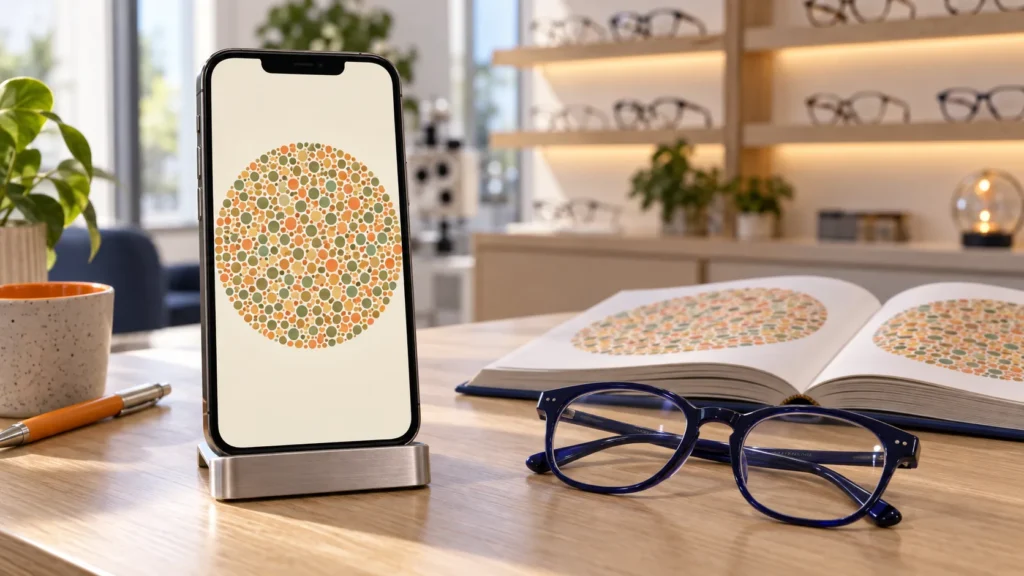
This free online color blind test shows 15 plates of colored dots with a number hidden inside, the same design principle used in the Ishihara color vision test. Type the number you see in each plate. At the end, you get a screening result showing whether your color vision has signs of a red-green deficiency, the most common type, and whether the pattern of errors points to a protan (red) or deutan (green) lean. This is a screening tool, not a diagnosis: a positive result should be confirmed by an optometrist or ophthalmologist.
Before you start, turn your screen brightness all the way up, turn off night mode and any blue light filter, take off tinted glasses, and hold the screen at arm’s length.
How to Take the Color Blind Test Correctly
The test works because the number and the background are painted in colors that a person with normal color vision can tell apart and a person with a red-green deficiency confuses, so anything that shifts the colors on your screen changes the result too. Four rules keep the test accurate:
- Full brightness, no filters. Night mode, blue light filters, and battery-saving display modes shift every color on the screen. They can make a hidden number visible when it shouldn’t be, or hide one you should see.
- No tinted lenses. Sunglasses, activated photochromic lenses, and color-blindness filter glasses invalidate the test. Clear prescription lenses do not affect it.
- Arm’s length, normal room light. Not in the dark, and not with sunlight hitting the screen.
- Answer within a few seconds. In a clinical exam, each plate is shown for about three seconds. If you need half a minute to decide on a number, the honest answer is “I don’t see a number.”
The first plate is a control: almost everyone sees it, color blind or not, because the number stands out by brightness rather than color. If you can’t see it, the problem is your screen, not your eyes.
What Your Result Means
The test scores 14 red-green items (single-number plates and two-number plates that check one type per digit) plus two blue-yellow plates.
| Errors on red-green plates | Result |
|---|---|
| 0 to 2 | No signs of red-green deficiency |
| 3 to 5 | Possible mild red-green deficiency |
| 6 or more | Possible red-green deficiency |
- No signs of red-green deficiency: A clinical Ishihara test would almost certainly also come back normal.
- Possible mild red-green deficiency: This can be a mild anomalous trichromacy, the most common form of color blindness, or it can be screen calibration. Repeat the test on another device; if the result holds, ask for a checkup.
- Possible red-green deficiency: This is the pattern produced by protanomaly, deuteranomaly, and red-green dichromacy. It’s worth confirming and classifying with an eye care provider.
- Protan or deutan lean: Half of the red-green plates are built to disappear for a red-cone (protan) deficiency, and the other half for a green-cone (deutan) deficiency. If you miss mostly one group, the test flags the lean. If errors are spread evenly, the type can’t be determined on screen.
- Blue-yellow flag: This only appears if you miss both blue-yellow plates. Tritan deficiencies are rare and often acquired, so they’re worth a checkup even if the rest of the test is normal.
Missing a single blue-yellow plate isn’t reported. On an uncalibrated screen, that’s noise, not signal.
What a Screen Test Can’t Tell You
An online color blind test is a useful screening tool, but it has three limits worth knowing before you draw conclusions:
- The screen isn’t calibrated. Every monitor and phone renders color a little differently. Printed Ishihara plates are manufactured under color control; a screen isn’t. That’s why this test reports “signs” of a deficiency, not a diagnosis.
- It doesn’t measure severity. Like the Ishihara test, the result is a pass or fail. To find out whether a deficiency is mild or severe, clinicians use the Nagel anomaloscope, still the clinical reference standard, or a sorting test like the Farnsworth D-15.
- It doesn’t satisfy official requirements. Some jobs and licenses require documented color vision. The Federal Aviation Administration requires pilots to be able to “perceive colors necessary to discern cockpit display colors, aircraft signaling, and airport lighting,” and a pilot who fails an approved test receives a certificate limited to daytime visual flight rules. Federal regulations for commercial truck drivers require “the ability to recognize the colors of traffic signals and devices showing standard red, green, and amber.” Both require testing by a certified examiner using each agency’s own method, not a screen test.
For the difference between screening and diagnostic testing, and how results are interpreted in a clinical exam, see the full guide on color blindness test types and methods. Light reaches the retina’s cones through the pupil, so understanding pupil anatomy is a useful starting point for how color vision works.
Frequently Asked Questions
Is an online color blind test accurate?
As a screening tool, yes, if you follow the screen conditions above. The National Research Council’s Committee on Vision reports that pseudoisochromatic plate tests like Ishihara detect about 96 percent of cases confirmed by an anomaloscope. Accuracy on a screen is lower because the display isn’t calibrated, which is why a positive result should be confirmed by an eye care provider.
What percentage of people are color blind?
According to Birch’s 2012 review in the Journal of the Optical Society of America A, red-green color deficiency affects about 8% of men and 0.4% of women of European descent. The gap exists because the genes for the red and green pigments sit on the X chromosome.
Why does the test distinguish between protan and deutan?
Because the plates are generated in your browser using colors that differ only in the signal from one specific cone. A plate whose colors differ only in the red cone’s signal disappears for a protan viewer and stays visible for a deutan viewer, and the reverse is also true. Comparing how many plates from each group you miss points to the type, something classic printed plates only do on their last few pages.
Can children take this test?
Yes, from the age they can reliably recognize numbers, usually five or six years old. Have an adult read the instructions and confirm the answers. For younger children, versions using shapes instead of numbers exist, but this test doesn’t include them.
Is color blindness curable?
No. Inherited deficiencies are stable for life. Color-blindness filter glasses change the contrast between some colors, but they don’t restore normal color perception, according to a 2022 systematic review and meta-analysis in Health Science Reports. When a deficiency shows up in adulthood, it can be caused by an eye disease or a medication, and treating the underlying cause is what matters then.
References
- National Research Council (US) Committee on Vision. Procedures for Testing Color Vision. National Academies Press, NCBI Bookshelf. ncbi.nlm.nih.gov
- Birch J. Worldwide prevalence of red-green color deficiency. Journal of the Optical Society of America A. 2012;29(3):313-320. PubMed PMID 22472762
- American Academy of Ophthalmology. How Color Blindness Is Tested. aao.org
- Male SR, Shamanna BR, Bhardwaj R, Bhagvati C, Theagarayan B. Color vision devices for color vision deficiency patients: A systematic review and meta-analysis. Health Science Reports. 2022;5(5):e842. PubMed PMID 36189411
- Federal Aviation Administration. Color Vision – Frequently Asked Questions. faa.gov
- Federal Motor Carrier Safety Administration. Qualifications of Drivers, 49 CFR § 391.41(b)(10). govinfo.gov