
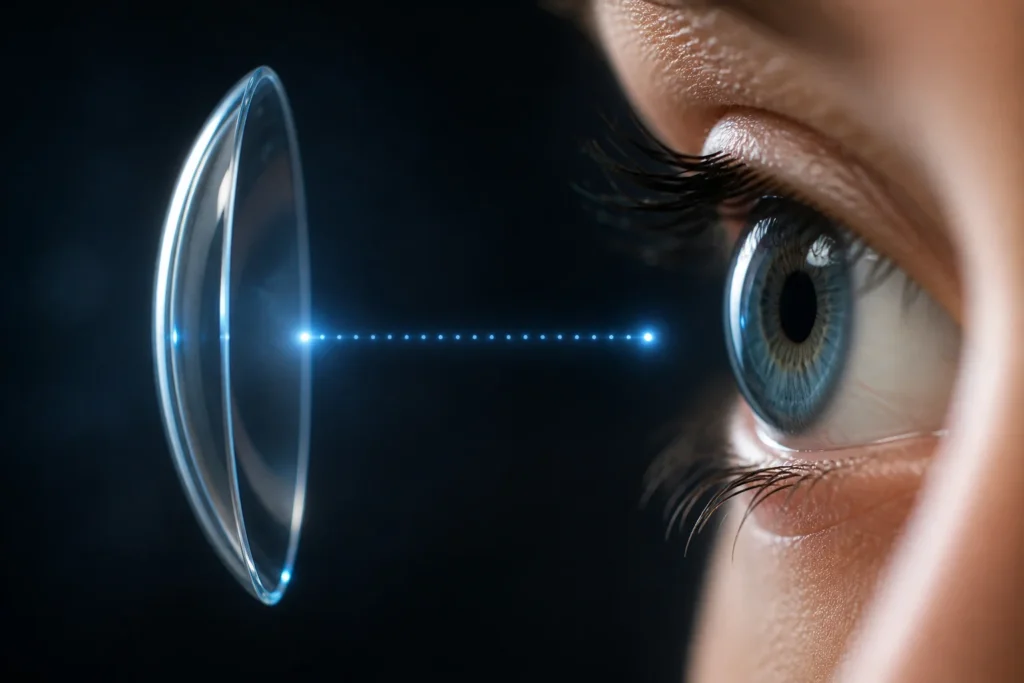
Quick Answer: Vertex distance is the gap between the back surface of a spectacle lens and the anterior cornea, typically 12-14 mm in standard frames. At ±4.00 D or higher, a change in this gap shifts effective lens power by a clinically meaningful amount. The compensation formula is F_c = F / (1 − d × F), where F is the refracted power in diopters and d is the change in vertex distance in meters. Below ±4.00 D, a 2 mm vertex change stays under 0.25 D, within ANSI Z80.1 tolerance. Above ±4.00 D, a −10.00 D prescription worn 2 mm farther from the cornea loses effective minus power and has to be ordered at −10.25 D to hold the same correction.
Rule of thumb: Vertex distance only matters above ±4.00 D. Below that, a 2 mm vertex change produces less than 0.25 D of effective power shift, within ANSI tolerance and below what most patients detect.
Why Power Changes When the Lens Moves
A spectacle lens’s secondary focal point is fixed relative to the lens. Move the lens farther from the cornea and the focal point moves farther from the retinal plane. For minus lenses, this reduces effective minus power; for plus lenses, it increases effective plus power. Move the lens closer and the effects reverse.
The practical consequence:
- Minus lenses moved farther from the eye: effective power decreases (less minus)
- Minus lenses moved closer to the eye: effective power increases (more minus)
- Plus lenses moved farther from the eye: effective power increases (more plus)
- Plus lenses moved closer to the eye: effective power decreases (less plus)
The higher the power, the steeper the focal-point-to-vertex relationship, which is why the 0.25 D threshold is crossed at prescription levels lower than most opticians expect.
The conventional refraction distance is 12 mm for contact lens calculations and the default in most lab order systems. Standard phoropters are calibrated to 13.75 mm back-vertex distance, though most refraction records use 12 mm as the working assumption. Both values appear in the literature. The clinically relevant number is the difference between refraction vertex and as-worn vertex, not either absolute value.
When Compensation Is Required
The ±4.00 D Threshold
Per 20/20 Magazine’s dispensing reference: “once prescriptions go beyond ±4.00 diopters, sensitivity to this distance increases dramatically.” This is the clinical consensus trigger: below ±4.00 D, ignore vertex changes up to 2 mm; at ±4.00 D and above, account for any vertex change greater than 2 mm. The 20/20 Magazine CE series on vertex, tilt, and wrap places a more conservative threshold at powers over 6 D for mandatory lab compensation. ANSI Z80.1, the US standard for prescription ophthalmic lenses, sets a refractive power tolerance of ±0.13 D for lenses up to ±6.50 D sphere. The arithmetic is worth stating honestly: a 2 mm vertex change produces only about 0.03 D at ±4.00 D and does not reach 0.13 D until roughly ±8.00 D. The ±4.00 D rule is a conservative dispensing convention, not a tolerance calculation, and it earns its place because vertex error rarely arrives alone: it stacks with tilt, wrap, and lid-correction error on the same order. The ANSI lens tolerance checker shows where a given power falls against the Z80.1 power tolerance.
Two conditions must both be true before compensation is required:
- Sphere power (or the higher meridional power for astigmatic Rx) is ±4.00 D or greater
- As-worn vertex distance differs from refraction vertex by more than 2 mm
If either condition is false, the power shift is below clinical detectability for most patients.
Plus vs. Minus at High Rx: The Asymmetry
For equal absolute powers the shift is not symmetric, and which sign moves more depends on the direction of travel. Moved 2 mm farther from the eye, +12.00 D compensates to +11.75 D (+11.7188 D unrounded, a shift of about 0.28 D), while −12.00 D compensates to −12.25 D (−12.2951 D unrounded, about 0.30 D). Moved 2 mm closer, it reverses: +12.00 D goes to +12.25 D and −12.00 D to −11.75 D. In either direction the larger change lands on whichever lens ends up needing more absolute power. The practical consequence at high plus: a frame that slips 2-3 mm forward leaves the wearer overcorrected unless the order was compensated for the as-worn vertex.
Measuring Vertex Distance
The measurement is taken with the patient in the selected frame, adjusted to its final worn position. Measure after frame adjustment. A frame not yet fitted to the patient’s face will give an incorrect vertex.
Methods Comparison
| Method | Principle | Typical Accuracy | Notes |
|---|---|---|---|
| Distometer | Calibrated spring gauge; tips contact the closed eyelid and back lens surface | ±0.5-1.0 mm | Manual standard; add 1 mm for lid thickness. Technique-sensitive. |
| Millimeter rule | Direct measurement from frame back surface to cornea; patient looks laterally | ±1-2 mm | Practical but parallax-prone; lid thickness not accounted for |
| Photo-based pupilometry | Corneal position derived from calibrated photo at known camera distance | ±0.5-1.0 mm | Captures as-worn geometry; Optogrid measures PD and SH from a photo using this method; vertex derived from frame depth and pupil position |
| Zeiss i.Terminal / Essilor Visioffice / Hoya iMeasure | Structured light or stereophotography; captures full position-of-wear set | Vendor-published parameter precision is typically 0.1 mm; combined vertex-measurement accuracy is generally reported in the 0.3 to 0.5 mm range across these systems | Lab-grade systems; simultaneously measure vertex, tilt, wrap, PD, and SH in one session |
Distometer Technique
- Patient closes eyes. Place the flat reference tip against the back of the lens at the optical center.
- Advance the spring-loaded inner tip until it contacts the closed eyelid. Read the scale.
- Add 1 mm for eyelid thickness.
- Record each eye separately; facial asymmetry often produces different vertex distances per eye.
Measure with the frame in its final adjusted position. Any adjustment after measurement requires a remeasure.
mm Rule and Photo-Based Alternatives
When no distometer is available, have the patient look toward one ear (to expose the corneal apex), then measure from the back lens surface to the cornea with a millimeter rule. No lid correction is needed, but hold the rule parallel to the lens plane to avoid parallax. Accuracy is adequate for position-of-wear documentation.
Optogrid derives vertex distance from a calibrated patient photograph, capturing the spatial relationship between the lens plane and the pupil position without manual contact. This integrates into a PD measurement methods workflow where all fitting parameters come from a single imaging session.
The Formula and Worked Examples
The compensation formula, per 20/20 Magazine’s vertex distance reference: F_c = F / (1 − d × F). You can compute the compensated power for any prescription and vertex change with the free vertex distance calculator. The effect of vertex distance on off-axis lens performance is also documented in the peer-reviewed literature: Fontaine, Simonet, and Gresset (1997) demonstrated in Optometry and Vision Science that aspheric ophthalmic lenses are especially sensitive to vertex distance changes, with off-axis performance degrading more sharply at reduced vertex distances than spherical lenses of equivalent power.
- F = refracted power in diopters
- d = change in vertex distance in meters (positive = frame closer to the cornea than at refraction; negative = frame farther)
- F_c = compensated power to order
Worked Example 1: High Minus (−10.00 D)
Refracted at −10.00 DS at 12 mm. As-worn vertex: 14 mm, so the lens sits 2 mm farther out: d = −0.002 m.
F_c = −10.00 / (1 − (−0.002) × (−10.00)) = −10.00 / 0.980 = −10.2041 D
Rounded: −10.25 D. Worn farther from the eye, a minus lens needs more minus. Ordering −10.00 D undercorrects by roughly 0.25 D.
Worked Example 2: High Plus (+8.00 D)
Refracted at +8.00 DS at 12 mm. As-worn vertex: 8 mm (tight nose pad, small frame), so the lens sits 4 mm closer: d = +0.004 m.
F_c = +8.00 / (1 − 0.004 × 8.00) = +8.00 / 0.968 = +8.2645 D
Rounded: +8.25 D. Worn closer to the eye, a plus lens needs more plus. Ordering +8.00 D undercorrects by roughly 0.25 D, a meaningful difference at this power.
Vertex Compensation Reference Table
Compensated power (F_c) values by sphere power and vertex change. All values rounded to the nearest 0.25 D. Use this table as a dispensing-floor reference when the vertex change is known.
d = vertex change in mm (positive = frame closer to the eye than the refraction distance; negative = frame farther)
| Sphere (D) | d = −4 mm | d = −2 mm | d = 0 mm | d = +2 mm | d = +4 mm |
|---|---|---|---|---|---|
| +12.00 | +11.50 | +11.75 | +12.00 | +12.25 | +12.50 |
| +10.00 | +9.50 | +9.75 | +10.00 | +10.25 | +10.50 |
| +8.00 | +7.75 | +7.75 | +8.00 | +8.25 | +8.25 |
| +6.00 | +5.75 | +6.00 | +6.00 | +6.00 | +6.25 |
| +4.00 | +4.00 | +4.00 | +4.00 | +4.00 | +4.00 |
| −4.00 | −4.00 | −4.00 | −4.00 | −4.00 | −4.00 |
| −6.00 | −6.25 | −6.00 | −6.00 | −6.00 | −5.75 |
| −8.00 | −8.25 | −8.25 | −8.00 | −7.75 | −7.75 |
| −10.00 | −10.50 | −10.25 | −10.00 | −9.75 | −9.50 |
| −12.00 | −12.50 | −12.25 | −12.00 | −11.75 | −11.50 |
All values rounded to the nearest 0.25 D using F_c = F / (1 − d × F) with d in metres.
Note: For toric prescriptions, apply the formula to each meridional power separately. The cylinder itself does not change; only the sphere power and the cylinder endpoints are vertex-compensated.
What the Lab Compensates vs. What You Must Specify
Modern free-form and digital surfacing designs apply vertex compensation automatically when position-of-wear data is submitted. As IOT Lenses documents in their position-of-wear resource: “Vertex distance influences how rays strike the lens across the entire surface, and the software uses that information to optimize peripheral optics, not just adjust the central power.” For free-form orders, submit the raw refracted power plus as-worn vertex, pantoscopic tilt, and wrap angle; the surfacing algorithm handles the rest.
Finished stock lenses and semi-finished blanks surfaced without position-of-wear input receive no automatic compensation. For high-prescription patients with special-condition prescriptions (prism, high astigmatism, post-surgical Rx) or any high-prescription lenses ordered through designs that do not accept position-of-wear data, calculate F_c manually and note on the lab order: “Power compensated for vertex change at [X] mm. Do not re-compensate.” Sending both a pre-compensated power and position-of-wear data to a lab that double-compensates produces an underpowered lens. Confirm your lab’s workflow before calculating.
Vertex Distance, Pantoscopic Tilt, and Wrap
Vertex distance does not act in isolation. Pantoscopic tilt changes the effective vertex across gaze directions: the back surface sits closer to the cornea for downward gaze and farther for upward gaze. At prescriptions below ±7.00 D and tilt below 12°, this variation stays below clinical threshold. Above those values, tilt and vertex interact in ways the single-vertex formula cannot fully capture, which is why high-Rx sport frames require full position-of-wear input rather than a one-number correction. Wrap angle compounds with tilt in the horizontal plane; sport frames at 15-20° of each produce errors no single-parameter correction can address.
For fitting height for progressives (and progressive lens fitting more broadly), vertex and fitting cross position both shift when a frame slips forward. The two errors accumulate. Measure vertex after frame adjustment, and re-verify segment height if the adjustment substantially changed the nose pad or temple position. Vertex omission ranks among the progressive lens fitting errors most likely to trigger an avoidable remake.
High-index lens design adds another wrinkle: thinner high-index lenses can let frames seat slightly closer to the eye, which combined with the primary ±4.00 D threshold means high-index high-Rx orders deserve a vertex re-check whenever the fitted frame depth differs meaningfully from the refraction setup.
Common Mistakes on the Dispensing Floor
In dispensing audits across high-Rx orders, lid-correction omission with the distometer technique is the single most common source of vertex error. A 1 mm omission at −10.00 D shifts power by about 0.10 D, roughly half the ±2% ANSI Z80.1 tolerance that applies above ±6.50 D, so it clears inspection on its own and turns into a remake only when it stacks with a second error. The second most frequent error is measuring vertex on an unadjusted frame, then completing the fitting adjustment without remeasuring.
Measuring vertex before frame adjustment. A frame adjusted after measurement sits at a different vertex than recorded. Measure last.
Forgetting the lid correction. The distometer contacts the eyelid, not the cornea. Without adding 1 mm, every reading is 1 mm short: a 0.10 D error at −10.00 D.
Narrow-PD frames pushing the lens forward. Wide frames ordered for small-PD patients produce a thicker nasal edge that pushes the lens back surface forward. The as-worn vertex exceeds the nominal frame depth. Measure the fitted frame, not the frame spec sheet.
Double-compensating on free-form orders. Submitting a pre-compensated power alongside position-of-wear data to a lab that applies automatic compensation produces an underpowered lens. Confirm the lab’s workflow before calculating.
Head tilt during photo-based measurement. Consistent head tilt shifts apparent pupil position and frame plane angle. Photo-based tools are sensitive to posture. Measure in habitual head position.
Frequently Asked Questions
When do I have to compensate for vertex distance?
When the prescription is ±4.00 D or greater in any meridian, and the as-worn vertex differs from the refraction vertex by more than 2 mm. Below ±4.00 D, a 2 mm vertex change produces less than 0.25 D of shift, within ANSI Z80.1 tolerance. Above ±4.00 D the shift grows with the square of the power: a 2 mm change is about 0.03 D at ±4.00 D, 0.13 D at ±8.00 D and 0.28 D at ±12.00 D.
What is the vertex distance formula?
F_c = F / (1 − d × F), where F is the refracted power in diopters, d is the change in vertex distance in meters (positive when the frame sits closer to the cornea than the phoropter, negative when farther), and F_c is the compensated power to order. Round to the nearest 0.25 D. For toric prescriptions, apply the formula to each meridional power separately; the cylinder value itself does not change.
Is 12 mm or 13.75 mm the standard refraction vertex distance?
Both appear in the literature. Standard phoropters are calibrated to 13.75 mm, but most prescriptions and lab systems use 12 mm as the working assumption. The clinically important number is the difference between refraction and as-worn vertex. Use whatever distance is recorded on the prescription; if none is recorded, use 12 mm.
Does the lab compensate automatically?
For free-form and digital surfacing designs, yes, when position-of-wear data (vertex, tilt, wrap) is submitted. Stock and semi-finished lenses surfaced without position-of-wear input do not. Confirm your lab’s workflow before calculating: sending a pre-compensated power to a lab that also applies position-of-wear compensation produces a double-compensated, underpowered lens.
How accurate does my vertex measurement need to be?
Distometer accuracy of ±0.5-1.0 mm is adequate for all standard clinical situations. A 1 mm error at −10.00 D produces 0.10-0.14 D of power shift, within one 0.25 D rounding step. The larger error sources are frame slip after measurement and forgetting the 1 mm lid correction when using a distometer.
Can I measure vertex distance without a distometer?
Yes. Have the patient look toward one ear to expose the corneal apex, then measure from the back lens surface to the cornea with a millimeter rule. No lid correction is needed. Accuracy is ±1-2 mm, adequate for most clinical purposes. Photo-based tools derive vertex from the lens plane and pupil position in a calibrated image.
Does vertex distance matter for low prescriptions?
Below ±4.00 D, a 2 mm vertex change produces less than 0.25 D of shift, which is below ANSI Z80.1 tolerance and below what most patients detect. Vertex distance is not a clinical variable for prescriptions under ±4.00 D except in extreme cases (vertex change of 6-8 mm or more).
How does vertex distance affect progressive lenses?
For progressive lenses, vertex distance affects power at every gaze point and the effective position of the reading zone. A frame slipping forward increases vertex, which increases effective plus power in the near zone and shifts where the wearer finds that zone. For free-form progressives, submitting the as-worn vertex with the order lets the lab accommodate it in the surface design. For standard progressives, a vertex change over 2 mm at prescriptions above ±4.00 D warrants manual compensation of the distance power.

I grew up inside an optical shop. My mother likes to tell how, as a kid, I would watch eyeglasses being assembled, play with the tools, and draw on the back of service order slips. The family business taught me early what a precise measurement and work done right are worth.
I went on to spend more than twenty years as a software engineer, always keeping an eye on the optical world. Optogrid was born where the two meet: digital measurement technology (pupillary distance and fitting heights) built by someone who knows the dispensing counter from the inside.