
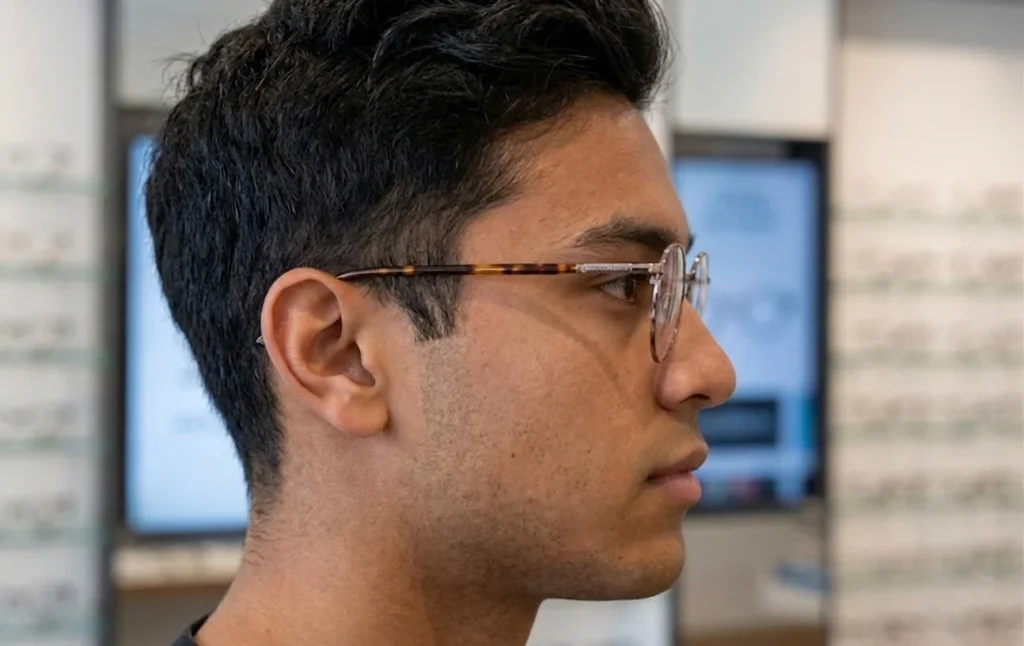
In short, pantoscopic tilt is the angle between the plane of a spectacle lens and the vertical plane when the frame is worn in the patient’s habitual head position. Normal as-worn tilt runs 8-12 degrees, close to the 8-10 degree value most progressive lens designs assume. Inside that band, the optical impact is negligible; outside it, tilt changes effective lens power, induces unwanted cylinder, shifts the optical center relative to the pupil, and in progressive lenses, moves the corridor, with the size of each shift scaling with both the degree of tilt and the prescription’s power.
In practice, most opticians never hand-calculate tilt formulas. Free-form labs apply compensation automatically from submitted position-of-wear measurements, and frame adjustment handles most tilt deviations. The formulas below matter because they tell you when a tilt deviation is clinically significant, whether to reach for the adjustment pliers, submit full PoW data to the lab, or do nothing.
What Pantoscopic Tilt Is (and What It Is Not)
Two terms get confused constantly: pantoscopic angle and pantoscopic tilt.
Pantoscopic angle is a frame metric measured off the wearer. It describes the angle of the frame front relative to the temples. It can be adjusted by bending the temples or changing the nose pad height.
Pantoscopic tilt is the as-worn measurement. It is “the angle formed by the lens tilt in the vertical plane relative to the patient’s visual axis when worn,” as defined in 20/20 Magazine’s dispensing reference. These are not the same number for every patient. Two patients wearing the same frame model can have different pantoscopic tilt values because their facial anatomy positions the frame differently.
As-worn values typically cluster at 8-12°. IOT Lenses’ position-of-wear resource confirms this range, noting that values vary based on frame fit characteristics and individual facial anatomy. Some sources treat 3-7° as the optical norm before compensation becomes relevant; the difference reflects habitual frame position versus the narrower range where tilt-induced error is negligible. Sport frames can reach 15-20° or more. Rimless or semi-rimless frames adjusted flat may sit at 3-5°.
Decision Tree: Compensate in the Order or Adjust the Frame?
Not every tilt deviation requires a compensated prescription. This decision framework covers the vast majority of clinical scenarios:
Step 1: Measure the as-worn pantoscopic tilt. Use a protractor on the lens plane with the patient in habitual posture.
Step 2: Compare to the lens design assumption. Most standard progressives assume 8-10°. Check the manufacturer’s fitting guide.
Step 3: Calculate deviation from assumption. Deviation = measured tilt minus design assumption.
Step 4: Apply the threshold. ANSI Z80.1-2020 allows ±0.13 D sphere tolerance for lenses up to ±6.50 D. Tilt-induced power shifts within this tolerance are unlikely to cause clinical symptoms; shifts exceeding it warrant compensation. Outside the US, ISO 21987 is the equivalent international standard for mounted spectacle lenses: it defines the standard as-worn position-of-wear conditions, including pantoscopic angle, that a finished lens is checked against.
| Deviation from Design Assumption | Sphere Power | Recommended Action |
|---|---|---|
| ≤ 2° | Any | No action needed |
| 3-5° | < ±3.00 D | Adjust frame if possible; otherwise note in order |
| 3-5° | ≥ ±3.00 D | Adjust frame; if not possible, order with tilt compensation |
| > 5° | Any | Adjust frame to target tilt AND order with tilt compensation |
| > 5° | High wrap sport frame | Order with full position-of-wear compensation (tilt + wrap + vertex) |
Frame Adjustment vs. Lab Compensation: Which to Try First
Frame adjustment first. Tilt is corrected most simply by adjusting the frame: bending the temples at the skull bend changes pantoscopic angle. Changing nose pad height adjusts the vertical position of the frame on the face. These are the adjustments to attempt before reaching for compensated prescription powers.
Lab compensation second. When the frame cannot be adjusted to the target tilt (high-wrap sport frames, certain rimless designs, patients with facial anatomy that prevents standard adjustment), a compensated prescription is the right answer. Most free-form progressive labs accept as-worn measurements and compute the compensated surface automatically. The National Academy of Opticianry’s continuing education course on vertex distance, tilt, and wrap confirms: “unlike the case of vertex distance changes, where a new lens power must be ordered to compensate for positional change, this situation does not call for an alteration of the original prescription. Simply change the amount of tilt or optical center placement until the proper relationship is achieved.”
For detailed guidance on the full set of physical frame adjustment parameters that interact with tilt, vertex distance, and wrap, the dispensing literature recommends addressing all three simultaneously when fitting high-prescription or progressive lenses. Uncompensated tilt deviations above the clinical threshold are among the leading causes of eyeglass remakes, a cost avoidable with a 30-second measurement at the fitting stage.
How Tilt Alters Effective Lens Power: Martin’s Formula
When a lens tilts away from perpendicular to the visual axis, it introduces oblique astigmatism. Martin’s tilt formula quantifies this:
New sphere power: D_sph = D × (1 + sin²θ / 2n)
Induced cylinder: D_cyl = D_sph × tan²θ
Where D is the prescribed sphere power, θ is the degrees of tilt, and n is the lens refractive index (1.50 for standard CR-39, 1.60 for mid-index, etc.). The induced cylinder axis runs at 180°, regardless of the original prescription axis.
At typical powers and tilts, the errors are small: a -4.00 DS lens at 12° tilt produces only -0.06 D of sphere shift and -0.18 DC of induced cylinder, both below the ANSI tolerance and below what most patients detect. At higher powers the same tilt generates clinically significant error: a -10.00 DS lens at 12° produces approximately -0.46 DC x 180, enough to affect the refraction noticeably. This is why the decision tree thresholds scale with prescription power.
Optical Center Displacement and Induced Prism
The optical center must be lowered 1mm for every 2° of pantoscopic tilt (0.5mm per degree) so the lens is correctly positioned for the patient’s gaze angle. The geometry behind this: tan(2°) x 27mm (the typical distance from lens to the eye’s center of rotation) ≈ 1mm. If the OC is not dropped accordingly, the patient looks through a displaced portion of the lens, creating unwanted prism via Prentice’s rule.
| Pantoscopic Tilt | OC Drop Required | OC Error if Not Adjusted | Approximate Induced Prism (-4.00 D lens) | Clinical Significance |
|---|---|---|---|---|
| 0° | 0 mm | 0 mm | 0 Δ | None |
| 4° | 2 mm | 2 mm | 0.8 Δ | Minor for most Rx |
| 8° | 4 mm | 4 mm | 1.6 Δ | Noticeable (binocular tension) |
| 10° | 5 mm | 5 mm | 2.0 Δ | Significant (adaptation failure risk) |
| 12° | 6 mm | 6 mm | 2.4 Δ | High (remakes likely) |
| 15° | 7.5 mm | 7.5 mm | 3.0 Δ | Very high (routine compensation required) |
| 18° | 9 mm | 9 mm | 3.6 Δ | Extreme (prescription compensation mandatory) |
Induced prism approximated using Prentice’s rule (Δ = D × d, where d is displacement in cm). Values assume no optical center adjustment for tilt. Real-world prism depends on prescription power, lens type, and fitting height.
This is why the same National Academy of Opticianry course frames the rule plainly: “As a rule-of-thumb, for each 2 degrees of pantoscopic tilt, the optical center of the lenses should be placed 1mm below the distance viewing center.”
Retroscopic Tilt: The Opposite Problem
While pantoscopic tilt tilts the bottom of the lens toward the cheeks, retroscopic tilt does the reverse: the bottom of the lens kicks away from the face, with the top sitting closer than the bottom. According to 20/20 Magazine’s dispensing guide, retroscopic tilt means “the lens bottom is rotated away from the cheeks.”
Retroscopic tilt is almost always a fitting problem rather than an intentional design choice. Common causes include temples set too low on the ears (pulling the frame bottom forward), loose or worn-down nose pads, and heavy lenses in a lightweight frame where temple tension cannot keep the bottom seated against the face.
The optical consequences are the same as for pantoscopic tilt (induced oblique astigmatism and optical center displacement) but in the opposite vertical direction. Martin’s formula still applies, substituting the retroscopic angle for θ. The OC displacement also reverses: instead of dropping the optical center below the pupil, a retroscopically tilted lens requires the OC above the pupil. Retroscopic tilt often goes unnoticed because it looks like a frame that is simply sitting too low; adjusting the temple skull bend and nose pads to create 8-12° of pantoscopic tilt corrects it.
In progressive dispensing, retroscopic tilt is particularly damaging: the near zone moves upward relative to the reading position, which is exactly where the distance zone should be. Patients typically complain that they cannot read without tipping the glasses down.
Wrap Angle: How Face Form Compounds Tilt
Pantoscopic tilt operates in the vertical plane. Wrap angle (also called face form tilt) operates in the horizontal plane, curving the lens around the face. In standard dress eyewear, wrap angles of 4-5° are common and produce minimal optical disturbance. Above 10°, as found in sport and performance frames, the effects become clinically significant.
The critical point is that wrap and tilt compound each other rather than acting independently. When both are present, the lens is tilted simultaneously around two axes, and the combined oblique presentation to the visual axis produces errors that exceed the simple sum of each parameter’s individual effect.
For standard dress frames with wrap angles under 5°, wrap-induced power error is generally below clinical threshold and can be ignored. For any frame with wrap angle above 10°, wrap compensation should be calculated alongside tilt compensation, and both values submitted to the lab as part of the full position-of-wear set.
Traditional progressive designs recommended “a pantoscopic tilt of 8 to 10 degrees and a companion frame wrap angle between 5 and 7 degrees” as their fitting targets, per 20/20 Magazine’s position-of-wear series. Modern free-form designs accept measured as-worn values and compute compensated surfaces, removing the need to hit those legacy defaults. This only works, though, if the practitioner actually provides the measurements.
Tilt and Vertex Distance: A Coupled Problem at High Rx
Vertex distance is the gap between the back surface of the lens and the cornea, typically 12-14mm for standard frames. Pantoscopic tilt changes the effective vertex distance depending on gaze direction: the back surface sits slightly closer to the cornea for downward gaze and slightly farther for upward gaze. For prescriptions below ±7.00 D, this variation is usually below the clinical compensation threshold. See the vertex distance compensation guide for the formula, worked examples, and a reference table for high prescriptions.
At higher powers, the interaction matters. The practical rule: for prescriptions above ±7.00 D and pantoscopic tilt above 12°, vertex distance should be measured and submitted to the lab alongside tilt. Most free-form progressive labs accept all three position-of-wear parameters simultaneously (tilt, wrap, and vertex) and compute the compensated surface from the full set.
Tilt and Progressive Lenses: Why the Margin Is Smaller
In a single vision lens, tilt-induced errors affect the full lens uniformly. In a progressive lens, the corridor position, fitting cross, and near zone are all sensitive to vertical displacement of the optical center. The effects are compounded, and tilt mismatch shows up in audits as one of the recurring progressive lens fitting errors driving avoidable remakes.
Progressive lens designs are manufactured with a specific pantoscopic tilt assumption. Lens engineers historically used a default of approximately 10 degrees, based on real-world fitting data, as documented in 20/20 Magazine’s position-of-wear series. If the as-worn tilt deviates significantly from that assumption, several things happen:
The fitting cross shifts. If the lens is ordered for 10° tilt but worn at 15°, the progression zone sits higher relative to the patient’s line of sight than intended. The patient may experience a shorter reading corridor, a narrowed intermediate zone, or difficulty finding the near zone without head tilt.
Fitting height changes. A fitting height taken with the frame adjusted to 8° tilt will not translate correctly if the patient eventually wears the frame at 14°.
Free-form compensation applies. Modern free-form progressive designs use as-worn measurements to back-calculate the lens surface geometry. When the actual tilt matches the design input, the corridor is exactly where the fitting cross predicted. When it does not, the corridor drifts.
Research by Bakaraju et al. (2008) in Ophthalmic and Physiological Optics found that pantoscopic tilt induces non-uniform hyperopic shifts in spectacle-corrected myopia, with effects increasing at higher tilt angles and stronger prescriptions. For high myopes, the researchers noted these shifts may be sufficient to play a role in myopia progression, though further study is needed.
Where Tilt Compensation Matters Most
Three scenarios where understanding tilt-induced error changes clinical decisions:
High-Rx sport and safety frames. When pantoscopic tilt is structurally fixed at 15-20° and cannot be adjusted out, the induced errors are clinically real. A -6.00 D lens at 18° tilt generates roughly -0.65 DC of induced cylinder at axis 180, on top of whatever cylinder the prescription already carries. If the lab is not receiving position-of-wear data and computing a free-form compensated surface, the patient gets a lens that does not match the refraction. For patients with prescriptions above ±3.00-4.00 D sphere and frame tilt greater than 12°, the lens fitting for special conditions workflow applies: measure all three position-of-wear parameters and submit them to the lab for full compensation.
Non-adapt troubleshooting. When a patient returns saying “something’s off” and the prescription checks out on the lensometer, tilt is a plausible culprit. Running a quick mental estimate of the induced error (using the OC displacement table above or the Martin formula) tells you whether the as-worn tilt could explain the symptoms before you start questioning the refraction or the lens design.
Deciding when full position-of-wear measurement is worth it. Knowing that a -10.00 D myope at 15° tilt is looking at roughly 0.7 DC of induced cylinder is what justifies submitting all three PoW parameters to the lab rather than relying on standard fitting assumptions. For standard-power dress frames, the extra measurement step adds little value. For high-Rx or high-tilt combinations, it eliminates a category of remakes that are genuinely difficult to diagnose after the fact.
Measuring Pantoscopic Tilt Accurately
The measurement is taken with the patient wearing the adjusted frame in their habitual posture, looking straight ahead. A protractor or angle gauge placed on the lens plane will give the pantoscopic angle of the frame; the as-worn tilt also accounts for head position and posture.
Digital measurement tools that photograph the patient in the frame capture pantoscopic tilt implicitly: because the photograph reflects the actual frame position on the actual patient’s face, the measurement includes the effect of tilt on pupil position. Optogrid works this way, deriving pantoscopic tilt from patient photographs so the value fed to the lab reflects the actual as-worn geometry rather than a manual estimate.
Manual pupillometers measure anatomical PD without reference to the frame’s tilt. This is accurate for single vision lenses when the optical center will be placed at pupil height. For progressive fitting, the clinically relevant number is the pupil position relative to the frame’s fitting reference point, which depends on tilt.
Frequently Asked Questions
What is the normal range for pantoscopic tilt?
Most adults wear spectacle frames with 8-12° of pantoscopic tilt. This range varies based on frame design, nose pad position, temple bend, and individual facial anatomy. Sport and wrap frames routinely exceed 15°. Flat or rimless frames adjusted parallel to the facial plane may sit at 3-5°. The as-worn measurement, taken with the patient in habitual head position, is the number that matters for lens design.
How does pantoscopic tilt create unwanted prism?
When the optical center is not dropped to compensate for tilt, the patient’s line of sight passes through a vertically displaced portion of the lens. Prentice’s rule applies directly: for a -4.00 D lens at 10° tilt with no optical center adjustment, the 5mm of undropped displacement generates 2.0Δ of vertical prism. That is enough to cause eyestrain and measurable fixation disparity. The fix is either to drop the optical center when ordering (1mm per 2° of tilt) or to adjust the frame to reduce the tilt.
Why does pantoscopic tilt matter more for progressives than single vision?
Progressive lenses have a fixed corridor structure: the distance zone, intermediate zone, and near zone are positioned vertically relative to the fitting cross. When pantoscopic tilt shifts the effective optical center position, those zones shift relative to the patient’s gaze. The result is a shorter usable corridor, a narrowed near zone, or difficulty transitioning between zones, even when the prescription is correct. Standard progressive designs are optimized for approximately 10° tilt; deviations of 5° or more produce measurable corridor degradation.
When should I order a compensated prescription for pantoscopic tilt?
Order a compensated prescription when: (1) the as-worn tilt deviates more than 5° from the progressive design assumption and the frame cannot be adjusted, (2) the sphere power is ±3.00 D or greater and tilt deviation is more than 3°, or (3) you are fitting a high-wrap sport or safety frame where the tilt is inherent to the frame design. For deviations of 2° or less, frame adjustment alone is sufficient regardless of prescription power.
Does Martin’s formula give the complete picture of tilt-induced error?
Martin’s formula accurately predicts first-order tilt-induced sphere and cylinder changes and is the clinical standard for compensation calculations. Research by Kalikivayi et al. using Shack-Hartmann wavefront sensors found that higher-order aberrations also contribute at elevated tilt angles: spherical aberration and vertical secondary astigmatism showed statistically significant negative correlation with pantoscopic tilt, while third-order coma did not reach significance. For everyday tilt values of 8-15°, Martin’s predictions are clinically sufficient. For extreme tilts above 15°, wavefront-guided free-form surface design provides more complete compensation.
Cite: Kalikivayi et al., Ophthalmol Case Rep, Allied Academies
What other frame parameters interact with pantoscopic tilt?
Pantoscopic tilt, wrap angle (face form), and vertex distance all affect lens performance and must be considered together for high-prescription or sport frame dispensing. Wrap angle introduces oblique astigmatism in the horizontal plane, while pantoscopic tilt does so in the vertical plane; when both are elevated, their effects compound rather than simply add. Vertex distance determines how much effective power shift occurs as the lens moves closer to or farther from the cornea. Traditional progressive designs assumed approximately 5-7° of wrap alongside 8-10° of tilt; sport frames often carry 15-25° of wrap alongside 15-20° of tilt, which is why full position-of-wear compensation is standard practice for those prescriptions rather than an optional upgrade.
What is the relationship between pantoscopic tilt and vertex distance?
Pantoscopic tilt changes the effective vertex distance across gaze directions. As the bottom of the frame tilts toward the cheeks, the back lens surface sits slightly closer to the cornea for downward gaze and slightly farther for upward gaze. For prescriptions below ±7.00 D, this variation is typically below clinical threshold. At higher powers, the combined effect of tilt and vertex distance change should be addressed together as part of a full position-of-wear measurement submitted to the lab.

I grew up inside an optical shop. My mother likes to tell how, as a kid, I would watch eyeglasses being assembled, play with the tools, and draw on the back of service order slips. The family business taught me early what a precise measurement and work done right are worth.
I went on to spend more than twenty years as a software engineer, always keeping an eye on the optical world. Optogrid was born where the two meet: digital measurement technology (pupillary distance and fitting heights) built by someone who knows the dispensing counter from the inside.