
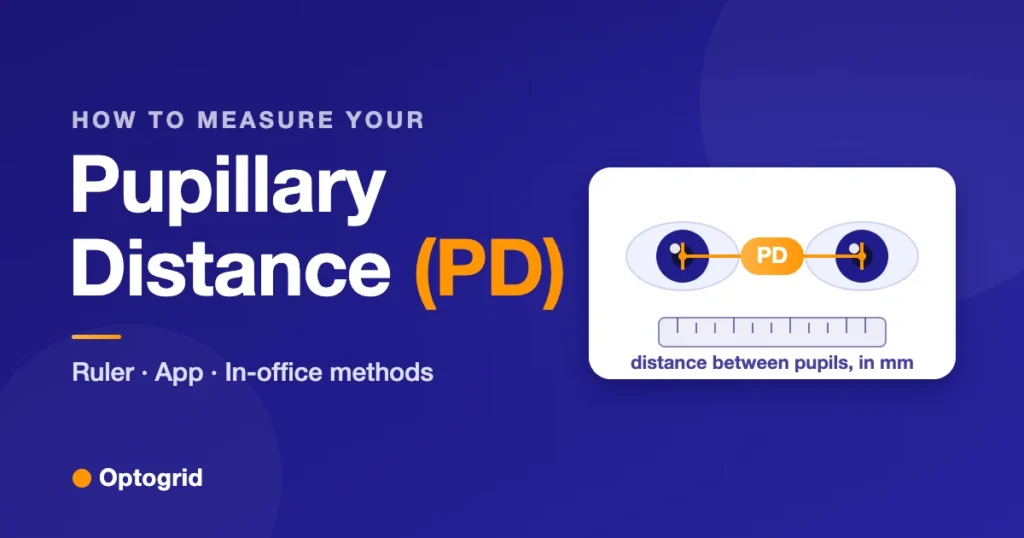
Pupillary distance (PD) is the measurement in millimeters between the centers of your two pupils. To measure it yourself, stand 18 inches from a bathroom mirror, hold a millimeter ruler flat against your brow, align the zero mark over your right pupil center, then close your right eye and read the mark that falls over your left pupil center. That number is your binocular PD. For the most reliable result, repeat three times and average the readings. For progressive lenses or high prescriptions, a professional measurement with a pupillometer is strongly recommended, as home methods can miss by 2–6 mm at the limits of their accuracy range.
Why Getting PD Right Matters for Your Lenses
PD tells your optician (and the lab grinding your lenses) exactly where to place the optical center of each lens so it aligns with your line of sight. When that center is off, the light passing through the lens is no longer straight: Prentice’s rule, a foundational formula in optical dispensing, states that induced prism in prism diopters equals lens power multiplied by decentration in centimeters. In practical terms, a 2 mm error with a -3.00 D lens creates 0.6 prism diopters of unintended prismatic effect, enough to cause eyestrain and headaches in sensitive patients.
Progressive lenses are the most unforgiving. The near, intermediate, and distance zones are stacked vertically, and even a small horizontal PD error shifts the corridor. This is why the why accurate PD matters page covers accuracy in depth: when the stakes are high, precision is worth the extra step.
Adult PD typically falls between 54 mm and 70 mm, with mean values around 61.7 mm for women and 64.0 mm for men based on US Army anthropometric data cited on the average PD values page, which holds the full population table. For most single-vision prescriptions, a 1 mm error is workable; for progressives, the tolerance is tighter.
Method 1: Mirror and Ruler (Solo, No Helper)
What you need: A millimeter ruler (not a tape measure), a mirror at eye level, good lighting.
- Position yourself 18 inches from the mirror. Closer distorts the reading; farther makes it hard to read.
- Hold the ruler flat against your forehead, just below your eyebrows, parallel to the floor.
- Close your left eye. Align the ruler’s zero mark with the center of your right pupil.
- Without moving the ruler, open your left eye and close your right eye.
- Read the millimeter mark that lines up with the center of your left pupil. That is your binocular PD.
- Repeat the process three times. Average the numbers. Discard any reading that differs from the others by more than 2 mm.
Common mistakes to avoid:
- Moving your gaze to follow the ruler (causes parallax error). Look straight ahead at your own pupils throughout.
- Using a flexible tape measure. It bends and shifts.
- Measuring in dim light. If you cannot clearly see your pupil centers, the measurement is not reliable.
This method is fast and adequate for single-vision lenses. Research published in Optometry and Vision Science found that self-measurement with a mirror had a mean difference of only +0.46 mm compared to an optical pupillometer, though the limits of agreement were wide: from -5.22 mm to +6.14 mm in the studied sample. Most people land within 1–2 mm, but outliers exist (McMahon et al., 2012, Optometry and Vision Science).
Method 2: Have a Friend Measure You
What you need: A millimeter ruler, a helper, a fixation target (a small sticker or dot on the wall works well).
- Sit or stand at the same height as your helper, about arm’s length apart.
- Fix your gaze on a point directly behind your helper’s head at eye level. Keep looking at that point throughout.
- Your helper holds the ruler horizontally under your eyes, aligning zero over the center of your right pupil.
- Without moving the ruler, your helper reads the mark over the center of your left pupil.
- Repeat three times and average.
Why a friend measures less accurately than you think: The same 2012 study found that friend-assisted measurements had a mean difference of +2.00 mm versus the pupillometer, with limits of agreement spanning -3.80 mm to +7.81 mm. The extra variable is your helper’s viewing angle: unless they look at your pupils head-on (not at an angle), parallax error compounds. The fixation target behind your helper’s head helps: it keeps your eyes in primary gaze rather than slightly converged toward the helper’s face.
Method 3: Smartphone App or Photo-Based Measurement
Several apps use your phone camera to estimate PD from a selfie or a photo taken with a credit card held to the forehead as a scale reference. Accuracy depends heavily on camera focal length, phone-to-face distance, and lighting. A 2012 study with an early iPod app found errors ranging from -3.24 mm average with limits of agreement out to +9.57 mm, significantly worse than mirror self-measurement with a ruler.
App technology has improved substantially since 2012. More recent phone-based systems using depth cameras (structured light or time-of-flight sensors) achieve much tighter accuracy than flat-photo apps. For online glasses retailers, a photo-based app may be the only practical option. If you go this route, prefer an app that uses your phone’s depth sensor over one that uses a single selfie camera.
For more on how phone-based apps compare, see measure your PD with an app. A photo-based system run by your optician under controlled conditions is a different, more accurate category than a consumer selfie app, covered in Method 5 below.
Method 4: Reading PD Off Your Prescription
If an optician has measured your PD recently, it may already be on your prescription. Look for:
- A single number (e.g., “PD: 64”): this is your binocular distance PD.
- Two numbers separated by a slash (e.g., “PD: 32/31”): these are monocular PDs, right eye first (OD), then left (OS). They sum to your binocular PD.
- Two sets (e.g., “PD: 64/61”): the first is distance PD, the second is near PD (for reading glasses or bifocals).
Not all prescriptions include PD. The Federal Trade Commission’s updated Eyeglass Rule requires prescribers to release your prescription to you, but PD is only mandated on the prescription form in a small number of US states. If your PD is not on the prescription, ask your optician; they are required to give you your medical records, which include any measurements taken during your exam.
For a full explanation of the difference between the two types, see monocular vs binocular PD.
Method 5: In-Office Measurement by an Optician
This is the most accurate option available outside of clinical research settings. An optician uses one of two approaches:
Manual pupillometer: The patient looks through a set of eyepieces at a fixation target. The optician adjusts a sliding scale while viewing the pupil reflection through the instrument, then reads the measurement directly. Most manual pupillometers measure to 0.5 mm increments.
Digital measurement system: A photo or structured-light scan of the patient’s face is processed by software that locates pupil centers and calculates both distance and near PD, plus segment height, simultaneously. For opticians and optical practices, Optogrid works this way, capturing PD and segment height from a patient photo taken on a phone or tablet, with a digital workflow that removes the parallax error inherent in manual ruler methods. The Cleveland Clinic recommends in-office measurement by an eye care specialist as “always going to be the most accurate reading,” particularly for progressive lenses, bifocals, trifocals, or any prescription requiring measurements across multiple vision distances.
A 2021 study published in the Journal of Optometry found that both manual ruler and automatic pupillometer methods showed good inter-session repeatability; the differences between the methods, while statistically significant, were not clinically meaningful (Gantz, Shneor, Doron, 2021). For how optical practices approach this measurement professionally, see how optical shops measure PD professionally.
Method Comparison
| Method | Tools needed | Typical accuracy | Best for |
|---|---|---|---|
| Mirror + ruler (solo) | Millimeter ruler, mirror | Within 1–2 mm for most people; up to 6 mm at limits | Single-vision, low-to-moderate Rx |
| Friend-assisted ruler | Millimeter ruler | Within 2 mm on average; wider variation | Single-vision when mirror unavailable |
| Smartphone app (flat photo) | Phone with camera | Older apps: about 3 mm bias, errors up to 9.5 mm | Online ordering, low-stakes Rx |
| Consumer phone app (depth camera, self-captured) | Phone with depth sensor | Tighter than flat-photo apps; varies by phone | Online ordering with modern phones |
| In-office pupillometer | None (optician provides) | Reads to 0.5 mm increments | Progressive lenses, bifocals, high Rx |
| Optician-operated digital system (phone/tablet photo or scan) | None (optician provides) | Good inter-session repeatability, comparable to manual methods (Gantz 2021) | All prescription types |
Measuring PD in Children and Other Special Situations
Measuring a child’s PD requires extra patience: children shift their gaze more readily, making parallax errors more likely. Professional measurement with a pupillometer is the standard recommendation for pediatric fittings. See measuring a child’s PD for specific guidance.
PD also changes slightly as a child grows, and very slightly across adulthood, so it is worth remeasuring if your prescription changes significantly. For more on whether and when PD shifts, see does your PD change.
Frequently Asked Questions
Can I measure my PD myself at home?
Yes. Using a millimeter ruler and a mirror, most people can get within 1–2 mm of their actual PD, which is sufficient for single-vision lenses. Stand 18 inches from the mirror, align the ruler’s zero mark with one pupil, then switch eyes and read the mark at the other pupil. Repeat three times and average the results. For progressive lenses or high prescriptions, a professional measurement is more reliable.
How do I measure PD without a ruler?
Some smartphone apps estimate PD from a selfie using a credit card held to your forehead as a size reference. Accuracy varies by app and phone model: apps using a depth sensor (common on newer iPhones and Android flagships) outperform flat-photo apps. Another option is to check your existing glasses prescription, where your PD may already be recorded. If none of these are available, your optician can measure it at no charge during an exam.
What is the average pupillary distance for adults?
Mean PD for adult women is approximately 61.7 mm; for adult men, approximately 64.0 mm. The practical range for most adults is 54–70 mm. A small percentage of people fall outside this range. Full population data by age, sex, and ethnicity is covered on the average PD values page.
Is measuring PD with an app accurate enough for glasses?
For single-vision lenses with a low-to-moderate prescription, many apps are close enough. For progressive lenses, bifocals, or prescriptions above about +/-3.00 D, the accuracy range of flat-photo apps can introduce prismatic effects that cause eyestrain. Depth-sensor apps are more reliable. If in doubt, get the measurement from your optician before ordering high-cost lenses online.
What happens if my PD measurement is wrong?
An incorrect PD shifts the optical center of the lens away from your pupil. Per Prentice’s rule, this induces unintended prism, which the eye must compensate for by overworking the muscles that control gaze alignment. The result can be headaches, eyestrain, blurred vision, or difficulty adapting to new lenses. Errors above 3 mm are usually noticeable immediately; smaller errors may cause subtle fatigue over time. For progressive lens patients, even 1 mm of horizontal error can make the reading corridor difficult to locate.
How do I find PD on my glasses prescription?
Look for “PD” or “IPD” on the prescription form. A single number (e.g., 64) is binocular PD. Two numbers separated by a slash (e.g., 32/31) are monocular PDs for the right and left eyes respectively. If no PD appears, your state may not require prescribers to include it. Ask your optician directly; they are required to give you any measurements recorded during your exam under HIPAA and state medical-records laws.
What is the difference between monocular and binocular PD?
Binocular PD is the full distance between both pupil centers. Monocular PD is each pupil’s distance from the center of the nose bridge, measured separately. The two monocular values add up to your binocular PD. Online retailers often require monocular PDs (especially for asymmetric faces), and they are always required for progressive lenses. The full explanation is on the monocular vs binocular PD page.

I grew up inside an optical shop. My mother likes to tell how, as a kid, I would watch eyeglasses being assembled, play with the tools, and draw on the back of service order slips. The family business taught me early what a precise measurement and work done right are worth.
I went on to spend more than twenty years as a software engineer, always keeping an eye on the optical world. Optogrid was born where the two meet: digital measurement technology (pupillary distance and fitting heights) built by someone who knows the dispensing counter from the inside.