
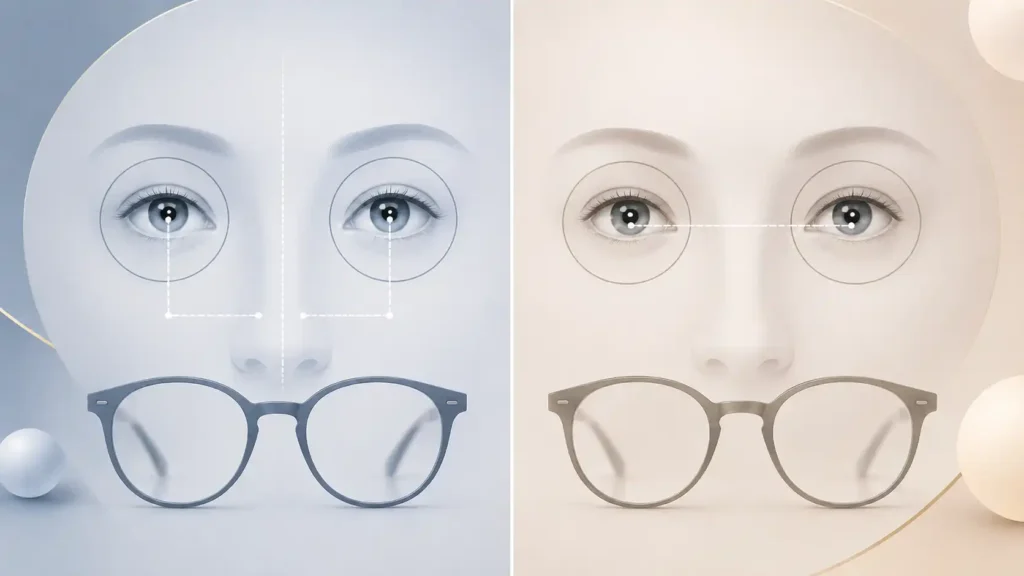
Binocular PD is a single number: the total distance between the centers of both pupils. Monocular PD is two numbers: the distance from the nose-bridge midline to the right pupil and to the left pupil, measured separately. The two rarely split evenly, because most faces are not perfectly symmetrical, and that gap is exactly why progressive lenses and high-power prescriptions call for monocular PD specifically rather than a binocular value divided in half.
Pupillary distance (PD) appears on nearly every prescription, yet the vocabulary trips up patients and new dispensing staff alike. There are actually four related measurements: binocular (dual) PD and monocular PD describe where you measure from (pupil-to-pupil vs. nose-bridge-to-each-pupil); distance PD and near PD describe what the eyes are doing during the measurement (fixating far vs. converging on a near object). Getting these distinctions right matters most when fitting progressive lenses, where a 1 mm centration error can measurably degrade vision.
The Four PD Measurements: Quick Reference
| Term | What it measures | Typical use |
|---|---|---|
| Binocular distance PD | Center-to-center distance between both pupils, eyes fixating far | Single-vision distance lenses; a starting point for monocular measurement |
| Monocular PD (OD / OS) | Nose-bridge midline to each pupil, measured per eye | Progressive lenses, high prescriptions, asymmetric faces |
| Distance PD | Either binocular or monocular, taken while fixating far | All distance-correction lenses |
| Near PD | Either binocular or monocular, taken while fixating at reading distance | Reading glasses, near portion of progressive lens fitting |
Binocular PD vs. Monocular PD
Binocular (dual) PD is the total distance between the centers of both pupils. According to BS EN ISO 13666:2019, it is measured while “the eyes are fixating an object at an infinite distance in the straight-ahead position.” One number describes both eyes together, such as 64 mm.
Monocular PD splits that measurement into two values, one per eye. Per the same standard (section 5.30), monocular PD is the distance from “the centre of the pupil and the mid-line of the bridge of the nose or the spectacle frame when the eye is in the primary position.” A typical pair of monocular values might be OD 33 mm / OS 31 mm, which sums to a binocular PD of 64 mm.
The two monocular values are often unequal, and that asymmetry is entirely normal. Most faces are not perfectly symmetrical, so the right pupil sits a different distance from the nose midline than the left. Using only the binocular total and splitting it in half introduces a centration error on both lenses equal to the difference between the true monocular values.
How much does that asymmetry typically run? In a 2021 study of 199 adults measuring manual interpupillary distance, mean right-eye distance PD was 30.4 ± 1.7 mm against a mean left-eye distance PD of 29.9 ± 1.5 mm, a population-average gap of about 0.5 mm, and the right eye measured wider than the left in 57% of participants (Gantz et al., Journal of Optometry, 2021). That is only an average: individual patients fall well outside it, and a binocular split has no way to tell which patient is which.
Why Progressive Lenses Require Monocular PD
For single-vision distance lenses with low to moderate prescriptions, a binocular PD split evenly is usually close enough. For progressive lenses, monocular values are non-negotiable.
As the Optician Online CPD article on dispensing fundamentals states: “Mono PDs are essential when dispensing progressive power lenses (PPLs) so that each eye looks through the correct part of the lens when working at intermediate and reading distances.”
The manufacturing tolerance for monocular centration in a progressive lens is 1 mm per eye regardless of prescription power, per BS EN ISO 21987:2017 §5.5.2.2. To understand why that margin is narrow, consider Prentice’s rule: induced prism (in prism diopters) equals decentration in centimeters multiplied by lens power in diopters. A 1 mm decentration on a +3.00D lens produces 0.30 prism diopters per eye; across both lenses that imbalance is clinically significant and can cause asthenopic symptoms. The 1 mm tolerance leaves no room for rounding or estimation errors in a progressive prescription.
Prentice’s rule is what connects a millimeter of asymmetry to how much a patient will actually notice it. The typical 0.5 mm gap measured above produces about 0.10 Δ of prism per eye at +2.00 D and 0.30 Δ at +6.00 D, small enough that most patients tolerate it. Push that to the full 1 mm ISO 21987 allowance and the prism doubles at every power. For the full breakdown across decentration and lens power, including where horizontal and vertical prism actually start causing symptoms, see Prentice’s rule and induced prism.
High-powered single-vision lenses and lenses with significant aspheric designs benefit from monocular values for the same reason: the optical center must sit where the patient actually looks.
Distance PD vs. Near PD
Distance PD is taken while the patient fixates on an object effectively at infinity, so the visual axes are parallel. This is the value most commonly recorded on a prescription.
Near PD is taken while the patient fixates at a close working distance (typically 40 cm for reading tasks). Because the eyes converge inward to maintain a fused image at near, the pupil-to-pupil separation is smaller. Per ANSI Z80.1-2020 (as cited by Wikipedia’s entry on pupillary distance), near PD is “the separation between the visual axes of the eyes, at the plane of the spectacle lenses, as the subject fixates on a near object at the intended working distance.”
The practical consequence: optical centers for reading glasses should be placed at the near PD, not the distance PD. Using the larger distance PD for a reading lens shifts the optical center outward from where the eyes actually land, introducing unwanted base-out prism and potential eyestrain.
How Much Smaller Is Near PD?
The reduction varies by the patient’s distance PD and the intended working distance, so there is no single universal number. The Optician Online dispensing fundamentals article notes that a traditional 4 mm reduction is accurate for standard reading distances and below-average PDs, while a 5 mm difference is more appropriate for above-average PDs. Other practitioners use a rule of approximately 1.5 mm inset per eye at 40 cm, which produces similar totals for an average PD.
These are approximations, not substitutes for measurement. A patient with an unusual working distance (close laptop work, extended near tasks) or a large PD may fall outside the standard estimate. Whenever near PD is clinically significant, measure it directly rather than subtracting from distance PD.
Converting Between Binocular and Monocular PD
If only a binocular distance PD is available and monocular values are needed, the conventional starting point is to halve it: OD = binocular ÷ 2, OS = binocular ÷ 2. This is a reasonable approximation for symmetric faces, but it will be wrong by the amount of any facial asymmetry.
The 2020 Magazine article on monocular PDs notes that if measured monocular values do not sum to the true binocular PD, “the width of the reading areas and the width of the corridors will be narrowed by about 2 mm for every 1 mm of error.” This is a lens-performance consequence, not just an arithmetic one.
For fitting progressives, always measure monocular PD directly. The approximation is only acceptable when:
- The lens type is single-vision with low to moderate power
- The prescription has no significant aspheric or high-power characteristics
- Direct monocular measurement is genuinely unavailable
Document the method used. If you label a value as estimated from binocular, the lab and any future fitter know the limitation.
How PD Is Measured
A full explanation of measurement technique is outside the scope of this reference page. For a practical guide to measuring your PD step by step, or for method comparisons, see how PD is measured across four clinical approaches, including accuracy and cost data. For progressive fitting specifically, accurate PD for progressives covers both PD and segment height together.
Dual PD measurement using digital tools with bridge markers is covered separately, including how to handle asymmetric frames. For how PD values relate to population norms, see average PD values by age, gender, and ethnicity. For the question of whether a patient’s PD is likely to have shifted since their last pair, see does pupillary distance change with age.
Where Mono PD Appears on a Prescription
Monocular PD values are written as two numbers separated by a slash or listed under OD (right eye) and OS (left eye). A value like “32/30” means the right pupil is 32 mm from the nose midline and the left is 30 mm. Some prescriptions record a single binocular value; others record both distance and near PD. For a full guide to reading all the fields on an eyeglasses prescription, including OD, OS, sphere, cylinder, and axis, see How to Read Your Eyeglasses Prescription.
Progressive lens fitting also requires segment height (SH) in addition to monocular PD, so both measurements should be taken together at the fitting appointment.
Digital measurement tools capture monocular and dual PD in a single workflow. Optogrid, for example, records both distance and near monocular values from a phone or tablet, removing the manual ruler step and reducing transcription errors. For patients measuring at home, see the guide to pupillary distance apps covering how phone-based measurement works and its accuracy limits.
Frequently Asked Questions
What is the difference between monocular and binocular PD?
Binocular PD is a single number representing the total distance between both pupil centers, measured while the eyes fixate far. Monocular PD splits that into two values: the distance from the nose-bridge midline to the right pupil (OD) and to the left pupil (OS). Most faces have some asymmetry, so the two monocular values are often different from each other. Their sum should equal the binocular PD.
What does mono PD mean on my prescription?
Mono PD (or monocular PD) is the distance from the center of your nose bridge to each pupil, recorded separately for the right eye (OD) and left eye (OS). It is listed as two numbers, such as 33/31, meaning 33 mm for the right eye and 31 mm for the left. Progressive lens labs require these individual values because the optical center of each lens must align with each pupil independently.
What is near PD?
Near PD is the distance between your pupil centers (or from nose bridge to each pupil, measured monocularly) while your eyes are converging on a close object, typically at 40 cm reading distance. Because your eyes turn slightly inward at near, the near PD is smaller than your distance PD. Near PD is used to set the optical centers of reading glasses and to determine the inset of the near zone in progressive lenses.
Is monocular PD more accurate for dispensing than binocular PD?
For progressive lenses and high-power prescriptions, yes. Binocular PD divided by two assumes perfect facial symmetry, which most patients do not have. Monocular PD measured directly accounts for the actual position of each pupil relative to the nose bridge. The standard manufacturing tolerance for progressive monocular centration is 1 mm (BS EN ISO 21987:2017 §5.5.2.2), so any error introduced by estimating from binocular is taken from an already narrow margin.
How do I convert binocular PD to monocular PD?
The rough conversion is to halve the binocular value: OD = total ÷ 2, OS = total ÷ 2. For a binocular PD of 64 mm, that gives 32 mm per eye. This is only a valid approximation for symmetric faces and low-power single-vision lenses. For progressive lenses, always measure monocular PD directly. Do not use the estimated value for progressive fitting unless direct measurement is genuinely unavailable, and document that the value is estimated.
How do I convert distance PD to near PD?
A commonly cited approximation is to subtract 3 to 5 mm from the binocular distance PD (or 1.5 to 2.5 mm from each monocular value) to estimate the near PD at a 40 cm working distance. The Optician Online dispensing fundamentals article gives 4 mm as the traditional reduction for standard distances and below-average PDs, and 5 mm for above-average PDs. These are estimates. The reduction varies with working distance and individual convergence, so direct near-PD measurement is preferred whenever possible.
When is near PD required?
Near PD is required when making single-vision reading glasses or any lens intended primarily for near work. For progressive lenses, labs typically calculate the near zone inset from the distance monocular PD and the lens design parameters, so you may not need to submit a separate near PD value. Check with your lab. For intermediate-distance lenses (computer glasses), a working-distance-appropriate PD may also be needed.

I grew up inside an optical shop. My mother likes to tell how, as a kid, I would watch eyeglasses being assembled, play with the tools, and draw on the back of service order slips. The family business taught me early what a precise measurement and work done right are worth.
I went on to spend more than twenty years as a software engineer, always keeping an eye on the optical world. Optogrid was born where the two meet: digital measurement technology (pupillary distance and fitting heights) built by someone who knows the dispensing counter from the inside.