
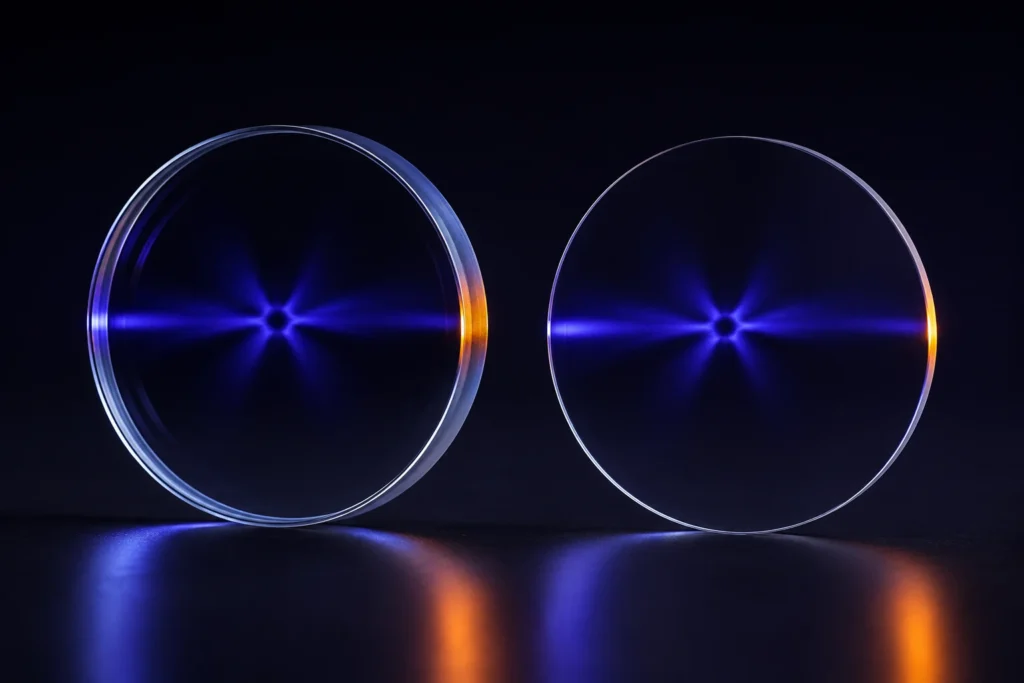
Trivex and polycarbonate are both impact-resistant lens materials that pass ANSI Z87.1 high-velocity testing, but they solve different problems on the dispensing floor. Polycarbonate is less expensive, more widely stocked, and remains the default for children’s eyewear and sports frames where cost and availability matter most. Trivex costs more and ships in fewer designs, but its lower specific gravity (1.11 g/cm³ versus 1.20 g/cm³) and higher Abbe value (43 versus 30) make it the better fit for adult patients bothered by lens weight or peripheral color fringing, and for rimless or drill-mount frames where its higher tensile strength resists cracking around drill holes. Neither material is the universal answer. The right pick depends on frame style, prescription, and whether optical clarity or unit cost is the deciding factor for that patient.
Trivex vs. Polycarbonate at a Glance
Polycarbonate has been the industry’s impact-resistant workhorse since the 1970s, developed from the same material used in astronaut helmet visors during the 1960s space race. Trivex arrived decades later: PPG Industries adapted a urethane-based material originally engineered for military eye protection into an ophthalmic lens, naming it Trivex for its three defining properties (optics, weight, strength), according to Vision-Ease’s technical comparison of the two materials. For the full picture across all six common lens materials, see our lens material comparison guide.
| Property | Trivex | Polycarbonate |
|---|---|---|
| Index of refraction | 1.53 | 1.586 |
| Specific gravity | 1.11 g/cm³ | 1.20 g/cm³ |
| Abbe value | 43 | 30 |
| Tensile strength | 61.2 kgf | 44.9 kgf |
| Impact standard | ANSI Z87.1, FDA drop-ball | ANSI Z87.1, FDA drop-ball |
| Typical Rx range | Plano to about ±6.00 D | Plano to about ±6.00 D |
| Relative cost | Premium | Lower, widest availability |
| Best frame fit | Rimless, drill-mount, semi-rimless | Full-rim, sport, safety, pediatric |
Source: Vision-Ease/HOYA “Polycarbonate vs. Trivex” technical guide.
Optical Clarity: Abbe Value and Chromatic Aberration
Abbe value measures how much a material scatters light into its component colors as it passes through the lens. Polycarbonate’s Abbe value of 30 is the lowest of any commonly dispensed lens material; Trivex’s Abbe of 43 cuts that dispersion meaningfully, which shows up as less color fringing and blur toward the edges of the lens, particularly in higher prescriptions.
The same Vision-Ease technical guide notes that “low Abbe value is seldom a concern when the corrective power of the lens is less than seven diopters,” since the point on the lens where chromatic aberration becomes visible is usually outside the wearer’s normal line of sight. In practice, that means the Abbe gap between the two materials matters most for patients above roughly ±4.00 D, or anyone who has specifically complained about color fringing or blur in polycarbonate lenses.
Weight: Specific Gravity Isn’t the Whole Story
Trivex’s lower specific gravity (1.11 g/cm³ versus polycarbonate’s 1.20 g/cm³) is the reason it’s marketed as the lighter material, and for a given lens shape and thickness, it is. But Trivex’s lower index of refraction means a given prescription needs more curvature and center or edge thickness to correct the same power. Depending on the patient’s Rx and the frame’s eye size, that added thickness can offset some or all of the weight advantage, so Trivex will not always be the lighter finished lens on the dispensing table. Checking a thickness calculation for the specific Rx and frame, rather than assuming Trivex wins on weight by default, avoids surprising a patient who chose it purely to save weight.
Impact Resistance: What the Testing Actually Shows
Both materials pass ANSI Z87.1 safety compliance testing and the FDA’s mandatory drop-ball test, which requires eyeglass lenses to withstand a 5/8-inch steel ball dropped from 50 inches onto the lens center without fracturing, per 21 CFR 801.410. But passing the same certification does not mean the two materials are equally tough at the margins.
A study by B. Ralph Chou and Jeffery K. Hovis at the University of Waterloo’s School of Optometry, cited in the Vision-Ease technical guide, found that lab technicians could not break 2mm polycarbonate lenses with blunt missiles even at the test apparatus’s maximum speed of approximately 100 m/s. Trivex lenses in the same test failed at 50 to 62 m/s, a range closer to 3mm CR-39 than to the 180 to 270 m/s impact resistance typically reported for polycarbonate. Both materials comfortably clear the ANSI and FDA thresholds required for dispensing, but polycarbonate has a wider practical safety margin above that floor.
One dispensing detail worth flagging: coatings reduce impact strength on any lens material. The same source, citing Colts Laboratories testing, notes that an abrasion-resistant coating typically cuts a lens’s impact strength by about 45%, and an anti-reflective coating removes roughly another 20% on top of that. A coated or AR-treated lens is meaningfully more fragile than its uncoated specification sheet suggests, on both Trivex and polycarbonate.
Rimless and Drill-Mount Frames: Where Trivex’s Strength Matters
Tensile strength, not impact resistance, is the property that determines how a lens holds up to drilling. Trivex measures 61.2 kgf compared to polycarbonate’s 44.9 kgf, and that higher resistance to lengthwise stress is what keeps a lens from cracking around a drill hole under the mounting pressure of a rimless or semi-rimless frame. PPG’s own product literature describes Trivex as “especially well-suited for rimless (drill-mount) and semi-rimless (supra) styles”, citing its robustness under that kind of stress concentration. Polycarbonate can still be drilled successfully with a sharp burr, low speed, and minimal pressure, but it has less margin for error.
Drill-mount jobs also raise the stakes on measurement accuracy: there’s no frame rim to visually mask a pupillary distance or segment height that’s off by a millimeter, so an inaccurate measurement shows up directly as an off-center drill hole or a misaligned progressive corridor. A digital PD and segment height measurement, taken with a tool like Optogrid before the job is cut, reduces that remake risk regardless of which material ends up on the lensmeter.
Cost and Availability
Polycarbonate remains the more economical option with the widest availability across labs, coatings, and lens designs, according to the Vision-Ease technical guide. Trivex commands a price premium and is offered in a narrower range of coatings and specialty designs, since fewer manufacturers produce it. For cost-sensitive dispensing, especially pediatric and first-pair patients, that availability gap is often the deciding factor over the optical or weight advantages Trivex offers.
Frequently Asked Questions
Is Trivex stronger than polycarbonate?
It depends which property you mean. Trivex has higher tensile strength (61.2 kgf versus 44.9 kgf), which makes it more resistant to cracking around drill holes. Polycarbonate has demonstrated higher blunt-impact resistance in independent testing, withstanding missile-impact speeds up to roughly 100 m/s without breaking, while Trivex failed between 50 and 62 m/s in the same test. Both pass ANSI Z87.1 and FDA drop-ball certification.
Why does Trivex cost more than polycarbonate?
Trivex is produced by fewer manufacturers and offered in a narrower range of coatings and designs than polycarbonate, which is widely available and manufactured at high volume. Polycarbonate remains the more economical, more widely stocked option across most labs.
Can Trivex be used for drill-mount rimless glasses?
Yes, and it’s often the preferred material for rimless and semi-rimless frames. Its higher tensile strength resists cracking around drilled mounting holes better than polycarbonate does, though polycarbonate can still be drilled successfully with a sharp burr and minimal pressure.
Does polycarbonate need a UV coating?
No. Polycarbonate blocks UV intrinsically without requiring an additional coating.
Which material is better for kids’ glasses?
Polycarbonate is the standard recommendation for children under 16, since cost and impact resistance outweigh the optical clarity advantage Trivex offers, and polycarbonate’s wider availability makes replacement lenses easier to source.
Does Abbe value matter for every prescription?
Not usually below about ±4.00 D. Low Abbe value is seldom a visible problem under roughly seven diopters of corrective power, since the part of the lens where chromatic aberration is strongest sits outside the wearer’s normal line of sight. Above that range, or for patients who have specifically complained about color fringing, Trivex’s higher Abbe value becomes a meaningful factor.

I grew up inside an optical shop. My mother likes to tell how, as a kid, I would watch eyeglasses being assembled, play with the tools, and draw on the back of service order slips. The family business taught me early what a precise measurement and work done right are worth.
I went on to spend more than twenty years as a software engineer, always keeping an eye on the optical world. Optogrid was born where the two meet: digital measurement technology (pupillary distance and fitting heights) built by someone who knows the dispensing counter from the inside.