
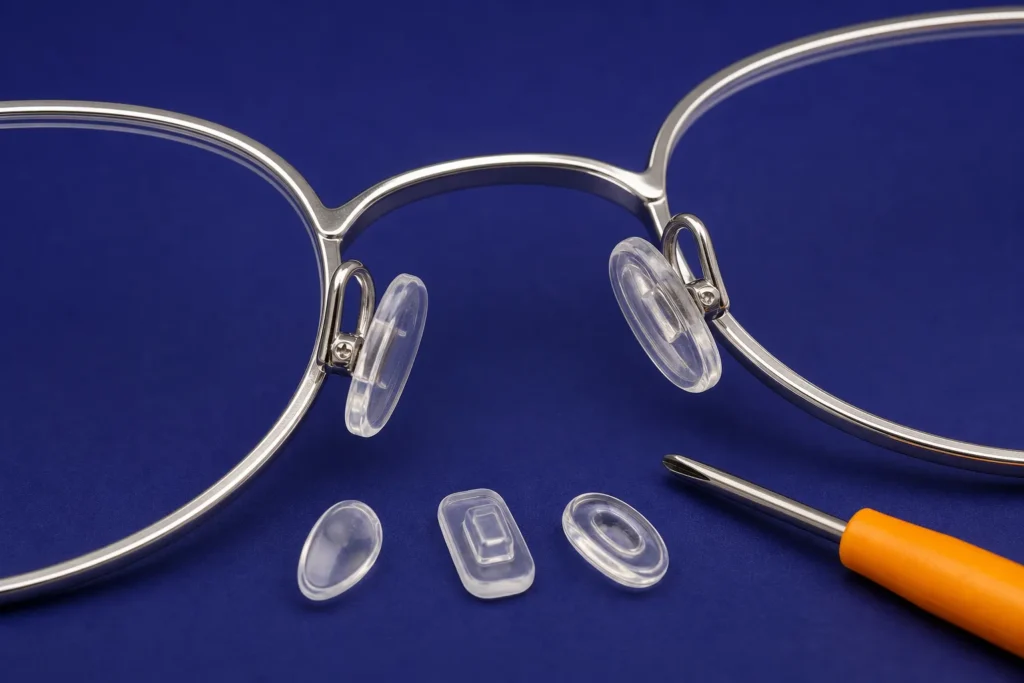
Quick answer: there are three nose pad mounting systems and they are not interchangeable. Screw-in pads have a tiny screw through the center. Push-in pads (also called snap-on or click-in) have a rectangular boss that presses into the pad arm. Slide-on pads slip onto a post or loop, common on thin wire frames. Identify the mount first, because material (silicone, PVC, acetate, titanium) is the secondary choice. A pad that turns green is metal corrosion on the pad arm, not dirt. And a pad that marks the nose is almost never fixed by fitting the same pad again.
Identify the Mount Before You Buy
Look at the back of the pad currently on the frame. This is the step that prevents buying the wrong pair.
| What you see behind the pad | System | How it comes off |
|---|---|---|
| A small screw in the center | Screw-in | Jeweler’s Phillips driver, counterclockwise |
| A rectangular boss, no screw | Push-in (snap-on, click-in) | Pull firmly, or push from behind with a plastic stick |
| A thin post or loop the pad slides onto | Slide-on | Pull along the axis of the post |
| Nothing: the bridge rests directly on the nose | Integrated saddle bridge | There is no pad to replace |
Two measurements finish the identification and prevent a second wrong order: the pad length along its longest axis, and on screw-in models the distance between mounting centers. Common pads run 11 to 15 mm long. Writing the number down before discarding the old pad beats comparing product photos.
Materials: What Actually Changes
| Material | Behavior | When to use it |
|---|---|---|
| Silicone | Soft, good grip, yellows and hardens over time | Default for most cases |
| Air-chamber silicone | Spreads pressure better, thicker profile | Heavy frames, patients who report marks |
| PVC / rigid acetate | More durable, slips more when the wearer sweats | Light use, discreet look |
| Coated titanium | Very durable, holds its shape | Patients with a history of reacting to common metal pad hardware |
One caution about the titanium sales pitch: it lowers the risk, it does not remove the possibility of a reaction. There is a documented clinical case of allergic contact dermatitis attributed to frames sold as titanium, reported by Bircher and Stern (2001) in Contact Dermatitis, precisely because parts described as titanium are often alloys or plated components rather than pure titanium. Describing the part as more durable with lower metal release is honest. Calling it hypoallergenic is not.
Why Do Nose Pads Turn Green?
Because metal on the pad arm, the screw, or the plating is corroding in contact with sweat, and the corrosion product collects on the inner face of a clear pad. Green is the signature of copper-bearing alloys. It is not bacteria, it is not mold, and alcohol does not remove it.
That has two practical consequences. First, cleaning buys a short reprieve: if the arm has already corroded, a new pad will green up again, so the part to inspect is the arm, not the pad. Second, there is a regulatory angle worth knowing at the dispensing desk. In the European Union, nickel release from articles in direct and prolonged contact with skin is limited to 0.5 µg/cm² per week under REACH Annex XVII. Eyewear has its own reference test method for this, EN 16128, “Ophthalmic optics, Reference method for the testing of spectacle frames and sunglasses for nickel release”, whose 2025 edition was published by CEN and summarized by SGS. Frames are a product category with a dedicated nickel test, separate from the general method used for jewellery.
General frame requirements, including marking and the tests a manufacturer has to meet, sit in ISO 12870.
Why Do Nose Pads Leave Marks?
A mark is pressure, and pressure is weight divided by contact area. There are only three ways to reduce it, and refitting the same pad is none of them:
- Increase contact area. A larger pad, or an air-chamber pad, spreads the same load.
- Reduce weight. A thinner, lighter lens changes the arithmetic at the source. In higher prescriptions, moving up in index or reducing the frame eye size takes more weight off the bridge than any pad swap. The weight effect is detailed in high index lenses.
- Redistribute the load. Angle the pads so they sit flat against the side of the nose instead of digging in with an edge, and confirm the temples are carrying their share. Techniques are in the frame adjustment guide.
The detail that gets missed: changing pad height changes vertex distance and the vertical position of the optical center relative to the pupil. At ±4.00 D and above, that shifts effective power, as covered in vertex distance compensation. Pushing a frame closer to the face to improve the pad contact is not an optically neutral adjustment.
A red mark that persists for hours with itching, scaling or eczema is outside the scope of an adjustment. The dermatological literature describes contact dermatitis from eyeglass frames and optical materials in Situm, Lugović-Mihić and Bulat (2013), and that case calls for a medical referral alongside a switch to inert hardware.
How to Replace Nose Pads
Screw-in. Rest the frame on a light cloth so a dropped screw stays findable. Turn counterclockwise with a jeweler’s Phillips driver. Seat the new pad on the arm, line up the hole, and tighten until firm without forcing it: the arm is thin and bends. If the screw spins without biting, the thread in the arm has opened up, and the fix is a new arm or the next screw diameter up.
Push-in. Pull the old pad off the arm. If it resists, push from behind with a plastic stick rather than levering with metal, which scars the boss. The new pad seats with firm pressure and a perceptible click. If it works loose later, the boss size is wrong.
Slide-on. Pull along the axis of the post without twisting. The new pad goes on the same way.
In all three cases the finish is identical: with the glasses on the wearer, check that both pads contact the nose at the same height and the same angle. Asymmetric pads are the most common reason a frame that was adjusted yesterday looks crooked again today.
When the Pad Is Not the Problem
Plastic frames with an integrated bridge. Many acetate frames have no pads at all, and the bridge rests directly on the nose. Searching for nose pads for plastic frames leads to stick-on pads, which work as a stopgap, slide when the wearer sweats, and do nothing for a bridge that is simply too wide. The real options are reshaping the bridge with heat, or moving to a model with a narrower bridge or with adjustable pad arms. Construction differences are covered in acetate eyeglass frames.
Glasses that slide down. When the frame slips, the cause is usually the bend of the temple behind the ear rather than the pads. A grippier pad masks the symptom for a few days.
Pads that yellow within months. Silicone yellows with sebum, sunscreen and heat. It is a consumable, and periodic replacement belongs in the maintenance routine described in the eyewear maintenance guide.
What to Keep at the Dispensing Bench
A minimal pad kit resolves most of these complaints in the same visit, and a complaint solved on the spot does not come back as a remake or a bad review:
- Push-in silicone pads in two sizes (roughly 11 and 13 mm)
- Screw-in silicone pads in the same two sizes
- One set of air-chamber pads for patients who report marks
- Spare screws in the diameter used by the pad arms most common in your stock
- A jeweler’s Phillips driver and a plastic stick for removing push-in pads without scarring them
Frequently Asked Questions
How do I know which nose pads fit my glasses?
Look at the back of the current pad. A screw through the center means screw-in, a rectangular boss with no screw means push-in, and a thin post the pad slides onto means slide-on. Then measure the old pad along its longest axis, usually 11 to 15 mm. Mount type and size decide the purchase; material is a secondary choice.
Why do my nose pads turn green?
It is corrosion of the metal pad arm, the screw or the plating in contact with sweat, and the residue collects under the clear pad. It is not bacteria or mold. If the arm has already corroded, a fresh pad will turn green again, so the part to inspect is the metal arm rather than the pad itself.
Are silicone nose pads better than PVC?
Silicone is softer and grips better, which makes it the default, but it yellows and hardens over time. PVC and rigid acetate last longer and slide more when the wearer sweats. For someone who reports marks, air-chamber silicone spreads pressure better than any change of material.
Will new nose pads stop the marks on my nose?
Only if the new pads increase contact area. A mark is pressure, meaning weight divided by area, so the real levers are a larger or air-chamber pad, a lighter pair (thinner lens, smaller frame), and re-angling the pads so they sit flat. Fitting an identical pad changes nothing.
Can you put nose pads on plastic frames?
Sometimes. Many acetate frames use an integrated saddle bridge with no pad arms, and stick-on pads there are a stopgap that slides with sweat. If the frame has metal pad arms, replacement is routine. Otherwise the durable fixes are reshaping the bridge with heat or choosing a frame with a narrower bridge.
How often should nose pads be replaced?
There is no standard interval. In practice silicone pads are a consumable and get replaced when they yellow, harden, deform or trap residue, which in daily wear with perspiration tends to be a few months. The check fits naturally into the same visit as a periodic frame adjustment.
Sources and References
- CEN / SGS: EN 16128:2025, reference method for testing spectacle frames and sunglasses for nickel release (eyewear-specific method, separate from the general jewellery method; 0.5 µg/cm²/week limit under REACH Annex XVII)
- ISO: ISO 12870, Ophthalmic optics, Spectacle frames, Requirements and test methods
- Bircher AJ, Stern WB: Allergic contact dermatitis from “titanium” spectacle frames, Contact Dermatitis, October 2001
- Situm M, Lugović-Mihić L, Bulat V: Dermatological aspects of contact dermatitis from eyeglass frames and optical materials, Collegium Antropologicum, April 2013

I grew up inside an optical shop. My mother likes to tell how, as a kid, I would watch eyeglasses being assembled, play with the tools, and draw on the back of service order slips. The family business taught me early what a precise measurement and work done right are worth.
I went on to spend more than twenty years as a software engineer, always keeping an eye on the optical world. Optogrid was born where the two meet: digital measurement technology (pupillary distance and fitting heights) built by someone who knows the dispensing counter from the inside.