
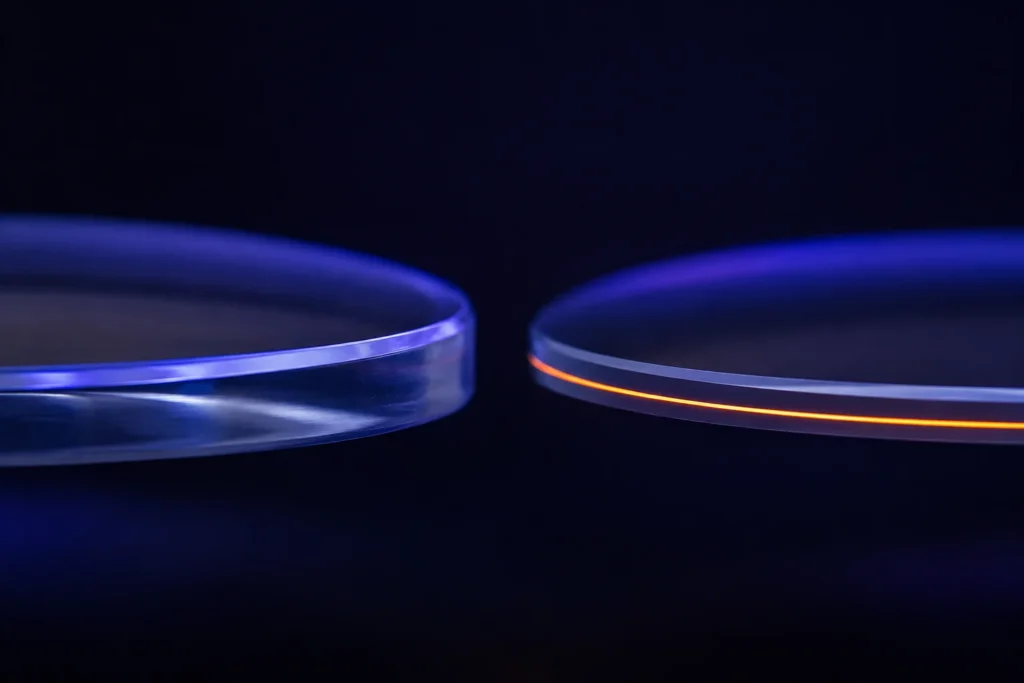
A higher refractive index bends light more per millimeter of material, which lets the lab use a flatter curve and produce a thinner lens for the same prescription. In practice, that means recommending mid-index 1.60 for roughly ±2.00 to ±6.00 D, high-index 1.67 for ±4.00 to ±8.00 D, and 1.74 for anything stronger, always with anti-reflective coating included. The trade-off is optical, not just cosmetic: every step up in index lowers the Abbe value, which increases chromatic aberration, and raises surface reflectance, which is why AR coating stops being optional above 1.60. Use the lens thickness calculator to check whether a specific Rx and frame combination actually justifies the upgrade before quoting it.
What “Index” Actually Means for a Lens
Refractive index is a ratio: how much slower light travels through the lens material compared to a vacuum. CR-39 has an index of 1.498, so light travels about 33% slower through it than through air. MR-174, at roughly 1.73, slows light by nearly 42%. That difference lets the lab cut a flatter curve for the same optical power, which is the entire mechanism behind “high-index equals thinner.”
The math behind that relationship, the sagitta formula and the lensmaker’s equation that connect prescription power, lens diameter, and material index to a final thickness in millimeters, is covered in detail in the science behind lens thickness. This article assumes that mechanism and focuses on the decision opticians actually face at the dispensing counter: which index to recommend, and what the patient is trading away to get it.
Index by Index: Specs and Where Each One Fits
The table below lists refractive index, Abbe value, specific gravity, and uncoated surface reflectance for the materials that cover nearly every prescription. Reflectance matters because it is the direct reason AR coating becomes mandatory as index rises, not just cosmetically preferred.
| Material | Index of Refraction | Abbe Value | Specific Gravity (g/cm³) | Reflectance, Uncoated | Typical Rx Range |
|---|---|---|---|---|---|
| CR-39 | 1.498 | 58 | 1.32 | 7.7% | Plano to ±4.00 D |
| Trivex | 1.530 | 44 | 1.11 | 8.4% | Plano to ±6.00 D |
| Polycarbonate | 1.586 | 30 | 1.21 | 9.6% | Plano to ±6.00 D |
| Mid-index 1.60 (MR-8) | 1.60 | 41 | 1.23 | 10.1% | ±2.00 to ±6.00 D |
| High-index 1.67 (MR-7/MR-10) | 1.661 | 32 | 1.37 | 11.8% | ±4.00 to ±8.00 D |
| Ultra-high-index 1.74 (MR-174) | 1.732 | 33 | 1.47 | 13.6% | ±6.00 D and above |
Source: POL Optic lens material specifications; cross-referenced against Laramy-K Independent Optical Lab’s lens materials guide and Mitsui Chemicals’ MR series product page for monomer naming. Rx ranges reflect typical dispensing guidance, not a manufacturer spec; the full material lineup, including Trivex and polycarbonate, is covered in the full lens material comparison.
Reflectance climbs with every step up in index: 7.7% for CR-39, 10.1% for 1.60, 11.8% for 1.67, and 13.6% for 1.74 (POL Optic). That is the physical reason AR coating changes from a nice-to-have to close to mandatory as the index rises.
A smaller number of labs also stock a 1.70-index tier, marketed by some suppliers under names like Thindex, sitting between 1.67 and 1.74. It is far less commonly stocked than either neighbor, and manufacturers position it as offering a better Abbe value than 1.67 while approaching 1.74’s thinness, but supply is limited enough that most independent labs treat 1.67 and 1.74 as the two practical high-index choices.
Matching Index to Prescription: A Decision Framework
The table above gives ranges, but the actual decision at the counter comes down to three questions:
- How strong is the Rx? Below ±2.00 D, no material meaningfully changes the cosmetic outcome; CR-39 or polycarbonate is fine. Between ±2.00 and ±4.00 D, mid-index 1.60 gives a visible reduction without a large price jump. Above ±4.00 D, 1.67 starts to earn its premium. Above ±6.00 D, 1.74 becomes worth discussing, particularly for high-myopes in fashion frames.
- How large is the frame? A large, round 54 mm frame in a strong minus prescription shows dramatically more edge thickness than the same Rx in a small, rectangular 46 mm frame. Checking a frame’s boxing dimensions against the lens thickness calculator before recommending an index upgrade avoids selling a costly premium that produces a barely perceptible difference.
- Has the patient tolerated a low-Abbe material before? Patients who have worn polycarbonate (Abbe 30) above ±4.00 D without complaining about color fringing are good candidates for 1.67 or 1.74, both of which sit in a similar Abbe range (31 to 33). Patients who switched away from polycarbonate specifically because of chromatic aberration are not.
Cylinder power changes this math. A prescription with significant cylinder has a worst-case meridian that can run 1.00 to 2.00 D higher than the sphere power alone, which pushes the effective power used for index selection higher than the sphere power on the prescription slip suggests.
The Abbe Trade-Off: What Thinness Costs You
Abbe value measures how much a material disperses white light into its component colors, chromatic dispersion. A high Abbe value means colors stay tightly focused together; a low one means they spread apart, producing visible color fringing at high-contrast edges, most noticeably in peripheral gaze.
CR-39’s Abbe of 58 is the best available in a common lens material. Every high-index step trades some of that away: 1.60 drops to 41, 1.67 to roughly 32, and 1.74 to roughly 33, landing in the same range as polycarbonate. According to research published in 20/20 Magazine, for materials in the polycarbonate Abbe range, “lateral color errors [are] more than twice that of the 0.12 threshold” for observable chromatic aberration at powers of +4.00 D and above, while below 2.00 D “lateral color will not be noticeable to the wearer.”
A material’s Abbe value only matters clinically once the prescription is strong enough to make lateral color error perceptible, roughly above ±3.00 D. Below that, arguing for a higher-Abbe material on optical grounds alone is not clinically supported.
That threshold is exactly where high-index materials get recommended in the first place, which is why the Abbe trade-off is unavoidable rather than incidental: the same patients strong enough to need 1.67 or 1.74 for thickness are also the ones most likely to notice the chromatic aberration those materials introduce. Pre-warning about the fringing before the sale, rather than explaining it after a complaint, prevents most post-fit returns on high-index orders.
Why AR Coating Is Not Optional on High-Index Lenses
The reflectance numbers in the table above are the reason. An uncoated 1.67 lens reflects nearly 12% of incident light across both surfaces, almost 1.5 times CR-39’s rate; an uncoated 1.74 lens reflects almost double CR-39’s rate. That reflected light does not just reduce transmission, it creates ghost images from bright sources at night and a visible sheen in photos, both of which undercut the cosmetic benefit the patient paid a premium for.
Why AR coating matters covers the interference mechanism and full cost-benefit case in detail. For dispensing purposes on high-index orders specifically, treat AR coating as effectively mandatory rather than an upsell: a bare 1.74 lens with no AR coating undermines the entire reason the patient paid for the material.
Myth: “Thinner Always Means Lighter”
It does not, and this is one of the most common misconceptions patients (and some dispensers) carry into a high-index conversation. Lens weight depends on volume times density, not thickness alone, and density rises with index. At low prescriptions, the volume savings from a higher index can be too small to offset the density penalty.
As detailed in Optogrid’s lens thickness reference, at around -2.00 D a 1.74 lens can end up heavier than CR-39 despite being measurably thinner, because 1.74’s density (1.47 g/cm³) is 11% higher than CR-39’s (1.32 g/cm³) while the sag difference at that power is too small to compensate. The crossover point shifts with prescription and diameter, but it typically sits around ±3.00 D. Below that, upgrading a patient to 1.74 for weight reasons alone can leave them with a heavier pair of glasses than they started with.
Frame geometry compounds this. A large round frame shows more edge thickness at any given index than a small rectangular one at the same Rx, which means the “upgrade” from 1.60 to 1.67 can be cosmetically dramatic in one frame and nearly invisible in another. Checking boxing dimensions before recommending an index change turns a guess into a defensible recommendation.
What High-Index Costs, and Where PD Accuracy Fits In
High-index materials carry a real price premium over CR-39 or mid-index 1.60, and that premium increases with index; 1.74 is typically the most expensive standard ophthalmic material a lab offers. Framing the conversation around what the patient is buying, thinner edges, better cosmetics in a strong Rx, and (with AR coating) a clearer lens, holds up better than framing it as “the good lenses.”
One consequence of that premium is worth flagging: accuracy matters more on high-index orders than on CR-39. Decentration, the gap between a lens’s optical center and the frame’s geometric center, adds edge thickness on top of whatever the prescription alone requires, and that effect compounds with a higher-index lens’s already-tighter tolerances. A monocular PD measurement that is off by a millimeter costs more in a 1.74 lens the patient paid a premium for than in a CR-39 lens where thickness was never the selling point. Digital PD and segment-height tools, including Optogrid’s phone-based measurement workflow, exist specifically to reduce that source of error compared to a manual pupillometer or ruler, which matters most on the orders where the patient is already paying to minimize thickness.
Frequently Asked Questions
What does “1.67” or “1.74” mean on a lens order?
It is the refractive index of the lens material, a ratio of how much slower light travels through that material compared to a vacuum. CR-39 is 1.498; MR-7 or MR-10 branded materials sold as “1.67” measure closer to 1.661; MR-174 sold as “1.74” measures closer to 1.732. A higher number lets the lab cut a flatter curve for the same prescription power, producing a thinner lens.
At what prescription should I start recommending high-index lenses?
Mid-index 1.60 earns its premium starting around ±2.00 to ±4.00 D. High-index 1.67 becomes worthwhile above roughly ±4.00 D, and 1.74 is typically reserved for prescriptions above ±6.00 D, especially in larger frames where edge thickness is most visible. Below ±2.00 D, no index upgrade produces a meaningful cosmetic difference.
Do high-index lenses always look thinner than mid-index lenses?
Not automatically. Thickness also depends on lens diameter and frame shape. A high-index lens in a large, round frame can still look thicker than a mid-index lens in a small, rectangular frame at a lower prescription. Checking frame dimensions against a thickness calculator before recommending an upgrade avoids selling a premium the patient won’t actually see.
Why do high-index lenses need anti-reflective coating?
Surface reflectance rises with refractive index: roughly 7.7% for CR-39 versus 13.6% for 1.74, uncoated. Without AR coating, that reflected light produces ghost images from bright sources and a visible sheen in photos, undercutting the cosmetic benefit the patient is paying the high-index premium for. AR coating is close to mandatory on any material at 1.60 or above.
Is there a real optical difference between 1.67 and 1.74?
Both sit in a similar Abbe range (roughly 31 to 33), so chromatic aberration is comparable between them. The practical difference is thickness and cost: 1.74 produces a further reduction over 1.67, most visible above roughly ±8.00 D, but at a meaningfully higher price. Below that power, the cosmetic gain from 1.74 over 1.67 is often too small to justify the cost difference.
Are high-index lenses more fragile than mid-index or CR-39?
High-index materials are not ANSI Z87.1 rated for occupational safety impact, the same limitation CR-39 and mid-index 1.60 share. For patients needing certified impact resistance, such as children or safety-eyewear wearers, polycarbonate or Trivex remains the appropriate choice regardless of prescription strength.
Is a 1.70-index lens a real option, or just marketing?
It is a real, if uncommon, material tier offered by select manufacturers, sitting between 1.67 and 1.74. Supply is limited enough that most independent labs default to 1.67 or 1.74 rather than stocking 1.70 as a standard option, so availability is the more likely limiting factor than the material itself.

I grew up inside an optical shop. My mother likes to tell how, as a kid, I would watch eyeglasses being assembled, play with the tools, and draw on the back of service order slips. The family business taught me early what a precise measurement and work done right are worth.
I went on to spend more than twenty years as a software engineer, always keeping an eye on the optical world. Optogrid was born where the two meet: digital measurement technology (pupillary distance and fitting heights) built by someone who knows the dispensing counter from the inside.