
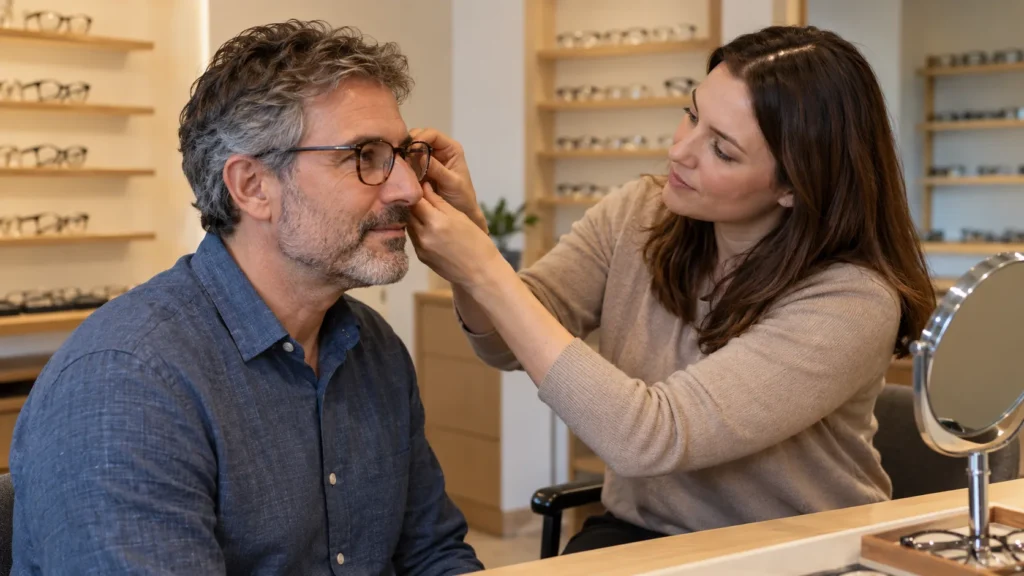
An optician fits and dispenses eyeglasses and contact lenses from a prescription written by someone else, and the one line of your job ad that depends on your state is the requirements line. In a state that licenses opticians, the ad names the license and the board. In a state that does not, it asks for a high school diploma and treats ABO or NCLE certification as a plus. The template below has both versions, ready to paste.
Pasteable summary for your ad: “We are hiring an optician to take prescriptions from order to finished glasses: measuring, helping patients choose frames and lenses, ordering from the lab, verifying the finished lenses, and fitting and adjusting the eyewear.”
If you are the candidate checking what the job involves, the duties and requirements sections apply to you too. For the career-side picture, see what an optician does day to day.
Optician job duties to put in the ad
The Bureau of Labor Statistics (BLS) lists seven duties for opticians: receiving customers’ prescriptions, measuring their eyes and faces “such as the distance between their pupils,” helping them choose frames and lens treatments, creating work orders for the optical laboratory, adjusting, repairing and replacing eyewear, assisting with contact lenses, and educating customers on eyewear care (BLS Occupational Outlook Handbook). O*NET’s task list for Opticians, Dispensing (29-2081.00) adds the shop-floor detail an ad needs (O*NET OnLine). Grouped the way a counter actually runs:
Prescription review and selection
- Evaluate prescriptions against the patient’s work and leisure visual needs (O*NET: “Evaluate prescriptions in conjunction with clients’ vocational and avocational visual requirements”).
- Obtain a customer’s previous record, or verify a prescription with the examining optometrist or ophthalmologist.
- Recommend lenses, lens coatings and frames, and coordinate frames with facial and eye measurements.
Measuring, ordering and verifying
O*NET’s highest-rated task, at 99 out of 100 importance, is to “measure clients’ bridge and eye size, temple length, vertex distance, pupillary distance, and optical centers of eyes, using measuring devices.” In your ad this is the line that tells a candidate whether you expect them to take PD and segment height themselves, and with what tools. Name the tools you use (pupillometer, PD ruler or a digital app), because it saves an interview question. Our guide to measuring pupillary distance covers the manual methods.
- Prepare work orders and instructions for the lab, and order frames and lenses.
- Verify that finished lenses are ground to specification, and determine a customer’s current prescription with a lensometer or lens analyzer when needed.
Fitting, repair and contact lenses
- Heat, shape or bend plastic or metal frames to fit the client, using pliers and hands, and repair damaged frames.
- Show customers how to insert, remove and care for contact lenses, where your state and practice allow the optician to do so.
- Instruct clients in how to wear and care for eyeglasses.
Records and store administration
- Maintain records of customer prescriptions, work orders and payments.
- Perform administrative duties such as tracking inventory and sales, submitting patient insurance information and simple bookkeeping.
- Optional, if it applies: supervise the training of student opticians (an O*NET task).
O*NET also lists cutting and edging lenses, grinding lens edges and applying coatings. Most retail shops send that work to a lab, so include it only if your shop has an edging bench.
Requirements line: licensing state vs. non-licensing state
The BLS says “some states require opticians to be licensed,” and our optician license requirements by state guide lists them: 21 states license opticians (the Commission on Opticianry Accreditation says “Twenty one states require licensure for Opticians”), New Hampshire requires registration only, and the other 28 states and DC have no state optician license.
One rule decides the wording: in a licensing state the requirements line names the license and the board, and in a non-licensing state it names the diploma and treats ABO or NCLE certification as a preference.
| Licensing state | Non-licensing state | |
|---|---|---|
| Credential line | Active [State] [license title the board uses] license, or registration as an apprentice with the [board name] | ABO and/or NCLE certification preferred |
| Education line | Whatever the board accepts as a route (state the route you will accept) | High school diploma or equivalent |
| Training | Hours under a supervisor count only as the board allows | On-the-job training provided |
| Who may dispense unsupervised | Only the license holder | Set by you |
Use the board’s own license title, because it is also the title candidates search for. “Ophthalmic dispenser” is the term in New York, New Hampshire, New Jersey and Kentucky, and “dispensing optician” is used in Washington, Georgia, Tennessee and Arizona; the state table in the license guide shows each board’s wording. New Hampshire is a special case: a registered ophthalmic dispenser must be 18 and have a high school diploma or equivalent, and someone with no training “shall not engage in activities that require the necessary knowledge and skills without being supervised and trained by a registered optician or other licensed eye care professional having at least one year of experience” (NH Code of Administrative Rules, Plc 803).
Two practical points for licensing states. First, ask for the license number and verify it with the board before the first shift, since the license is what lets the person dispense at your counter. Second, if you hire a trainee, say in the ad that you will sponsor or supervise an apprenticeship, and register the apprentice with the board first: Alaska, Connecticut, Florida and Georgia count only hours worked as a registered apprentice (see the license guide’s state table).
ABO and NCLE certification in the ad
ABO-NCLE “administers voluntary competency certification examinations for dispensing Opticians and Contact Lens Technicians.” ABO covers spectacles and NCLE covers contact lenses. Eligibility for the Basic exams is a high school diploma, GED or equivalent, and where a state licensing board has different rules, “the state requirement supersedes those of ABO-NCLE” (ABO-NCLE Basic Exam Handbook, Feb. 2025).
The BLS puts it this way: “Employers may require or prefer to hire candidates who have certification in eyeglass dispensing and contact lens dispensing.”
- Spectacles only shop: “ABO certification preferred.”
- Shop that fits contact lenses: “ABO and NCLE certification preferred” (or “NCLE required” if the person will fit contacts alone).
- Licensing state that builds its license on the exams: do not repeat the exam in the ad; the license line already covers it.
Exam fees, pass rates and renewal are in our ABO and NCLE certification guide. If you offer to pay exam fees, say so in the benefits section.
Skills to list
The BLS names six qualities for opticians. Use them as written and attach the shop task each one maps to:
| BLS quality | BLS wording | Where it shows in your shop |
|---|---|---|
| Detail oriented | “must be precise when taking customers’ measurements and recording lens type, product number, and other information” | PD and segment height, work orders |
| Dexterity | “frequently use special tools, such as pliers and pupilometers, to adjust and repair eyeglasses” | Frame adjustment and repair |
| Communication | “must be able to clearly explain options for frames and lenses” | Lens and coating recommendations |
| Customer service | “must be knowledgeable about the products they sell” | Frame and lens selection |
| Decision-making | “must decide which materials and designs are most appropriate for each customer’s preferences” | Material and design choice |
| Business skills | “may be responsible for operating an optical store” | Only for lead or manager openings |
Pay, hours and title
The BLS median annual wage for opticians was $47,260 in May 2025. It is a national figure; state and workplace pay differ a lot, so check optician salary by state before you set a range. On hours, the BLS says “most opticians work full time, but part-time work is common. They may work evenings and weekends.” State your actual schedule, since that is the answer to the first question most candidates ask.
For the title, O*NET’s reported job titles for this occupation include Dispensing Optician, Licensed Dispensing Optician (LDO), Licensed Optician, Registered Optician, Certified Optician, Ophthalmic Dispenser and Optical Technician. Pick the one that matches your state’s license term.
Optician assistant or optical assistant
The BLS and O*NET do not define an optician assistant role, so what follows is your choice as the employer, not a federal job category. Shops typically use the title for an entry-level hire who does not hold a license or certification: greeting patients, handling the front desk and scheduling, cleaning and basic frame care, and working toward becoming an optician.
The part that is not your choice is what the state lets an unlicensed person do. Washington is a clear example: its statute does not prohibit an unlicensed person from “performing mechanical work upon inert matter in an optical office, laboratory, or shop” or from selling eyewear that is “completely preassembled and sold only as merchandise,” and an apprentice must be designated in the state’s records at the request of a supervisor (RCW 18.34.010, RCW 18.34.020). In New Hampshire, a new registrant without training works under supervision (Plc 803 above). Check your own board before you put frame adjustments or dispensing in an assistant’s ad. In a state with no license, the limit is the one you set.
Copyable optician job description template
Replace everything in [brackets]. Delete the requirements option that does not apply to your state.
JOB TITLE: [Dispensing Optician / Licensed Dispensing Optician / Ophthalmic Dispenser / Optician]
LOCATION: [Shop name, city, state]
EMPLOYMENT TYPE: [Full time / Part time]
SCHEDULE: [Days and hours, including any evenings and Saturdays]
PAY: [$X to $Y per hour, plus commission or bonus if any]

SUMMARY
[Shop name] is hiring an optician to take prescriptions from order to finished glasses: measuring patients, helping them choose frames and lenses, ordering from the lab, verifying finished lenses, and fitting and adjusting eyewear. You will work [alongside our optometrist / in an independent optical shop with a team of [number]].

RESPONSIBILITIES
- Evaluate prescriptions against each patient's work and leisure visual needs, and verify a prescription with the prescriber when needed
- Help patients choose frames, lenses and coatings that match their prescription, face and daily use
- Measure pupillary distance, segment height, vertex distance and frame fit using [pupillometer / PD ruler / digital measurement tool]
- Prepare lab work orders and order frames and lenses [from our lab, [lab name]]
- Verify finished lenses against the prescription using a lensometer before dispensing
- Fit, adjust and repair eyeglasses
- [Show patients how to insert, remove and care for contact lenses] [delete if not offered]
- Maintain records of prescriptions, work orders and payments, and submit insurance information [through [system]]
- Track inventory and sales, and keep the frame display in order
- [Train and supervise optical assistants or apprentices] [delete if not applicable]

REQUIREMENTS: choose ONE

OPTION A, licensing state
- Active [State] [license title the board uses] license in good standing, or eligibility to register as an apprentice with the [board name]
- [ABO and/or NCLE certification preferred]
- [Experience: [X] years in an optical shop preferred]

OPTION B, state with no optician license
- High school diploma or equivalent
- ABO and/or NCLE certification preferred; we will train the right candidate
- [Experience: [X] years in an optical shop preferred]

SKILLS
- Precise with measurements and records
- Comfortable adjusting frames with pliers and other tools
- Able to explain lens and frame options clearly to patients
- Knowledgeable about the products we sell, or willing to learn them

BENEFITS
- [Health insurance / paid time off / continuing education and exam fee reimbursement / employee eyewear discount]

TO APPLY
Send your resume [and license number, if you hold one] to [email or link] by [date].
Optician assistant variant: change the title to Optical Assistant, replace the responsibilities with the front desk, scheduling, frame care and “frame adjustments and dispensing only under the supervision of a [licensed optician / optician]” lines your state allows, and replace the requirements with “High school diploma or equivalent; no license or certification required; we will train you.”
Frequently Asked Questions
What are the main duties of an optician?
The BLS lists receiving prescriptions, measuring customers’ eyes and faces, helping customers choose frames and lens treatments, creating lab work orders, adjusting, repairing and replacing eyewear, assisting with contact lenses and educating customers on eyewear care. O*NET adds verifying finished lenses, keeping records and submitting insurance information.
Does an optician need a license?
It depends on the state. Twenty-one states license opticians, New Hampshire requires registration only, and the other 28 states and DC have no state license. See the state-by-state license guide and write the requirements line to match.
What is a dispensing optician?
It is the standard title for an optician who fits and dispenses eyewear from a prescription. O*NET lists Dispensing Optician and Licensed Dispensing Optician (LDO) among its reported job titles, and some boards use “ophthalmic dispenser” for the same work.
What qualifications should I ask for when hiring an optician?
The BLS says opticians typically need at least a high school diploma, and some complete a 2-year associate’s degree or 1-year certificate. Others enter through an apprenticeship or on-the-job training. In a licensing state, ask for the license; elsewhere, ABO or NCLE certification is a common preference.
How much do opticians make?
The BLS median annual wage for opticians was $47,260 in May 2025. Pay varies by state and workplace, so use the optician salary by state breakdown to set a local range.
What does an optician assistant do?
There is no federal definition. Shops use the title for an entry-level role that handles the front desk, scheduling and basic frame care under supervision. What an unlicensed assistant may do at the dispensing counter is set by your state board, so check it before you list adjustments or dispensing.

I grew up inside an optical shop. My mother likes to tell how, as a kid, I would watch eyeglasses being assembled, play with the tools, and draw on the back of service order slips. The family business taught me early what a precise measurement and work done right are worth.
I went on to spend more than twenty years as a software engineer, always keeping an eye on the optical world. Optogrid was born where the two meet: digital measurement technology (pupillary distance and fitting heights) built by someone who knows the dispensing counter from the inside.