
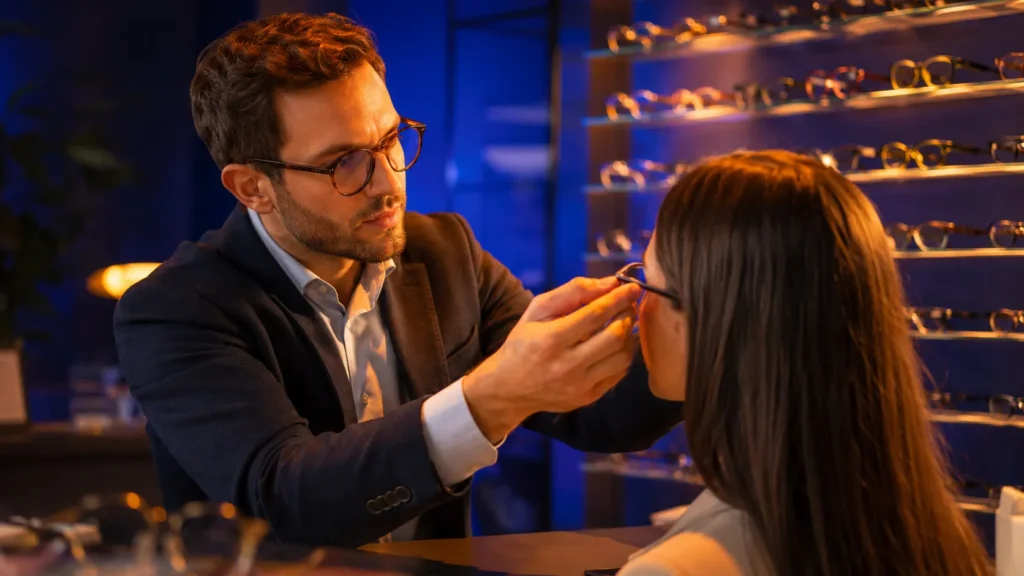
An optician is a trained technician who fits, dispenses, and adjusts eyeglasses and contact lenses from a prescription written by an optometrist or ophthalmologist. Opticians do not examine eyes, diagnose eye disease, or write prescriptions. Their job begins where the eye exam ends: turning a prescription into eyewear that actually fits the wearer’s face and daily life.
The American Academy of Ophthalmology describes opticians as technicians “trained to design, verify and fit eyeglass lenses and frames, contact lenses, and other devices to correct eyesight,” who “use prescriptions supplied by Eye M.D.s or optometrists, but do not test vision or write prescriptions for visual corrections.”
The Three O’s: How Opticians, Optometrists, and Ophthalmologists Differ
Patients, and plenty of job seekers, mix up the three “O” professions constantly. The split comes down to training and legal scope, not skill level or importance. Here is the breakdown side by side.
| Optician | Optometrist | Ophthalmologist | |
|---|---|---|---|
| Typical education | High school diploma plus on-the-job training, or a 1-2 year certificate/associate degree in ophthalmic dispensing | Doctor of Optometry (OD): 3-4 years college plus 4 years of optometry school | Medical degree (MD or DO): 4 years college, 4 years medical school, and residency, 12+ years total |
| Examines eyes / tests vision? | No | Yes | Yes |
| Diagnoses or treats eye disease? | No | Detects some conditions; treatment scope varies by state or country | Yes, including surgery |
| Writes eyeglass or contact lens prescriptions? | No | Yes | Yes |
| Fits and dispenses eyewear? | Yes, this is the core role | Sometimes, in-house | Rarely directly |
| Typical work setting | Retail optical shops, independent practices, ophthalmic labs | Private practices, retail optical chains, clinics | Hospitals, surgical centers, medical eye clinics |
An optometrist earns a Doctor of Optometry degree and, per the AAO, is “licensed to practice optometry, not medicine,” with a scope centered on “examining the eye for the purpose of prescribing and dispensing corrective lenses, and screening vision to detect certain eye abnormalities.” An ophthalmologist is a medical doctor who completes a minimum of 12 years of training and can diagnose, treat, and surgically correct eye disease. Only these two professions can write a prescription. An optician’s role starts after that prescription already exists: selecting frames, verifying lens specifications, and adjusting the finished product so it matches both the prescription and the wearer’s face.
What an Optician Does Day to Day
The daily work is hands-on and detail-heavy, closer to a skilled trade than an office job. A typical dispensing workflow includes:
- Interpreting the prescription. Reading the sphere, cylinder, axis, and add power, then explaining what it means for lens design and material choice. (If the abbreviations on a prescription look unfamiliar, see our guide on how to read an eyeglass prescription.)
- Helping select frames that suit the prescription, the wearer’s face shape, and how the glasses will actually be used, whether that’s a desk job, sports, or safety work.
- Taking fitting measurements, including pupillary distance (PD), segment height, vertex distance, and pantoscopic tilt. These four numbers determine whether progressive and multifocal lenses will perform the way they were designed to.
- Ordering and verifying lenses against the lab’s finished work. The Bureau of Labor Statistics notes that opticians “measure the customer’s face and head using a variety of computerized or manual tools, such as a pupillary distance ruler, to ensure the eyewear will fit properly,” then create “a work order for an ophthalmic laboratory technician” specifying exactly how the lenses need to be cut and fabricated.
- Adjusting, repairing, and troubleshooting fit after the glasses arrive, from bent temples and nose pads to lenses that don’t sit where the wearer’s eyes expect them to.
If you are hiring for this role, our optician job description turns these duties into a ready-to-post ad, with the requirements line worded for licensing and non-licensing states.
Why Measurement Precision Is the Optician’s Real Craft
Grinding a lens to the correct prescription power is only half the job. If the pupillary distance, segment height, vertex distance, or pantoscopic tilt is off by even a few millimeters, the optical center of the lens no longer lines up with the wearer’s line of sight. The prescription can be perfect and the glasses can still feel wrong, causing eye strain, distorted peripheral vision in progressives, or a remake.
That is why measurement is treated as a craft rather than a formality, and why more shops are pairing manual technique with digital tools, including AI in optical practices, to catch measurement errors before a lens ever reaches the lab.
Where Opticians Work and What the Job Outlook Looks Like
Most opticians work in retail optical chains or independent optical shops, often in the same location as an optometrist. Others work inside ophthalmic laboratories, verifying and finishing lenses before they reach the dispensing counter, or in medical practices alongside ophthalmologists.
According to the BLS, “the median annual wage for opticians was $47,260 in May 2025,” and employment “is projected to grow 4 percent from 2025 to 2035, about as fast as the average for all occupations,” with about 5,600 openings projected each year, mostly from workers transferring occupations or retiring. For pay by state, workplace and license, see our optician salary guide. Independent shops, especially those running multiple locations, increasingly lean on dedicated optical practice software to manage orders, inventory, and patient records alongside the hands-on dispensing work.
Training and Licensing: Why the Rules Change by State and Country
Requirements for becoming an optician are not the same everywhere, and posts that imply one country’s rules are universal get this wrong often. Treat the following as a starting point, not a substitute for checking your own state or country’s requirements.
In the United States, the BLS states plainly that “some states require opticians to be licensed.” Where licensing applies, “licensure usually requires completing an approved educational program or completing an apprenticeship or other supervised work experience,” in addition to passing one or more exams. Our guide to state-by-state optician license requirements lists what each licensing state asks for, with a link to its board. In states without mandatory licensing, employers commonly look for voluntary certification through the American Board of Opticianry and National Contact Lens Examiners (ABO-NCLE). That group describes its own certification as “mostly optional” but “a recognized verification that you have the skills and knowledge to perform your job at a higher level of competence,” covering areas such as “analyzing and interpreting prescriptions, the uses of ophthalmic equipment, and the fitting of spectacles and other devices.”
The United Kingdom takes a different approach entirely. Dispensing opticians there are regulated nationally by the General Optical Council, and under the UK government’s own regulated professions register, “it is illegal to practise if you are not registered.” That is a materially different bar than the state-by-state patchwork in the US.
Outside the US and UK, the picture changes again. In Brazil and many other countries, eyewear dispensing and optometry fall under separate regional or professional-council structures rather than a single national licensing exam. Opticians and shop owners working internationally should confirm current requirements with their local health authority or professional body rather than assume US or UK rules apply.
Frequently Asked Questions
What is the difference between an optician, an optometrist, and an ophthalmologist?
An optician fits and dispenses eyewear from an existing prescription but cannot examine eyes or write prescriptions. An optometrist examines eyes, tests vision, and prescribes corrective lenses (and, depending on the state or country, some medications). An ophthalmologist is a medical doctor who can also diagnose and surgically treat eye disease. See the comparison table above for the full breakdown.
Can an optician write an eyeglass prescription?
No. Opticians are not licensed to test vision or write prescriptions in the US or in countries with comparable scope-of-practice rules. They work from a prescription issued by an optometrist or ophthalmologist, then translate it into finished eyewear that matches the prescribed correction.
Do you need a degree to become an optician?
Not necessarily. In the US, many opticians enter the field with a high school diploma and on-the-job training, while others complete a one- to two-year certificate or associate degree in ophthalmic dispensing. Some states require a specific educational program or apprenticeship before licensure, so the path depends heavily on where you live.
What measurements does an optician take when fitting eyewear?
The core measurements are pupillary distance (PD), segment height, vertex distance, and pantoscopic tilt. Together they determine whether the optical center of each lens lines up with the wearer’s line of sight, which matters most for progressive and other multifocal lenses.
Where do opticians typically work?
Most work in retail optical chains or independent optical shops, often alongside or in referral relationships with optometrists and ophthalmologists. Others work in ophthalmic laboratories, verifying and finishing lenses before they reach the dispensing counter.
Is optician licensing required everywhere?
No. In the US, 21 states license opticians, and most of the rest (28 states and DC) have no state license, relying instead on employer-required certification such as ABO-NCLE. See which states require an optician license. Other countries set their own rules; the UK, for example, requires all dispensing opticians to register with the General Optical Council by law.
How long does it take to become a certified optician?
Timelines vary by path. On-the-job training combined with an entry-level position can lead to a first ABO certification exam within a year or two, while a formal associate degree program in ophthalmic dispensing typically runs about two years of full-time study. No prior experience is required to sit for the ABO Basic exam itself; see our optician certification guide for eligibility, fees and pass rates.

I grew up inside an optical shop. My mother likes to tell how, as a kid, I would watch eyeglasses being assembled, play with the tools, and draw on the back of service order slips. The family business taught me early what a precise measurement and work done right are worth.
I went on to spend more than twenty years as a software engineer, always keeping an eye on the optical world. Optogrid was born where the two meet: digital measurement technology (pupillary distance and fitting heights) built by someone who knows the dispensing counter from the inside.