
Short Answer: The global eyewear market was valued at USD 200.46 billion in 2024 and is projected to grow at a CAGR of 8.6% through 2030, reaching USD 335.90 billion. The five structural shifts driving that growth — digital measurement tools, virtual try-on conversion gains, sustainable materials, AI-driven personalization, and connected eyewear — are already creating competitive separations between optical businesses that have adopted them and those that have not.
Five Trends That Are Actually Changing the Optical Business in 2026
The eyewear industry is under genuine structural pressure from multiple directions simultaneously. Myopia rates are climbing — a landmark meta-analysis published in Ophthalmology projects 4,758 million people (49.8% of the world population) will have myopia by 2050, up from 22.9% in 2000. That creates sustained demand. But it also raises the stakes on measurement quality: more patients, more prescriptions, more room for dispensing errors that erode trust and generate remakes.
At the same time, online eyewear is gaining ground. Grand View Research estimates the global eyewear market at USD 200.46 billion in 2024, growing at a CAGR of 8.6% through 2030, with e-commerce projected to post the fastest growth of any distribution channel. For optical shops that have treated digital tools as optional, the competitive window to catch up is narrowing.
What follows is a data-grounded look at the five trends that matter most for optical professionals in 2026.
1. Digital PD Measurement Is Becoming the Standard, Not a Feature

Pupillary distance (PD) measurement has historically been a bottleneck. Manual rulers require a trained optician in the room. Traditional pupillometers cost $500–$2,000 and require the patient to visit the dispensary. Neither approach scales for remote dispensing or online sales.
Digital photo-based measurement tools have changed that equation. A peer-reviewed comparison of measurement techniques published in PMC found that mobile app-based PD measurements showed a mean difference of just −0.59 ± 1.17 mm versus pupillometer readings, with a strong correlation (r=0.9; p<.01) across repeated measurements. The authors confirmed that all methods produced induced prism values within the ISO 16034:2002 allowed tolerance of less than 0.33 prism diopters.
That clinical validation matters. Optical businesses can now:
- Offer remote measurement for online sales without sacrificing dispensing accuracy
- Send patients a photo measurement link before their appointment to reduce chair time
- Expand into PPE prescription eyewear programs that would otherwise require on-site visits
For a deeper comparison of how photo-based measurement stacks up against rulers, pupillometers, and printed reference cards, see Comparing 4 Pupillary Distance Measurement Methods: Accuracy, Cost & Best Use Cases.
What this means for your practice: If your current PD workflow requires a patient to be physically present for every measurement, you are excluding a segment of buyers who will find another way to get their prescription filled online.
2. Virtual Try-On Is Generating Measurable ROI — But Only When Implemented Properly
Virtual try-on (VTO) technology has been discussed in the eyewear industry for years. In 2026, there is enough implementation data to separate the effective deployments from the superficial ones.
Data from Fittingbox, which aggregates performance across optical retailers using their VTO platform, shows:
| Metric | Impact |
|---|---|
| Product return rate | Up to 28% reduction |
| Conversion rate | Up to 18% higher |
| Cart abandonment | 22% decrease |
| Multi-channel customer interaction | 25% increase |
One international optical chain documented a 20% increase in online conversion rate within six months of implementing a high-accuracy virtual fitting tool, alongside a 15% drop in returns.
The key qualifier is “high-accuracy.” VTO implementations that use low-resolution face mapping or only offer 2D overlays tend to underperform because customers do not trust the result. The tools delivering these ROI figures use facial landmarks to position frames in three dimensions and adjust for head rotation.
What makes a VTO implementation effective:
- Frame data at scale — the tool needs manufacturer-provided 3D frame files, not photographs
- Accurate face mesh — consumer-grade front cameras are sufficient; depth sensors are not required
- Prescription context — showing how a frame fits relative to the optical center, not just aesthetics
What this means for your practice: VTO is not primarily a marketing feature. It reduces remakes, returns, and customer dissatisfaction from frames that look different in person. The business case is in operations, not just conversion rates.
3. Sustainable Materials Are Shifting from Marketing to Specification

For most of the past decade, “sustainable eyewear” was a brand position held by a small number of specialty manufacturers. In 2026, bio-based and recycled materials are appearing in mainstream optical catalogs from major suppliers.
The material shift is real and measurable. Eastman’s Acetate Renew — now used by multiple frame manufacturers — consists of 60% sustainably sourced wood pulp and 40% certified recycled acetate. MYKITA uses a blend of 70% Acetate Renew flakes and 30% additives in select frames. Ray-Ban’s bio-based nylon lenses contain at least 40% biological content.
On the lens side, MR-174 — a high-index lens material developed by Mitsui Chemicals — produces 326 kg less carbon emissions per 100 kg of resin compared to its oil-based equivalent, with 80–90% biomass content.
The practical considerations for optical dispensaries:
- Supplier qualification: Bio-acetate and recycled metal frames are not visually distinguishable from conventional materials; verify supplier certifications
- Patient communication: Patients asking about sustainability are increasingly informed; vague claims about “eco-friendly” practices are not sufficient
- Durability: Bio-acetate meeting ISO 14855 (biodegradable under controlled composting conditions after 180 days) performs equivalently to standard acetate in normal wear conditions
What this means for your practice: Stocking a curated selection of verified sustainable frames creates a differentiation point that appeals to a growing patient segment, while also positioning your dispensary ahead of likely EU and global supply-chain regulations requiring material transparency.
4. AI-Driven Personalization Is Moving Into Lens Selection, Not Just Frame Fitting
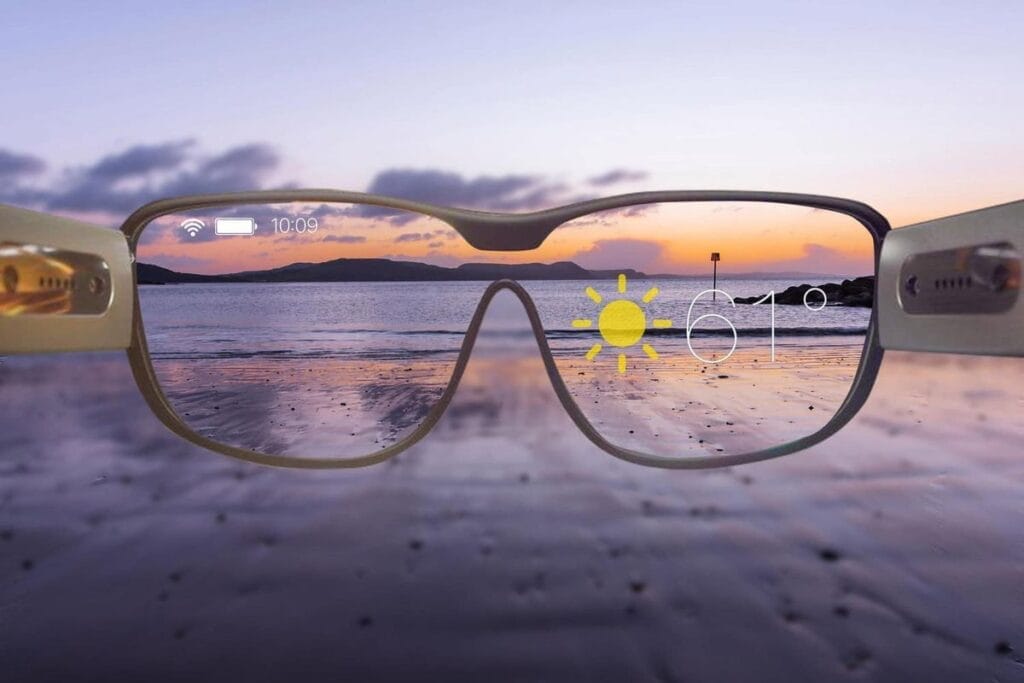
AI applications in eyewear have so far been most visible in frame recommendation and virtual try-on. In 2026, the more consequential development is AI entering the lens selection process.
The core problem it addresses: prescription lens selection involves a matrix of variables — refractive error, interpupillary distance, segment height, frame dimensions, lens index, coating requirements, and patient lifestyle — that most dispensing software handles through lookup tables and manual selection. As lens portfolios grow more complex (progressive designs alone now number in the dozens per manufacturer), the cognitive load on dispensers increases.
AI-assisted dispensing systems are starting to:
- Recommend lens designs based on a patient’s prescription history, lifestyle inputs, and frame geometry
- Flag combinations where the frame and prescription create fitting challenges (e.g., minimum segment height not met for the selected progressive)
- Predict lens selection outcomes based on patient profiles similar to historical cases
This is distinct from consumer-facing AI tools. The target user is the dispenser, not the patient, and the output is a ranked recommendation with reasoning, not a chatbot response.
What this means for your practice: AI dispensing tools reduce the skill gap between experienced and newer opticians on complex lens selections. They also create documentation for the dispensing decision, which matters when patients report dissatisfaction with progressive lenses.
For context on how digital tools are changing the optometry workflow more broadly, see The Impact of Digital Transformation in Optometry.
5. Connected Eyewear Is Finding Its First Real Use Cases
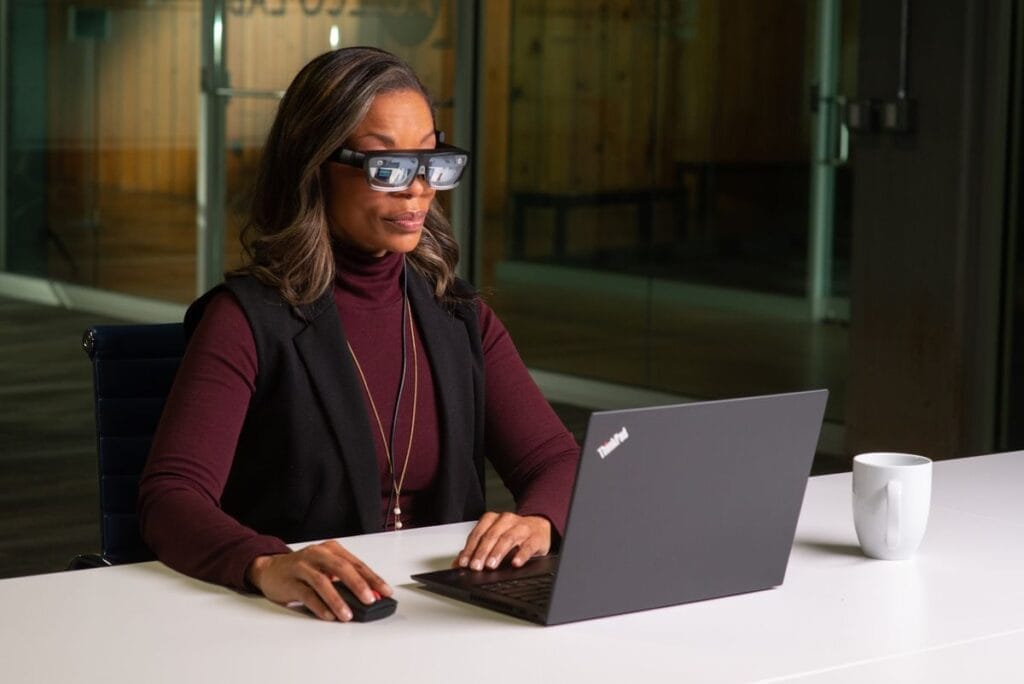
Smart glasses have been predicted as a mass-market product since Google Glass in 2013. The consumer versions have consistently disappointed. But two specific use cases are showing genuine traction in 2026:
Industrial and workplace smart glasses: Heads-up display applications in logistics, manufacturing quality control, and field service are growing because the value proposition is measurable. A technician viewing a wiring diagram through their glasses rather than a tablet has both hands free. Enterprise smart glasses in these settings are already a procurement line item for large companies, separate from the consumer market.
Prescription safety eyewear with embedded sensors: For workers who require both prescription lenses and safety certification, the administrative challenge of managing PPE eyewear programs has historically been solved badly — usually with over-the-glass (OTG) safety frames worn over prescription glasses, with all the fit and compliance problems that creates. New prescription safety eyewear platforms that combine digital PD measurement, remote ordering, and compliance tracking are reducing the per-employee cost and administrative overhead of managing PPE eyewear programs.
Biometric sensors embedded in eyewear frames (heart rate, body temperature monitoring) remain largely a development-stage application. The hardware exists; the clinical validation and regulatory pathway for health monitoring devices is what constrains mainstream adoption.
What optical businesses should watch: The prescription safety eyewear segment represents a high-volume, B2B revenue opportunity that most traditional optical dispensaries have not fully pursued. The barrier has been administrative complexity, which digital measurement and ordering tools are reducing. See Emerging Trends in Optical Measurement Solutions for more on how digital workflows are opening new business segments for optical providers.
What These Trends Have in Common
Each of the five trends above shares a structural feature: they reward optical businesses that have built digital measurement and dispensing infrastructure, and they create friction for businesses that have not.
Digital PD measurement is the foundation. Without it:
- You cannot offer a credible remote fitting workflow
- Virtual try-on tools cannot deliver their full accuracy (frame positioning depends on accurate PD and segment height data)
- AI lens selection recommendations cannot be validated without accurate measurement inputs
The businesses gaining ground in 2026 are using digital measurement to extend their reach (online sales, PPE programs, remote patients) while maintaining the accuracy that prescription eyewear requires.
For optical professionals looking at how to implement photo-based PD and segment height measurement for both in-clinic and remote cases, Remote Pupillary Distance Measurement: Technology and Business Impact for Optical Retailers provides a practical breakdown of the current technology options and their business implications.
Frequently Asked Questions
What is driving eyewear market growth in 2025 and 2026?
The primary driver is rising myopia prevalence, particularly among younger populations, combined with aging demographics requiring presbyopia correction. Research projects that nearly 50% of the global population will be myopic by 2050. Secondary drivers include increasing screen time, expanding access to eye care in emerging markets, and growth in online eyewear retail.
How accurate are digital PD measurement tools compared to traditional pupillometers?
A peer-reviewed comparison found mobile app-based PD measurements showed a mean difference of −0.59 ± 1.17 mm versus pupillometer readings, with strong correlation (r=0.9; p<.01). All methods produced induced prism values within ISO 16034:2002 tolerance thresholds. For routine prescriptions, digital tools perform within clinically acceptable ranges. The authors note additional caution is warranted for high prescriptions with prism or complex binocular vision cases.
What return-on-investment do optical retailers see from virtual try-on technology?
Based on data from optical retailers using high-accuracy VTO platforms: up to 28% reduction in product returns, up to 18% higher conversion rates, and 22% decrease in cart abandonment. One case study documented a 20% increase in online conversion within six months of implementation. Results vary significantly based on implementation quality — particularly frame data accuracy and face-mapping precision.
What is bio-acetate and how does it differ from standard acetate?
Bio-acetate replaces petroleum-based plasticizers with plant-derived alternatives, typically from cotton linter or wood pulp. Eastman’s Acetate Renew, for example, consists of 60% sustainably sourced wood pulp and 40% certified recycled acetate. In wear performance and optical quality, bio-acetate is functionally equivalent to standard acetate. It meets ISO 14855 biodegradation standards, meaning it breaks down under controlled composting conditions within 180 days, compared to decades for conventional plastic.
Are smart glasses a realistic revenue opportunity for optical dispensaries in 2026?
For consumer lifestyle smart glasses: not yet at meaningful volume. For prescription safety eyewear programs and enterprise applications: yes. The growth is in B2B segments where the value proposition is measurable (compliance, productivity, safety). Optical businesses that can manage prescription safety eyewear programs — combining digital measurement, certified frame selection, and compliance documentation — are finding this to be a viable service line.
How should optical dispensaries evaluate AI lens selection tools?
Key questions to ask any vendor: What training data was the recommendation engine built on, and from which prescription populations? How does it handle edge cases (high cylinders, large add powers, unusual frame geometries)? Does it provide reasoning for recommendations that dispensers can review and override? AI tools that function as black boxes create liability problems when patients dispute dispensing decisions.
What is the minimum measurement infrastructure needed to offer online eyewear sales?
At minimum: a validated digital PD measurement tool that works on consumer smartphones, a way to capture segment height (SH) for progressive lens dispensing, and a process for verifying prescription data. Photo-based tools like Optogrid address all three, allowing patients to submit a measurement from their phone before the frame is ordered. Without accurate measurement, online prescription lens sales generate high rates of remakes and returns that erode margins.
Will sustainable eyewear materials cost more for patients?
Currently, frames using certified bio-acetate or recycled metals carry a modest price premium over conventional equivalents — typically 5–15% at retail. That gap is narrowing as production volumes increase and more manufacturers adopt sustainable materials as a standard specification rather than a premium option. Several major frame groups have set sustainability targets that will make bio-based materials standard in their lines within the next few years.

I am a seasoned software engineer with over two decades of experience and a deep-rooted background in the optical industry, thanks to a family business. Driven by a passion for developing impactful software solutions, I pride myself on being a dedicated problem solver who strives to transform challenges into opportunities for innovation.