
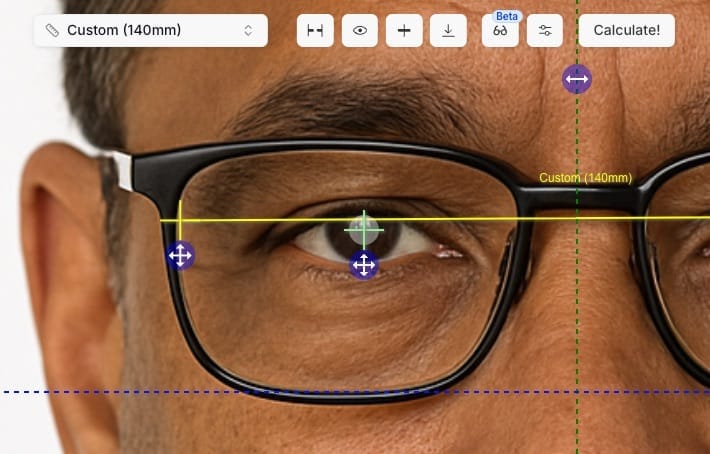
Optogrid is a SaaS platform that measures Pupillary Distance (PD), Dual PD, and Segment Height (SH) from patient photographs using calibration references. It reduces measurement time by 50-66% compared to traditional pupilometers, eliminates $500 to $2,000 in specialized equipment costs, and supports remote eyewear orders and prescription PPE programs. Digital photo-based methods achieve accuracy within +/-0.5mm when proper protocols are followed.
How Photo-Based Optical Measurement Works
Optogrid uses calibration-based photogrammetry to extract precise optical measurements from standard patient photographs. The workflow involves:
- Photo capture: The patient photographs their face while holding a reference object of known dimensions (credit card, calibration card, or existing eyewear frames)
- Reference calibration: Software identifies the reference object and establishes scale
- Facial landmark detection: Computer vision algorithms locate pupil centers and frame reference points
- Measurement calculation: The system calculates PD, Dual PD, and Segment Height based on calibrated distances
- Quality validation: Built-in checks flag images with insufficient lighting, head tilt, or calibration errors
For a detailed walkthrough of each step, see the guide on how to measure PD, Dual PD, and SH with Optogrid.
This approach enables practices to obtain measurements remotely, reducing in-person appointment requirements and supporting distributed ordering workflows. According to a systematic review on teleoptometry, telehealth tools in optometry saw dramatic adoption during the COVID-19 pandemic, with “50.94% of optometrists offering teleoptometry services” and remote capabilities “reducing barriers, including reduced travel time and cost” for patients.
Digital vs. Traditional PD Accuracy
Professional pupilometers remain the gold standard for in-person measurement. However, digital photo-based methods achieve comparable results: a comparison of digital and manual PD rulers found digital tools achieve an accuracy margin of +/-0.5mm versus +/-2mm for manual rulers. For a broader analysis, see the comparison of PD measurement methods.
Manual ruler methods suffer from operator-induced parallax error, while digital methods produce consistent, repeatable measurements regardless of operator skill level. This consistency proves particularly valuable for multi-location optical chains and practices with high staff turnover.
Measurement Time: Optogrid vs. Traditional Methods
Optical fitting appointments are typically limited to 15 minutes. Every minute saved on measurement creates capacity for additional patients or higher-quality consultations.
| Task | Traditional Method | Optogrid | Time Saved |
|---|---|---|---|
| PD measurement | 2-3 min in-person | 1 min from photo | 50-66% |
| Dual PD | 3-4 min manual marking | 1 min automatic | 66-75% |
| SH measurement | 2-3 min with ruler | 1 min from photo | 50-66% |
| Remote order | Appointment required | Async photo submission | Eliminates visit |
A practice processing 20 optical measurements daily saves 20-40 minutes per day, translating to 83-167 hours annually. That time can serve 5-10 additional patients daily or be reinvested in higher-value consultation activities. Research on optical practice efficiency identifies reducing friction points in the patient journey as a core strategy for improving capture rates and profitability.
Cost Analysis: Equipment vs. SaaS Subscription
| Equipment/Service | Traditional Pupilometer | Optogrid SaaS |
|---|---|---|
| Initial purchase | $500-$2,000 | $0 (subscription) |
| Maintenance/calibration | $100-200/year | Included |
| Training requirements | Moderate (2-4 hours) | Minimal (30 min) |
| Remote capability | No | Yes |
| Multi-location access | Requires equipment per location | Single subscription, unlimited users |
| Dual PD support | Manual calculation | Automatic |
| Upgrade costs | Replace hardware | Automatic software updates |
A small optical practice spending $1,500 on a pupilometer plus $150 annual maintenance could recoup costs within 12-18 months when switching to a subscription model. This aligns with broader industry data: healthcare SaaS solutions typically achieve breakeven within 6-18 months, with “small practices with straightforward workflows typically reaching breakeven faster (6-9 months).”
The subscription model also eliminates depreciation risk. As measurement technology advances, subscribers receive automatic feature updates without additional capital expense.
Platform Capabilities: PD, Dual PD, and SH from One Photo
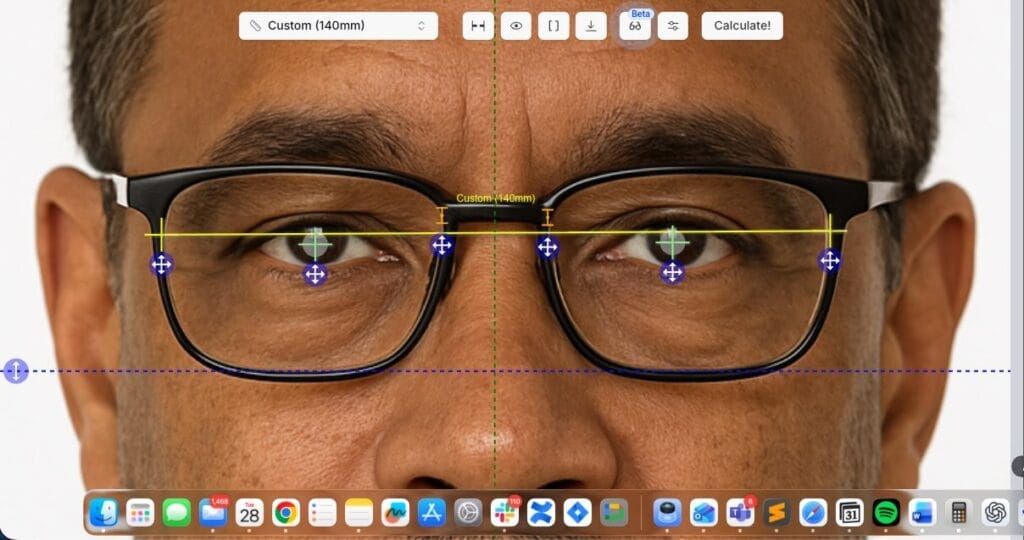
Optogrid measures three critical dimensions for prescription eyewear from a single photograph, eliminating multiple patient interactions or equipment repositioning:
- Pupillary Distance (PD): Single measurement for standard eyewear
- Dual PD: Separate left/right measurements for progressive lenses and asymmetric prescriptions
- Segment Height (SH): Vertical positioning for bifocals, trifocals, and progressive lenses
The platform accepts multiple calibration references, including standard credit cards (85.6mm x 53.98mm), custom high-contrast calibration cards provided by Optogrid, existing eyewear frames with known dimensions, and manual dimension input for specialty objects. This flexibility means measurements can happen in-store, at patient homes, or through mobile optical services.
Built-in quality controls flag potential issues before they affect lens orders: lighting analysis detects underexposed images, head position verification catches excessive tilt, calibration confidence scoring indicates reference detection quality, and comparative analysis flags measurements outside typical adult PD ranges (54-74mm).
Who Benefits from Photo-Based Measurement
Independent Optical Practices
Single-location opticians gain efficiency without capital investment. Photo submissions can be completed between appointments, remote consultations become practical for patients unable to visit in-person, and consistent measurement accuracy reduces returns due to lens fitting issues. Practices can expand into curbside or home service models without purchasing additional hardware.
Optical Retail Chains
Multi-location retailers need measurement consistency across dispersed teams. Optogrid standardizes methodology so every location uses identical protocols. New staff reach proficiency in 30 minutes (compared to 2-4 hours for manual methods), and management can audit measurement quality across all locations from a central dashboard.
Online Eyewear Retailers
E-commerce optical businesses face the challenge of obtaining measurements without physical contact. Customers upload photos and receive measurements via email, reducing cart abandonment caused by PD uncertainty. For opticians building out this channel, the guide on launching ecommerce for opticians covers platform and integration decisions.
Prescription PPE Programs
Prescription safety glasses must meet ANSI Z87.1 standards while providing accurate vision correction, and OSHA requires employers to provide Z87.1-compliant eye protection when workers face impact, chemical, dust, or optical radiation hazards.
Traditional PPE ordering requires workers to travel to optical providers for measurement, creating logistical challenges for remote job sites and distributed teams. Photo-based measurement solves this: safety managers photograph employees on-site using smartphones, corporate teams process orders from a single dashboard, and measurement records support OSHA compliance audits. For programs managing 50-500+ employees, eliminating per-employee travel reduces costs by an estimated $50-150 per employee in travel time, lost productivity, and coordination overhead.

Implementation: Setup in Under an Hour
Optogrid deployment requires minimal technical infrastructure:
- Create account (5 minutes): Sign up and enter practice information
- Add users: Set up staff accounts with role-based permissions
- Prepare references: Order calibration cards (optional, since credit cards work immediately)
- Complete training (30 minutes): Watch the training video covering photo capture and measurement workflow
No specialized hardware is required. Any smartphone, tablet, or computer with a camera functions as a measurement device.
Optogrid operates as a standalone tool (exporting CSV or PDF) or integrates via API with compatible practice management platforms. A hybrid workflow is also practical: use Optogrid for remote measurements while keeping traditional methods for in-office patients who prefer them.
For practices with high staff turnover, the training difference compounds. A practice hiring 2-3 new opticians annually saves 3-9 hours of training time yearly compared to pupilometer onboarding. Learn more about how measurement tools fit alongside inventory, POS, and CRM systems in the guide to digital tools for optical stores.
Frequently Asked Questions
How accurate is photo-based PD measurement compared to a pupilometer?
Photo-based measurement using Optogrid achieves +/-0.5mm to 1mm accuracy when proper photo protocols are followed, which matches or exceeds manual ruler methods. Professional pupilometers remain the gold standard for in-person use, but digital methods eliminate operator-induced parallax error that affects manual measurements. For the majority of prescription eyewear, +/-1mm accuracy is clinically acceptable and does not impact visual performance.
What equipment do I need to use Optogrid?
No specialized equipment is required. Optogrid works with any smartphone, tablet, or computer equipped with a camera. For calibration, a standard credit card (85.6mm x 53.98mm) serves as a reference object. Optogrid also provides optional high-contrast calibration cards for practices preferring dedicated reference tools.
Can Optogrid measure Segment Height for progressive lenses?
Yes. Optogrid measures Segment Height (SH) from the same photograph used for PD measurement. The software identifies the pupil center and frame lower edge, calculating the vertical distance required for bifocal, trifocal, and progressive lens positioning. This eliminates the need for separate SH measurement appointments or manual marking on demonstration frames.
How long does implementation take for an optical practice?
Initial setup requires approximately 30 minutes: creating an account, adding user permissions, and watching the training video. Staff can begin taking measurements immediately using credit cards as calibration references. Most practices achieve full proficiency within the first week of use.
What is the subscription cost for Optogrid?
Pricing varies based on practice size, measurement volume, and integration requirements. Visit the Optogrid pricing page for current plan details. For ROI context, practices eliminating a $1,500 pupilometer purchase plus $150 annual maintenance often achieve payback within 12-18 months, even before accounting for time savings and expanded service capabilities.
Can Optogrid integrate with my practice management software?
Optogrid offers API integration for compatible practice management systems, enabling automatic measurement data transfer to patient records and order workflows. For systems without direct integration, measurements export as CSV or PDF files. The platform works effectively in standalone or integrated mode.
Is photo-based measurement acceptable for all prescription types?
Photo-based measurement is appropriate for the majority of prescriptions: single-vision, bifocals, trifocals, and progressive lenses. It provides Dual PD for asymmetric prescriptions and handles both standard and prescription safety eyewear. For complex prescriptions involving prism or high astigmatism (>3.00D), some practitioners prefer in-person verification, but photo-based measurement provides an accurate starting point that rarely requires adjustment.
How does Optogrid handle data security and HIPAA compliance?
Optogrid stores patient measurement data in HIPAA-compliant cloud infrastructure with encryption for data in transit and at rest. The platform includes business associate agreements (BAAs) for covered entities, user authentication controls, audit logging, and configurable data retention policies. Patient photographs are processed for measurement extraction and then discarded; only numerical measurement data is retained.
Can patients measure themselves at home?
Yes. Optogrid supports self-service workflows where patients capture their own photos and submit them through a practice-specific portal. The practice receives measurements and can review image quality before processing orders. This is particularly valuable for online eyewear retailers, remote reorder workflows, and patients with mobility limitations.
Get Started with Optogrid
Practices considering photo-based measurement should evaluate their current measurement volume (higher volume creates faster ROI), remote ordering demand, multi-location consistency requirements, and PPE program opportunities.
For a demonstration of Optogrid’s measurement workflow, visit the Optogrid app or review the pricing plans to find the right fit for your practice.
Sources
- The Role of Optometry in the Delivery of Eye Care via Telehealth: A Systematic Literature Review
- Digital PD Rulers vs Manual: Which Is More Accurate?
- How to Increase Efficiency and Profitability – Modern Optometry
- Healthcare SaaS Solutions 2025: Complete Guide for Practice Leaders
- ANSI/ISEA Z87.1-2025: Current Standard for Safety Glasses
- What does ANSI Z87.1 mean in safety glasses?
- Comparing the Effectiveness of Smartphone Applications in the Measurement of Interpupillary Distance

I am a seasoned software engineer with over two decades of experience and a deep-rooted background in the optical industry, thanks to a family business. Driven by a passion for developing impactful software solutions, I pride myself on being a dedicated problem solver who strives to transform challenges into opportunities for innovation.