
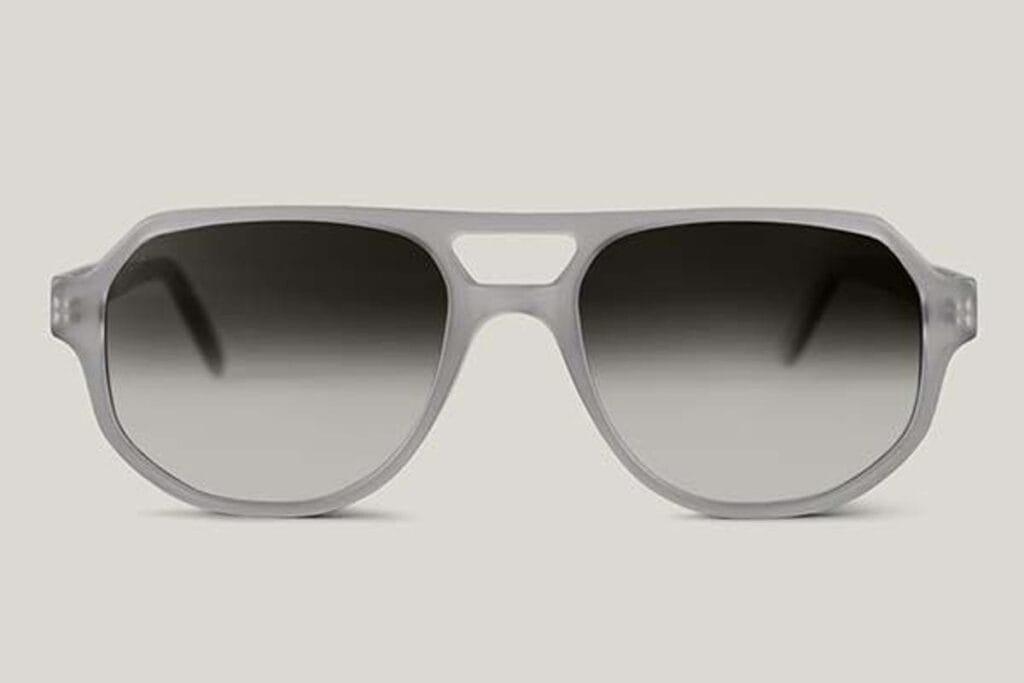
Professional frame adjustment relies on four critical parameters: pantoscopic tilt (ideal: 8 to 12 degrees), vertex distance (standard: 12 mm), horizontal alignment, and temple tension. For prescriptions above +/-5.00 D, changes in vertex distance alter the effective lens power and require documented compensation on the lab order. A 4 mm increase in vertex distance on a high-powered lens produces a clinically significant shift in effective prescription, enough to drop a patient from 6/6 to 6/9 acuity.
Vertex Distance, Pantoscopic Tilt, and Face Form Angle: Quick Reference
| Parameter | Typical range | Why it matters |
|---|---|---|
| Vertex distance | 12 mm reference distance (the phoropter position used during refraction); most as-worn distances fall between 8 and 10 mm | Prescriptions above +/-5.00 D need power compensation when the as-worn distance differs from the refraction distance |
| Pantoscopic tilt | 8 to 12 degrees for single vision; 10 to 15 degrees for progressives | Keeps the lens optical axis aligned with the visual axis; values outside this range induce oblique astigmatism |
| Face form angle (wrap angle) | 0 to 10 degrees on standard frames; 12 to 25 degrees or more on sport and wrap frames | Beyond the lens design’s tolerance, it induces prism and oblique astigmatism |
Each parameter is explained below, with sourcing and adjustment steps.
Frame adjustment is one of the most undervalued skills in optical dispensing: it determines how a pair of glasses should fit, reduces lens remakes, and builds patient loyalty. Done poorly, it generates returns, rework, and reputation damage.
This guide covers technique and parameters for dispensing opticians and optometric technicians, not aesthetics.
How Poor Adjustment Alters Effective Prescription and Causes Remakes

A poorly adjusted frame changes the position-of-wear parameters relative to the conditions of the original refraction. During the eye exam, the phoropter operates at a standard vertex distance of 12 mm with zero pantoscopic tilt. When the finished eyeglasses sit on the patient’s face at different parameters, the effective prescription shifts.
According to Opticianonline, increasing the back vertex distance from 10 mm to 14 mm on a high-powered lens produces a clinically significant difference in effective prescription. For a -15.00 D myope, reducing the vertex distance from 14 mm to 9 mm changes the required power to approximately -13.71 D. For a +10.00 D hyperope, moving from 10 mm to 14 mm creates a +0.52 D over-correction, potentially reducing vision from 6/6 to 6/9.
The most common adjustment errors that generate patient complaints are:
- Incorrect pantoscopic tilt: causes distortion and induced astigmatism
- Excessive vertex distance: alters effective power in high prescriptions
- Uneven temple pressure behind the ears: causes headaches and frame shifting
- Asymmetric nose pads: tilts the frame and displaces optical centers
- Horizontal frame twist: creates differential prismatic effect between the eyes
The Four Fundamental Adjustment Parameters
1. Pantoscopic Tilt
Pantoscopic tilt is the angle of the frame front tilted toward the face relative to the vertical plane. According to Opticianonline, the optimal range is 8 to 12 degrees so that the optical axis of the lens coincides with the visual axis of the eye.
The practical rule: for every 2 degrees of pantoscopic tilt, the optical center must be positioned 1 mm below the pupil center. This means the optical center heights recorded on the lab order must account for the actual tilt angle of the frame on the patient’s face.
Pantoscopic tilt values outside the optimal range introduce oblique astigmatism, which IOT Lenses describes as causing “changes in perceived sphere and cylinder” along with “axis shifts” and “changes in how the corridor of progressive lenses is perceived.”
How to verify on the patient:
- Place the frame on the patient’s face with lenses in position.
- Observe from the side: the lower edge of the frame should tilt slightly away from the face.
- Use a pantoscopic tilt gauge to measure the angle precisely.
- For progressive lenses, slightly higher angles (10 to 15 degrees) expand the near-vision zone. Adjust based on the lens design.
For single vision lenses, 8 to 12 degrees is standard. Progressive lenses often require higher angles, determined by the patient’s near-vision gaze position.
2. Vertex Distance
Vertex distance is measured from the anterior surface of the cornea to the posterior surface of the lens. The clinical standard is 12 mm, matching the distance used in the phoropter during refraction. When the fitting distance differs from the refraction distance on a high-Rx patient, use the vertex distance compensation formula, or the vertex distance calculator, to convert the prescribed power to the actual wearing distance before ordering.
That 12 mm figure is the refraction reference, not a prediction of where the finished frame will actually sit. According to IOT Lenses, “most patient vertex distances range from 8 to 10mm, but some patients fall outside this range.” That gap between the refraction distance and the as-worn distance is precisely what compensation corrects. It becomes clinically relevant when the prescription exceeds +/-5.00 D in any meridian, and in those cases the as-worn vertex distance must be recorded on the lab order and communicated to the laboratory.
Practical rules for vertex distance:
- Minus lenses (myopia): moving the lens closer increases effective power; moving it farther away decreases it.
- Plus lenses (hyperopia): the effect is reversed. Moving the lens farther away increases effective power.
Adjust the frame to maintain the shortest vertex distance possible without the lenses touching the eyelashes. Use a distometer to measure precisely when the prescription is high.
3. Face Form Angle (Wrap Angle) and Horizontal Alignment
The Association of British Dispensing Opticians (ABDO) defines face form angle as “the angle between the plane of the spectacle front and the plane of the lens shape,” describing how much the frame “wraps around” the patient’s face. The effect is most pronounced in sport and high-curve fashion frames. According to IOT Lenses, “most standard frames have approximately 0 to 10 degrees of wrap,” while “sport and fashion frames frequently exceed 12 degrees and can reach 25 degrees or more.”
When wrap angle exceeds what the lens design anticipated, oblique astigmatic aberrations occur. IOT Lenses notes that excessive wrap “induces both prism and oblique astigmatism because light rays must pass through the lens at increasingly oblique angles.” ABDO gives the compensation rule: face form angle “needs to be compensated for by horizontal decentration in an equivalent fashion, i.e. 1mm temporal decentration for every 2°.” High-wrap frames require specific compensation in the laboratory; record the wrap angle on the lab order.
Practical horizontal alignment check:
- Place the frame on a flat surface. All four contact points (two temple tips and two nose pads or bridge contact points) should touch the surface simultaneously.
- If the frame rocks, there is a twist in the eyewire that must be corrected before lenses are mounted.
4. Temple Length and Tension
Temple adjustment determines whether the frame holds its position or slides forward throughout the day. The correct temple length is measured by the Length to Bend (LTB): the distance from the hinge pivot to the point where the temple curves behind the ear.
A temple with too short an LTB creates excessive pressure on the sides of the head. A temple that is too long allows the frame to slide forward, changing every optical parameter simultaneously.
Material-Specific Adjustment Techniques

The table below summarizes differences between the two most common frame materials:
| Characteristic | Acetate | Metal |
|---|---|---|
| Heat required | Yes (60 to 80 degrees C in heated sand tray) | No |
| Primary tools | Heated sand tray, professional heat gun, temple pliers | Temple pliers, nose pad pliers, screwdriver set |
| Most common adjustments | Temple tips, pantoscopic tilt, frontal curvature | Nose pads, temples, hinges |
| Damage risk | Cracks if bent cold | Tool marks and permanent deformation from wrong tools |
| Reversibility | High (reheat and reshape) | Moderate (metal fatigues with repeated adjustment) |
Acetate Frames
Acetate is a thermoplastic: it softens with heat and reshapes without excessive mechanical force, its primary advantage for adjustment.
Required equipment:
- Heated sand tray (standard optical equipment), set between 60 and 80 degrees C
- Professional heat gun (alternative, minimum 80 degrees C output)
- Temple adjustment pliers
- Stable, non-slip work surface
Procedure for acetate temple adjustment:
- Remove the lenses or protect them with a soft cloth before applying heat.
- Heat the temple tip (the curved section behind the ear) in the sand tray for 10 to 15 seconds, until the material yields slightly to gentle pressure.
- With the material pliable, bend the temple tip with controlled, gradual pressure.
- Hold the position for a few seconds until the material cools.
- Place the frame on the patient’s face and verify the fit behind the ear.
For pantoscopic tilt adjustment in acetate:
- Heat the hinge area, not just the temple.
- Apply gentle, gradual torsion until reaching the desired angle.
- Measure with a pantoscopic tilt gauge before releasing.
Warning: Never attempt to bend cold acetate. The risk of cracking is high, particularly at integrated hinges.
Metal Frames
Metal allows precise, repeatable adjustments but requires proper tools to prevent permanent marks and deformation.
Nose pad adjustment:
Nose pads on metal frames are the most frequently adjusted component. To widen them (increase the gap):
- Hold the frame firmly.
- Use your thumbs to push the pad arms outward with gradual, symmetric pressure.
- Verify level: the frame should not tilt to either side.
To narrow the nose pads (when they are too wide and the frame slides):
- Use dedicated nose pad pliers, never general-purpose pliers.
- Apply pressure from both sides simultaneously.
- Test the fit on the patient’s nose.
Metal temple adjustment:
- Use metal-specific temple pliers.
- Support the temple on a rigid surface before applying force to prevent unintended twisting.
- Correct the drop angle (temple tip curve) in small increments and check on the patient after each step.
On-Face Verification Protocol
After any adjustment, on-face verification is mandatory. Use this protocol:
| Checkpoint | How to verify | Expected result |
|---|---|---|
| Horizontal level | Observe from the front at the patient’s eye level | Frame parallel to the eye line |
| Pantoscopic tilt | Observe from the side with a tilt gauge | 8 to 12 degrees (or per lens design spec) |
| Vertex distance | Use a distometer | 12 mm or as specified by the prescription |
| Nasal support | Ask the patient about symmetric pressure | No pain or asymmetric pressure |
| Temple support | Ask about pressure behind the ears | Comfortable contact, no pinching |
| Eye position in lenses | Verify with pupil marking | Optical centers aligned with pupils |
Key questions to ask the patient after adjustment:
- “Do you feel more pressure on one side of your nose than the other?”
- “Are the temples pinching behind either ear?”
- “When you look down to read, is your vision clear?”
- “Looking straight ahead, does the image feel tilted or do you feel dizzy?”
Progressive Lens Fitting: Additional Precision Required
Progressive lenses are particularly sensitive to frame position. The fitting parameters (mounting height, pantoscopic tilt, and vertex distance) are calculated for a specific position of wear. Any deviation shifts the progression corridor and can render the lens unusable.
According to research published in Scientific Reports, proper fitting is critical for progressive lens acceptance, and studies show that approximately 95% to 98% of patients successfully adapt to progressive lenses when they are properly fitted and adjusted.
Rules specific to progressive lenses:
- Never adjust the frame without the patient present. Fitting measurements are personal and position-dependent.
- Record the actual pantoscopic tilt on the lab order so the laboratory can apply the correct compensation.
- Verify the mounting height after every adjustment. The pupil mark position must not shift after the frame has been reshaped. For accurate measurements of PD, mounting height, and all fitting parameters, Optogrid captures these from a single patient photograph, eliminating manual reading errors. Learn how in the guide on how to measure PD and segment height with Optogrid.
- Counsel the patient on the adaptation period. Most patients adapt within 2 to 3 weeks, though the period can range from a few days to a month depending on the prescription.
When Adjustment Cannot Fix the Problem: Measurement Errors at the Source
A perfectly adjusted frame cannot compensate for PD or segment height errors made before lens fabrication. If discomfort persists after correct adjustment, investigate:
- Incorrect PD: causes horizontal induced prism. By Prentice’s Rule (P = F x d / 10), a 1 mm per-eye error in a 4.00 D lens generates 0.40 prism diopters of deviation. A study published in BMC Ophthalmology found that approximately 57% of individuals with single vision glasses were not looking through the optical center, and 40% of those with misaligned optical centers showed asthenopic symptoms including eye ache, headache, and visual fatigue. For reliable PD measurement methods, consult our comparison guide.
- Incorrect segment height: the patient looks above or below the progression corridor, missing the clear vision zone. Understanding minimum blank size calculations can help prevent these errors at the ordering stage, and for remote orders you can even determine fitting height without the physical frame.
- Outdated prescription: particularly common in patients over 40 or those with progressing myopia. Learn how to read an eyeglasses prescription to verify it is current before fabrication.
Essential Workbench Tools for Professional Frame Adjustment
A professional adjustment requires the right instruments: this is the minimum toolkit for a well-equipped dispensing bench.
| Tool | Use |
|---|---|
| Heated sand tray | Soften acetate for temple and pantoscopic tilt adjustments |
| Pantoscopic tilt gauge | Measure frame tilt angle precisely |
| Distometer (vertexometer) | Measure vertex distance, especially for high prescriptions |
| Metal temple pliers | Adjust metal temples without marks or twisting |
| Nose pad pliers | Symmetric adjustment of metal nose pads |
| Optical screwdriver set | Tighten/loosen hinges without stripping screw heads |
| Frontal curvature gauge | Measure wrap angle on curved frames |
| Optogrid | Capture PD, mounting height, and all fitting parameters from a patient photograph, eliminating manual reading errors |
The ABO (American Board of Opticianry) includes frame adjustment and fitting in its certification competencies, confirming that professional dispensing requires both technical knowledge and proper instrumentation. Selecting the right eyeglass frames for the patient’s facial anatomy before the adjustment process begins is equally important.
Proper eyewear maintenance after adjustment extends the fit’s life and reduces return visits. Understanding lens thickness helps opticians anticipate how weight distribution affects frame balance.
Frequently Asked Questions
What pantoscopic tilt angle works best for progressive lenses?
For progressive lenses, pantoscopic tilt typically ranges from 10 to 15 degrees, higher than the 8 to 12 degree standard for single vision. The increased angle expands the near-vision zone. Record the exact value on the lab order so the laboratory can calculate the correct corridor compensation for the lens design.
How often should a patient return for frame adjustment?
There is no fixed schedule. The patient should return whenever the frame causes discomfort, leaves marks on the nose, triggers headaches, or when vision seems tilted or distorted. As a general guideline, a daily-wear frame may need minor adjustments every 6 to 12 months as materials stretch and settle.
Can I adjust acetate frames with a household hair dryer?
Yes, provided the hair dryer produces sufficient heat (80 degrees C or higher at the output) and you take care not to overheat the lenses. A heated sand tray is preferable because it distributes heat more evenly and with better temperature control, reducing the risk of localized overheating or surface damage.
Does frame adjustment need to be redone after changing lenses?
Yes. Swapping lenses can slightly alter the frame parameters, particularly in rimless and nylon-groove (semi-rimless) mountings where lens shape contributes to structural tension. Always verify the adjustment after mounting new lenses.
Is a vertex distance of 15 mm instead of 12 mm clinically significant?
It depends on the prescription power. For prescriptions up to +/-3.00 D, a 3 mm difference has minimal optical impact. For prescriptions above +/-5.00 D, the difference is clinically significant and requires power compensation. Document the actual vertex distance and communicate it to the laboratory.
How can I tell if a frame is twisted before mounting lenses?
Place the frame on a flat surface. If all four contact points (two temple tips and two nose pad or bridge points) do not touch the surface simultaneously, the frame has a twist that must be corrected before lenses are cut and mounted. Mounting lenses in a twisted frame will produce uneven optical center heights.
What symptoms indicate an incorrect PD in the finished eyeglasses?
The patient reports double vision, visual fatigue toward the end of the day, a sensation that the glasses “pull to one side,” or difficulty converging when reading. These symptoms arise from induced prism caused by horizontal misalignment between the optical centers and the patient’s pupils.
Related Reading
- How to Read Eyeglasses Prescription: understand what the prescription requires before fabrication.
- Comparing PD Measurement Methods: accuracy comparison of digital, pupillometer, and ruler methods.
- How to Measure PD, Dual PD, and SH with Optogrid: digital measurement to reduce fitting errors.
Sources:
- Opticianonline, Fundamentals of ophthalmic dispensing part 3: Face, frame and fitting
- IOT Lenses, How Vertex Distance, Pantoscopic Tilt, and Wrap Angle Affect Prescription Accuracy
- ABDO (Association of British Dispensing Opticians), Digital centration, Dispensing Optics, March 2021
- BMC Ophthalmology / PMC, Influence of prismatic effect due to decentration of optical center in ophthalmic lens
- Scientific Reports / Nature, Adaptation to Progressive Additive Lenses: Potential Factors to Consider
- ABO-NCLE, American Board of Opticianry Certification Standards

I grew up inside an optical shop. My mother likes to tell how, as a kid, I would watch eyeglasses being assembled, play with the tools, and draw on the back of service order slips. The family business taught me early what a precise measurement and work done right are worth.
I went on to spend more than twenty years as a software engineer, always keeping an eye on the optical world. Optogrid was born where the two meet: digital measurement technology (pupillary distance and fitting heights) built by someone who knows the dispensing counter from the inside.