
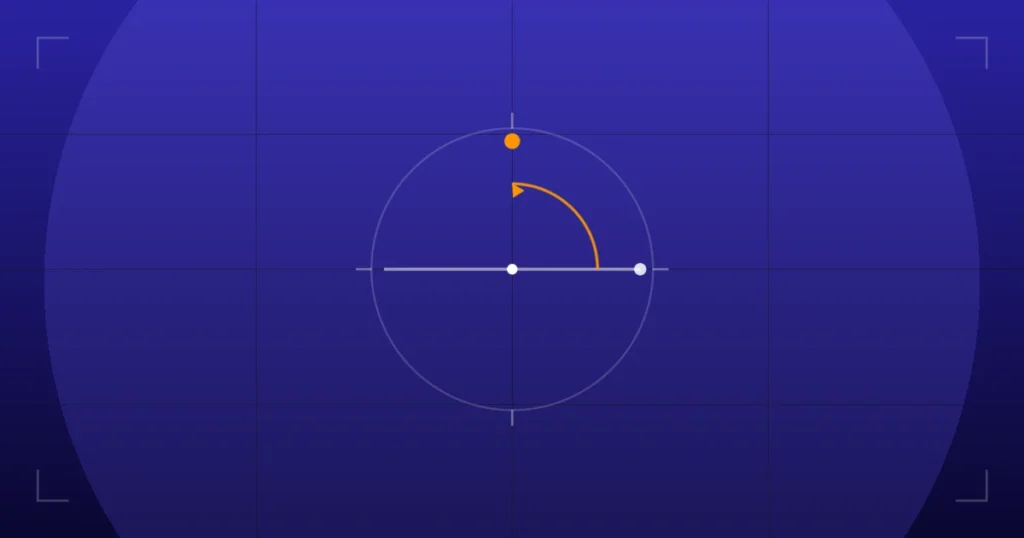
Transposition rewrites a sphero-cylindrical prescription from plus-cylinder to minus-cylinder form, or back, without changing the lens at all. The two forms describe the same optical correction; only the notation differs. Enter sphere, cylinder and axis, and this calculator returns the transposed prescription instantly, along with the spherical equivalent that both forms share.
The Three Steps
Transposition follows the same three steps every time:
- New sphere = add the sphere and cylinder together.
- New cylinder = keep the same number, reverse the sign.
- New axis = rotate 90 degrees: add 90 if the axis is 90 or less, subtract 90 if it is over 90.
New sphere = sphere + cylinder. New cylinder = same power, opposite sign. New axis = axis ± 90 degrees.
Worked Examples
Take +1.00 +1.00 × 090 in plus-cylinder form:
- New sphere: +1.00 + 1.00 = +2.00
- New cylinder: +1.00 becomes −1.00
- New axis: 90 + 90 = 180
The minus-cylinder form is +2.00 −1.00 × 180. Both prescriptions bend light identically, and a lensmeter reads them the same. A second case, −2.25 +0.75 × 135, transposes to −1.50 −0.75 × 045: sphere −2.25 + 0.75 = −1.50, cylinder reversed to −0.75, axis 135 − 90 = 45.
The rule runs the same way in reverse. Take −3.00 −1.25 × 030, a minus-cylinder Rx straight off a phoropter, and convert it to plus-cylinder form: sphere −3.00 + (−1.25) = −4.25, cylinder −1.25 becomes +1.25, axis 30 + 90 = 120. The plus-cylinder form is −4.25 +1.25 × 120, and the spherical equivalent (−3.625 on both sides) confirms the two are the same lens.
Plus-Cylinder vs. Minus-Cylinder at a Glance
Both rows of each pair below are the same lens, just written in the two different notations. Pairing the worked examples this way makes the shared spherical equivalent easy to check at a glance.
| Form | Example Rx | Spherical Equivalent |
|---|---|---|
| Plus-cylinder | +1.00 +1.00 × 090 | +1.50 |
| Minus-cylinder | +2.00 −1.00 × 180 | +1.50 |
| Plus-cylinder | −2.25 +0.75 × 135 | −1.875 |
| Minus-cylinder | −1.50 −0.75 × 045 | −1.875 |
| Minus-cylinder | −3.00 −1.25 × 030 | −3.625 |
| Plus-cylinder | −4.25 +1.25 × 120 | −3.625 |
What Is Spherical Equivalent?
Spherical equivalent is the sphere power plus half the cylinder power (SE = S + C/2). It collapses a sphero-cylindrical prescription into one number describing the mean power at the circle of least confusion, and it stays identical no matter which cylinder form the prescription is written in (StatPearls, NIH). That is why comparing the spherical equivalent before and after transposing a prescription is a reliable check that the arithmetic was done correctly.
Why Both Forms Exist
Most optometric phoropters are set up in minus-cylinder form, while some ophthalmic practice and older equipment work in plus-cylinder. Labs and dispensing software may expect one form. Reading a prescription written in the unfamiliar form, or ordering in the wrong one, is where transposition errors creep in; see how to read an eyeglasses prescription for a field-by-field breakdown of sphere, cylinder and axis. Because the optical power is unchanged, the spherical equivalent (sphere plus half the cylinder) is identical in both forms, which is a quick way to check that a transposition was done correctly. For what the cylinder and axis describe, see astigmatism explained.
A Note on Axis
The axis always stays between 1 and 180 degrees. Adding or subtracting 90 keeps it in range: an axis of 180 transposes to 90, and an axis of 30 transposes to 120. The cylinder rotates exactly 90 degrees because the two principal meridians of the lens are perpendicular.
From Transposition to Dispensing
Transposition matters whenever the form a prescription is written in doesn’t match what the next step needs. Surfacing labs are the most common case: many require minus-cylinder form for processing, so a plus-cylinder Rx from a doctor who prefers that convention needs converting before the order can go out (Laramy-K Optical Lab). It also comes up when cross-checking an incoming Rx against a patient’s old glasses or a contact lens fitting written in the other form, since a copying error is easy to miss when the two are never put in the same notation.
Getting the cylinder form right is only half the job of getting a lens correct. The other half is measuring the frame to the eyes accurately, since even a correctly transposed Rx will not fit properly if the PD or segment height is off. Optogrid’s digital PD and segment height workflow captures both measurements from a phone or tablet, so the numbers feeding the lab order are as accurate as the prescription itself.
Frequently Asked Questions
How do you transpose a prescription?
Add the sphere and cylinder for the new sphere, reverse the sign of the cylinder, and rotate the axis 90 degrees (add 90 if it is 90 or less, subtract 90 if it is over 90). The result is the same lens written the other way.
Does transposition work the same going from minus-cylinder to plus-cylinder?
Yes. The three-step rule is symmetric: whichever form you start in, add the cylinder to the sphere, reverse the cylinder’s sign, and rotate the axis 90 degrees. Running the steps on a minus-cylinder Rx produces the equivalent plus-cylinder prescription just as reliably as the reverse.
Does transposition change the prescription?
No. Plus-cylinder and minus-cylinder forms describe the identical lens. The spherical equivalent (sphere plus half the cylinder) is the same in both, which is a quick way to check your work.
Why do optometrists and ophthalmologists write cylinder differently?
Most optometric phoropters are set in minus-cylinder form, while some ophthalmic practice and older equipment use plus-cylinder. Both are valid; transposition converts between them.
What happens to the axis when you transpose?
It rotates exactly 90 degrees and stays between 1 and 180. An axis of 180 becomes 90; an axis of 45 becomes 135.
Can transposition produce a plano sphere?
Yes. If the sphere and cylinder are equal and opposite, the transposed sphere is zero (plano). The arithmetic is the same; only the written form looks different.
Is this the same as other optical transposition calculators?
Yes, in the sense that matters: any correct transposition calculator applies the same three-step rule (add cylinder to sphere, reverse the cylinder sign, rotate the axis 90 degrees), because that rule is just the algebra of the two notations, not a proprietary method. This tool is Optogrid’s own implementation of that standard transposition and is not affiliated with any other calculator or optical lab.