
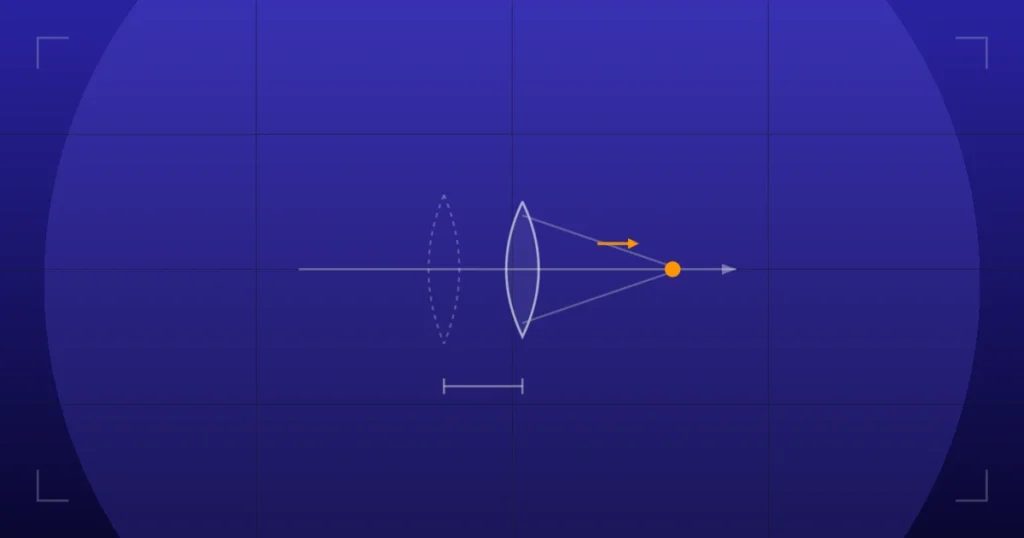
Vertex distance is the gap between the back surface of the lens and the apex of the cornea. Change that gap and you change the power the eye actually receives, so a high-power prescription refracted in a phoropter often has to be ordered at a different number once you know where the lens will really sit. This back vertex distance calculator does that arithmetic: enter the refracted power, the vertex it was refracted at, and the as-worn vertex, and it returns the compensated power to order.
Use this vertex calculator when the lens stays in front of the eye and only the gap changes. To convert a spectacle Rx all the way onto the cornea, which is the special case of moving the lens the full 12 mm or so onto the eye, use the glasses-to-contacts converter instead. Measurement technique, the distometer and a full reference table are in the vertex distance compensation guide.
The Vertex Distance Formula
F_c = F / (1 − d × F), where F is the refracted power in dioptres, d is the change in vertex distance in metres (positive when the lens is worn closer to the eye than at refraction), and F_c is the power to order.
Note what d is and is not. ISO 13666:2019, the ophthalmic optics vocabulary standard, defines vertex distance as “the horizontal distance between the back surface of the lens and the apex of the cornea, measured with the eyes in the primary position”. The d in the formula is not that distance, it is the change in it. Plugging in the as-worn vertex instead of the difference is the most common way this calculation goes wrong.
Direction is easy to sanity-check: a lens worn closer to the eye than the phoropter shifts toward plus (less minus, more plus); worn farther, it shifts toward minus (more minus, less plus).
For a mental cross-check, the National Academy of Opticianry gives a shortcut: “diopters squared, divided by 1000. That value is multiplied by the millimeter of change.” At 10.00 D over 2 mm that is 100 / 1000 × 2 = 0.20 D, which matches the exact formula to well inside a quarter-dioptre step. The shortcut drifts once the move gets large, so use it to catch a keying error, not to place the order.
Worked Examples
- −10.00 D refracted at 12 mm, worn at 14 mm (2 mm farther, d = −0.002): −10.00 / (1 − (−0.002) × −10.00) = −10.00 / 0.980 = −10.20 D, ordered as −10.25 D. Worn farther, it needs more minus.
- +8.00 D refracted at 12 mm, worn at 8 mm (4 mm closer, d = +0.004): +8.00 / (1 − 0.004 × 8.00) = +8.00 / 0.968 = +8.26 D, ordered as +8.25 D. Worn closer, it needs more plus.
How Big the Shift Actually Gets
Change in ordered power for a minus lens worn farther from the eye, or a plus lens worn closer, computed with F_c = F / (1 − d × F):
| Refracted power | 2 mm difference | 4 mm difference |
|---|---|---|
| 4.00 D | 0.03 D | 0.07 D |
| 6.00 D | 0.07 D | 0.15 D |
| 8.00 D | 0.13 D | 0.26 D |
| 10.00 D | 0.20 D | 0.42 D |
| 12.00 D | 0.30 D | 0.61 D |
| 15.00 D | 0.46 D | 0.96 D |
The shift grows with the square of the power, which is why it stays invisible through the mid powers and then arrives quickly.
When to Compensate
±4.00 D is the figure most references quote as the point where vertex distance starts to matter, and it is exactly right for a spectacle-to-contact conversion, where the lens travels the whole 12 mm onto the cornea. For a spectacle-to-spectacle change of two to four millimetres it is an attention threshold rather than an ordering threshold: the table above shows the shift does not reach a full 0.25 D step until somewhere between 8.00 and 10.00 D.
The National Academy of Opticianry draws the mandatory line in the same place: “spectacles all powers greater than 7.00 Diopters in either principal meridian must be compensated. For contact lenses, all powers greater than 4.00 Diopters in either principal meridian must be compensated.”
Read practically: check the vertex on anything from ±4.00 D up, and expect to change the order above roughly ±7.00 D whenever the as-worn vertex differs from the refraction vertex by more than 2 mm. Whether the compensated number is worth ordering is also a tolerance question, and the ANSI lens tolerance checker shows where a given power sits against the Z80.1 limits. For toric prescriptions, compensate each principal meridian separately; the cylinder axis does not change. Accurate as-worn geometry is part of what Optogrid captures from a photo of the patient in the chosen frame.
Frequently Asked Questions
What is the vertex distance formula?
F_c = F / (1 − d × F), where F is the refracted power, d is the change in vertex distance in metres (positive when the lens is worn closer to the eye than at refraction), and F_c is the power to order. Round to the nearest 0.25 D.
Is back vertex distance the same as vertex distance?
Yes. Vertex distance was formerly called back vertex distance and is still abbreviated BVD on prescription pads and lab orders. ISO 13666:2019 uses “vertex distance” and defines it as the horizontal distance from the back surface of the lens to the apex of the cornea with the eyes in primary position.
When do you compensate for vertex distance?
The National Academy of Opticianry requires compensation for spectacle powers greater than 7.00 D in either principal meridian, and for contact lens powers greater than 4.00 D. In spectacle work, a 2 mm vertex difference produces about 0.03 D of shift at 4.00 D and about 0.20 D at 10.00 D, so the change only reaches a quarter-dioptre ordering step in the higher powers.
Which way does the power change?
A lens worn closer to the eye than it was refracted needs a shift toward plus (less minus, more plus). Worn farther, it needs a shift toward minus (more minus, less plus).
Is the refraction vertex 12 or 13.75 mm?
Both are used. Phoropters are often calibrated to 13.75 mm, while 12 mm is the common working assumption. What matters is the difference between the refraction vertex and the as-worn vertex, not either value alone.
How do you compensate an astigmatic prescription?
Apply the formula to each principal meridian separately (the sphere, and the sphere plus the cylinder). The cylinder axis does not change.