
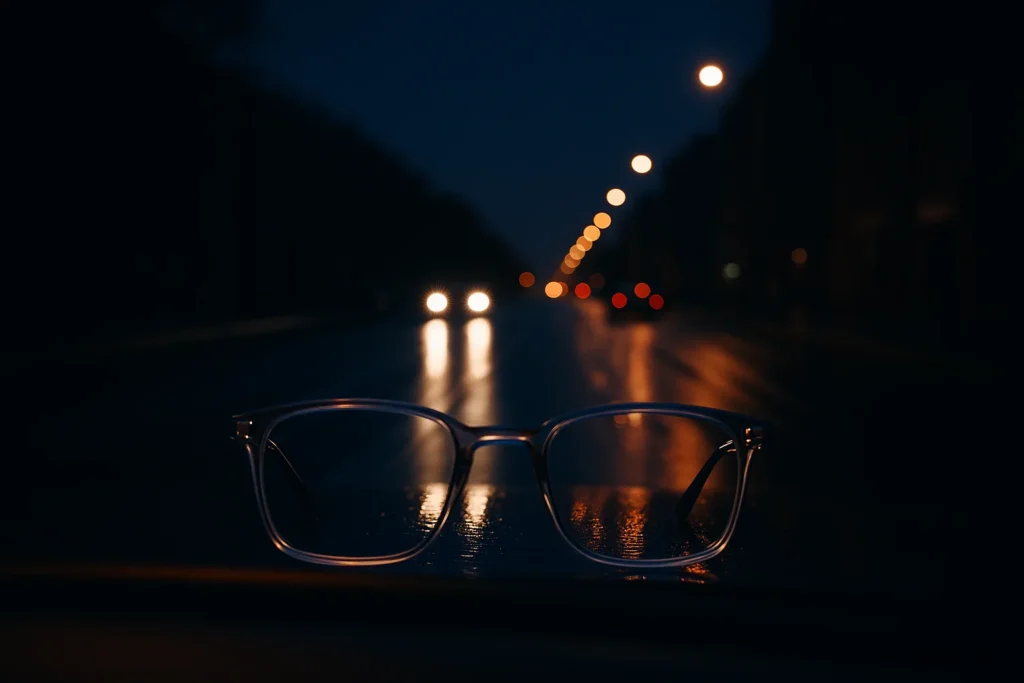
The most effective tool against nighttime driving glare is a pair of clear prescription lenses with a quality anti-reflective (AR) coating, combined with an accurate current prescription and clean lens surfaces. AR coating reduces the reflections that occur at each lens-air boundary, raising light transmittance (the fraction of incoming light that passes through a lens rather than being reflected or absorbed) and cutting the halos and starbursts that appear around oncoming headlights. Yellow-tinted “night driving glasses” are widely marketed, but a clinical trial published in JAMA Ophthalmology found no significant improvement in pedestrian detection compared with clear lenses. Because tinted lenses reduce total light reaching the eye, they can make nighttime visibility worse rather than better. If glare persists despite well-maintained clear lenses and an updated prescription, an eye exam with an eye care professional is the right next step, since progressive glare can indicate a cataract or other condition that requires clinical evaluation.
Understanding Glare on the Road at Night
Optical scientists distinguish two categories of glare. Discomfort glare causes eye strain and visual fatigue without necessarily preventing you from seeing clearly. Disability glare is more serious: it reduces contrast and the ability to detect objects, typically when a brighter light source (such as oncoming high beams) scatters across the visual field and washes out a dimmer target (such as a pedestrian in dark clothing).
Both types produce recognizable visual artifacts under typical driving conditions. Halos are rings of light surrounding a point source, often caused by diffraction through the eye’s optics or mild corneal irregularities. Starbursts are radial spikes that radiate outward from a light source, commonly linked to higher-order aberrations (HOAs), which are small optical imperfections of the eye’s refractive system that become more noticeable when the pupil dilates in the dark.
Anti-Reflective Coating: The Evidence-Based Fix
An anti-reflective (AR) coating is a series of ultra-thin optical layers deposited on the lens surface. These layers use a principle called destructive interference to cancel light that would otherwise reflect back from the lens-air boundary. More of the available light passes through the lens and reaches the eye instead of bouncing toward oncoming traffic as a ghost reflection.
Independent lab measurement of eight commercial pre-coated AR lenses put visible-light transmission between 92% and 97% depending on the coating, against 92% for an uncoated control lens (Metsing & Carlson, African Vision and Eye Health, 2022). The gain over an untreated lens is a few percentage points, not the “99%-plus” figure repeated in marketing copy, and it varies enough between brands that the specific coating matters more than the presence of a coating. Uncoated standard plastic lenses reflect a fraction of incoming light at each surface, which counts for more in already-dim conditions. For drivers on unlit roads or facing oncoming traffic with bright LED headlamps, that transmittance gain translates to fewer halos, reduced starburst intensity, and lower eye strain over long distances at night.
Premium AR coatings also include hydrophobic and oleophobic outer layers that resist smudging and water spots. This matters because dirty lenses scatter light in ways that create veiling glare, described below. For a complete explanation of how AR coating works and what to look for, see the guide to anti-reflective coating on glasses.
Why Yellow-Tinted Night Driving Glasses Fall Short
Yellow and amber-tinted glasses are sold with the claim that filtering certain wavelengths reduces glare and improves contrast in low light. Researchers have tested this claim directly.
A 2019 study in JAMA Ophthalmology enrolled 22 participants with normal visual acuity in a driving simulator. Each participant wore three commercially available yellow-lens products and a clear lens, then was measured on response time to detect pedestrians under nighttime conditions with and without oncoming headlight glare. The study found no significant main effect of yellow lenses across all tested conditions (P = .42). Response times with yellow lenses were no better than with clear lenses under any condition. The authors concluded that their findings “do not appear to support having eye care professionals advise patients to use yellow-lens night-driving glasses.”
The American Academy of Ophthalmology (AAO) explains the underlying reason: tinted lenses “are designed to limit or reduce the amount of light getting to the eye. Anything that does this at night will actually make it harder to see, not easier.” The JAMA study also noted a notable discrepancy: most participants subjectively felt the yellow lenses brightened their view, even though objective response times showed no benefit. That mismatch between perceived and actual performance is a safety concern, because it may lead drivers to take risks they would not otherwise take.
Polarized Lenses at Night: Not Recommended
Polarized lenses work by filtering horizontally polarized light, eliminating glare reflected off flat surfaces like water or wet pavement. They work well for daytime driving and outdoor activities. At night, the mechanism becomes a liability: blocking additional light in an already low-light condition can inhibit vision even more rather than helping. Polarized lenses can also interfere with LCD instrument panels and navigation screens, making it harder to read the dashboard. Eye care professionals consistently advise against polarized lenses for nighttime driving.
Other Real Causes of Night Glare
Uncorrected or outdated refractive error. The pupil dilates significantly in the dark, admitting light through a wider area of the cornea and crystalline lens. Uncorrected refractive error (myopia, hyperopia, or astigmatism) and HOAs, including coma and spherical aberration, become more perceptible under these conditions. Coma causes light from point sources to smear into comet-like streaks; spherical aberration causes peripheral rays to focus at a different point from central rays, producing rings around lights. Accurate prescription lenses that are optically centered over the wearer’s visual axis reduce this class of aberration-related glare.
Pupillary distance (PD) measurement is a core component of proper optical centration: when the optical center of each lens sits directly in front of the wearer’s pupil, off-axis aberrations are minimized. Even small centration errors can introduce prismatic displacement and worsen the visual noise that contributes to nighttime glare. Practices that use digital measurement tools, such as Optogrid, can capture and verify PD data precisely, which is particularly useful for patients obtaining eyewear outside a traditional in-office fitting.
Dirty or scratched lenses. Surface contamination, fingerprints, and scratches scatter incoming light in multiple directions, creating a diffuse veiling glare that reduces contrast across the entire visual field. Cleaning lenses with a microfiber cloth and a lens-safe solution before night drives is one of the most direct and lowest-cost corrections available.
Age-related changes and cataracts. The crystalline lens yellows and scatters more light internally with age. Cataracts, clouding of the crystalline lens, can produce severe disability glare. If glare is worsening progressively, especially in one eye, an evaluation by an eye care professional is the appropriate next step. This is not something a lens prescription change can address on its own.
Photochromic Lenses and Night Driving
Photochromic lenses (sometimes called light-adaptive or Transitions lenses) darken in response to ultraviolet light and return to a near-clear state when UV is absent. At night, with negligible UV, they remain essentially clear. Paired with an AR coating, photochromic lenses are well-suited for nighttime driving: they deliver the transmittance benefit of AR coating without adding tint. A practical note for daytime users: most automotive glass filters UV, which can slow the darkening response during daytime driving. This has no effect on nighttime performance.
What Helps and What Doesn’t: A Comparison
| Option | Recommended for Night Driving? | Why |
|---|---|---|
| Clear lenses with quality AR coating | Yes | Raises measured light transmittance to about 96-97% for the better coatings, from 92% uncoated; reduces internal reflections, halos, and starbursts |
| Up-to-date prescription | Yes | Corrects refractive error and HOAs amplified by a dilated pupil at night |
| Clean, unscratched lenses | Yes | Scratches and surface contamination scatter light and increase veiling glare |
| Photochromic lenses (at night) | Yes, with AR coating | Return to near-clear in low-UV nighttime conditions |
| Yellow or amber tinted lenses | Not recommended | Reduce total light transmittance; no improvement in pedestrian detection found in clinical testing |
| Polarized lenses (at night) | Not recommended | Block too much light in low-illumination conditions; can interfere with LCD dashboard displays |
| Dark or mirrored lenses at night | Not recommended | Further restrict already-limited available light |
Frequently Asked Questions
Do anti-glare glasses actually help with night driving?
Yes, when “anti-glare” refers to lenses treated with an anti-reflective (AR) coating. AR coating reduces reflections at each lens surface and raises light transmittance, which cuts halos and starbursts around headlights. Lenses marketed as “anti-glare night driving glasses” that have a yellow or amber tint are a different product and lack clinical support. The distinction is significant: AR coating on clear lenses helps; a yellow or amber tint at night does not.
Are yellow night driving glasses effective?
No. A 2019 study in JAMA Ophthalmology found no significant difference in pedestrian detection response time when participants wore yellow-lens glasses versus clear lenses during simulated night driving, with or without headlight glare. The American Academy of Ophthalmology explains that any lens designed to reduce the light reaching the eye makes it harder, not easier, to see in already-dim conditions.
Can I wear polarized sunglasses at night to reduce headlight glare?
No. Polarized lenses filter horizontally polarized reflected light, which is useful in bright daylight. At night, where available light is already limited, reducing it further impairs rather than aids vision. Polarized lenses can also affect the readability of LCD dashboard displays. They are designed for daytime use in high-brightness conditions, not for nighttime driving.
What causes halos and starbursts around headlights at night?
Halos (rings around light sources) are typically caused by diffraction through the eye’s optics or mild corneal irregularities. Starbursts (radial spikes) are more often linked to higher-order aberrations such as coma and spherical aberration, which become more visible when the pupil dilates in dim light. Dirty or scratched lenses also contribute to both effects by scattering incoming light. An AR coating on clean lenses reduces the lens-surface component, while an accurate prescription addresses the eye’s own refractive component.
Does an updated prescription reduce glare when driving at night?
Yes. Uncorrected refractive error is amplified at night when the pupil dilates, admitting light through a wider area of the cornea and lens. Uncorrected astigmatism in particular smears point light sources, worsening both halos and starbursts. An accurate current prescription, properly centered over each pupil, reduces the aberration-related component of nighttime glare. If your prescription is more than a year or two old and you notice increasing difficulty seeing at night, an updated eye exam is a practical first step.
When should I see an eye doctor about night glare?
See an eye care professional if night glare is worsening progressively over weeks or months, is noticeably worse in one eye than the other, or is accompanied by reduced contrast sensitivity or cloudy vision during the day. These patterns can indicate cataracts, dry eye, or other conditions that require clinical evaluation rather than a lens change alone. The AAO recommends keeping your prescription current and consulting an ophthalmologist when nighttime vision changes noticeably.

I grew up inside an optical shop. My mother likes to tell how, as a kid, I would watch eyeglasses being assembled, play with the tools, and draw on the back of service order slips. The family business taught me early what a precise measurement and work done right are worth.
I went on to spend more than twenty years as a software engineer, always keeping an eye on the optical world. Optogrid was born where the two meet: digital measurement technology (pupillary distance and fitting heights) built by someone who knows the dispensing counter from the inside.