
Quick Answer
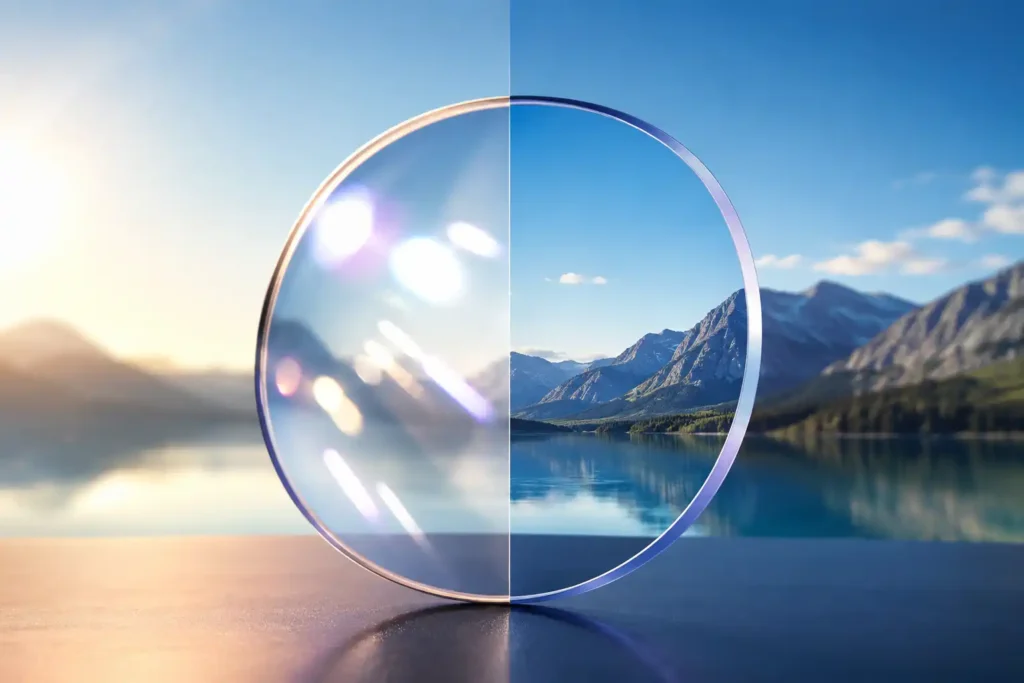
Anti-reflective (AR) coating applies ultra-thin metal-oxide layers to both lens surfaces, canceling reflections through destructive interference. Independent lab testing puts light transmission for AR-coated lenses in the 92% to 97% range depending on the coating, not the flat 99%+ figure often quoted in marketing copy. For most prescription wearers, the benefits are still real: less glare at night, cleaner vision on screens, and lenses that look clear in photos rather than showing a mirror-like sheen. AR coating is worth the upcharge for anyone driving at night, working long hours at a screen, or wearing high-index lenses. It adds less value for sunwear, safety glasses, or very mild prescriptions used mainly outdoors.
How Does Anti-Reflective Coating Work?
Every lens surface reflects some light back rather than transmitting it. A bare CR-39 plastic lens reflects roughly 8% of available light across both surfaces, which translates to about 92% light transmission to the eye. High-index lenses reflect even more because their denser optical structure has a higher refractive index, compounding the loss.
AR coating addresses this through thin-film interference. According to Laramy-K Independent Optical Lab, an independent optical laboratory resource: “Light incident upon an AR coated lens experiences reflection at both the AR layer and the surface of the lens. However, the thickness of the AR layer is such that the light waves reflected from the AR surface are 180° out of phase with light waves reflected from the surface of the lens.” Those out-of-phase waves cancel each other out (destructive interference), eliminating the reflection.
The energy does not disappear. As Laramy-K notes: “The Law of Conservation of Energy states that energy can neither be created nor destroyed. So, what happens to the energy from the cancelled light waves? It is transferred through the lens medium to the patient’s eyes improving contrast and clarity.”
The coating is applied in multiple alternating layers of materials with different refractive indices, typically metal oxides. All the layers together are “usually about 0.2 to 0.3 microns thick,” according to All About Vision.
What that stack actually buys in transmitted light is more modest than marketing copy sometimes implies. A 2022 peer-reviewed comparison of eight pre-coated AR lenses published in African Vision and Eye Health found visible-light transmission ranging from 92% to 97% across brands. The Hoya SVV coating transmitted the most at 97%, Crizal Easy, Hoya HVLL, Crizal Forte, and Lens Tech all transmitted 96%, and one tested coating (Zeiss Drive) transmitted 92%, identical to the uncoated control lens used in the study. The takeaway for the dispensing counter: AR coating helps, but how much depends on the specific coating on the lens, not just whether the label says “AR.”
Inside a Modern Multi-Layer AR Stack
Premium AR is not a single film. It is a stack of functional layers built into the lens during manufacturing, each doing a different job. Understanding the stack explains why a branded coating costs more, and why cleaning technique matters so much.
Working outward from the lens surface, a modern coating typically combines:
- A hardening and adhesion base. This layer bonds the stack to the lens and adds scratch resistance before the optical layers go on.
- The anti-reflective layers. These are the alternating high and low refractive index metal-oxide layers that produce the interference effect. All About Vision notes that “some of the higher-quality AR coatings use up to seven layers,” and ZEISS DuraVision Platinum is described as “an integrated system of nine precisely applied coating layers.”
- An anti-static layer. Static charge on a lens surface attracts dust. ZEISS states its anti-static layer “decreases the buildup of static electricity by over 90%,” and Essilor applies its anti-static layer between the AR layers so the lens repels dust and dirt, per an industry guide to Crizal coatings.
- A hydrophobic and oleophobic top coat. This low-surface-energy outer layer makes water bead and roll off, and resists skin oils and fingerprints. ZEISS specifies a water contact angle of at least 110 degrees on its coated lenses, versus roughly 95 degrees without the top coat.
That top functional layer is the part gentle cleaning protects. It is only a few nanometers thick, so abrasive dry-wiping wears it away first, which is why an aging coating starts smudging and beading poorly long before the optical layers themselves fail. For how the lens material underneath the coating affects both thickness and reflectance, see the science behind lens thickness.
Real Benefits of AR Coating
The optical gain is real, though it varies by context.
Night driving. Oncoming headlights produce halos and ghost images when reflected off uncoated lenses. AR coating reduces these reflections, lowering visual noise during night driving. All About Vision notes the benefit of “fewer halos and ghost images from lens reflections” and “less discomfort from blue-tinted headlights.” AR is in fact the core of a good pair of anti-glare night driving glasses.
Screen use. Lens reflections from monitor light are a consistent source of visual fatigue during extended computer work. Reducing them with AR coating can lessen eye strain symptoms, though the benefit is modest if ambient lighting is already well controlled.
Cosmetic appearance. Uncoated lenses photograph with a mirror-like sheen that hides the wearer’s eyes. AR-coated lenses appear nearly clear, which matters for video calls, photographs, and public presentations.
High-index and strong prescriptions. The case for AR coating is strongest on high-index lenses. All About Vision states that “AR coating is often recommended for all eyeglass lenses. This is particularly true for polycarbonate and high-index lenses, which reflect more light than regular glass or plastic lenses.” Patients with higher prescriptions require thinner, denser high-index materials, and those materials have a higher refractive index that reflects more light, making AR coating more impactful, not less. See the lens material comparison guide for how refractive index affects reflectance across CR-39, polycarbonate, Trivex, and high-index.
AR Coating vs. Blue-Light Filter vs. Other Coatings
One of the most common points of confusion at the dispensing counter: patients ask for “blue-light lenses” when they may actually want AR coating, or they assume the two are the same thing. They are not.
| Coating | What It Does | When to Recommend | Limitations |
|---|---|---|---|
| Anti-reflective (AR) | Cancels lens reflections via thin-film interference; independent testing shows 92-97% light transmission depending on the coating | Almost all prescription lenses, especially high-index; night drivers; screen workers | Shows fingerprints and smudges more readily; requires gentle cleaning |
| Blue-light filter | Blocks or absorbs a portion of short-wavelength visible light (roughly 380-500 nm) | Patients with self-reported screen fatigue who want to try it; caveat about limited evidence | Does not reduce reflections; evidence for reducing digital eye strain is weak; may cause a slight yellow tint |
| Scratch-resistant | Hardens the lens surface to resist minor abrasion | Standard inclusion on most modern lenses | Not scratch-proof; does not protect against impacts |
| Hydrophobic / oleophobic | Causes water droplets to bead and roll off; reduces oil adhesion | Rainy climates; patients who handle lenses often | Wears down over time; does not improve optics |
On the blue-light question: the American Academy of Ophthalmology is worth consulting for nuance, and All About Vision notes that “there isn’t much scientific evidence to support these claims” about blue-light lenses easing eye strain or preventing retinal damage. AR coating, by contrast, has a clear optical mechanism. For a deeper look at the evidence on blue-light filtering, see the blue light glasses guide.
AR, scratch-resistant, hydrophobic, and UV coatings are often applied as a bundled package in modern premium lenses, and a separate anti-fog coating can be added for patients who deal with lens fogging. When a patient asks “what does AR coating include?” the honest answer is: it depends on the lab and lens package. Confirm with the supplier which coatings are bundled versus priced separately.
Limitations: What AR Coating Does Not Do
The case for AR coating is strong, but there are real tradeoffs to set with patients upfront.
Smudges show more. Because AR-coated lenses are nearly clear, fingerprints and oils on the surface are more visible than on tinted or uncoated lenses. This is physics, not a defect. Patients who handle their glasses frequently will notice this.
Early or cheap coatings can craze or peel. Single-layer AR coatings from older or budget products have a poor track record for durability, and the gap between coatings is measurable, not just anecdotal. In the same peer-reviewed durability comparison cited above, Crizal Forte withstood 60 abrasion strokes before showing damage and passed a 70°C heat-stress test, while three of the budget coatings tested failed that same heat test and held up for only 10 strokes under steel wool. When patients complain about a previous AR experience, ask which lens it was on and what lab applied it.
Glare protection has limits. As noted by ophthalmologists at the AAO, “the glare protection from an anti-reflective coating is very slight” in conditions of extreme glare (direct sun, water, snow). For outdoor glare, polarized lenses are the appropriate solution. See the polarized lenses guide for a practical comparison.
How to Clean AR-Coated Lenses
AR coating is durable when cared for properly, but the surface micro-structure is more sensitive to abrasion and harsh chemicals than bare plastic.
Do:
- Use a spray lens cleaner formulated for coated lenses and a clean microfiber cloth.
- Rinse with warm water before wiping if the lens is visibly dirty or gritty.
- Store glasses in a case to avoid contact scratches.
Do not:
- Dry-wipe with clothing, paper towels, or tissues. These fibers are abrasive and will etch the coating surface over time.
- Use window cleaner, dish soap with additives, or household cleaning sprays. Many contain solvents or abrasives that degrade the coating.
- Wipe lenses while they are still hot (left in a car in summer). Heat stress weakens bonded coatings.
For a full cleaning protocol across all lens types and coatings, the eyewear maintenance guide covers the right tools and technique in detail.
AR Coating Warranty: What’s Actually Covered
Most practices back AR coating with a warranty against crazing and peeling, separate from frame or lens-material coverage. Terms vary by shop. One real dispensing policy covers standard AR coating “against peeling or crazing” for one year from pickup, while another gives two years on premium branded coatings like Crizal and Hoya but only one year on generic AR.
Two things patients often misunderstand: the warranty covers coating defects, not scratches, and the remedy is replacement, not repair, since peeled or crazed AR cannot be restored to its original state. Setting that expectation at the point of sale, alongside the cleaning guidance above, prevents most “why won’t you fix this” conversations months later.
Is Anti-Reflective Coating Worth the Extra Cost?
For most prescription wearers, yes. The clearest cases:
- High-index lenses: AR coating is close to mandatory here. Without it, high-index lenses reflect noticeably more light, negating part of the clarity benefit of the thinner material. Use the lens thickness calculator to gauge whether a prescription is strong enough to justify high-index in the first place.
- Strong prescriptions: Thicker edges and denser materials mean more surfaces and more reflection. AR coating recovers that lost transmission.
- Regular screen users: The visual fatigue reduction from cutting lens reflections is modest but cumulative over an eight-hour workday.
- Night drivers: The halos and ghost images from oncoming headlights are one of the most consistent patient complaints AR coating addresses.
Where AR coating adds little value:
- Prescription sunglasses (mirror or tint already filters light; AR coating can actually increase eye exposure on the back surface, which is why sun AR is usually applied on the back surface only)
- Very mild prescriptions worn only outdoors
- Safety eyewear where impact resistance takes priority over optics
The upcharge varies widely, from nominal on kit lenses to significant on premium branded coatings. As a rough benchmark, NVISION puts the typical cost of adding AR coating at about $20 to $90 per pair, with basic single-layer treatments at the low end and multi-layer branded stacks at the high end.
At the dispensing counter, the most effective way to position AR value is to let the patient experience the comparison: hold an uncoated lens and an AR-coated lens side by side under the office light and point out the reflection. The visual difference is immediate and convincing. Given how much coating quality varies by brand, name what is actually being sold rather than treating “AR” as one generic feature. Setting care expectations alongside that demonstration (the smudge tradeoff, the proper cleaning technique, and the warranty terms above) leads to better outcomes and fewer warranty returns.
For a complete overview of lens types and how they interact with coatings and materials, the prescription lenses guide is a useful reference for both dispensing staff and patients researching their options.
Frequently Asked Questions
Does AR coating affect lens durability?
Modern multi-layer AR coatings are designed to last the life of the lenses when cared for correctly. The main durability risk comes from improper cleaning (dry-wiping with abrasive materials) or exposure to high heat, which can stress the coating bond. Single-layer budget AR coatings applied as an aftermarket treatment have historically had more crazing and peeling problems. Lenses with AR applied as part of the manufacturing stack (most premium lenses today) are significantly more stable.
Can I get AR coating on prescription sunglasses?
Yes, but the application differs. On prescription sunglasses, AR coating is typically applied to the back surface only. This prevents the reflection of light coming up from behind the wearer from bouncing off the inside of the tinted lens and into the eye. Applying AR to the front surface of a sunglass lens would increase the amount of light entering the lens, which is counterproductive for sun protection.
What is the difference between anti-reflective and anti-glare coating?
The terms are used interchangeably in retail and patient-facing marketing. Technically, anti-reflective describes the optical mechanism (thin-film interference that cancels reflected light), while anti-glare describes the practical benefit. Some manufacturers use “anti-glare” to describe a matte surface treatment that diffuses rather than cancels reflections. If a patient asks, confirm what the lab means by the term before ordering.
Does AR coating help with night driving?
AR coating reduces halos and ghost images caused by light reflecting off the back and front surfaces of uncoated lenses. This makes it genuinely useful for night driving, where oncoming headlights are the main source of these reflections. It will not eliminate glare from direct light sources, for that, polarized lenses are more effective outdoors during the day, though polarized lenses are not suited for nighttime use.
How long does AR coating last?
Quality AR coating is designed to last for the full lifespan of the lens. In practice, how long it remains optically effective depends heavily on how the glasses are cleaned and stored. Patients who dry-wipe their lenses with clothing or paper towels can degrade the coating surface within months. Patients who use lens spray and a microfiber cloth typically see no coating degradation over the two to three years between prescription changes.
Is AR coating the same as blue-light blocking?
No. AR coating cancels reflections through destructive interference, it is a physical, optical process that does not filter specific wavelengths. Blue-light filtering adds a coating or tint that absorbs or reflects short-wavelength visible light (roughly 380–500 nm). The two can be applied together on the same lens. AR coating has a clear mechanism and optical benefit; blue-light filter lenses have weaker evidence for the digital eye strain claims made for them. Many modern lens packages bundle AR with blue-light filtering, so confirm with the lab what is included.
Who benefits most from AR coating?
Patients with high-index lenses or strong prescriptions benefit most because these lens materials reflect more light by default, and AR coating recovers that lost transmission. Regular screen users and night drivers also see consistent benefit. AR coating adds less value on prescription sunglasses (where tint already manages light) and on very mild prescriptions used mainly outdoors.

I grew up inside an optical shop. My mother likes to tell how, as a kid, I would watch eyeglasses being assembled, play with the tools, and draw on the back of service order slips. The family business taught me early what a precise measurement and work done right are worth.
I went on to spend more than twenty years as a software engineer, always keeping an eye on the optical world. Optogrid was born where the two meet: digital measurement technology (pupillary distance and fitting heights) built by someone who knows the dispensing counter from the inside.