
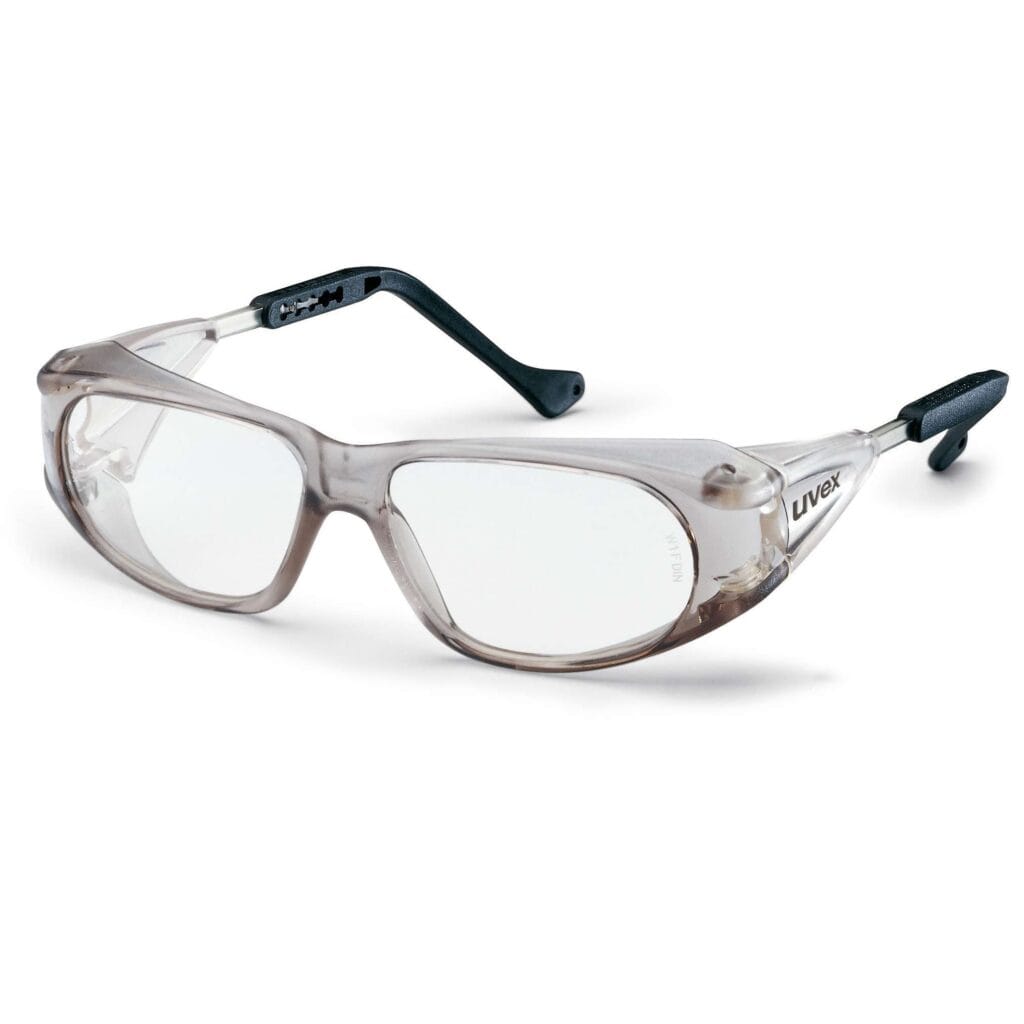
Short Answer: Prescription PPE eyewear must meet ANSI Z87.1 impact standards while also placing each lens’s optical center precisely in front of the wearer’s pupil. A misaligned optical center induces unwanted prism, causing eye strain, headaches, and reduced visual acuity — serious hazards in an industrial environment. Optogrid measures pupillary distance (PD), dual PD, and segment height (SH) from a patient photograph, giving optical shops the accuracy needed to produce compliant prescription safety glasses without in-person measurement equipment.
When an employer sends a worker to your optical shop for prescription safety glasses, you’re filling a dual order: vision correction and ANSI-certified impact protection in the same lens. The fabrication starts with measurement, and for safety frames, measurement accuracy is held to a higher standard than for dress eyewear. According to the U.S. Bureau of Labor Statistics, workers suffered 18,510 eye-related injuries and illnesses in 2020, with many concentrated in industries where prescription eyewear wearers need integrated PPE rather than goggles worn over glasses.
What ANSI Z87.1 Requires for Prescription Safety Eyewear
ANSI/ISEA Z87.1 is the U.S. national standard for occupational and educational eye and face protection. For prescription lenses, the standard sets requirements across three areas relevant to optical measurement:
- Impact resistance: Lenses must withstand high-mass and high-velocity impact tests without fracturing or dislocating. This requirement shapes the minimum lens thickness: 2.0mm for polycarbonate and Trivex, 3.0mm for high-index plastics. Thickness, in turn, affects how lenses are fabricated and centered. For a full breakdown of how materials compare on index, Abbe value, and impact ratings, see the lens material comparison guide.
- Optical quality: Lenses must be within specified power tolerances (typically ±0.12 to ±0.25 diopters depending on prescription power) and must not introduce unintended prismatic effects beyond acceptable limits.
- Marking: Frames and lenses must carry permanent ANSI Z87.1 markings to certify compliance.
An optical shop filling a prescription PPE order is responsible for producing lenses that meet both the worker’s visual prescription and the standard’s optical quality requirements. That starts with an accurate PD measurement. For the employer’s OSHA compliance obligations, see Prescription Safety Glasses: OSHA & ANSI Z87.1 Compliance.
Why Optical Center Alignment Is a Safety Issue, Not Just a Comfort Issue
The optical center of a prescription lens is the point through which light passes without refraction. When the optical center does not align with the wearer’s pupil, the lens behaves like an unintended prism.
Research published in PMC (National Library of Medicine) documents this mechanism: “The quantity of prism induced depends on the power of an ophthalmic lens and the displacement of optical center of the lens to the pupillary center of eye.” The same study found that approximately 57% of single-vision spectacle wearers were not viewing through the optical center. These wearers experienced a mean decentration of 3.5mm. The researchers concluded that “the induced prismatic leads to reduced stereo acuity, fusional convergence, and in turn affects binocular vision status.”
For a worker on a production floor or construction site, reduced stereo acuity and binocular vision disruption are not minor inconveniences. They affect depth perception, reaction time, and coordination.
A separate PMC study on optical center fitting states the consequence directly: “If the pupillary distance is measured incorrectly, the optical centre will be incorrectly set within the spectacle frames.” The wearer then experiences “eye strain, discomfort, and headaches,” a failure mode that prescription safety glasses are supposed to eliminate, not introduce.
Accurate monocular PD (each eye’s individual distance from the nose bridge to the pupil) measurement is therefore not optional for prescription PPE. It is the prerequisite for producing safety eyewear that actually protects the worker as the ANSI standard intends.
How Optogrid Measures PD and SH for Prescription Safety Glasses
Optogrid is a browser-based platform for optical shops and optometrists. The measurement workflow requires no physical device or specialized equipment. You need only a photograph of the patient.
The process:
- The optical shop uploads a photograph of the patient, with or without existing eyeglass frames in the photo.
- Optogrid’s algorithm identifies facial landmarks and calculates monocular PD (right and left separately), dual PD (total interpupillary distance), and segment height (the vertical position of the reading zone in a bifocal or progressive lens) for progressive or bifocal safety lenses.
- The measurements are returned in under 60 seconds, ready for the lab order.
Because ANSI Z87.1 safety frames have fixed frame dimensions that differ from standard optical frames, accurate monocular PD values are particularly important. A symmetric PD value that splits total PD equally across both eyes may misplace the optical center in workers with facial asymmetry, which, as the PMC data shows, is the majority. Monocular measurement is the clinical standard for safety eyewear fabrication. Unlike adjustable dress frames that can be physically shifted to center the optical axis, safety frames have fixed temple widths and rigid dimensions — so an asymmetric face requires asymmetric monocular PD values to place each lens’s optical center correctly.
For optical shops handling prescription PPE orders remotely (for example, an employer sending employee prescriptions in bulk), Optogrid enables measurement from photographs without requiring each worker to visit the dispensary in person. The measurement accuracy (±0.5mm) is comparable to clinical pupillometers, as documented in remote PD measurement research.
Who Uses Optogrid for Prescription PPE Orders
Optogrid fits into the workflow for several types of optical businesses:
| Business Type | PPE Use Case |
|---|---|
| Industrial optical suppliers | Bulk prescription PPE orders for manufacturing, construction, and chemical processing employers |
| Independent optical shops | Filling individual prescription safety glass orders for local tradespeople and contractors |
| Online prescription eyewear retailers | Measuring remote customers ordering safety glasses without an in-person visit |
| Occupational health clinics | Supporting employer vision programs that include prescription PPE as a benefit |
For shops that already handle prescription eyewear, adding prescription PPE to their service offering is a natural extension, provided the measurement workflow scales to the order volume. Optogrid processes each measurement in under a minute, making it practical for both individual and batch orders.
For a broader view of how digital measurement tools fit into a modern optical shop’s software stack, see Essential Software Solutions for Eyewear Retailers.
The Connection Between Measurement Accuracy and PPE Compliance
When an employer requires ANSI Z87.1-compliant prescription safety glasses for a worker, they place legal and liability trust in the optical shop filling that order. A pair of safety glasses that passes the impact test but causes the wearer chronic headaches, eye strain, or reduced depth perception due to optical center misalignment has failed its core purpose.
Accurate PD and SH measurements are the foundation of that compliance. They determine where the optical center sits, how the lens power is distributed across the visual field, and whether the safety frame provides the coverage the standard requires.
Optogrid’s photo-based approach removes the main source of error in that process: manual measurement with a millimeter ruler. Ruler-based measurement is subject to parallax, patient movement, and operator inconsistency. Digital measurement from a calibrated photograph produces the same result every time, for every patient.
To understand how Optogrid’s measurement technology was developed, starting from direct experience in a family-owned optical retail business, see From Family Legacy to Tech Innovation: The Story Behind Optogrid.
Frequently Asked Questions: Prescription PPE and PD Measurement
What is the ANSI Z87.1 standard for prescription safety glasses?
ANSI/ISEA Z87.1 is the U.S. national standard that defines impact resistance, optical quality, and coverage requirements for occupational eye and face protection. For prescription lenses, it sets tolerances for refractive power accuracy and limits on unintended prismatic effects. OSHA’s 29 CFR 1910.133 requires that employer-provided prescription eye protection comply with this standard.
Why does PD accuracy matter more for safety glasses than regular eyewear?
Safety frames are thicker and heavier than standard optical frames, and their fixed dimensions leave less room to compensate for an off-center optical placement. Additionally, workers wearing safety glasses in industrial environments are subject to physical exertion, vibration, and variable lighting — conditions where even moderate optical center misalignment can cause fatigue, reduced depth perception, or double vision. Research shows a mean decentration of 3.5mm produces measurable binocular vision disruption.
Can Optogrid measure PD for progressive or bifocal safety lenses?
Yes. Optogrid measures both PD (monocular and dual) and segment height (SH), which is required for progressive and bifocal safety lenses to correctly position the reading zone within the frame.
How accurate is photo-based PD measurement for PPE fabrication?
Optogrid measures to ±0.5mm accuracy — within the tolerance range of clinical pupillometers. This accuracy is sufficient for prescription safety glass fabrication under ANSI Z87.1 optical quality requirements. For detailed accuracy data and methodology, see the remote PD measurement technology guide.
Does the patient need to be present for Optogrid to take a measurement?
No. Optogrid requires only a photograph of the patient. This makes it suitable for remote workers, bulk employer PPE programs where employees submit photos, and online order workflows where the customer is not physically present at the dispensary.
What industries most commonly require prescription PPE eyewear?
The U.S. Bureau of Labor Statistics data shows that workplace eye injuries are concentrated in manufacturing, construction, and service industries. Any employer with OSHA-mandated eye protection requirements where workers have prescriptions — including chemical processing, machining, welding, carpentry, and laboratory environments — has workers who need prescription safety glasses rather than over-the-glasses goggles.
How does Optogrid fit into an optical shop’s prescription PPE workflow?
After receiving a customer’s prescription (from their optometrist or employer records), the shop uploads a photograph to Optogrid, receives PD and SH measurements in under 60 seconds, and enters those measurements into the lab order alongside the prescription details. No additional measurement equipment is required.

I grew up inside an optical shop. My mother likes to tell how, as a kid, I would watch eyeglasses being assembled, play with the tools, and draw on the back of service order slips. The family business taught me early what a precise measurement and work done right are worth.
I went on to spend more than twenty years as a software engineer, always keeping an eye on the optical world. Optogrid was born where the two meet: digital measurement technology (pupillary distance and fitting heights) built by someone who knows the dispensing counter from the inside.