
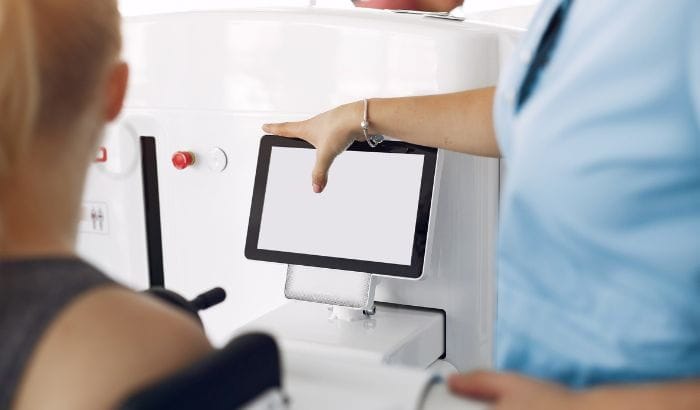
A digital lensmeter is an electronic optical instrument that automatically measures the dioptric power (sphere, cylinder, and axis), prism, and optical center of ophthalmic lenses. Models equipped with Shack-Hartmann sensors analyze up to 108 measurement points simultaneously, with increments as fine as 0.01 D, eliminating the subjectivity of manual readings.
The digital lensmeter (also called an auto lensmeter or electronic focimeter) verifies whether a manufactured lens falls within the prescribed tolerance before dispensing to the patient. In an optical shop, this control reduces returns, rework, and financial losses. Prescription errors rank among the leading causes of customer dissatisfaction, and the digital lensmeter addresses this by delivering automatic, reproducible results in accordance with the requirements of ISO 8598-1:2014 for focimeters.
Digital vs. Analog Lensmeter: 8 Differences That Affect Lens Verification
| Criterion | Analog Lensmeter | Digital Lensmeter |
|---|---|---|
| Reading | Manual (operator adjusts target visually) | Automatic (sensor processes the result) |
| Human error risk | High (depends on operator experience) | Low (objective, reproducible reading) |
| Measurement speed | Slow (manual adjustment per meridian) | Seconds per lens (position and read) |
| Minimum increment | Typically 0.25 D | Down to 0.01 D in advanced models |
| Supported lens types | Single vision and bifocal | Single vision, bifocal, progressive, and multifocal |
| Additional measurements | Not available | UV, transmittance, refractive index (model-dependent) |
| Connectivity | None | USB, Bluetooth, data export (model-dependent) |
| Training requirement | High to ensure accuracy | Lower, with touchscreen-guided interface |
The primary advantage of a digital model is not just speed: it is consistency. Two operators using the same digital lensmeter obtain equivalent results, something impossible to guarantee with an analog instrument. As described in the Lensometry chapter on StatPearls, lensmeters may be manual, semi-automatic, or fully automatic, with automatic models eliminating operator variability from the reading.
What a Digital Lensmeter Measures
The digital lensmeter measures the power of ophthalmic lenses and, depending on the model, offers additional functions:
- Dioptric power: sphere (SPH), cylinder (CYL), and axis (AX)
- Prism: value and base direction (horizontal and vertical)
- Optical center: location and automatic or assisted marking
- Ultraviolet (UV): percentage of UV radiation transmittance
- Refractive index: lens material identification
- Transmittance: in models with this specific function
- Lens type detection: single vision, progressive, or multifocal (automatic in advanced models)
For practices that fit contact lenses, some models also include a dedicated contact lens measurement mode. The ZEISS VISULENS 550, for example, offers a contact lens mode in addition to standard, progressive, and UV modes.
Components of an Electronic Lensmeter and Their Functions
To use a digital lensmeter efficiently, understand each component:
- Display screen: shows the power captured by the sensor in real time. Recent models use color touchscreens ranging from 5.7″ to 7″ for easier navigation
- Lens rest: used when measuring lenses already mounted in a frame
- Marking pins: mark the optical center and axes on the lens. Always use the manufacturer’s original ink and pins to ensure legible markings
- Clamping arm: stabilizes the lens during the reading, eliminating unwanted tilt angles. Should be used for every measurement
What Appears on the Digital Lensmeter Screen
Regardless of model, the basic information displayed on screen includes:
- Eye indicator: R (right) and L (left)
- Measurement scale: configurable in steps of 0.01 D, 0.06 D, 0.125 D, or 0.25 D, per ISO 8598-1:2014
- Lens type: single vision, progressive, or automatic detection
- Dioptric power: sphere (SPH), cylinder (CYL), and axis (AX)
- Prism: horizontal or vertical, with value and base
- Centering target: reference for alignment
- Optical center marking: centering crosshair
- Settings menu
About measurement steps: ISO 8598-1:2014 specifies that focimeters may display values rounded to the smallest increment of 0.25 D or 0.125 D. The value “0.12 D” frequently listed in equipment manuals is shorthand for 0.125 D. Models like the ZEISS VISULENS 550 and the Nidek LM-1800PD also offer 0.06 D and 0.01 D increments for higher-precision verification.
Sensor Comparison: Which Technology to Choose
The sensor type defines both the precision and speed of a digital lensmeter. The table below compares the three technology categories available on the market.
| Feature | Basic Optical Sensor | Hartmann-Shack Sensor | Advanced Wavefront Sensor |
|---|---|---|---|
| Measurement points | Few (sequential measurement) | 81 to 108 simultaneous points | 81+ points with full wavefront analysis |
| Minimum increment | 0.25 D | 0.01 D to 0.25 D (configurable) | 0.01 D to 0.25 D (configurable) |
| Progressive detection | Manual or limited | Automatic | Automatic with corridor mapping |
| UV measurement | Not available | Available on select models | Available (e.g., ZEISS VISULENS 550 with 365-480 nm spectrum) |
| Recommended for | Low-volume shops, basic verification | Medium to high-volume shops, labs | High-precision labs, complex lens verification |
| Model examples | Entry-level models | Nidek LM-1800PD (108 points), Huvitz HLM-1 | ZEISS VISULENS 550 (81 points, Shack-Hartmann) |
The Nidek LM-1800PD uses a Hartmann sensor with 108 simultaneous measurement points within the lens support cone, according to the manufacturer’s specifications. The ZEISS VISULENS 550 operates with an 81-point Shack-Hartmann sensor at a wavelength of 545 nm (e-line), per the ZEISS product page.
How to Choose the Right Digital Lensmeter for Your Practice

Choosing the wrong model creates technical, financial, and operational consequences. The criteria below organize the decision by order of importance.
Measurement Precision: The Most Critical Factor
When evaluating precision, consult the technical manual, not just the sales sheet. Verify:
- Minimum reading increment: ranges from 0.25 D to 0.01 D. The smaller the step, the greater the ability to detect micro-variations, especially in progressive lenses and complex digital lens designs
- Error margin (tolerance): more precise instruments show less variation across repeated measurements of the same point
- Number of measurement points: sensors with more points (81 to 108) capture power with greater spatial resolution
Intuitive Interface: Efficiency at the Counter
A well-designed interface reduces training time and the risk of operational errors. Evaluate:
- Self-explanatory menus and clearly defined function icons
- Operational workflow with minimal steps
- Language and terminology familiar to the operator
Additional Features: Versatile vs. Specialized
Extra features define the equipment profile. Consider:
- Automatic lens detection: identifies single vision, progressive, or multifocal without manual adjustment. Reduces measurement time per patient
- Contact lens measurement: essential if your practice fits contact lenses
- Automatic or assisted optical center marking: speeds up verification and positioning
- Connectivity and data export: USB, Bluetooth, integration with practice management software, and report export. Useful for maintaining organized technical records and verification traceability
If your shop stocks lenses with varying refractive indices (CR-39, 1.6, 1.67, 1.74), choose a model that identifies the index automatically. This prevents classification errors during verification.
Speed and Performance: Throughput Without Compromise
In high-volume practices, measurement speed directly impacts productivity. Instruments with Hartmann-Shack or wavefront sensors measure lenses in seconds, including progressives, which require simultaneous mapping of multiple points.
Technical Support and Service: What to Evaluate Beyond Warranty
Measurement instruments require periodic calibration to maintain reliability. Before purchasing, verify:
- Warranty duration and what it covers (parts, labor, calibration)
- Authorized service centers in your region: response time affects the period without the equipment
- Availability of certified calibration: ISO 9342-1 specifies the requirements for test lenses used in focimeter calibration
- Remote support: resolution of operational questions without on-site technician visits
Lens Verification and Pupillary Distance: Two Complementary Processes
Power verification with the lensmeter confirms that the lens was manufactured according to the prescription. But verification does not end there: the naso-pupillary distance (NPD) and pupillary distance (PD) determine the lens centering point in the frame.
A lens with the correct power but the wrong NPD causes visual discomfort, fatigue, and in more severe cases, unwanted prismatic effect. The two processes (power verification with the lensmeter and NPD measurement with a digital pupillometer) form the complete quality control before dispensing to the patient.
For optical professionals who need to serve patients remotely or expand their coverage area, Optogrid’s Virtual Pupillometer measures PD and NPD from a smartphone photograph.
Digital Lensmeter and Progressive Lenses: Why It Demands More From the Equipment
Progressive lenses have continuous power variation across their surface, from the distance zone through the progressive corridor to the near zone. Complete verification requires an instrument capable of:
- Locating and measuring the distance reference point (DRP) and the near reference point (NRP)
- Automatically detecting the lens type (progressive vs. single vision) to prevent incorrect measurements
- Measuring the addition (ADD), which is the power difference between the distance zone and the near zone
ISO 8980-2:2017 specifies the requirements and verification methods for power-variation lenses (including progressives), defining the tolerances the lens must meet at the distance reference point and for the addition. ISO 21987:2017 complements this by defining tolerances for mounted lenses, including progressives.
Entry-level models cannot correctly detect short-corridor progressives or highly complex digital designs. If your practice works with progressive lenses, this is a pass/fail criterion when selecting equipment.
Frequently Asked Questions About Digital Lensmeters
What is the difference between a digital and analog lensmeter?
An analog lensmeter requires the operator to manually adjust optical targets for each meridian of the lens, making the result dependent on the operator’s skill and experience. The digital model uses electronic sensors (such as the Hartmann-Shack, with 81 to 108 measurement points) that perform the reading automatically, with configurable increments from 0.01 D to 0.25 D, reducing human error and increasing measurement consistency.
What is NPD and how does the lensmeter relate to it?
NPD (Naso-Pupillary Distance) is the distance in millimeters from each pupil to the center of the nose. The lensmeter does not measure NPD: it verifies the lens power. A pupillometer is the correct instrument for measuring NPD. The two devices are complementary: the lensmeter confirms the lens was manufactured with the correct power; the pupillometer ensures it will be centered at the right point in front of the patient’s eye.
What is the best digital lensmeter for a small optical shop?
For shops with moderate patient volume and no in-house lab, a model with 0.25 D increment, simplified interface, and progressive lens detection covers most verification needs. Models with Hartmann-Shack or wavefront sensors (such as the Nidek LM-1800PD or the ZEISS VISULENS 550) are better suited for optical labs or shops that handle high-prescription and complex digital lens designs.
Does a digital lensmeter need calibration?
Yes. A digital lensmeter must be calibrated periodically using certified reference lenses, following the manufacturer’s recommendations. ISO 9342-1 specifies the requirements for test lenses used in focimeter calibration. Calibration frequency depends on usage volume and laboratory requirements.
What is the Hartmann-Shack sensor in a lensmeter?
The Hartmann-Shack (or Shack-Hartmann) sensor is a microlens array that divides the wavefront of light passing through the measured lens into multiple simultaneous points. The ZEISS VISULENS 550 uses 81 measurement points, while the Nidek LM-1800PD uses 108 points. Each point is analyzed individually, and the processor calculates power based on the deviation of each beam, enabling measurements with less dependence on exact lens positioning.
Can a digital lensmeter measure contact lenses?
Some models include this function, but it is not standard. The ZEISS VISULENS 550, for example, has a dedicated contact lens mode. If your practice fits contact lenses, verify specifically whether the desired model supports contact lens measurement before purchasing.
What technical standards regulate digital lensmeters?
The main standards are ISO 8598-1:2014 (requirements and test methods for general-purpose focimeters), ISO 8980-2:2017 (specifications for power-variation lenses), and ISO 13666 (ophthalmic lens vocabulary). In the United States, The Vision Council publishes industry guidelines and technical standards for optical equipment and retail best practices.
Complete Verification: Prescription Power and Pupillary Distance
Accurate eyewear dispensing depends on two simultaneous controls: the lens power (verified with a digital lensmeter) and correct centering (ensured by precise pupillary distance measurement).
With Optogrid’s Virtual Pupillometer, you can measure PD and NPD with precision from anywhere, without additional physical equipment. See how it works in practice in the guide to measuring PD and segment height with Optogrid.
References
- American Academy of Ophthalmology. Basic and Clinical Science Course (BCSC), Section 3: Clinical Optics and Vision Rehabilitation. San Francisco: AAO, 2025-2026.
- International Organization for Standardization. ISO 8598-1:2014 — Optics and optical instruments — Focimeters — Part 1: General purpose instruments.
- International Organization for Standardization. ISO 8980-2:2017 — Ophthalmic optics — Uncut finished spectacle lenses — Part 2: Specifications for power-variation lenses.
- International Organization for Standardization. ISO 21987:2017 — Ophthalmic optics — Mounted spectacle lenses.
- International Organization for Standardization. ISO 9342-1:2023 — Optics and optical instruments — Test lenses for calibration of focimeters — Part 1.
- International Organization for Standardization. ISO 13666 — Ophthalmic optics — Spectacle lenses — Vocabulary.
- Musa, M. J.; Zeppieri, M. Lensometry. In: StatPearls. Treasure Island (FL): StatPearls Publishing, 2023.
- Brooks, C. W.; Borish, I. M. Ophthalmic Lenses and Dispensing. Butterworth-Heinemann.
- Brooks, C. W. System for Ophthalmic Dispensing. Elsevier.
- The Vision Council. Industry guidelines and technical standards for optical equipment and retail best practices.
- ZEISS. VISULENS 550 — Lensmeter. Product technical specifications.
- NIDEK. Auto Lensmeter LM-1800PD/1800P. Product technical specifications.

I am a seasoned software engineer with over two decades of experience and a deep-rooted background in the optical industry, thanks to a family business. Driven by a passion for developing impactful software solutions, I pride myself on being a dedicated problem solver who strives to transform challenges into opportunities for innovation.