
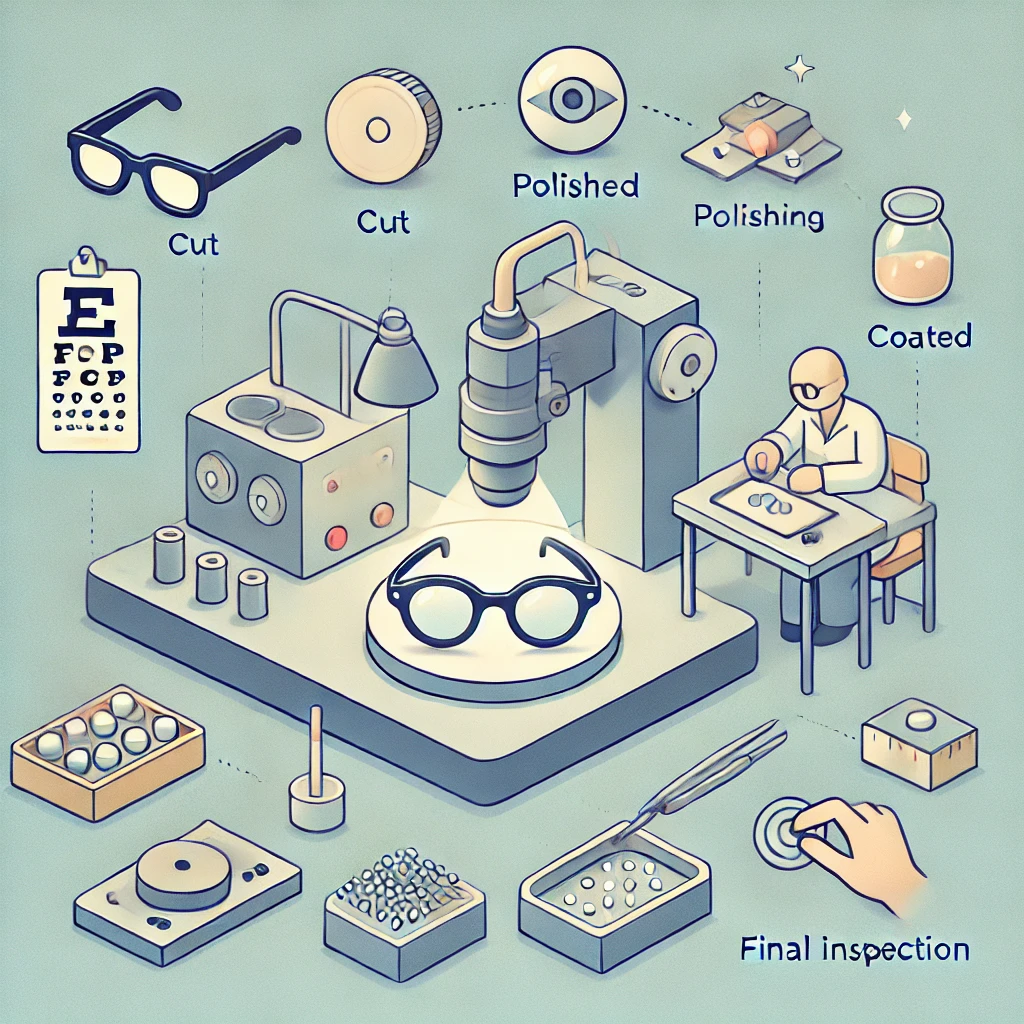
Short Answer: Ophthalmic lens manufacturing transforms a semi-finished lens blank into a prescription lens through four core stages — surfacing (or freeform generation), polishing, coating, and edging. Material choice (CR-39, polycarbonate, Trivex, or high-index plastic) determines the optical and physical properties of the final lens. Coating technologies — AR, hard coat, hydrophobic, oleophobic, and blue light filter — are then applied in layers to enhance performance and durability. Accurate pupillary distance (PD) and segment height (SH) measurements are critical inputs: errors at this stage cannot be corrected after manufacturing without remaking the lens.
Lens Materials Compared: Refractive Index, Abbe Value, and Best Use Cases
Choosing the right lens material is the first manufacturing decision, and it determines lens thickness, optical clarity, impact resistance, and weight. The core optical properties to compare are the refractive index (higher = thinner lens for a given power) and the Abbe value (higher = less chromatic aberration and clearer peripheral vision).
The following specifications are sourced from Laramy-K Independent Optical Lab’s lens material comparison guide:
| Material | Refractive Index | Abbe Value | Specific Gravity (g/cm³) | Best Use Case |
|---|---|---|---|---|
| CR-39 | 1.50 | 58 | 1.32 | Low-to-mid prescriptions (±0 to ±3.00), best optical clarity, most coatable |
| Polycarbonate | 1.58 | 29 | 1.21 | Children’s eyewear, sports, safety glasses — impact resistance priority |
| Trivex | 1.53 | 46 | 1.11 | Drill-mount frames, active lifestyles — lightest material with good optics |
| High-index 1.60 | 1.60 | 42 | 1.22 | Mid-to-strong prescriptions (±3.00 to ±5.75), balance of thin and clear |
| High-index 1.67 | 1.67 | 32 | 1.35 | Strong prescriptions (±5.75 to ±8.00), significantly thinner edges |
| High-index 1.74 | 1.74 | 30–32 | 1.46–1.47 | Very strong prescriptions (±8.00+), thinnest available |
Reading the table:
- Abbe value below 40 means visible chromatic aberration (color fringing) is possible at the periphery of the lens — relevant for polycarbonate (29) and high-index 1.67 and 1.74.
- Specific gravity determines weight. Trivex (1.11) is the lightest material. High-index plastics are denser — a 1.67 lens is heavier than a 1.60 lens of equivalent prescription.
- CR-39 has the highest Abbe value of any plastic material (58), giving it the best peripheral optical clarity of all lens plastics.
For a deeper look at how lens type intersects with prescription design, see our guide on prescription lenses: types, materials, and coatings (Lentes de Grau).
How a Lens Blank Becomes a Finished Prescription Lens
Every prescription lens starts as a semi-finished blank — a standardized disc of cured lens material, typically 70–80mm in diameter, with one pre-formed convex (front) surface. The back surface is blank. The job of the optical laboratory is to transform this blank into a lens that precisely matches the patient’s prescription.
The process involves four sequential stages:
Stage 1 — Blank Selection and Blocking
The lab selects a blank with a base curve that matches the prescription requirements. The blank is then blocked: secured to a metal or alloy chuck using a low-melting-point alloy or UV-cure adhesive. Blocking maintains the lens at a precise angle throughout surfacing so the prescription is ground in the correct orientation relative to the optical axis.
Stage 2 — Surfacing (Generation and Fining)
Surfacing is where the back surface of the blank is shaped to create the optical prescription. There are two main approaches:
Conventional surfacing uses pre-fabricated grinding tools (laps) that match standard base and cross curves. The lens is pressed against the rotating tool with polishing compound. Precision is limited to approximately 0.25 diopter (1/4 diopter) increments — the result of physical tool constraints.
Freeform (digital) surfacing uses a computer-controlled diamond-tip lathe to machine the back surface directly from the prescription data. According to Hoya Vision Care’s comparison of freeform and conventional surfacing, freeform is “refined to 1/100 of a diopter or 10 times more than a standard conventional lens,” compared to conventional technology’s “accuracy of 1/10 of a diopter.”
The practical advantages of freeform surfacing include:
- Prescriptions corrected in 0.01 diopter increments (vs 0.25 conventional)
- Incorporation of additional fitting parameters: vertex distance, pantoscopic tilt, frame wrap
- Wider fields of clear vision, with peripheral distortion significantly reduced
- Any single-vision blank can be used to produce a progressive design — expensive progressive blanks are not required
After generation, the lens goes through fining (a finer abrasive step) and then polishing with progressively finer compounds until the surface is optically clear.
Stage 3 — Hard Coat Application
Once polished, the bare lens surface is soft and easily scratched. A hard coat (scratch-resistant coating) is applied immediately after polishing, before any other coatings. The hard coat is a liquid solution cured onto the lens surface with ultraviolet light, creating a durable scratch-resistant layer. This is a prerequisite for AR coating adhesion — AR coatings bond more reliably to a hard-coated surface than to bare plastic.
Stage 4 — Edging and Fitting
Edging is the final manufacturing step before the lens reaches the patient. The edger traces the frame shape (either from a physical pattern or a digital scan) and grinds the lens circumference to match.
For progressive lenses, edging must be done with the optical center and progressive corridor positioned correctly within the frame — which is why accurate segment height measurement is essential before the lens is ordered. If the SH is wrong, edging correctly positioned cannot compensate.
Coating Technologies: AR, Hard Coat, Hydrophobic, Oleophobic, and Blue Light
Modern ophthalmic lenses receive multiple coatings applied in a specific sequence. Each layer serves a distinct function. Premium lenses stack these coatings for combined performance.
Anti-Reflective (AR) Coating
AR coating is applied by physical vapor deposition (PVD) inside a vacuum chamber at pressures of 10⁻² to 10⁻³ mbar. Multiple ultra-thin layers of contrasting metal oxides — each just 50–150 nanometers thick — are deposited in a sequence determined by optical physics to create destructive interference that cancels reflected light waves. Modern premium AR coatings reduce total lens reflectance to approximately 0.5–1.5%, meaning up to 99% of available light reaches the eye.
AR coating benefits for wearers:
- Reduced glare during night driving and screen use
- Improved cosmetic appearance (lenses appear nearly invisible)
- Enhanced contrast and visual comfort in low-light conditions
Hydrophobic Coating
Applied over the AR stack, a hydrophobic top coat causes water to bead and run off the lens surface rather than spreading into a film. This reduces fogging, streaking, and the smearing that occurs when a wet lens is wiped with a cloth. It also extends the lifespan of the underlying AR coating by reducing water-borne contaminant adhesion.
Oleophobic Coating
An oleophobic coating prevents skin oils, cosmetics, and fingerprints from bonding strongly to the lens surface. Smudges wipe away more easily and with less pressure — reducing the micro-scratching that builds up from frequent cleaning. Most premium AR packages include oleophobic properties as part of the top coat layer.
Hard Coat (Scratch-Resistant)
As described in Stage 3 above, hard coat is the foundation of the coating stack. Optical-grade plastic without hard coat will show visible scratches from normal daily use within weeks. The hard coat is UV-cured and chemically bonded to the lens, not simply applied on top.
Blue Light Filter Coating
Blue light filter coatings are designed to reflect or absorb a portion of high-energy visible (HEV) blue light in the 400–450 nm range emitted by digital screens, LED lighting, and daylight. These coatings introduce a slight warm tint (approximately 2–4% more yellow in appearance) as a trade-off for reduced blue light transmission.
Important distinction: Blue light filter coatings are different from photochromic treatments. Photochromic lenses (such as Transitions) darken in UV light — a molecular change embedded in the lens during manufacturing, not a surface coating.
For guidance on preserving these coatings after purchase, see our eyewear maintenance guide.
Quality Control: How Labs Verify Prescription Accuracy
Before a finished lens leaves the laboratory, it passes through a quality control sequence:
- Lensometry — An automated lensometer measures the finished power of the lens in both sphere, cylinder, and axis. Values must fall within ANSI Z80.1 tolerances for the given prescription.
- Centration verification — The optical center (or for progressives, the fitting cross) is confirmed to be within tolerance of the ordered PD and SH values. Per ISO 21987, the manufacturing tolerance for progressive lens monocular centration is 1mm.
- Visual inspection — Surface defects, coating blemishes, or edging chips that would affect vision or cosmetic quality are identified under a loupe or inspection light.
- Coating adhesion test — A cross-hatch tape test or bake test confirms that AR and hard coat layers are bonded correctly and will not peel.
- Thickness measurement — Center and edge thickness are verified against the lab’s calculations for the ordered prescription and material index.
How Accurate PD and SH Measurements Improve the Manufacturing Workflow
Every stage described above operates on the values provided by the optician at the point of fitting: prescription power, PD (monocular or binocular), and segment height (for progressive and bifocal lenses). These values are the inputs that drive the freeform surfacing algorithms and determine edging position.
The clinical consequence of measurement error is direct. According to a study published in PMC (National Library of Medicine), when the optical center is set incorrectly due to a PD error, patients experience “blurred or distorted vision” that “can cause the patient to experience eye strain, discomfort, and headaches” — and the only correction is to remake the lenses.
ISO 21987 sets the monocular centration tolerance for progressive lenses at 1mm. This means that a PD measurement error of more than 1mm per eye — before any manufacturing tolerances are added — will produce a lens outside the standard for progressive centration.
Digital measurement tools remove the dominant source of this error. Optogrid’s photo-based PD and SH measurement platform captures monocular PD and segment height from a calibrated photograph, delivering precise values that feed directly into the laboratory order. Errors introduced by ruler misplacement, patient movement, or parallax in manual measurement are eliminated.
For progressive lens patients in particular — where both PD and SH directly affect corridor positioning — accurate digital measurements translate into fewer remakes, reduced material waste, and better patient outcomes on first delivery.
Sustainability Practices in Modern Optical Labs
Lens manufacturing is energy and material-intensive, and laboratories are responding with measurable operational changes:
- Closed-loop water recycling in polishing and wet-edging to reduce water consumption
- Solvent-free, water-based hard coat formulations replacing older solvent-based systems
- Single-vision blank freeform production reduces the range of blanks that must be stocked and discarded, cutting inventory waste
- Energy-efficient vacuum systems for AR coating chambers
- Blank blank recovery programs — some labs return unused or defective blanks to material suppliers for regrinding
FAQ: Lens Manufacturing Technology
What is the difference between freeform and conventional lens surfacing?
Conventional surfacing uses pre-fabricated grinding tools and produces prescriptions in 0.25 diopter increments. Freeform (digital) surfacing uses a computer-controlled diamond-tip lathe that generates the prescription in 0.01 diopter increments — ten times more precise — and can incorporate individual fitting parameters such as vertex distance and pantoscopic tilt.
Why does Abbe value matter when choosing a lens material?
The Abbe value measures how much a lens material disperses light into its component colors. A lower Abbe value produces more chromatic aberration — visible as color fringing or reduced clarity at the edges of the lens. CR-39 (Abbe 58) and Trivex (Abbe 46) have the best optical clarity of common plastic lens materials. Polycarbonate (Abbe 29) and high-index 1.67 (Abbe 32) trade optical clarity for thinness and impact resistance.
What is the correct order for applying lens coatings?
The standard sequence is: (1) hard coat applied immediately after polishing, UV-cured onto the bare surface; (2) AR coating deposited by physical vapor deposition in a vacuum chamber; (3) hydrophobic and oleophobic top coats applied over the AR stack. Blue light filter layers are integrated within the AR deposition stack, not applied separately.
Can a lens be recoated if the AR coating wears out?
Technically yes — some optical labs offer recoating services where old AR is stripped and a new coating stack is applied. However, this is uncommon in practice because the stripping process can damage the lens surface, and the cost is often close to a new lens. For most patients, when AR coating fails visibly, replacing the lens is the better outcome.
What happens if the pupillary distance measurement is wrong?
A PD error shifts the optical center of the lens away from the patient’s pupil, creating an unintended prismatic effect. For strong prescriptions and progressive lenses, even a 1mm monocular error can cause eye strain, headaches, and adaptation failure. Per ISO 21987, the acceptable monocular centration tolerance for progressive lenses is 1mm — so measurement errors at the fitting stage directly impact whether a finished lens meets the international standard.
What is a lens blank and where does manufacturing begin?
A semi-finished lens blank is a standardized disc (typically 70–80mm in diameter) with one pre-formed front surface curve and a flat back. The blank is manufactured by lens material suppliers (such as PPG for Trivex or Mitsui Chemicals for MR-series high-index materials) and sold to optical laboratories. The lab adds the prescription to the back surface through surfacing, then applies coatings, and finally edges the lens to fit the patient’s frame.
Why do polycarbonate lenses need a scratch-resistant hard coat when CR-39 does not?
CR-39 plastic has inherent hardness that gives it the highest scratch resistance of any uncoated optical plastic. Polycarbonate is significantly softer — without a hard coat, it scratches from ordinary cleaning within weeks. Trivex also requires hard coating for the same reason. Most labs apply hard coat as a standard step regardless of material to extend coating longevity.
See also:
- Segment Height for Progressive Lenses: The Optician’s Fitting Guide
- Remote PD Measurement: Technology Guide for Opticians
- Eyewear Maintenance Guide: How to Clean and Care for Your Glasses
- Lentes de Grau: Tipos, Materiais, Revestimentos e Como Escolher

I am a seasoned software engineer with over two decades of experience and a deep-rooted background in the optical industry, thanks to a family business. Driven by a passion for developing impactful software solutions, I pride myself on being a dedicated problem solver who strives to transform challenges into opportunities for innovation.