
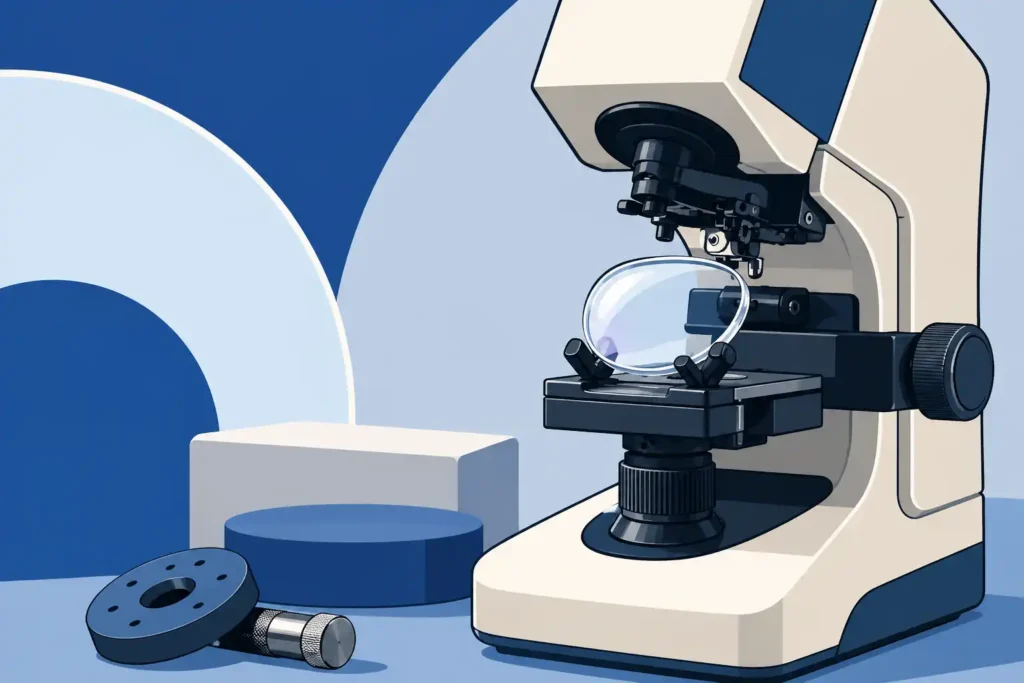
A complete lensmeter calibration routine has two parts: eyepiece adjustment (manual units only) and an accuracy check against a known reference. The procedure takes under five minutes and should run at the start of every working day. ISO 8598-1:2014 sets the maximum permissible indication error for a general-purpose focimeter at ±0.06 D.
Two Concepts Opticians Often Confuse
Eyepiece adjustment corrects for the operator’s refractive error (manual lensmeters only). It must be repeated each time a different operator uses the instrument and does not verify instrument accuracy.
Instrument zeroing and accuracy check verifies that the lensmeter produces correct power readings against a traceable reference. This applies to both manual and automatic units and is what “calibration” means in a compliance context. Skipping the accuracy check means you do not know whether the instrument is reading correctly.
Manual Lensmeter Calibration: Step-by-Step
Step 1: Adjust the Eyepiece for Your Eye
With no lens on the stage, rotate the eyepiece fully counterclockwise, then slowly clockwise until the reticle hairlines snap into sharpest focus. Stop the moment they appear sharp — continuing past that point lets your accommodation compensate and introduces a false reading. Per Cordero (Community Eye Health Journal, 2016), “the reticle should be in focus. If it is not, adjust the eyepiece until it is sharply focused.”
Step 2: Zero the Power Wheel
With no lens on the stage, approach zero from the plus side: turn the power wheel into plus, then slowly decrease until the mires snap into focus. Per Cordero (2016): “Do not oscillate the wheel back and forth to find the best focus.” The wheel should read zero. If it reads anything other than zero after correct eyepiece setup, note the offset.
Step 3: Check the Axis Scale at 180°
Rotate the axis wheel to 180°. The axis reticle line should align precisely with the 180° mire; a consistent offset indicates axis scale drift affecting all cylinder readings.
Step 4: Verify Prism at Zero
With the power wheel at zero and no lens on stage, the prism reading should show no deviation. A persistent prism value indicates the prism compensator is out of zero.
Step 5: Accuracy Check Against a Reference Lens
Place a certified test lens on the stage and read it. Per ISO 9342-1:2023, which defines requirements for focimeter reference lenses, the indicated value should fall within ±0.06 D of the certified value. If outside tolerance, document the offset, compensate in measurements, and schedule service. Do not adjust internal optics yourself.
Automatic Lensmeter Calibration: Step-by-Step
Step 1: Power-On Self-Test
Wait for the initialization sequence to complete; readings taken before it finishes are unreliable.
Step 2: Clear the Stage and Read Empty
Confirm no lens is on the stage, then trigger a measurement. The display should show 0.00 sphere, 0.00 cylinder, and 0 prism. A non-zero result indicates sensor drift, sensor window contamination, or a shifted reference value.
Step 3: Accuracy Check Against a Reference Lens
Place a certified test lens on the stage and record the reading. Per ISO 8598-1:2014, indication error must not exceed ±0.06 D. For powers beyond ±10 D, check your manufacturer’s specification for extended-range tolerance.
Step 4: Clean the Sensor Window If Readings Are Noisy
If readings are inconsistent on the same reference lens, inspect the sensor window first. A smudged CCD window is the most common cause. Use a clean microfiber cloth; do not blow compressed air directly onto exposed sensor elements.
Manual vs. Automatic Lensmeter Calibration Comparison
| Calibration Element | Manual Lensmeter | Automatic Lensmeter |
|---|---|---|
| Eyepiece adjustment | Required before each operator session | Not applicable |
| Power-zero check | Set with power wheel, no lens on stage | Automated on startup; verify via empty-stage read |
| Axis zero check | Manual alignment to 180° mire | Self-calibrated; check with reference lens |
| Prism zero check | Manual with empty stage | Empty-stage read; should show 0.00 |
| Reference lens check | Required for accuracy verification | Required for accuracy verification |
| Tools needed | Certified test lens (ISO 9342-1) | Certified test lens (ISO 9342-1) |
| Recommended frequency | Daily (eyepiece + zero); weekly (reference lens) | Daily (empty-stage read); weekly (reference lens) |
| Service interval | Every 12 months or when offset exceeds ±0.12 D | Every 12 months or per manufacturer spec |
Calibration Frequency Matrix
Most practices lump all calibration tasks together, which leads to either over-servicing or undetected drift. A schedule that separates check types by frequency:
| Frequency | Task | Who |
|---|---|---|
| Daily | Eyepiece adjustment (manual only) + empty-stage zero check | Operator |
| Weekly | Reference lens accuracy check; document the offset value | Operator |
| Monthly | Review weekly offset log for drift trend | Practice manager |
| Annual | Full manufacturer service calibration with traceable test equipment | Qualified technician |
“It must become a good habit for the optician to periodically check the accuracy of such an important instrument as the frontometer,” per IODA focimeter calibration documentation.
ANSI Z80.1-2015 sets the sphere tolerance for single-vision lenses within ±6.50 D at ±0.13 D. A lensmeter offset of ±0.12 D consumes nearly all of that margin, making the weekly reference-lens check the most practical remake-risk control a practice has.
Common Causes of Calibration Drift
Manual lensmeters: power drum wear, prism cell drift from vibration or impact, lamp aging, and eyepiece lock nut loosening.
Automatic lensmeters: sensor window contamination (most common — in our experience a dirty sensor window is the culprit more often than any internal component failure), CCD sensor aging, reference mirror contamination, and firmware-update reference value corruption.
A consistent offset in one power range but not another points to optical path misalignment rather than a zero error. That requires manufacturer service, not field adjustment.
Troubleshooting: Three Common Symptoms
Persistent power error across all lenses. Run the zero procedure. Per Cordero (2016), “if the power wheel still does not read zero, the error must be compensated for in all future measurements made with the lensmeter, or the lensmeter needs maintenance.”
Persistent axis drift. Consistent degree-offset readings indicate a mechanical shift in the axis scale or reticle. This requires service; do not attempt to recalibrate internally.
Persistent prism on a plano lens. Check stage tilt and prism compensator zero. Try a second plano from your calibration set before assuming instrument fault.
When to Consider a Digital Alternative
A digital lensmeter is a separate instrument with its own calibration requirements — it does not fix a bench unit that is out of tolerance. It is useful as a second data point for difficult geometries (high-wrap frames, lenticular lenses) while the bench unit awaits service, not as a substitute for servicing it.
Frequently Asked Questions
How often should a lensmeter be calibrated?
The zero check (eyepiece adjustment + empty-stage read) should run daily. A reference lens accuracy check should run weekly. A full service calibration by a qualified technician should occur annually, or sooner if the measured offset exceeds ±0.12 D.
Can I calibrate a lensmeter without a certified calibration set?
The zero check and eyepiece adjustment do not require a calibration set, but verifying actual measurement accuracy does. A reference lens with a traceable power value (per ISO 9342-1:2023) is required. A lens of unknown power tells you nothing about whether the instrument is within tolerance.
What tolerance is acceptable for a calibrated lensmeter?
Per ISO 8598-1:2014, the maximum permissible indication error for a general-purpose focimeter is ±0.06 D for powers within roughly ±10 D; Table 1 of the standard tiers tolerances at higher absolute powers. Most dispensing prescriptions fall within the ±10 D window, so ±0.06 D is the working benchmark for routine practice.
What is the difference between eyepiece adjustment and instrument calibration?
Eyepiece adjustment corrects for the operator’s refractive error (manual lensmeters only). Instrument calibration verifies accuracy against a traceable reference and applies to both manual and automatic units. The two address different problems and are not interchangeable.
When should a lensmeter be sent for service rather than compensated manually?
Send the unit for service when offset exceeds ±0.12 D on a reference lens, when axis drift cannot be corrected by the operator, when prism reads non-zero on an empty stage after confirming stage seating, or when readings are erratic on the same lens across repeated attempts. Manual compensation is a short-term workaround; the underlying cause requires professional diagnosis.
Does lensmeter calibration affect my overall dispensing accuracy?
Yes. A systematic offset flows into every prescription lens you verify, inflating your remake rate. Vertex power verification and PD measurement accuracy both depend on a calibrated lensmeter as the baseline reference.

I grew up inside an optical shop. My mother likes to tell how, as a kid, I would watch eyeglasses being assembled, play with the tools, and draw on the back of service order slips. The family business taught me early what a precise measurement and work done right are worth.
I went on to spend more than twenty years as a software engineer, always keeping an eye on the optical world. Optogrid was born where the two meet: digital measurement technology (pupillary distance and fitting heights) built by someone who knows the dispensing counter from the inside.