

An ophthalmologist is a medical doctor (MD or DO) who specializes in eye and vision care. According to the American Academy of Ophthalmology (AAO), ophthalmologists are “the only eye doctors with medical degrees” and complete 12 to 14 years of education and training. They diagnose and treat all eye diseases, perform surgery, and prescribe eyeglasses and contact lenses. For routine eye exams and glasses prescriptions, an optometrist provides comparable care and may be more accessible.

How Ophthalmologists Are Trained in the United States
An ophthalmologist’s training is one of the longest in medicine. The AAO describes the typical pathway as “a four-year college degree followed by four years of medical school and at least four additional years of medical and surgical training”.
The training pathway, step by step
- Undergraduate degree: 4 years of college, typically with pre-med coursework in biology, chemistry, and physics
- Medical school: 4 years leading to an MD (Doctor of Medicine) or DO (Doctor of Osteopathic Medicine) degree
- Internship year: 1 year of general clinical training in internal medicine, surgery, or a transitional program
- Ophthalmology residency: Minimum 3 years of specialized hospital-based training. The AAO states that “after four years of medical school and one year of internship, every ophthalmologist spends a minimum of three years of residency in ophthalmology”
- Fellowship (optional): 1 to 2 additional years in a subspecialty such as retina, glaucoma, pediatric ophthalmology, or oculoplastics
The minimum training before independent practice is 12 years after high school. Ophthalmologists who pursue fellowship subspecialization invest 13 to 14 years total.
Board certification
Many ophthalmologists pursue board certification through the American Board of Ophthalmology (ABO). The AAO explains that “a board-certified ophthalmologist has passed a rigorous two-part examination given by the American Board of Ophthalmology designed to assess his/her knowledge, experience, and skills”. Ophthalmologists certified after 1992 must renew their certification every 10 years.
Ophthalmologist, Optometrist, and Optician: Comparison Table
These three professionals work in eye care but with fundamentally different training, scope, and legal authority. Understanding the distinction helps patients and optical professionals route care correctly.
| Ophthalmologist | Optometrist | Optician | |
|---|---|---|---|
| Medical doctor? | Yes (MD or DO) | No (OD degree) | No |
| Training | 4 years college + 4 years medical school + 1 year internship + 3 years residency (12+ years) | 2-4 years college + 4 years optometry school (6-8 years) | Associate degree, certificate program, or apprenticeship (1-2 years) |
| Performs eye exams? | Yes | Yes | No |
| Prescribes glasses and contacts? | Yes | Yes | No (fills prescriptions) |
| Prescribes medications? | Yes (all) | Yes (varies by state) | No |
| Performs surgery? | Yes | No (in most states) | No |
| Diagnoses eye diseases? | Full diagnosis and treatment | Detection, diagnosis, and management (scope varies by state) | No |
| Common conditions managed | Cataracts, glaucoma, retinal diseases, refractive surgery, strabismus, ocular trauma | Refractive errors, contact lens fitting, dry eye, vision therapy, low vision rehabilitation | Eyeglasses fitting, frame adjustments, lens dispensing |
| When to see them | Eye disease, surgery needed, systemic conditions affecting the eyes, emergencies | Routine eye exams, prescription updates, contact lens fitting | Filling a glasses prescription, frame selection, adjustments |
The AAO defines an optometrist as someone who “receives a doctor of optometry (OD) degree after completing 2 to 4 years of college-level education, followed by four years of optometry school”, while opticians are “technicians trained to design, verify and fit eyeglass lenses and frames, contact lenses and other devices to correct eyesight”.
Clinical Procedures Ophthalmologists Perform
Diagnostic examinations
Ophthalmologists conduct a full range of diagnostic tests that go beyond routine vision checks:
- Visual acuity and refraction: determines the prescription for corrective lenses. To understand what these numbers mean, see our guide on visual acuity
- Fundoscopy (dilated eye exam): examines the retina, optic nerve, and blood vessels at the back of the eye
- Tonometry: measures intraocular pressure to screen for glaucoma
- Slit-lamp biomicroscopy: inspects the cornea, iris, lens, and anterior structures under magnification
- Visual field testing (perimetry): maps peripheral vision loss, used primarily in glaucoma monitoring
- Optical coherence tomography (OCT): produces high-resolution cross-sectional images of retinal layers
- Fluorescein angiography: maps retinal blood flow to diagnose diabetic retinopathy and macular degeneration
Medical and surgical treatments
Ophthalmologists are the only eye care professionals authorized to perform all of the following:
- Prescribe ophthalmic medications, including antibiotic, corticosteroid, and anti-glaucoma eye drops
- Administer intravitreal injections (anti-VEGF therapy) for wet age-related macular degeneration
- Perform cataract surgery via phacoemulsification, replacing the clouded lens with an artificial intraocular lens
- Conduct refractive surgery (LASIK, PRK) to reduce or eliminate dependence on glasses
- Treat retinal detachment and other ophthalmic emergencies
Prescribing glasses and contact lenses
When an ophthalmologist writes a glasses prescription, it includes the refractive correction (sphere, cylinder, axis) along with pupillary distance (PD). For progressive and bifocal lenses, the segment height is also specified, as both parameters are critical for accurate lens fabrication. To understand what each number on a prescription means, read how to read your eyeglasses prescription. For a comparison of methods used to measure PD, see PD measurement methods.
Major Eye Conditions Treated by Ophthalmologists
Cataracts

Cataracts occur when the eye’s natural lens becomes progressively opaque, causing blurred vision, glare sensitivity, and frequent prescription changes. The National Eye Institute (NEI) reports that “more than half of all Americans age 80 or older either have cataracts or have had surgery to get rid of cataracts.” Treatment is surgical: the clouded lens is removed through phacoemulsification and replaced with an artificial intraocular lens. Cataract surgery is one of the most commonly performed procedures in the United States, and the vast majority of patients recover functional vision afterward.
Glaucoma
Glaucoma damages the optic nerve, typically through elevated intraocular pressure, and progresses without noticeable symptoms in its early stages. It is a leading cause of irreversible blindness worldwide. According to research published by the AAO, approximately 4.22 million adults in the United States had glaucoma in 2022, yet the NEI estimates that half of people with glaucoma do not know they have it. Treatment with eye drops, laser therapy, or surgery can slow or stop progression, but cannot restore vision already lost. Regular comprehensive eye exams are the only reliable way to detect glaucoma before significant damage occurs.
Refractive errors: myopia, hyperopia, and astigmatism
Refractive errors are the most common vision problems managed in ophthalmology and optometry practices. Myopia (nearsightedness), hyperopia (farsightedness), and astigmatism (distorted vision at all distances) are corrected with prescription lenses, contact lenses, or refractive surgery. In children, early correction is critical to prevent amblyopia (lazy eye), a condition where the brain suppresses input from one eye due to uncorrected refractive imbalance. For younger patients who need contact lenses, see our guide on contact lenses for kids.
Age-related macular degeneration (AMD)
AMD affects the macula, the central part of the retina responsible for sharp, detailed vision. It occurs in two forms: dry (gradual atrophy of retinal cells) and wet (abnormal blood vessel growth with leakage). The National Eye Institute reports that “11 million people in the United States” have AMD, making it a leading cause of vision loss for older adults. Wet AMD requires prompt treatment with anti-VEGF injections to prevent rapid vision loss.
Diabetic retinopathy
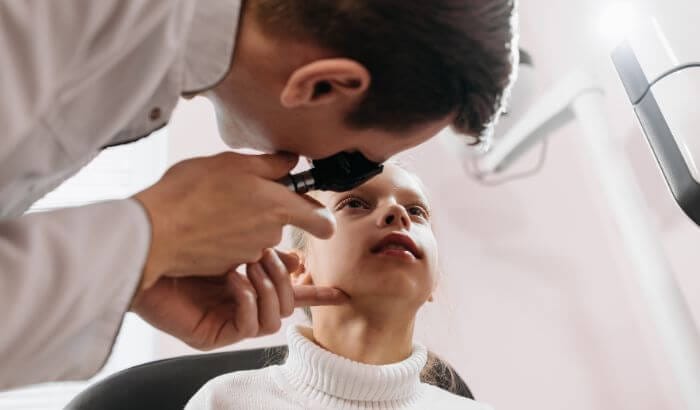
Diabetic retinopathy results from chronic high blood sugar damaging the blood vessels in the retina. The CDC’s Vision and Eye Health Surveillance System estimates that 9.6 million people in the United States were living with diabetic retinopathy in 2021, with 1.84 million having vision-threatening disease. All patients with diabetes should have annual dilated eye exams, even without visual symptoms, because early detection allows treatment before irreversible damage occurs.
When to See an Ophthalmologist vs. an Optometrist

See an ophthalmologist when:
- You have symptoms of eye disease: eye pain with redness, sudden flashes of light, new floaters, or partial vision loss
- You need eye surgery (cataracts, LASIK, retinal detachment repair)
- You have systemic conditions that affect the eyes: diabetes, hypertension, autoimmune disorders
- You have a family history of glaucoma or macular degeneration
- An optometrist has identified a condition requiring medical or surgical intervention
- You need ophthalmic medications (prescription eye drops with antibiotics, steroids, or anti-glaucoma agents)
- A child has suspected strabismus, amblyopia, or corneal abnormalities
See an optometrist when:
- You need a routine eye exam (recommended at regular intervals based on age and risk factors)
- You want to update your glasses or contact lens prescription
- You have difficulty seeing at distance or near without other symptoms
- You need a first-time contact lens fitting
- You suspect your prescription has changed
Symptoms that require emergency care:
- Sudden vision loss in one or both eyes
- A rapid increase in floaters accompanied by flashes of light (possible retinal detachment)
- Severe eye pain with redness and decreased vision
- Sudden-onset double vision
- A “shadow” or “curtain” covering part of your visual field
These symptoms may indicate ophthalmic emergencies where the time to treatment directly affects the outcome.
How Often Should You Get an Eye Exam
The American Academy of Ophthalmology recommends that adults with no risk factors receive a baseline comprehensive eye exam at age 40. After that, the recommended intervals are:
| Age Group | Recommended Frequency (No Risk Factors) |
|---|---|
| Under 40 | Every 5 to 10 years |
| 40 to 54 | Every 2 to 4 years |
| 55 to 64 | Every 1 to 3 years |
| 65 and older | Every 1 to 2 years |
| Diabetics (any age) | Annually, even without symptoms |
| Family history of glaucoma | Annually after age 40 |
| High myopia (above -6.00 D) | Annually, with emphasis on retinal exam |
Children should have vision screening at birth, before age 3, and again before starting school. The AAO’s pediatric screening guidelines recommend prompt referral to an ophthalmologist if any abnormalities are detected.

Frequently Asked Questions
What is the difference between an ophthalmologist and an optometrist?
An ophthalmologist is a medical doctor (MD or DO) who completes 12 to 14 years of training, including medical school and a surgical residency. They can diagnose and treat all eye diseases, perform surgery, and prescribe any medication. An optometrist holds a Doctor of Optometry (OD) degree after 6 to 8 years of education and provides primary eye care: eye exams, glasses and contact lens prescriptions, and management of certain eye conditions. When an optometrist detects a condition requiring surgery or advanced medical treatment, they refer to an ophthalmologist.
Do I need a referral to see an ophthalmologist?
In most cases, no. Ophthalmology is typically a self-referral specialty in the United States, meaning you can schedule an appointment directly. Some insurance plans, particularly HMOs, may require a referral from a primary care physician. Check with your insurance provider to confirm your plan’s requirements.
At what age should a child first see an eye doctor?
The AAO recommends vision screening at birth (the red reflex test performed by pediatricians) and again before age 3. A comprehensive eye exam before starting school is also recommended. Even without visible symptoms, early screening can detect conditions like amblyopia, strabismus, and refractive errors that, if left untreated during the critical developmental window, can cause permanent vision impairment.
How long does a comprehensive eye exam take?
A complete ophthalmologic exam, including patient history, visual acuity, refraction, tonometry, slit-lamp examination, and dilated fundoscopy, typically takes 45 minutes to 90 minutes. Pupil dilation alone requires 20 to 30 minutes to take full effect, and blurred near vision may persist for several hours afterward. Follow-up visits are generally shorter.
Can an ophthalmologist prescribe glasses?
Yes. Prescribing corrective lenses is a core part of ophthalmologic training. After a refraction test, the ophthalmologist writes a prescription specifying the power for each eye plus the pupillary distance, which the optician needs to fabricate the lenses correctly. For progressive or bifocal lenses, the segment height measurement is also included.
What is the difference between cataracts and glaucoma?
Cataracts and glaucoma are distinct conditions affecting different parts of the eye. A cataract is the clouding of the eye’s natural lens, causing progressively blurred vision. It is treated with surgery that has a high success rate. Glaucoma is damage to the optic nerve, usually from elevated eye pressure, and is often called the “silent thief of sight” because it progresses without early symptoms. Glaucoma treatment can stop further damage but cannot reverse vision already lost. A person can have both conditions simultaneously.
Does insurance cover ophthalmologist visits?
Most health insurance plans, including Medicare, cover medically necessary ophthalmologist visits. This includes exams for diagnosed conditions (glaucoma, cataracts, diabetic eye disease) and necessary surgical procedures. Routine refractive exams for glasses prescriptions may fall under separate vision insurance plans rather than medical insurance. Cosmetic procedures such as blepharoplasty for cosmetic purposes are typically not covered.
Sources and References
- American Academy of Ophthalmology, “What Is an Ophthalmologist?” – definitions of ophthalmologist, optometrist, and optician; training requirements
- AAO, “Training and Certification for Ophthalmologists” – residency structure, board certification through ABO
- AAO, “Frequency of Ocular Examination” (Clinical Statement) – recommended eye exam intervals by age and risk factors
- National Eye Institute, “Cataracts” – cataract prevalence data for Americans age 80+
- AAO EyeNet, “Updated Prevalence of Glaucoma in the United States” – 4.22 million adults with glaucoma in 2022
- National Eye Institute, “Age-Related Macular Degeneration” – 11 million Americans with AMD
- CDC Vision and Eye Health Surveillance System, “Diabetic Retinopathy Prevalence” – 9.6 million Americans with diabetic retinopathy in 2021

I am a seasoned software engineer with over two decades of experience and a deep-rooted background in the optical industry, thanks to a family business. Driven by a passion for developing impactful software solutions, I pride myself on being a dedicated problem solver who strives to transform challenges into opportunities for innovation.