

Independent optician practices buying software need five connected categories, not one all-in-one platform: practice management (Crystal PM, RevolutionEHR), EHR (Compulink, Optivate), lab ordering (VisionWeb), frame inventory (Frames Data), and digital measurement (Optogrid). This guide compares the actual products in each category, what they cost where that’s public, and how to tell them apart before you sign a contract.
Each category has a distinct job, and the gaps between them, a re-typed prescription, a lab order phoned in by hand, are where transcription errors and remakes accumulate, contributing to the industry’s average 15% remake rate. The comparison below names the actual vendors and what separates them; the category sections after it cover what each type of software does in more depth.
The Five Software Categories at a Glance
| Category | Core Function | Typical Monthly Cost | Integration Priority | Example Vendors |
|---|---|---|---|---|
| Practice Management | Scheduling, intake, recall | $150-$350/location | High (connects to EHR, POS) | Crystal PM, RevolutionEHR, MaximEyes |
| EHR | Exam records, Rx, imaging | Often bundled with PM | Critical (feeds optical module) | RevolutionEHR, Compulink, EyeMD EMR |
| Lab Ordering | Electronic Rx transmission | Varies (lab-dependent) | Critical (receives Rx from EHR) | VisionWeb, LabOMS |
| Frame Inventory / POS | Stock counts, sales, insurance | $100-$250/location | High (links to lab orders) | Frames Data |
| Digital Measurement | PD, SH, fitting parameters | Subscription-based | High (feeds lab order directly) | Optogrid, pupillometers |
“Optician Software” Means Different Things Depending on Where You Practise
Before shortlisting anything, check which market a vendor was built for, because the same search term returns two different product categories.
In the United States, “optician software” usually means optometry practice management and EHR. The products are organised around the exam and around US insurance billing: Crystal PM, RevolutionEHR, Compulink. That is the stack the rest of this guide compares in detail.
In the United Kingdom, Ireland and Canada, “opticians software” usually means dispensing practice management, organised around the dispense, the recall and frame stock rather than around a US claim:
- Optix is a UK system covering diary, direct debits, recalls, stock, clinical tools and business intelligence, supported from Yorkshire. It has a companion product, Audix, for audiology.
- Ocuco sells Acuitas 3 to independents and chains and Innovations 3 to labs, from a Dublin head office with London, US and Canadian customers. Its OptiCommerce product covers the online side.
- Glasson is a cloud practice-management system for opticians and optometrists, operating in Canada, Ireland and Poland.
- VisionProPOS combines practice management with point of sale and states it is used by more than 500 optical practices across Canada.
None of these publish pricing; all four route you to a demo or a quote.
Neither list is wrong. They answer different questions, and the workflows do not transfer: US insurance billing has no counterpart in a GOS-era UK system, and a US practice-management product will not model a UK recall the way a UK vendor does. If a shortlist mixes the two, you are comparing products that were never competing.
How Crystal PM, RevolutionEHR, and 10 Other Optician Software Vendors Compare
The five-category list above tells you what to shop for. The table below names the actual products practices choose between, mapped to those same categories, with pricing linked to the vendor’s own current page wherever they publish one. The four non-US systems above are listed at the end for the same comparison.
| Product | Category | Best Fit | Notable Integration | Pricing Basis |
|---|---|---|---|---|
| Crystal PM | Practice Management | Independent practices choosing between exam-only, full-service, and all-module tiers | Available as cloud-hosted or in-office deployment | Quote only, across Essentials/Plus/Pro tiers |
| RevolutionEHR | Practice Management | Practices wanting EHR and practice management from one vendor | Bundling EHR with practice management earns a 15-20% discount for new customers | $319/mo (exam-or-optical-only) up to $830/mo (Premium) |
| MaximEyes | Practice Management | Practices wanting exam records, scheduling, optical POS, and imaging under one login | Combines clinical and dispensing workflows in a single interface | Quote only |
| Compulink (Eyecare Advantage) | EHR | Multi-specialty groups running optometry alongside ophthalmology or other specialties | EHR, practice management, and optical POS share one database | Quote only |
| Optivate (formerly EyeMD EMR) | EHR | Ophthalmology practices needing surgical and diagnostic imaging workflows, not general optometry dispensing | Built-in DICOM imaging; connects to any practice management system via HL7 | Quote only |
| VisionWeb | Lab Ordering | Practices ordering from multiple labs and frame suppliers electronically | Now part of EssilorLuxottica’s Helix ecosystem alongside CLX and 4PatientCare | Not publicly listed |
| Frames Data | Frame Inventory | Dispensaries needing a searchable, regularly updated frame and price database | Also embedded inside VisionWeb, Eyefinity, and otto | $574.95/yr in the US (Frames Data 365) |
| Optogrid | Digital Measurement | Any practice size, including remote or online dispensing | Measurements export directly to the lab order; remote links let patients submit their own photo | $9.90 to $49/mo, tiered by patient volume |
| Optix | Practice Management (UK) | UK practices wanting diary, recalls, direct debits and stock in one system | Audix companion product for audiology | Quote only, demo request |
| Ocuco Acuitas 3 | Practice Management (IE/UK/NA) | Independents and chains, with Innovations 3 for labs in the same family | OptiCommerce for the online storefront | Quote only, demo request |
| Glasson | Practice Management (CA/IE/PL) | Cloud-first independents outside the US | Not published | Quote only, demo request |
| VisionProPOS | Practice Management + POS (CA) | Canadian practices, single location through multi-location | Not published | Free trial, then quote |
Quote-only pricing is the norm in this category, not vendor evasiveness. Optical practice software bundles implementation and training into the contract, so a vendor needs your provider count and module list before a number means anything. Where a vendor does publish a figure, the price above links straight to their current page.
Four Questions That Actually Differentiate These Vendors
The category framework tells you what to shop for. These four questions tell you which specific product fits your practice, and a category overview cannot answer them.
Single location or multiple? Crystal PM and RevolutionEHR both scale per doctor or per location (RevolutionEHR’s published tiers start at $319/mo for an exam-or-optical-only site), so a multi-location group pays materially more than the same feature set would cost a solo practice. Confirm the per-location math before comparing sticker prices across vendors.
Does the EHR and optical module share one database, or two that sync? Compulink’s Eyecare Advantage runs EHR, practice management, and optical POS on a single database across the specialties it serves. A platform assembled from acquired modules on separate databases can look integrated in a demo and still re-key data behind the scenes. Ask the vendor directly rather than assuming from the marketing page.
Is lab ordering native, or a separate connection? VisionWeb is a standalone lab-ordering service that plugs into whichever practice management or EHR system you already run, not a module bundled inside one. That is not a downside: it means your lab-ordering choice is independent of your EHR choice, though you are evaluating two vendor relationships instead of one.
What happens to your data if you leave? None of the vendors above publish contract length or data-export terms on their marketing pages. Ask directly: what format do you get your patient records in, is there a fee to export them, and what is the minimum contract term? This is the question independent practices skip most often, and regret skipping.
The Five Software Categories for Optician Practices

Most practice management platforms market themselves as all-in-one solutions, but independent practices typically rely on a combination of specialized tools. Understanding what each category does helps you evaluate vendor claims and avoid paying for features you will never use.
1. Practice Management and Scheduling
Practice management software runs the front office: appointment booking, patient intake, recall campaigns, and schedule optimization. For a single-OD practice doing 15 to 25 exams per day, this is where inefficiency shows up first.
Key features to evaluate:
- Online self-scheduling with real-time calendar sync. Outpatient no-show rates range between 23.1% and 33.6%, and automated appointment reminders consistently reduce that figure. One optometry group cut no-shows by 33%, from 17% to approximately 11%, after implementing automated multi-channel reminders.
- Automated recall campaigns by due date, age, or condition
- Waitlist management that fills cancellations without staff intervention
- Multi-location support if you operate more than one dispensing location
Questions to ask vendors: how many steps does booking take, and can patients confirm or reschedule by SMS without calling?
2. Electronic Health Records (EHR)
Optometry-specific EHR systems store patient history, exam findings, prescriptions, and imaging in one place. Generic medical EHRs lack the optical dispensing workflows and lens order integrations that make the clinical-to-dispensary handoff efficient.
Key features to evaluate:
- Prescription management with automatic transfer to the optical module
- Diagnostic imaging integration, including optical coherence tomography (OCT), fundus photography, and visual fields linked directly to the patient chart
- Customizable exam templates for your specific workflow (dry eye, myopia management, low vision)
- Insurance and billing integration so claims flow from the exam without re-entering data
A well-integrated EHR removes one of the most preventable sources of dispensing errors: re-keying a prescription from paper into a lab order form, since every field that transfers automatically is one less chance for a transcription mistake to become a remake.
3. Optical Lab Ordering
Lab ordering software connects your optical module directly to your lab network, sending prescription data electronically instead of by phone or fax. Manually entering prescriptions into lab websites while serving patients invites transcription errors, and an incorrect pupillary distance can only be rectified by remeasuring correctly and remaking the spectacles.
Key features to evaluate:
- Electronic order submission with error checking before the order leaves your system
- Status tracking so you know where each job is in production without calling the lab
- Remake and cancellation workflow built into the interface
- Integration with your EHR so prescription data flows through without re-entry
The labs you work with determine which ordering platforms are available to you. Confirm compatibility before committing to a practice management system.
4. Frame Inventory and Point-of-Sale
Frame inventory management gives you accurate, real-time counts by brand, style, and SKU. Without it, purchasing runs on estimates, which means stockouts on popular frames or capital tied up in slow movers.
Key features to evaluate:
- Barcode or RFID scanning for fast, accurate stock counts
- Automatic reorder triggers based on minimum stock thresholds
- Insurance integration at the point of sale for copay calculations and frame allowance tracking
- Vendor EDI (electronic data interchange) connections to simplify purchasing and receive invoices electronically
The dispensary is where practices generate optical revenue, and inventory software that shows which frames are selling, and which are sitting, drives better purchasing decisions.
5. Digital PD and Segment Height Measurement Tools

Pupillary distance (PD) and segment height (SH) are among the most consequential measurements in dispensing. If the optical centre is not correctly aligned, light rays that pass through the lens are refracted, or bent, which leads to blurred or distorted vision. This can cause the patient to experience eye strain, discomfort, and headaches.
The tolerances are strict: ANSI Z80.1 specifies a horizontal fitting point tolerance of +/-1.0 mm per lens for progressive addition lenses. This is where eyewear fitting software earns its place: it improves both measurement consistency and the data path to the lab order.
PD Measurement Methods Compared
| Method | Accuracy (Mean Difference vs. Pupillometer) | Repeatability | Cost | Lab Integration |
|---|---|---|---|---|
| PD Ruler | 0.54 +/- 0.74 mm (distance); variations of 1 to 5 mm possible | Low, operator-dependent | Under $20 | None (manual entry) |
| Digital Pupillometer | 0.25 mm mean difference, +/-0.4 mm SD (Essilor CRP) | High | $800-$3,000 | Varies by device |
| Photo-Based Platform (e.g., Optogrid) | Strong test-retest reliability (r=0.9, p<.01) | High | Subscription-based | Direct digital export |
PD rulers have operator variability as their main weakness. Research shows the PD ruler measurement was an overestimate compared with the pupillometer, partly because rulers measure from the pupil center while pupillometers measure the visual axis. Variations of 1 to 5 mm are possible when the examiner or patient moves during measurement.
Digital pupillometers improve repeatability substantially. The Essilor corneal reflection pupillometer achieves a mean difference of approximately 0.25 mm with a standard deviation of 0.4 mm, far tighter than ruler-based methods.
Photo-based digital measurement platforms like Optogrid capture binocular and monocular PD, segment height, and fitting parameters from a photograph of the patient wearing their chosen frame. The measurement record is stored digitally and can be attached directly to the lab order, removing the transcription step entirely. For practices that serve remote patients or operate an online dispensary, photo-based measurement enables patients to submit their own data via a link, without a second in-person visit.
How the Software Stack Fits Together
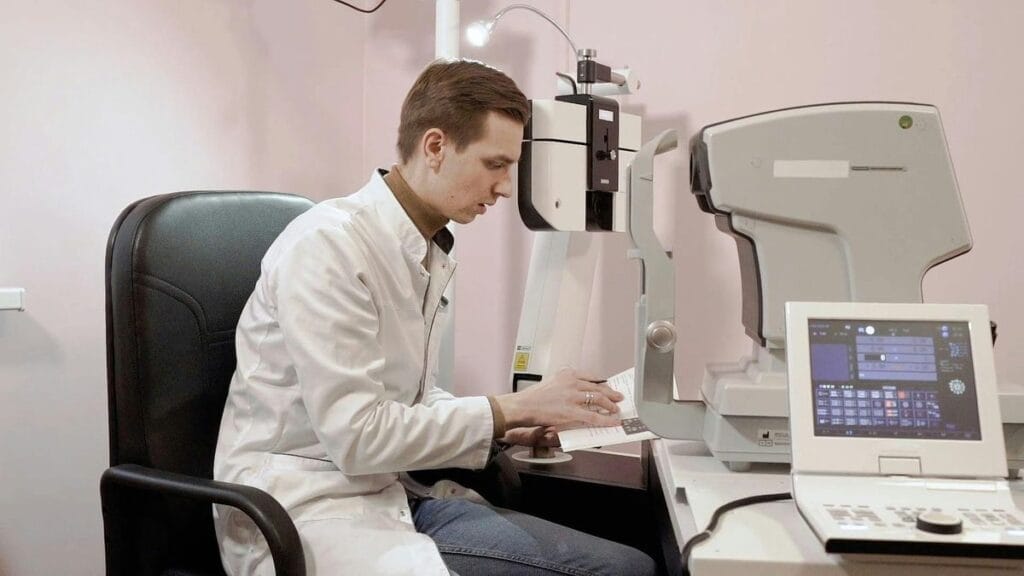
The goal is a continuous data path from the exam chair to the lab to the patient, with no re-keying and no paper handoffs. A well-integrated stack looks like this:
| Stage | Software Category | What Flows Through |
|---|---|---|
| Patient arrival | Practice management | Appointment confirmation, intake forms |
| Exam | EHR | Prescription, imaging, clinical notes |
| Dispensing | Optical module + measurement tool | Frame selection, PD/SH, lens prescription |
| Lab order | Lab ordering software | Complete order transmitted electronically |
| Pickup | POS | Payment, insurance claim, receipt |
| Recall | Practice management | Automated reminder at due date |
Gaps in this chain, typically between the EHR and the optical module or between dispensing and lab ordering, are where errors accumulate. Each manual handoff is one more chance for a transcription error to become a remake.
Estimated Costs of Going Digital
One of the most common questions from practice owners is what these tools actually cost. Exact pricing depends on practice size, number of providers, and which modules you need. These are typical ranges based on 2025-2026 market data:
| Tool Category | Typical Monthly Cost | Implementation Timeline | Notes |
|---|---|---|---|
| Practice management / POS | $150-350/provider | 4-12 weeks | Optical-specific systems cost more than generic retail POS |
| Cloud-based EHR | $200-600/provider | 4-12 weeks | Data migration from existing systems adds to first-year cost |
| Inventory management | Often bundled with POS | 1-4 weeks standalone | Standalone options exist but integration with POS is critical |
| Digital PD measurement | Varies by tool and volume | Days to 2 weeks | Photo-based tools like Optogrid require minimal setup |
For a small independent practice (1-2 providers), expect a first-year investment of $6,000-$15,000 across EHR and POS, excluding hardware. Multi-location practices should budget for centralized licensing, which often reduces per-location cost but increases total spend.
Implementation Priorities by Practice Size
Not every practice should implement everything at once. A sequenced approach based on the highest-friction bottlenecks:
Small independent practice (1-2 optometrists):
- Cloud EHR with diagnostic device integration, which eliminates the largest documentation burden
- Digital PD measurement to reduce remakes and enable remote fitting capability
- Basic inventory management (even a spreadsheet-to-software upgrade improves visibility)
Mid-size practice or small chain (3-10 locations):
- Unified POS with centralized inventory across locations
- Patient portal and recall automation to recapture more existing patients
Online optical retailer:
- Digital PD measurement is foundational; you cannot fabricate accurate lenses without it
- Automated prescription verification to reduce liability and customer service volume
- Inventory automation, because online volume creates stock management complexity at scale
Vendor Evaluation Criteria for Independent Practices

Independent optician practices have different needs than large optical chains. When evaluating software, apply these criteria:
Integration depth, not just breadth. Ask how data moves between modules. An all-in-one platform that re-keys data between its own modules internally has the same error risk as two separate systems connected by a CSV export.
Training time. Staff should be able to handle core tasks within the first week of daily use. Software that requires months of training is a liability when staff turn over.
Support response time. When lab orders fail to transmit or the scheduler goes down, you need same-day support. Verify the support model before signing.
Total cost of ownership. Per-user fees and add-on modules can substantially increase what you pay. Cloud-based practice management subscriptions typically range from $150 to $350 per month per location, but costs vary widely based on user count and feature tier. Ask for all-in pricing with your expected user count before evaluating the base subscription price.
Data portability. If you switch vendors, you need your patient records and prescription history. Confirm the export format and whether there are fees to retrieve your own data.
Optogrid’s Role in the Stack
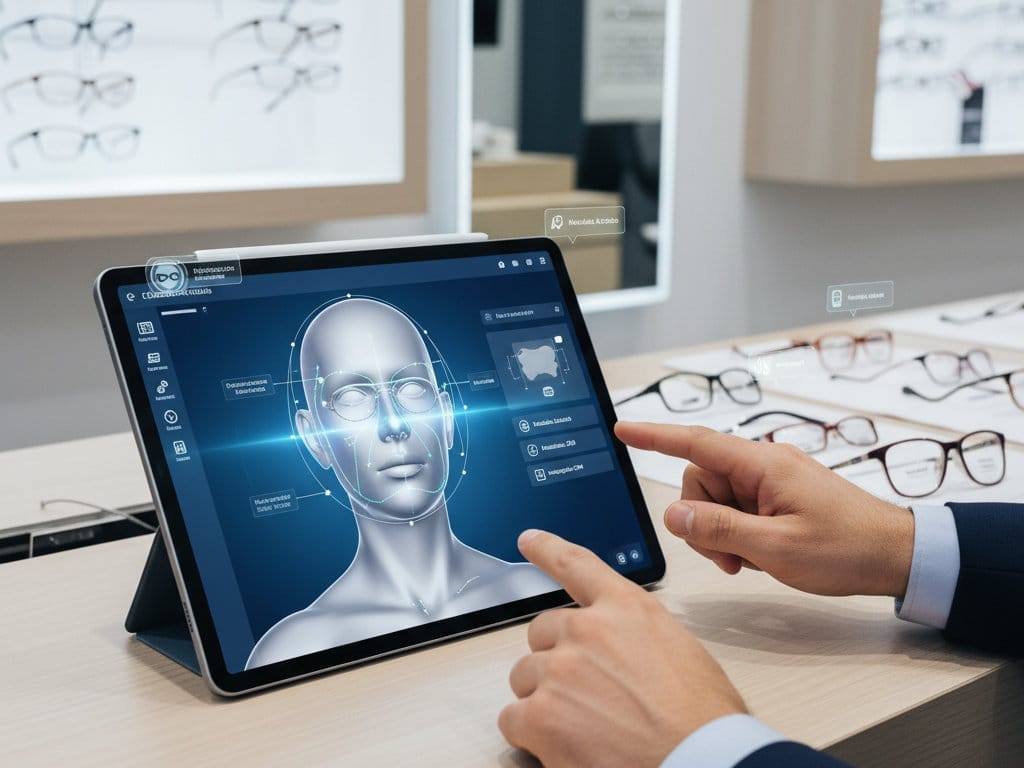
Optogrid is a digital measurement platform designed for optician practices and eyewear retailers. It captures PD, segment height, and fitting measurements from a photo of the patient wearing their chosen frame, and those measurements feed directly into the dispensing workflow.
Key capabilities:
- In-practice measurements using a standard tablet or smartphone camera
- Remote patient links that let you send a patient a link to capture their own measurements from home. You review and approve the data in your dashboard before it reaches the lab order.
- Custom reference markers for lab-specific centration requirements
- Measurement history stored per patient, accessible across visits
For practices running an online sales channel, Optogrid’s remote measurement link closes the biggest gap in online dispensing: collecting accurate fitting data without an in-person visit. For a breakdown of which AI tools are delivering measurable results in optical practices today beyond measurement, see AI in optical practices.
Frequently Asked Questions
What is the most important software for an independent optician practice?
Practice management software with appointment scheduling and automated recall is typically the highest-leverage first investment. It reduces no-shows and keeps the chair full. Once scheduling is stable, the next priority is an EHR with a connected optical module to eliminate prescription re-entry.
Can I use separate tools for each function or do I need an all-in-one platform?
Both approaches work. All-in-one platforms simplify vendor relationships and can reduce integration complexity, but they sometimes compromise on individual module depth. Many established practices use a best-in-class scheduling tool, a specialized optometry EHR, and a separate measurement platform. The key is verified integration between tools, not the number of vendors.
What does optician software cost for a single-location practice?
Budget $6,000 to $15,000 for the first year across EHR and practice management for a 1-2 provider practice, before hardware. Individual products vary: RevolutionEHR publishes tiers from $319 to $830 per month depending on features and whether EHR is bundled with practice management, while most of the field, including Crystal PM, MaximEyes, and Compulink, prices by quote based on provider count and modules. A frame database subscription like Frames Data runs about $575 per year separately from core EHR and practice management spend.
How does digital PD measurement reduce remakes?
An incorrect PD means the optical center of the lens does not align with the patient’s pupil, which requires remaking the lenses. Digital measurement tools reduce the operator variability inherent in manual rulers, where variations of 1 to 5 mm are possible, and create a digital record that transfers directly to the lab order. This removes the transcription step that most often causes PD-related remakes.
What should I ask before signing a practice management software contract?
Ask about: all-in pricing with your expected user count, support response time guarantees, data export format and portability, training resources, and which lab networks and measurement tools have pre-built integrations. Always run a pilot period before full rollout.
Does Optogrid work with remote patients?
Yes. Optogrid can send patients a measurement link they complete from home using their own device. The optician reviews and approves the data before it enters the dispensing workflow, maintaining clinical oversight while eliminating the need for a second in-person fitting visit.
How do I evaluate whether my current software stack has gaps?
Map the data path from exam prescription to lab order. Identify every step where data is manually re-entered or transferred by phone, fax, or paper. Each manual handoff is a potential error point. Software gaps are usually visible as repeated corrections, remake requests, or staff time spent on the phone with labs or insurance providers.
What PD accuracy do different measurement methods achieve?
Research comparing PD measurement methods found a mean difference of 0.54 mm between PD rulers and pupillometers for distance measurements. Digital pupillometers like the Essilor CRP achieve approximately 0.25 mm mean difference with +/-0.4 mm standard deviation. ANSI Z80.1 specifies a +/-1.0 mm horizontal tolerance for progressive lenses, making precision critical for that lens type.

I grew up inside an optical shop. My mother likes to tell how, as a kid, I would watch eyeglasses being assembled, play with the tools, and draw on the back of service order slips. The family business taught me early what a precise measurement and work done right are worth.
I went on to spend more than twenty years as a software engineer, always keeping an eye on the optical world. Optogrid was born where the two meet: digital measurement technology (pupillary distance and fitting heights) built by someone who knows the dispensing counter from the inside.