
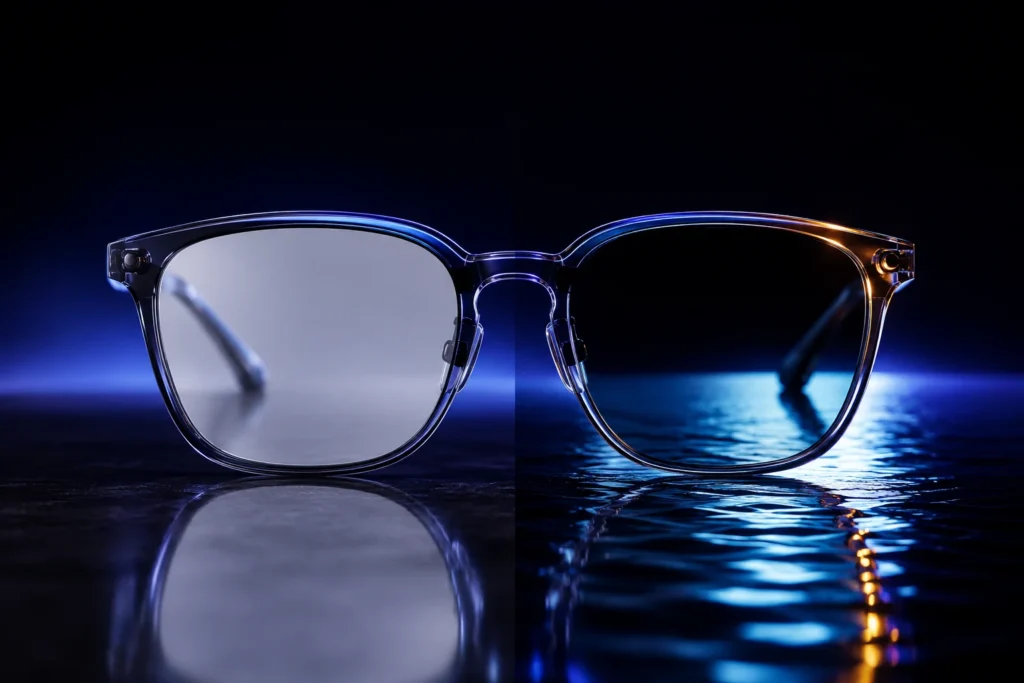
Photochromic and polarized lenses solve two different problems, and mixing them up at the dispensing counter is a common source of patient dissatisfaction. Photochromic lenses use a chemical reaction to UV exposure to change tint darkness over a period of seconds to minutes. Polarized lenses use a fixed directional filter to block reflected glare from flat surfaces such as water, wet asphalt, and snow, and their tint never changes. Neither technology replaces the other. The right recommendation depends entirely on which problem the patient is actually trying to solve, not on which lens sounds more advanced.
What Each Technology Actually Solves
Photochromic lenses (how photochromic lenses work) respond to ultraviolet radiation. They darken outdoors and clear indoors, giving the wearer one pair of glasses that functions as both everyday eyewear and sunglasses. What they do not do is cut glare: a photochromic lens at full darkness still transmits reflected light from a wet road or a lake the same way a plain tinted lens would.
Polarized lenses (how polarized lenses work) contain a filter aligned to block horizontally vibrating light, which is the dominant component of glare bouncing off flat surfaces. The American Academy of Ophthalmology explains that this filter design means “the lenses block all the horizontal light waves bouncing off a smooth pond or a shiny car hood.” What polarized lenses do not do is adapt: the tint is fixed and identical whether the wearer is indoors, outdoors, or in low light.
Neither photochromic nor polarized status has anything to do with UV protection. A lens is only UV-blocking if it is specifically treated for it, and that applies regardless of which of these two technologies it uses. The AAO recommends looking for sunglasses that block “99 percent or 100 percent of all UV light,” a standard covered in more detail in our UV protection guide.
Photochromic vs. Polarized: Side by Side
| Photochromic | Polarized | |
|---|---|---|
| What triggers it | UV light exposure | Nothing; the filter is always active |
| Response time | 15 to 45 seconds to darken, 2 to 15 minutes to clear | Instant, and it never changes |
| Indoors | Clear or near-clear | Same fixed tint as outdoors |
| Behind a car windshield | Stays clear in most standard versions (windshields block over 99% of UV) | Full glare reduction, unaffected by the windshield |
| Reflected glare (water, wet road, snow) | Not reduced | Eliminated |
| LCD and OLED screens | No interaction | Can black out or distort at certain viewing angles |
| Adapts to changing light levels | Yes | No |
| UV protection | Only if the lens is separately UV-treated | Only if the lens is separately UV-treated |
| Best-fit patient | Moves frequently between indoor and outdoor settings | Drives, fishes, boats, or skis regularly |
A Decision Framework for the Fitting Room
Use the patient’s actual daily pattern, not their stated preference for “the good lenses,” to decide between the two:
- Moves between indoor and outdoor environments all day (retail staff, delivery drivers, patients who commute on foot or by transit): photochromic is the better fit.
- Drives long distances, fishes, boats, or spends significant time on snow or open water: recommend polarized lenses for the glare reduction.
- Has diagnosed photophobia or extreme light sensitivity and also drives frequently: this is the profile where a combined photochromic-polarized product earns its higher price.
- Relies on a phone, GPS, or dashboard display throughout the day: flag the LCD interaction risk before recommending polarized, or steer toward photochromic instead.
- Is a pilot or aircrew member: neither standard photochromic nor polarized lenses are appropriate. See the FAA guidance below.
- Wants continuous sun protection without carrying a second pair of glasses: photochromic covers this, but confirm the UV treatment on the lens independently of the tint behavior.
Where Each Technology Breaks Down
Every dispensing conversation should include the failure mode, not just the benefit. Surprises after the sale are what drive returns and complaints.
Photochromic lenses stay clear behind most windshields. Automotive glass blocks over 99% of UV radiation, and standard photochromic lenses activate only from UV, so they offer little to no glare reduction while driving. A small number of models are engineered around this: Nikon markets Transitions XTRActive as “the darkest photochromic light intelligent lens in hot temperatures and in the car,” because it responds to high-intensity visible light in addition to UV. That is the exception, not the default behavior of photochromic lenses as a category.
Polarized lenses can black out digital screens. The AAO lists specific situations where polarized lenses are not recommended, including looking at “LCD (liquid crystal display) screens such as car dashboard controls, ATM cash machines, cell phones, some watches,” seeing ice on roads while driving, seeing icy patches while skiing, and night driving. Each of these is a case where the glare polarization removes is actually a useful visual cue, or where the screen’s own polarized output conflicts with the lens filter.
Pilots should avoid both, for different reasons. The FAA’s pilot safety brochure states plainly that “polarized sunglasses are not recommended because of their possible interaction with displays or other materials in the cockpit environment.” The same brochure notes that standard photochromic lenses are a poor fit too, since “reduced UV exposure in a cockpit can further limit their effectiveness.” For any patient who flies, neither technology is the safe default; a neutral gray tint with fixed transmittance is the standard recommendation instead.
Combining Both: Photochromic-Polarized Lenses
Some products combine both technologies in a single lens, adjusting tint with UV exposure while also filtering reflected glare. These exist specifically for patients who spend substantial time outdoors in variable light and also drive or engage in water or snow activities regularly. The tradeoff is cost: combined lenses carry a meaningfully higher price than either technology alone, and the same LCD-screen and windshield-activation limitations of each individual technology still apply. Set that expectation before the sale so the higher price does not become a point of friction later.
Frequently Asked Questions
What is the main difference between photochromic and polarized lenses?
Photochromic lenses change tint darkness in response to UV light, taking 15 to 45 seconds to darken and several minutes to clear. Polarized lenses have a fixed filter that blocks horizontally reflected glare from surfaces like water and wet roads, and the tint never changes. One adapts to light levels; the other blocks a specific type of glare. They solve different problems and are not interchangeable.
Can a patient wear both photochromic and polarized lenses at the same time?
Yes. Combined photochromic-polarized lenses exist and adjust tint with UV exposure while also filtering reflected glare. They cost noticeably more than either technology alone and still carry the same underlying limitations, such as reduced activation behind most car windshields and potential interaction with LCD screens for the polarized component.
Do polarized lenses block UV rays?
Not automatically. Polarization and UV protection are separate features of a lens. A polarized lens has no UV protection unless it is separately treated for it. The same is true of photochromic lenses. Always confirm the lens carries a UV400 label or documentation stating it blocks 99 to 100 percent of UV light, independent of whether it is polarized or photochromic.
Why don’t photochromic lenses darken behind a car windshield?
Automotive windshields block more than 99% of UV radiation, and standard photochromic lenses activate only in response to UV. Without enough UV reaching the lens, it stays clear or nearly clear while driving. A small number of models, such as Transitions XTRActive, are engineered to also respond to visible light and can partially darken behind glass, but this is the exception rather than how most photochromic lenses behave.
Should pilots wear polarized or photochromic sunglasses?
Neither is recommended as a default. The FAA’s pilot safety guidance states that polarized sunglasses are not recommended because of their possible interaction with displays or other materials in the cockpit, and separately notes that reduced UV exposure inside a cockpit can limit photochromic lens effectiveness. A neutral gray tint with a fixed, moderate transmittance is the standard recommendation for pilots instead.
Do polarized lenses cause problems with phone or dashboard screens?
Yes, in some cases. The American Academy of Ophthalmology lists LCD screens, including car dashboard controls, ATM machines, cell phones, and some watches, as situations where polarized lenses are not recommended, because the screen’s own polarized output can interact with the lens filter and cause the display to dim or distort at certain viewing angles.
Which lens type should I recommend for a patient who drives every day?
For most daily drivers, polarized lenses are the better fit because they cut glare from wet roads, oncoming windshields, and hoods, which reduces eye fatigue on long drives. The exception is a patient who also relies heavily on a phone or dashboard screen for navigation, in which case the LCD interaction should be discussed before the sale. Photochromic lenses will not reduce driving glare in most standard versions, since they stay clear behind the windshield.

I grew up inside an optical shop. My mother likes to tell how, as a kid, I would watch eyeglasses being assembled, play with the tools, and draw on the back of service order slips. The family business taught me early what a precise measurement and work done right are worth.
I went on to spend more than twenty years as a software engineer, always keeping an eye on the optical world. Optogrid was born where the two meet: digital measurement technology (pupillary distance and fitting heights) built by someone who knows the dispensing counter from the inside.