
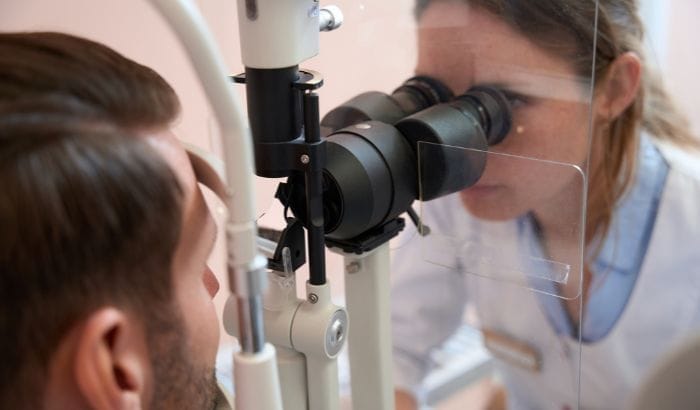
Quick Answer: Visual acuity is the eye’s ability to distinguish fine detail at a specific distance. It is measured with a Snellen chart — and a result of 20/20 (6/6 in meters, or 0.0 on the logMAR scale) indicates vision within the accepted normal range. Results below that threshold may point to refractive errors such as myopia or astigmatism, or to conditions that require an eye examination.
What is visual acuity
Visual acuity is a measure of how well the visual system can detect and differentiate details — letters, edges, and contours — at a standardized distance. The test determines the smallest letter or symbol a person can correctly identify, with each eye tested separately.
The examination answers a straightforward question: at what minimum distance can the eye resolve a detail subtending one minute of arc? That concept — the minimum angle of resolution (MAR) — is the foundation of every modern visual acuity measurement system.
High visual acuity does not equal perfect vision: it measures only central resolving power. Other components — peripheral vision, color vision, and contrast sensitivity — require separate testing.
How visual acuity is measured: the Snellen chart, decimal scale, and logMAR
The Snellen chart
In 1862, Dutch ophthalmologist Herman Snellen introduced a standardized system for assessing visual acuity using optotypes — characters drawn on a 5×5 unit grid — replacing the arbitrary reading passages that clinics had been using. The system made consistent comparisons between patients and institutions possible for the first time.
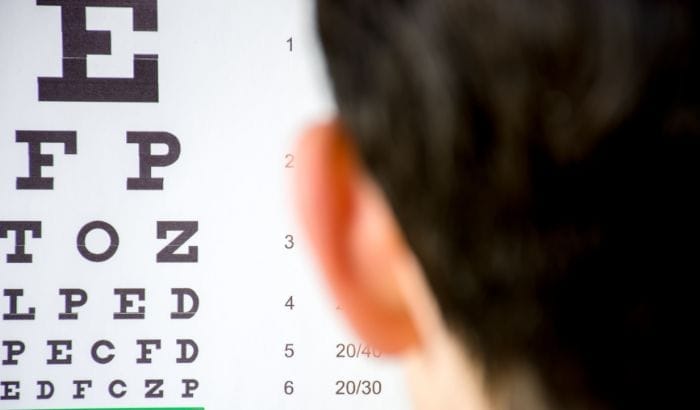
The chart consists of rows of letters that decrease progressively in size. The test is performed at 20 feet (6 meters in the metric system). The patient covers one eye and reads the letters from top to bottom; the last row read correctly defines their visual acuity.
How to read the Snellen fraction:
- The top number is the patient’s distance from the chart (20 feet)
- The bottom number is the distance at which a person with standard vision can read that same row
- A result of 20/20: the patient sees at 20 feet what a person with standard vision sees at 20 feet
- A result of 20/50: the patient sees at 20 feet what a person with standard vision sees at 50 feet — weaker acuity
In countries using the metric system, the test distance is 6 meters, so 6/6 is equivalent to 20/20.
The logMAR scale
The logMAR scale (logarithm of the Minimum Angle of Resolution) is preferred in clinical research because it provides uniform spacing between lines and greater sensitivity for detecting small changes in acuity. A 2010 study published in Arquivos Brasileiros de Oftalmologia (“Tables for measuring visual acuity on a logarithmic scale”) found that logMAR charts are the most appropriate for clinical follow-up and population-based visual acuity surveys.
On the logMAR scale, the result is expressed as the logarithm of the reciprocal of the decimal acuity fraction:
- logMAR 0.0 = 20/20 = 6/6 (normal standard)
- logMAR 0.3 = 20/40 = 6/12
- logMAR 1.0 = 20/200 = 6/60 (severe visual impairment threshold)
The lower the logMAR value, the better the visual acuity. Negative values (e.g., −0.1) indicate acuity above the standard.
What the numbers mean: normal vision, low vision, and legal blindness
The World Health Organization (WHO) classifies visual impairment based on presenting visual acuity — that is, the acuity a person has with whatever correction they use in daily life, not under ideal clinic conditions. The definitions follow the ICD-11 (International Classification of Diseases, 11th Revision):
| Category | Visual acuity (better eye) |
|---|---|
| No visual impairment | 6/12 or better (≥ 20/40) |
| Mild impairment | Worse than 6/12 to 6/18 |
| Moderate impairment | Worse than 6/18 to 6/60 |
| Severe impairment | Worse than 6/60 to 3/60 |
| Blindness | Worse than 3/60, or visual field less than 10° |
According to the WHO report “Prevention of avoidable blindness and visual impairment” (EB124/7), blindness is defined as presenting visual acuity worse than 3/60 in the better eye, or a visual field of less than 10°.
What does 20/20 vision mean?
20/20 vision is not synonymous with perfect vision — it is the statistical reference standard. It means the eye can resolve details that subtend 1 minute of arc, which is close to the theoretical resolving limit of the human eye. Some people achieve 20/15 or even 20/10, indicating above-standard acuity.
What does “low visual acuity” mean?
Low vision is the clinical term for visual acuity below 6/18 in the better eye, even with the best available optical correction. It differs from blindness: people with low vision can still see, but with significant functional limitation for everyday activities such as reading and recognizing faces.
What is legal blindness?
In the United States, legal blindness is defined as best-corrected visual acuity of 20/200 or worse in the better eye, or a visual field of 20 degrees or less. This definition is used for Social Security disability determination and other government programs. The WHO threshold for blindness (worse than 3/60) is stricter and is used in global epidemiological surveys.
Main conditions that reduce visual acuity
Several eye conditions directly affect the sharpness of vision. The most common are:
Refractive errors
These account for the majority of cases of reduced visual acuity and are usually correctable with lenses.
- Myopia (nearsightedness): the eye focuses the image in front of the retina, making distant objects blurry. Corrected with diverging (minus) lenses.
- Hyperopia (farsightedness): the eye focuses the image behind the retina, causing difficulty with near focus (and in more pronounced cases, distance as well). Corrected with converging (plus) lenses.
- Astigmatism: an irregularity in the curvature of the cornea or lens distorts the image at all distances. Corrected with cylindrical lenses.
- Presbyopia: progressive loss of near-focusing ability with aging, typically beginning around age 40. Corrected with multifocal or reading lenses.
Cataract
A cataract is the progressive clouding of the crystalline lens — the eye’s natural lens. As the lens loses transparency, the amount and quality of light reaching the retina decrease, gradually reducing visual acuity. Early symptoms include “foggy” vision, increased light sensitivity, and frequent changes in prescription. Treatment is surgical, replacing the clouded lens with an intraocular lens (IOL).
Age-related macular degeneration (AMD)
AMD affects the macula, the central region of the retina responsible for fine-detail vision. It causes progressive loss of central vision — the part of the visual field used for reading, recognizing faces, and performing precision tasks — while peripheral vision is usually preserved. There are two forms: dry (atrophy of retinal cells) and wet (abnormal blood vessel growth causing bleeding and edema).
Glaucoma
Glaucoma damages the optic nerve, usually due to elevated intraocular pressure. It initially affects peripheral vision, but without treatment it can progress to compromise central acuity. Because it is often silent in its early stages, early detection depends on routine eye examinations.
Visual acuity development in children
Visual acuity is not fully developed at birth. In newborns, the visual system is still immature, and visual sharpness improves progressively over the first years of life as the visual cortex matures.
Research published in PMC (Visual Acuity Norms in Preschool Children: The Multi-Ethnic Pediatric Eye Disease Study) shows that the proportion of children with acuity of 20/40 or better rises from 81% at 30–35 months to virtually 100% by 60–72 months.
Amblyopia: when development goes wrong
Amblyopia (“lazy eye”) occurs when the brain begins to suppress the visual input from one eye — usually because of strabismus, a significant difference in prescription between the eyes, or a visual obstruction during childhood. It is the most common cause of monocular visual impairment in children, with a prevalence of 2–3% in the pediatric population according to a review published in PMC (Amblyopia in children, 2014).
Treatment is most effective when started during the critical period of visual development, before age 7. That is why early vision screening — especially between ages 3 and 5 — is essential to detect the condition in time.
Children rarely complain of poor vision in one eye because the other eye compensates. The only way to detect amblyopia is through a clinical examination that tests each eye separately.
When to have a visual acuity test
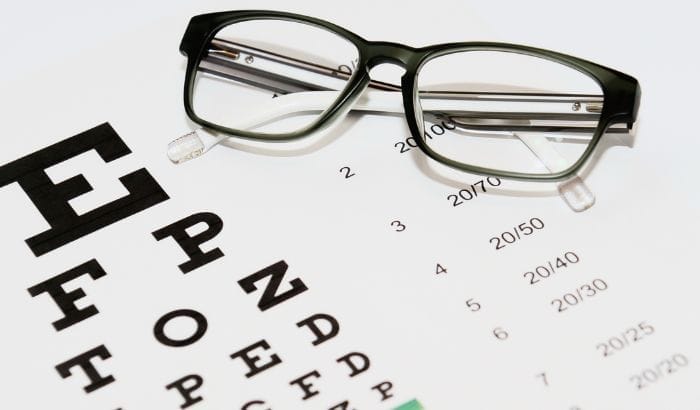
A visual acuity test is recommended:
- In early childhood: vision screening between ages 3 and 5 is recommended by the American Academy of Pediatrics and the U.S. Preventive Services Task Force to detect amblyopia and refractive errors early
- During school age: difficulty reading, trouble seeing the board, or habitually holding objects too close are warning signs
- In adulthood: every two years for adults without symptoms or risk factors; annually for those over 60 or with diabetes
- Whenever symptoms arise: sudden change in visual clarity, double vision, difficulty adjusting to light or darkness, or spots in the visual field
If you notice that your eyeglass prescription changes frequently or that your current lenses no longer fully correct your vision, a new acuity test can identify changes in your refraction.
Warning signs that call for urgent eye care
Seek immediate attention if you or your child experience:
- Sudden onset of floaters accompanied by flashes of light — this may indicate retinal detachment
- Rapid loss of vision in one or both eyes
- Severe eye pain with reduced vision
- Sudden onset of double vision
- A “shadow” or progressively darkening area in the visual field
Who performs the visual acuity test
The test can be performed by:
- Ophthalmologist: a physician specializing in eye diseases and surgery; performs a comprehensive exam, including a dilated fundus examination
- Optometrist: a doctor of optometry licensed to perform refractions, prescribe corrective lenses, diagnose eye conditions, and in most U.S. states, treat certain eye diseases
- Optician: a trained professional who fits and dispenses eyeglasses and contact lenses based on a prescription; may perform basic acuity screening
- School nurse or trained screener: in school and community health screening programs
Prescribing corrective lenses or any therapeutic intervention requires evaluation by an ophthalmologist or optometrist.
Telehealth and remote screening
In underserved areas with limited access to eye care specialists, telehealth models allow a trained technician to perform the visual acuity test at a clinic or school while an ophthalmologist or optometrist reviews the results and issues a report remotely. This workflow extends the reach of vision screening without compromising diagnostic quality.
Optogrid supports this model by enabling accurate digital measurement of optical parameters — such as pupillary distance — from a photograph, with no physical equipment required on-site.
Other tests that complement the visual acuity exam
The Snellen test evaluates central acuity only. For a complete visual assessment, an eye care provider may also perform:
- Ishihara test: 38 cards with colored circles containing numbers; detects and classifies color vision deficiency (absence or dysfunction of cone photoreceptors sensitive to specific colors)
- Potential Acuity Meter (PAM): uses a laser to assess retinal function directly, commonly indicated before and after eye surgeries such as cataract removal or corneal transplant
- Visual field testing (perimetry): maps the visual field, essential for detecting glaucoma
- Tonometry: measures intraocular pressure
- Optical coherence tomography (OCT): high-resolution imaging of the retinal layers
Frequently asked questions about visual acuity
What is visual acuity?
Visual acuity is a measure of the eye’s ability to distinguish fine detail at a standardized distance. The result indicates the smallest line of letters or symbols a person can identify on the Snellen chart.
What does 20/20 visual acuity mean?
20/20 vision means the eye sees at 20 feet the same level of detail that a person with standard vision sees at 20 feet. It is not synonymous with perfect vision — it is the statistical baseline. Some people achieve 20/15 or 20/10, indicating above-standard acuity.
What is normal visual acuity?
Normal acuity is considered to be 20/20 (6/6), equivalent to logMAR 0.0. The WHO classifies acuity of 6/12 or better in the better eye as no visual impairment. Values below 6/18 already constitute some degree of visual impairment.
How is the visual acuity test done?
The patient stands 20 feet (6 meters) from the Snellen chart, covers one eye, and reads the letters or symbols from top to bottom. The last row read correctly defines the acuity for that eye. The test is non-invasive and takes only a few minutes.
What is the difference between Snellen and logMAR?
Snellen expresses acuity as a fraction (20/20, 20/40); logMAR expresses it as the logarithm of the minimum angle of resolution (0.0, 0.3, 1.0). The logMAR scale is more precise for clinical research and patient follow-up because its increments are uniform. Both scales measure the same visual capability — just with different notation.
What is legal blindness?
In the United States, legal blindness is defined as best-corrected visual acuity of 20/200 or worse in the better eye, or a visual field of 20 degrees or less. The WHO uses a stricter threshold: presenting visual acuity worse than 3/60 in the better eye, or a visual field of less than 10°. These definitions determine eligibility for disability benefits and accommodations.
When do children reach adult-level visual acuity?
Most children reach 20/20 acuity between ages 5 and 7. Visual development begins at birth and progresses rapidly during the first three years. That is why vision screening between ages 3 and 5 is critical for detecting conditions like amblyopia before the critical developmental window closes.
Who can prescribe glasses after a visual acuity test?
In the United States, prescribing corrective lenses is within the scope of practice of ophthalmologists and optometrists. Opticians fit and dispense eyewear based on a valid prescription but do not prescribe. For progressive lenses, bifocals, or cases involving ocular disease, evaluation by an ophthalmologist or optometrist is required.
References
- Messias A, Jorge R, Cruz AA. Tabelas para medir acuidade visual com escala logarítmica: porque usar e como construir [Tables for measuring visual acuity on a logarithmic scale]. Arquivos Brasileiros de Oftalmologia. 2010;73(1):96–100. SciELO Brasil
- Snellen H. Optotypi ad visum determinandum. Utrecht: P.W. van de Weijer, 1862. Historical context: PubMed — Snellen and his optotypes
- World Health Organization. Prevention of avoidable blindness and visual impairment. Document EB124/7. Geneva: WHO, 2009. WHO
- Donahue SP, Nixon CN; Section on Ophthalmology, American Academy of Pediatrics. Visual system assessment in infants, children, and young adults by pediatricians. Pediatrics. 2016;137(1). Preschool acuity norms: PMC Visual Acuity Norms in Preschool Children
- Webber AL, Wood JM. Amblyopia: prevalence, natural history, functional effects and treatment. Clinical and Experimental Optometry. 2005. Pediatric amblyopia review: PMC Amblyopia in children
- World Health Organization. Blindness and visual impairment — Fact sheet. who.int

I am a seasoned software engineer with over two decades of experience and a deep-rooted background in the optical industry, thanks to a family business. Driven by a passion for developing impactful software solutions, I pride myself on being a dedicated problem solver who strives to transform challenges into opportunities for innovation.