
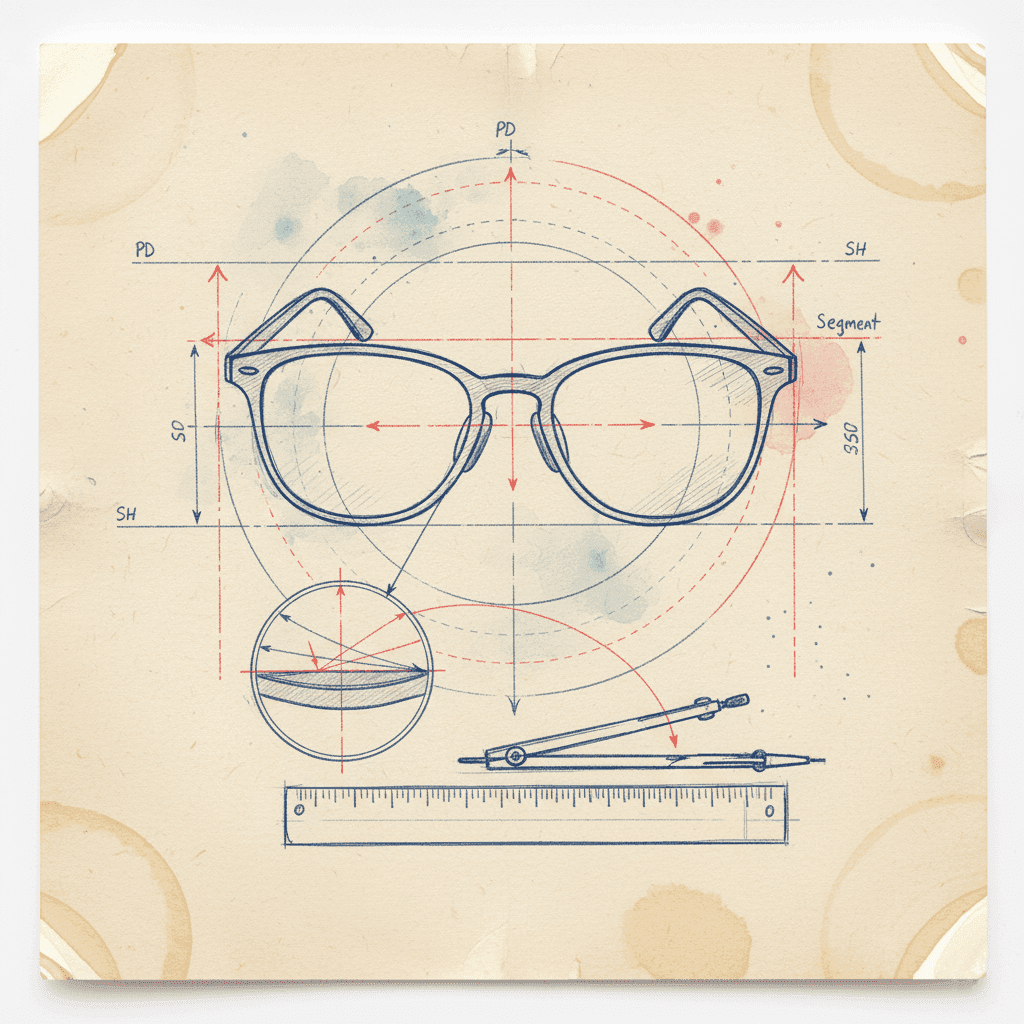
Short Answer: Accurate PD (Pupillary Distance) and SH (Segment Height) measurements ensure that prescription eyewear provides optimal vision correction and comfort. PD measures the distance between your pupils (typically 54-74mm for adults), while SH measures the height from the bottom of the lens to your pupil for multifocal lenses. According to research on optical center alignment, errors of just 2-3mm can cause eye strain, headaches, and reduced lens effectiveness, especially with progressive or high-index lenses.
Why PD and SH Accuracy Matters for Visual Comfort
When prescription lenses are manufactured, the optical center must align precisely with your pupils to ensure clear, comfortable vision. This alignment depends on two critical measurements: Pupillary Distance (PD) and Segment Height (SH).
Studies on interpupillary distance measurement show that misalignment between the optical center of the lenses and the patient’s PD can cause distorted, blurred vision, eye strain, headaches, and visual discomfort. In some cases, significant misalignment can even lead to double vision (diplopia).
The severity of these symptoms depends on several factors:
- Prescription strength: Higher prescription powers magnify the effects of measurement errors
- Lens type: Progressive and multifocal lenses require greater precision than single vision lenses
- Lens material: High-index lenses are more sensitive to decentration errors
- Individual tolerance: Some patients adapt better to minor misalignments than others
Understanding Prismatic Effects from Incorrect PD
When lenses are decentered from the patient’s actual PD, they introduce unwanted prismatic effects. The relationship is straightforward: for every millimeter of decentration, one-tenth of a diopter of prism is induced at the horizontal meridian. For example, a 3.50 D lens decentered by 1mm creates 0.35 diopters of prism.
While small amounts of prism may be tolerable for some patients, research indicates that this can lead to visual disturbances that impact daily activities and visual function, particularly when the induced prism exceeds patient tolerance levels.
What Happens When PD and SH Measurements Are Incorrect
Inaccurate optical measurements don’t just cause minor inconvenience—they can significantly impact visual performance, patient comfort, and business outcomes for optical retailers.
Visual Symptoms and Patient Discomfort
When PD measurements are off by even 2-3mm, patients may experience:
- Eye strain and fatigue: Eyes work harder to compensate for misaligned optical centers
- Headaches: Often occurring after extended wear, particularly with near work
- Blurred or distorted vision: Images may appear unclear or warped
- Dizziness or disorientation: Especially when looking through different parts of the lens
- Difficulty adapting: Progressive lens wearers may never fully adapt to incorrectly fitted lenses
- Double vision (diplopia): In severe cases of significant misalignment
According to comparative analysis of measurement techniques, these symptoms can lead to visual fatigue and potential damage to the eyes over extended periods.
Business Impact for Optical Retailers
Beyond patient discomfort, measurement errors create significant business consequences:
- Increased remake rates: Incorrectly measured glasses must be remanufactured
- Higher return rates: Dissatisfied customers return ill-fitting eyewear
- Lost revenue: Remakes consume materials and labor without additional revenue
- Damaged reputation: Poor fitting experiences lead to negative reviews
- Reduced patient loyalty: Customers seek other providers after bad experiences
Industry Standards: PD and SH Measurement Tolerances
Professional optical organizations have established specific tolerance standards to ensure lens performance and patient comfort.
ANSI Z80.1 Standards for Prescription Eyewear
ANSI Z80.1 is the American National Standard for Prescription Ophthalmic Lenses. The most recent version (ANSI Z80.1-2020) provides comprehensive recommendations for prescription lens tolerances.
Key tolerance specifications include:
- Multifocal segment height: Each lens shall be within ±1.0mm of the specified height
- Segment height difference: The difference between segment heights in a mounted pair shall not exceed 1.0mm
- Base curve: When specified, shall be supplied within ±0.75 D
These standards ensure that lenses meet minimum quality requirements for vision correction and patient comfort.
ISO 8980 International Optical Standards
ISO 8980 provides international specifications for uncut finished spectacle lenses. The standard covers:
- Back vertex power tolerances for single-vision and multifocal lenses
- Cylinder axis tolerances (no requirements for cylindrical power less than 0.12 D)
- Prismatic power tolerances
- Temperature conditions for verification (23°C ± 5°C)
The standard specifies that to determine prismatic power tolerances, the value S of the higher absolute principal power should be found, where (0.1 × S) corresponds to the prismatic effect of 1mm displacement.
ANSI Z87.1 Standards for Prescription Safety Eyewear
For prescription safety eyewear, ANSI Z87.1-2025 establishes even stricter requirements:
- Prescription accuracy: Must be within ±0.12 to ±0.25 diopters (depending on power)
- PD fabrication tolerance: Lenses must be manufactured within a specific tolerance range of the prescribed PD
- Minimum lens thickness: 2.0mm for polycarbonate/Trivex, 3.0mm for high-index plastics
- Impact resistance: Must pass Drop Ball Impact Test (1-inch steel ball from 50 inches)
These stricter tolerances ensure that prescription safety eyewear provides both vision correction and workplace protection.
Tolerance Recommendations by Lens Type
Different lens types have varying tolerance requirements based on their optical design and intended use.
| Lens Type | Recommended PD Tolerance | Recommended SH Tolerance | Consequences of Error |
|---|---|---|---|
| Single vision | ±2mm | N/A | Mild eye strain, minor discomfort |
| Bifocal | ±1.5mm | ±1.0mm | Reading difficulty, neck strain from head tilting |
| Progressive | ±1mm | ±1mm | Difficulty adapting, visual distortion, narrow viewing zones |
| High-index (1.67+) | ±1mm | ±1.5mm | Chromatic aberration, reduced clarity, peripheral distortion |
| Prescription PPE (ANSI) | ±1mm | ±1.5mm | Safety compliance issues, discomfort during extended wear |
| Wrap sports eyewear | ±1mm | ±1.5mm | Peripheral distortion, reduced field of view |
How PD and SH Measurements Are Taken
Understanding measurement methods helps optical professionals select the appropriate tools for each situation. For a detailed comparison of accuracy, cost, and best use cases across different approaches, see our guide to comparing PD measurement methods.
Traditional Manual Measurement Methods
PD Ruler Method
The simplest method uses a millimeter ruler held against the bridge of the nose. The optician measures the distance from the center of one pupil to the center of the other while the patient looks straight ahead. While accessible, this method has limitations:
- Subject to parallax error
- Dependent on steady hand positioning
- Accuracy typically ±2mm
- Difficult for self-measurement
Manual Pupillometer
A manual pupillometer provides improved accuracy over ruler measurements. The instrument sits on the patient’s nose, and the optician aligns crosshairs with each pupil. Benefits include:
- Reduced parallax error
- Accuracy typically ±1mm
- Can measure monocular PD (left and right separately)
- More consistent results than rulers
Digital Measurement Technologies
Automated Digital Pupillometers
Modern automated pupillometers use infrared sensors or cameras to detect pupil positions. These devices offer:
- Accuracy within ±0.5mm
- Automatic calculation of monocular and binocular PD
- Reduced operator error
- Consistent, repeatable measurements
- Often include SH measurement capability
Photo-Based Measurement Systems (Optogrid)
Photo-based systems like Optogrid represent the latest advancement in optical measurement technology. The process works by:
- Patient holds a reference card (typically a credit card or calibration card) at bridge level
- Photograph is taken from the appropriate distance
- Software analyzes the photo, using the reference card for scale calibration
- System calculates both PD and SH with ±0.5mm accuracy
This approach offers unique advantages:
- Remote measurement capability: Patients can be measured from photos, which is transforming how online vision care services deliver accurate prescriptions without in-person visits
- Permanent record: Photos document the measurement for future reference
- Reduced patient contact: Particularly valuable for hygiene concerns
- Consistent methodology: Less dependent on operator technique
- Multiple measurements: Can verify accuracy through repeated analysis
Monocular vs Binocular PD
Understanding the difference between these measurements is important for lens manufacturing:
- Binocular PD: The total distance between pupil centers (e.g., 63mm)
- Monocular PD: Individual distances from each pupil to the bridge centerline (e.g., 31.5mm right, 31.5mm left)
Monocular PD measurements are more accurate because they account for facial asymmetry. Most people have slight differences between their right and left monocular measurements. An analysis of 14,904 real-world PD measurements confirms this, showing that left and right monocular PD values average within 0.03mm of each other across a large population.
Segment Height Measurement for Multifocal Lenses
SH measurement is critical for bifocal and progressive lenses. Professional guidance on segment height indicates:
For Bifocals:
- Measure from the bottom of the lens opening to the lower eyelid
- Patient should be in natural posture with eyes in primary gaze
- Typical range: 18-22mm for most frame styles
For Progressive Lenses:
- Measure to the center of the pupil (fitting cross position)
- Requires at least 10mm above the fitting cross for distance vision
- Less than 10mm may cause non-adaptation
- Typical range: 20-24mm depending on frame size
For a deeper dive into fitting height requirements specific to progressive-addition lenses, see our segment height guide for progressive lenses.
Common Measurement Errors to Avoid:
- Patient looking up or down during measurement
- Frame not positioned as it will be worn
- Not accounting for frame pantoscopic tilt
- Using frame center instead of lens center
- Not measuring in natural head position
Special Considerations for Different Lens Types
Each lens type presents unique measurement challenges and precision requirements.
Single Vision Lenses
Single vision lenses are the most forgiving of measurement errors because they have a consistent optical power throughout. However, accuracy still matters:
- Errors beyond ±2mm can cause discomfort with higher prescriptions
- High-index materials require tighter tolerances due to chromatic aberration
- Wrap frames for sports need accurate monocular PD due to base curve
Progressive and Bifocal Lenses
Multifocal lenses demand the highest measurement precision. Progressive lenses have strict fitting requirements:
- PD errors shift the progressive corridor, reducing usable viewing zones
- SH errors can make distance vision unusable or place near vision in the wrong position
- Research on progressive lens fitting emphasizes that proper vertical and horizontal positioning is essential for patient adaptation
According to progressive lens fitting guidelines, segment height varies depending on frame shape and style, and is a specific calculation unique to the position of the patient’s eyes and the frames worn.
High-Index Lenses
High-index lenses (1.67, 1.74) magnify the effects of measurement errors:
- Greater prismatic effect from decentration
- More noticeable chromatic aberration when off-center
- Require ±1mm PD accuracy for optimal performance
- Particularly critical for prescriptions above ±4.00 D
Patients with high refractive errors, prism prescriptions, or occupational lens needs face additional fitting complexity beyond standard dispensing. Our prescription lens fitting guide for special conditions covers vertex distance compensation, prism splitting, and other advanced fitting considerations in detail.
Prescription Safety Eyewear (ANSI Z87.1 Compliance)
Prescription safety glasses must meet both vision correction and impact protection standards. ANSI Z87.1 compliance requirements include:
- Tighter optical tolerances than dress eyewear
- Minimum lens thickness requirements affecting optical center placement
- Base curve limitations that impact PD positioning
- Documentation requirements for workplace safety compliance
Accurate PD and SH measurements are essential for ensuring that prescription safety eyewear meets ANSI Z87.1 requirements while providing comfortable vision for extended workplace wear.
Wrap Sports Eyewear
Sports frames with wrap (base curve 6-8) present special challenges:
- Standard PD measurements may not account for base curve effects
- Monocular PD becomes more critical due to asymmetric lens positioning
- SH measurements need to account for frame tilt and vertex distance
- Higher prescriptions may have reduced optical zones with wrap frames
5 Signs Your PD or SH Measurements May Be Incorrect
If patients report these symptoms after receiving new eyewear, measurement error should be investigated:
- Persistent headaches after 1-2 weeks of wear, especially occurring during reading or computer work
- Eye strain or fatigue that wasn’t present with previous glasses
- Difficulty adapting to progressive lenses after 2-3 weeks (normal adaptation is 1-2 weeks)
- Need to turn head instead of using eyes to see through different parts of progressive lenses
- Images appear distorted or tilted when looking through the lenses, particularly in peripheral vision
When these symptoms occur, remeasure PD and SH and compare to the values used for lens manufacturing.
Factors That Affect Measurement Accuracy
Several variables can introduce error into PD and SH measurements:
- Patient positioning: Head tilt, chin position, or looking away from straight ahead
- Frame positioning: Frame not sitting as it will be worn (adjusted for fit)
- Measurement distance: Standing too close or too far affects parallax
- Operator technique: Inconsistent methodology between measurements
- Lighting conditions: Poor lighting makes pupil location difficult to identify
- Patient cooperation: Movement, blinking, or inability to maintain gaze
- Facial asymmetry: Not accounting for differences in monocular PD
- Equipment calibration: Uncalibrated or poorly maintained measurement tools
Optogrid’s Approach to Accurate PD and SH Measurement
Optogrid addresses many traditional measurement challenges through its photo-based methodology. The system provides:
Calibration and Accuracy
- Uses reference card (credit card or calibration card) for precise scale
- Software algorithms analyze pupil positions relative to known reference
- Achieves ±0.5mm accuracy comparable to professional equipment
- Eliminates parallax error inherent in manual measurements
Remote Measurement Workflow
The Optogrid process enables measurements without in-person appointments. For a step-by-step walkthrough, see our tutorial on how to measure PD, Dual PD, and SH with Optogrid. The basic workflow is:
- Patient receives instructions via email or text
- Takes a properly positioned photograph with reference card
- Uploads photo to Optogrid system
- Optical professional reviews and approves measurements
- Results integrate directly with lens ordering systems
Validation and Quality Control
- Multiple measurements can be taken and averaged
- Photos provide permanent record for verification
- Opticians can review and adjust measurements if needed
- System flags questionable measurements for manual review
Applications for Optical Retailers
- Remote sales and telemedicine consultations
- Prescription PPE programs for workplaces
- Replacement lens orders for existing frames
- Initial measurements for online eyewear purchases
By removing the need for specialized equipment and in-person measurement, Optogrid makes accurate PD and SH measurement accessible in situations where traditional methods are impractical. For a deeper look at how remote PD technology is reshaping optical retail workflows, see our guide to remote pupillary distance measurement.
Frequently Asked Questions
What is Pupillary Distance (PD)?
Pupillary Distance (PD) is the distance between the centers of the pupils, measured in millimeters. It is an essential measurement for accurately fitting prescription eyewear. Average adult PD ranges from 54-74mm, with men typically averaging 64mm and women averaging 62mm.
Why is accurate PD measurement important?
Accurate PD measurement ensures that the optical center of the lenses aligns with the center of the pupils, providing clear and comfortable vision. According to research on optical prescribing and fitting, misalignment can cause eye strain, headaches, blurred vision, and in severe cases, double vision.
What is Dual PD?
Dual PD, also called monocular PD, refers to measuring the distance from each pupil to the bridge centerline separately (e.g., 31.5mm OD, 32.5mm OS). This is more accurate than binocular PD because it accounts for facial asymmetry. Most people have slight differences between their right and left monocular measurements.
How is Segment Height (SH) measured?
Segment Height (SH) is measured from the bottom of the lens opening to the specific reference point for the lens type. For bifocals, this is typically the lower eyelid position. For progressive lenses, it’s the center of the pupil when looking straight ahead. According to ANSI Z80.1 standards, segment height should be within ±1.0mm for multifocal lenses.
Why is accurate SH measurement crucial?
Accurate SH measurement ensures that multifocal segments are positioned correctly for optimal vision and comfort. For progressive lenses, incorrect SH can make the distance portion unusable or place the reading area too high or low, preventing successful adaptation. Progressive lens fitting guidance indicates at least 10mm is needed above the fitting cross for adequate distance vision.
What tolerance is acceptable for PD measurements?
Acceptable tolerance varies by lens type. Single vision lenses can typically tolerate ±2mm, while progressive and high-index lenses should be within ±1mm. ANSI Z87.1 standards for prescription safety eyewear require even tighter tolerances to ensure both vision correction and impact protection.
How do I know if my PD measurement is wrong?
Signs of incorrect PD include persistent headaches after wearing new glasses, eye strain or fatigue, difficulty adapting to progressive lenses beyond 2-3 weeks, needing to turn your head instead of moving your eyes, and distorted or tilted images. If you experience these symptoms, have your PD remeasured and compared to what was used for your lenses.
Can PD change over time?
In adults, PD typically remains stable after age 20. However, PD should be remeasured with each new prescription because small changes can occur due to facial structure changes, weight fluctuations, or medical conditions affecting facial symmetry. Children’s PD increases as they grow, so it should be measured for each new pair of glasses.
Why is SH more critical for progressive lenses?
Progressive lenses have different optical zones at different heights—distance vision at the top, intermediate in the middle, and near vision at the bottom. The corridor connecting these zones is narrow (typically 10-14mm wide). If SH is incorrect, the progressive corridor doesn’t align with the patient’s natural eye position, making the lenses difficult or impossible to use effectively.
What are the benefits of accurate measurements for Prescription PPE?
Accurate measurements ensure that prescription safety eyewear meets both ANSI Z87.1 impact protection standards and provides correct vision. This is critical for workplace safety, as workers need both clear vision and eye protection. Properly fitted PPE eyewear increases compliance with safety protocols and reduces workplace injury risk.
Conclusion
Accurate PD and SH measurements are fundamental to prescription eyewear performance, patient comfort, and optical business success. The precision of these measurements directly affects lens effectiveness, patient satisfaction, and remake rates.
Modern measurement technologies, including digital pupillometers and photo-based systems like Optogrid, have made accurate optical measurements more accessible and consistent than ever before. By understanding industry standards (ANSI Z80.1, ISO 8980, ANSI Z87.1), measurement methodologies, and lens-specific requirements, optical professionals can ensure every patient receives eyewear that provides optimal vision correction and comfort.
For optical retailers serving prescription PPE markets, workplace safety programs, or remote fitting applications, accurate measurement tools are not just about quality—they’re about meeting safety standards, reducing costly remakes, and building patient trust through consistently excellent outcomes.
Learn more about implementing accurate PD and SH measurement in your optical practice with the OPTOGRID system.

I am a seasoned software engineer with over two decades of experience and a deep-rooted background in the optical industry, thanks to a family business. Driven by a passion for developing impactful software solutions, I pride myself on being a dedicated problem solver who strives to transform challenges into opportunities for innovation.