
Short answer: Digital PD measurement platforms like Optogrid achieve ±1mm accuracy at $29-49/month and serve both in-store and remote customers from a single subscription. Digital pupillometers reach ±0.5mm for $200-800 but require the patient to be physically present. Plastic rulers average 0.5-2mm variance. The right PD measurement system depends on your lens mix, order volume, and whether you serve online customers.
Key findings from this comparison:
- Digital pupillometers deliver ±0.5mm accuracy per product specifications, but cost $200-800 with no remote capability
- Online tools like Optogrid achieve ±1mm accuracy, meeting ANSI Z80.1-2015 progressive lens tolerances (±1.0mm)
- PD rulers average 0.54mm overestimation vs. pupillometers, with limits of agreement up to 1.98mm per a 2024 comparative study
- Poor-fitting eyewear costs U.S. and U.K. retailers over $26 billion annually according to a FUEL3D industry report
Disclosure: This comparison is published by Optogrid. We include our product alongside other methods and aim to present accurate, sourced data for all options.
Accurate pupillary distance (PD) measurement directly affects lens fitting quality, patient comfort, and return rates. Yet many optical retailers still rely on methods that introduce measurable error, particularly for progressive and high-index prescriptions where tolerances are tightest.
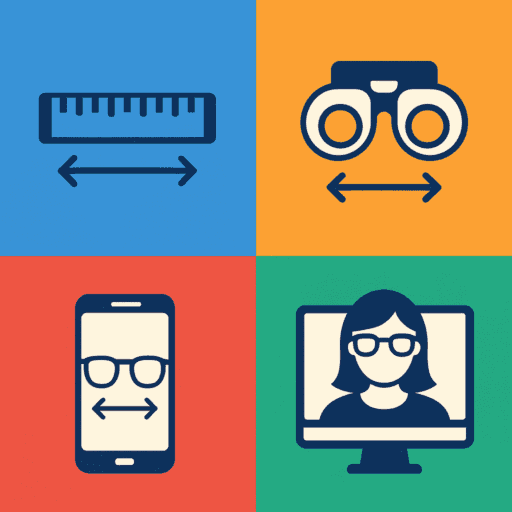
This guide compares four PD measurement approaches: plastic rulers, digital pupillometers, printed online rulers, and digital PD measurement platforms like Optogrid. For a workflow walkthrough, see how Optogrid measures PD and segment height. Each section covers accuracy data, cost structure, scalability, and practical business impact.
PD Accuracy Requirements by Lens Type (ANSI Z80.1-2015)
Before comparing methods, it helps to understand what accuracy each lens type demands. The ANSI Z80.1-2015 standard sets the industry-recognized tolerances:
| Lens Type | ANSI Z80.1 Horizontal Tolerance | Practical Implication |
|---|---|---|
| Single vision (0 to ±2.75D) | ±0.67 prism diopters | More forgiving; ruler methods often sufficient |
| Single vision (>±2.75D) | ±2.5mm total | Tighter tolerance for higher powers |
| Progressive addition | ±1.0mm per eye | Requires pupillometer or calibrated digital tool |
| Multifocal (bifocal) | Same as single vision | Follows single vision tolerance thresholds |
Progressive lenses have the strictest PD tolerance at ±1.0mm per eye. This means any measurement method with variance exceeding 1mm creates risk of corridor misalignment, peripheral distortion, and adaptation problems.
For practices dispensing 30% or more progressive lenses, measurement accuracy is not optional. It directly determines remake rates and patient satisfaction.
1. Plastic Ruler (In-Person)
What it is: A millimeter-marked ruler held against the bridge of the nose to measure the distance between pupils.
Pros:
- Low cost: under $5 per ruler
- No training or calibration needed
- No power source or technology required
Cons:
- Measurable variance: A 2024 study in Clinical Optometry found PD rulers produced a mean difference of 0.54 ± 0.74mm compared to pupillometers for distance IPD, with limits of agreement from -0.91mm to 1.98mm
- Parallax error: The same study noted that “PD ruler measurement also rely on solely human observation could lead human errors called parallax error and error could be from the different distance gap between the ruler and eye”
- Near PD is worse: For near IPD, the mean difference increased to 1.08 ± 0.99mm with limits of agreement reaching 3.03mm
- Hygiene concerns: difficult to sanitize between patients
- No remote option: entirely in-clinic, limiting e-commerce reach
- Inconsistent across operators: different staff members produce different readings, partly because the examiner’s own PD creates parallax relative to the patient
Note: Ruler-based measurements in high-volume dispensaries often require manual adjustments post-order when readings fall outside tolerance, adding delays and extra shipping costs. The variance documented above (LoA up to 1.98mm) explains why this happens more frequently with progressive and high-power prescriptions.
2. Digital Pupillometer (In-Person)
What it is: A handheld device that uses corneal reflection to electronically calculate PD. It eliminates parallax error by placing the fixation light on the same axis as the measurement optics.
Pros:
- High precision: Essilor’s PD-82 Digital Pupillometer specifies accuracy within 0.5mm
- Quick readings with minimal operator training
- Measures monocular PD for optimal progressive lens fitting
- Professional image: clinical-grade equipment enhances patient confidence
Cons:
- Equipment expense: $200-$800 per unit
- Calibration requirements: annual calibration costs $50-150, plus device replacement every 5-7 years
- No remote capability: serves only walk-in clients
- Maintenance overhead: cleaning, battery replacement, and storage
Digital pupillometers eliminate the parallax error inherent in ruler measurements because they sight the corneal reflection using a coaxially-mounted light source. This makes them the reference standard for clinical PD measurement. For high-power prescriptions, additional fitting parameters matter too. Proper lensmeter calibration ensures the device reading matches the ground lens. Vertex distance compensation accounts for the gap between the lens and the eye in strong Rx values.
Note: Digital pupillometers improve in-clinic first-pass accuracy but provide no solution for online orders. Practices with an e-commerce channel typically need a second measurement method for remote customers, since a pupillometer only works when the patient is physically present.
3. Printed Online Ruler (Remote DIY)
What it is: Customers download and print a PDF ruler, position it under their nose, and take a selfie. Staff then manually measure the image. For the step-by-step consumer process, see how to measure your PD at home.
Pros:
- Zero hardware cost: relies on customer’s printer
- Extends service to online shoppers
- Simple concept for customers to understand
Cons:
- Manual labor bottleneck: each measurement requires 5-8 minutes of staff review time, and a significant portion require re-submission due to poor photo quality or ruler misalignment
- User frustration: complex instructions lead to high drop-off rates
- Printer scaling errors: inconsistent print dimensions invalidate ruler accuracy
- Compounding error sources: the base ruler variance is joined by print scaling errors, photo angle, and manual image measurement, each adding its own deviation
- High return potential: the FUEL3D study found that “nearly half of eyewear purchases are returned or have to be adjusted due to poor fit.” Manual remote methods add measurement error on top of frame fit issues
Research on self-measurement supports this concern. A study published in Optometry and Vision Science found that self-measured PD had limits of agreement from -5.22mm to +6.14mm compared to pupillometer readings, far exceeding ANSI tolerances for any lens type.
Note: The manual review bottleneck compounds with volume. Each rejected submission triggers a support ticket and a second round of instructions, which means the real labor cost per completed measurement is higher than the time for a clean submission alone. Practices that have moved from printed rulers to automated tools report that this queue disappears almost entirely.
4. Digital PD Measurement Platform (e.g., Optogrid)
What it is: A digital PD measurement platform is a browser-based or tablet-based system that automates PD capture using computer vision. Customers photograph themselves with a reference object (such as a credit card), and the platform computes PD and Dual PD without any manual staff review. Unlike single-location in-person tools, a digital platform runs the same measurement workflow for in-store tablet stations and remote online orders. If a photo is slightly tilted or misframed, an image-rotation tool lets staff or the customer correct the angle before the algorithm runs.
Pros:
- Calibrated accuracy: Computer vision algorithms calibrate against ISO/IEC 7810 standard card dimensions (85.60 x 53.98mm), achieving ±1mm accuracy, which meets ANSI Z80.1 progressive lens tolerances
- Low friction: Step-by-step prompts with real-time feedback reduce mistakes. Completion time is typically under 2 minutes
- Automated processing: No manual reviews, no staffing bottlenecks, immediate order completion
- Platform integration: APIs and plugins for Shopify, WooCommerce, and custom platforms
- Scalable: Handles traffic spikes during promotions without additional staff or equipment
- Data capture: Measurements stored in customer profiles for reordering and CRM integration
Cons:
- Subscription cost: typically $29-49/month depending on volume. Break-even is typically 15-25 measurements per month when factoring in reduced returns and labor savings
- Connectivity requirement: customers need internet access and a modern browser
- Initial setup: 1-2 hours for integration and staff training
Peer-reviewed research backs the accuracy of computer-vision PD capture. A 2023 study in Cureus compared three smartphone PD apps against a digital pupillometer across 44 subjects. The best-performing app reached a mean absolute error of 0.51mm, though results varied by app, with errors ranging up to 1.38mm. The 2024 Clinical Optometry study cited above found a mobile PD app differed from the pupillometer by just -0.59mm for distance IPD. The consistent finding across both studies: validated, calibrated computer-vision tools reach clinically acceptable accuracy, while unvalidated apps cannot be assumed to. That is why reference-object calibration, which Optogrid uses, matters.
Optogrid also works as an in-store tool. Running on any tablet or laptop, it provides a cost-effective alternative to physical pupillometers at a fraction of the upfront cost. The same workflow works for in-store tablet measurements and customer self-service via Patient Links.
Note: Switching from a manual remote method to an automated tool like Optogrid removes the measurement-review queue and the associated labor cost. The subscription cost is typically offset when return shipping and customer service labor decrease, especially for stores with progressive lens orders where PD tolerance is tightest. The exact savings depend on order volume, lens mix, and return shipping rates.
12-Month Cost-Benefit Analysis
Total cost of ownership over 12 months reveals the business impact of each method:
| Method | Initial Cost | Ongoing (Annual) | Time per Measurement | Accuracy | Total 12-Month Cost (100/mo) |
|---|---|---|---|---|---|
| Plastic Ruler | $5 | $0 | 2-3 min ($1.50) | 0.5-2mm variance | ~$1,805 equipment/labor + return costs |
| Digital Pupillometer | $500 | $100 calibration + $80 amortized | 1 min ($0.50) | ±0.5mm | ~$1,280 equipment/labor + lower return costs |
| Printed Online Ruler | $0 | $0 hardware | 6 min review ($3.00) | 2-4mm+ variance | ~$3,600 labor + high return costs |
| Optogrid | $0 | $588 ($49/mo) | 0 min staff time | ±1mm | $588 subscription + moderate return costs |
Modeled assumptions (adjust for your own costs): staff labor rate $30/hour, average order value $180, return processing cost $20/return, 100 measurements per month. Figures are illustrative estimates, not audited financial data.
At 100 measurements per month, automated online tools eliminate roughly $1,800 in annual labor costs compared to plastic rulers and $3,000+ compared to printed rulers. The primary cost differentiator at scale is staff time. Manual methods require proportional labor increases; SaaS tools do not.
How to Choose the Right Method for Your Practice
Modern PD measurement systems, such as digital pupillometers and computer-vision platforms, replace the ruler and the examiner’s eye with electronics. A pupillometer sights the corneal reflection on the same axis as its fixation light, which removes parallax and reaches ±0.5mm, but it needs the patient in the store. A platform calculates PD and Dual PD from a photo calibrated against a standard-size card, reaches ±1mm (within the ANSI Z80.1 progressive tolerance) and runs the same workflow on a store tablet and for remote customers. Which one fits depends on the factors below.
By Business Model
- Brick-and-mortar only: Digital pupillometer or tablet-based Optogrid both work well
- Hybrid (physical + online): A digital PD measurement platform provides multi-channel PD measurement consistency, using one workflow for in-store tablets and online orders with a single training protocol
- E-commerce primary: Online tools are necessary; manual methods create bottlenecks
By Budget
- Under $50: Plastic ruler (accept higher variance and returns)
- $50-300/year: Optogrid subscription with no upfront hardware
- $500-1,000: Digital pupillometer for maximum in-clinic precision
By Lens Mix
This is the most important factor for accuracy requirements:
- Primarily single vision (low power): Ruler accuracy is often sufficient per ANSI Z80.1 tolerances
- 30%+ progressive/high-index: ±1mm accuracy (Optogrid level) becomes important to meet ANSI progressive tolerances
- Specialty lenses (occupational progressives, high-curve wraps): ±0.5mm digital pupillometer accuracy preferred
By Order Volume
- Under 50/month: Manual methods may be sustainable, but consider staff time opportunity cost
- 50-200/month: Online tools provide clear ROI through labor savings
- Over 200/month: Automation becomes necessary; manual review does not scale cost-effectively
Decision Summary
- Need remote capability? Online measurement tool
- Budget under $50, in-person only? Plastic ruler (accept limitations)
- Clinic-only, maximum precision, no e-commerce? Digital pupillometer
- Hybrid business or growing online? A digital PD measurement platform enables multi-channel consistency (one tool, one training workflow, in-store and remote)
Recommended Upgrade Path
Start with plastic rulers for low-volume, single vision dispensing. When your monthly volume exceeds 50 orders or your progressive lens mix reaches 30%, switch to a calibrated online tool like Optogrid to meet ANSI tolerances and eliminate per-measurement labor costs. If your progressive mix exceeds 50% and you need sub-millimeter precision for specialty lenses, such as occupational progressives or high-curve wraps, add a digital pupillometer for in-clinic use. Keep your online tool in place for remote orders.
Explore Optogrid’s pricing to compare plans against your monthly measurement volume, or see how PD measurement works with Optogrid to evaluate the workflow.
Side-by-Side Comparison
| Method | Accuracy | Cost | Remote | Scalability | Best For |
|---|---|---|---|---|---|
| Plastic Ruler | 0.5-2mm variance | Under $5 | No | Low | Low budgets, low-power single vision |
| Digital Pupillometer | ±0.5mm | $200-800 + maintenance | No | Medium | Clinics needing maximum precision |
| Printed Online Ruler | 2-4mm+ variance | Free | Yes | Low (manual bottleneck) | Small businesses testing online sales |
| Digital PD Platform (Optogrid) | ±1mm | $29-49/mo | Yes | High | Multi-channel practices, e-commerce, hybrid and growing businesses |
Frequently Asked Questions
What is the most accurate way to measure pupillary distance?
Digital pupillometers offer the highest accuracy. The Essilor PD-82 specifies accuracy within 0.5mm using corneal reflection technology. Online tools like Optogrid achieve ±1mm, which meets ANSI Z80.1 progressive lens tolerances of ±1.0mm per eye.
Can online PD measurement match in-person accuracy?
Calibrated online tools approach clinical accuracy. Optogrid calibrates against ISO/IEC 7810 standard card dimensions (85.60 x 53.98mm) to achieve ±1mm. By comparison, a 2024 study found manual PD rulers had limits of agreement up to 1.98mm versus pupillometers. A well-calibrated online tool can match or exceed that ruler accuracy.
How much does a digital pupillometer cost compared to online tools?
Digital pupillometers cost $200-800 upfront plus $100-150/year for calibration, totaling $300-950+ in the first year. Online tools like Optogrid cost $29-49/month ($348-588/year) with no upfront investment. Online tools become more cost-effective at 15-20+ measurements per month when factoring in labor savings.
What PD accuracy do progressive lenses require?
ANSI Z80.1-2015 specifies ±1.0mm per eye for progressive addition lenses. Errors exceeding this tolerance cause corridor misalignment and adaptation difficulties. Plastic rulers, with documented variance up to 1.98mm, fall outside this tolerance. Both digital pupillometers (±0.5mm) and calibrated online tools (±1mm) meet the standard. Progressive lenses also benefit from segment height measurements for proper vertical positioning.
What causes PD measurement errors with plastic rulers?
Three factors drive the error. Parallax error occurs when the examiner’s line of sight is not perpendicular to the ruler. Angle kappa is the offset between the pupillary axis and visual axis, typically 3-5 degrees nasally, which means rulers and pupillometers reference slightly different anatomical points. Inter-operator variance comes from differences in PD between the examiner and the patient. A 2024 comparative study documented these factors.
Do I need separate PD measurements for distance and reading glasses?
Near PD is typically 2-4mm smaller than distance PD because eyes converge when focusing up close. Most practices use distance PD unless fitting progressive or specialized near-vision lenses. Optogrid measures distance PD by default, appropriate for the majority of prescriptions. For progressives, capturing segment height and dual PD improves fitting accuracy.
Can customers measure their own PD reliably?
Guided, automated tools produce better results than manual self-measurement. A study in Optometry and Vision Science found self-measured PD had limits of agreement from -5.22mm to +6.14mm compared to pupillometer readings. Automated tools with built-in photo validation and reference object calibration significantly narrow this variance by removing manual measurement steps.
How does PD measurement method affect return rates?
Poor-fitting eyewear costs U.S. and U.K. retailers over $26 billion annually according to a FUEL3D study, with “nearly half of eyewear purchases returned or adjusted due to poor fit.” While PD error is one contributing factor alongside frame fit, choosing a measurement method that consistently meets ANSI tolerances reduces the PD-related portion of these returns.
How do you measure PD for progressive lenses with a pupillometer?
Use monocular PD, the distance from the bridge center to each individual pupil, rather than one binocular total. This matters for progressives because the two corridors are positioned independently, so a centering error on just one eye can misalign that eye’s near zone. A digital pupillometer captures monocular PD directly: the patient fixates on the device’s built-in light, which sits on the same axis as the measurement optics and removes the parallax error that affects ruler readings. ANSI Z80.1 allows only ±1.0mm per eye for progressive addition lenses, well inside a pupillometer’s ±0.5mm accuracy but tighter than a plastic ruler’s typical 0.5-2mm variance.

I grew up inside an optical shop. My mother likes to tell how, as a kid, I would watch eyeglasses being assembled, play with the tools, and draw on the back of service order slips. The family business taught me early what a precise measurement and work done right are worth.
I went on to spend more than twenty years as a software engineer, always keeping an eye on the optical world. Optogrid was born where the two meet: digital measurement technology (pupillary distance and fitting heights) built by someone who knows the dispensing counter from the inside.