
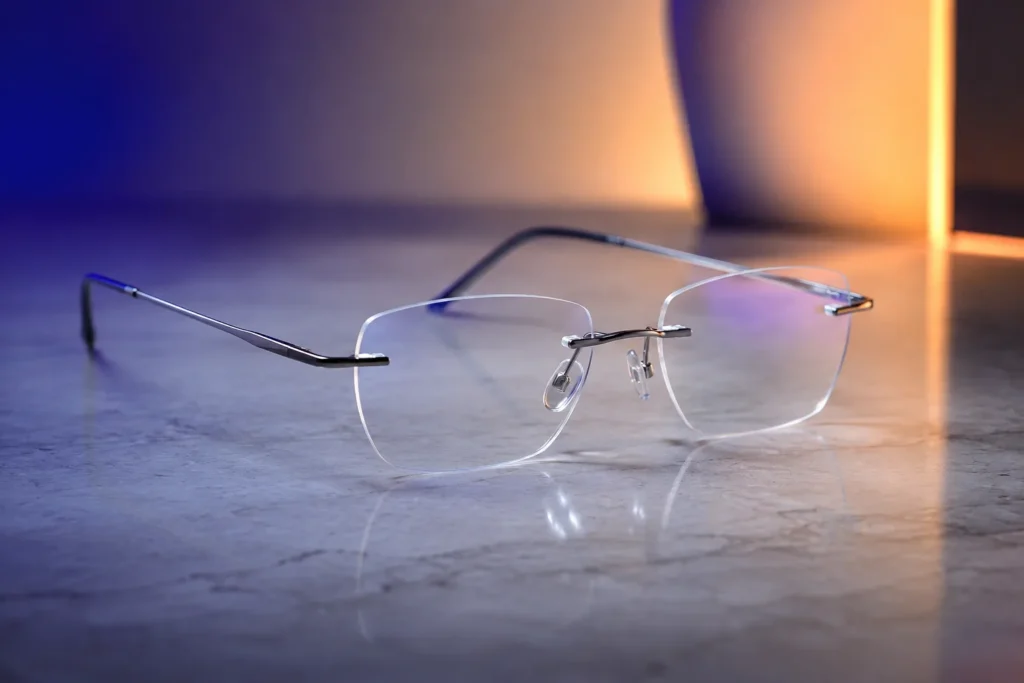
Rimless glasses have the lenses attached directly to the bridge and temples, with no surrounding rim holding them in place. That minimal design keeps weight to a minimum and gives the face a clean, open appearance, but it places all structural stress on the lens itself at the mounting points. For most adults with a low to moderate prescription who treat their glasses carefully, rimless and semi-rimless styles are practical and durable with proper maintenance. They do require specific lens materials (polycarbonate or Trivex, not CR-39), periodic screw tightening by an optician, and a prescription that does not produce a noticeably thick edge. High prescriptions, active lifestyles, and frequent rough handling are better served by full-frame designs.
How Rimless and Semi-Rimless Frames Are Built
There are two distinct construction types under the “rimless” category, and understanding the difference affects every decision from lens material to repair cost.
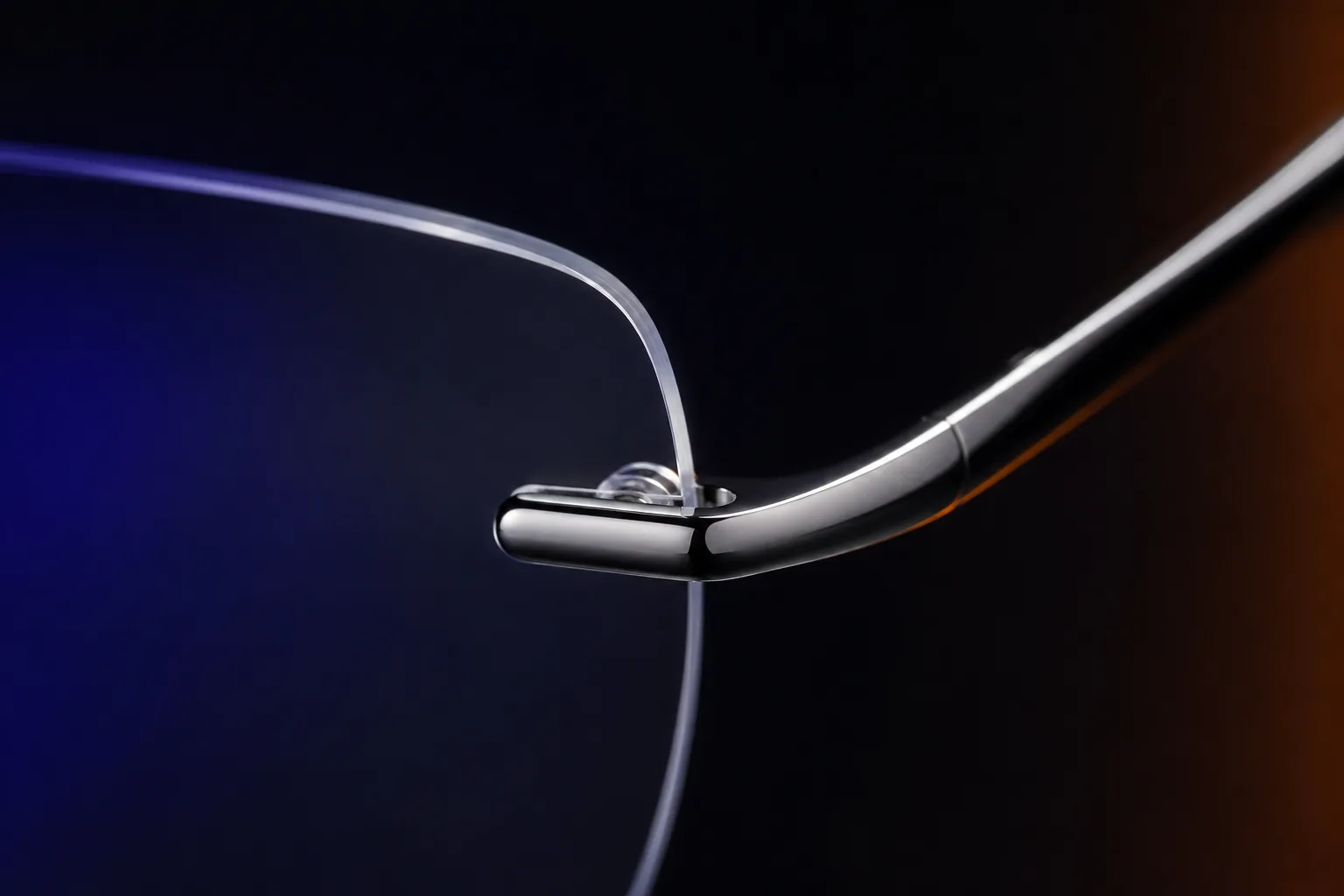
Three-piece / drill-mount frames have no frame front at all. The bridge and temple hinges attach directly to the lenses via small holes drilled through the lens at the nasal and temporal edges. Inside each hole sits a nylon or silicone bushing (also called a grommet), which cushions the lens against the screw and distributes the clamping force across the lens material. The result is the most minimal frame design available.
Semi-rimless / nylon supra / groove-and-cord frames have a partial metal or acetate rim running along one edge of the lens (usually the top), with a thin nylon cord (supra line, typically 0.5 mm in diameter) sitting in a machined groove around the opposite edge to hold the lens. Some designs invert this configuration, rimming the bottom and leaving the top open. The cord is field-replaceable, and because the design distributes load along the full groove rather than concentrating it at two drill points, it places less stress on the lens material.
Understanding these two constructions matters when choosing eyeglass frames that will fit the wearer’s prescription, lifestyle, and maintenance expectations.
Why Lens Material Is Non-Negotiable in Drill-Mount Frames
The most critical technical point for rimless dispensing: the lens material must be impact-resistant.
Standard CR-39 plastic (refractive index 1.50) is too brittle for drill-mount applications. The stress concentrated at each drill hole can cause the lens to crack or chip, particularly along the axis from the mount point outward to the lens edge. Glass has the same brittleness problem. Neither material belongs in a three-piece rimless mount for everyday wear.
Polycarbonate and Trivex are the accepted materials for drill-mount rimless frames. Both meet the ANSI Z87.1 high-velocity impact standard. For drill mounts specifically, Trivex has higher tensile strength and lower density than polycarbonate (specific gravity 1.11 versus 1.20 for polycarbonate), making it less likely to develop stress fractures around mount points over years of temperature cycling and daily handling. Polycarbonate is a sound, more affordable alternative for most prescriptions; the tradeoff is a higher level of chromatic aberration (color fringing at the lens periphery), since polycarbonate has a lower Abbe value than Trivex.
PPG Industries, the developer of Trivex, positions the material as “clear, light, thin and strong” and calls it “an excellent choice for rimless (or drill-mount) frames” thanks to its robustness and stress-free characteristics, and it remains the material many labs specify by default for rimless orders.
For semi-rimless groove-and-cord frames, the material constraint is somewhat more flexible since the cord distributes load rather than two discrete drill holes. Polycarbonate or Trivex is still the more reliable recommendation for longevity, but some labs use CR-39 in supra mounts for lower prescriptions.
For a full breakdown of refractive indices, Abbe values, and thickness trade-offs across all common lens materials, see the lens material comparison guide.
Prescription Range and Edge Thickness
For myopic (negative sphere) prescriptions, lenses are thinnest at the optical center and thickest at the outer edges. A full-frame rim conceals that edge. A rimless or semi-rimless frame does not.
As a practical dispensing guideline, prescriptions below -4.00D are generally workable in smaller rimless shapes; -4.00D to -6.00D is borderline with increasingly visible edges as frame size increases; above -6.00D, 1.67 or 1.74 high-index lenses in a smaller full-frame design typically produce a cleaner cosmetic result.
Hyperopic (positive) prescriptions are thicker at the center and thinner at the edge, so edge appearance is less of a concern, though very high plus powers can still produce noticeable center thickness.
Several additional technical factors affect how a rimless lens will look and perform:
- Minimum blank size: The smallest uncut lens diameter from which the lab can cut the finished lens while correctly positioning the optical center over the pupil. Larger rimless frame shapes demand a larger blank, which can conflict with prescriptions where the optical center sits far from the geometric center. See the minimum blank size guide for specifics, or run the minimum blank size calculator for a specific frame and Rx.
- Base curve: The front curvature of the uncut lens affects the edge profile and how the finished lens fits the mount geometry. Steeper base curves can increase edge thickness in minus prescriptions.
- Edge finishing: In drill-mount rimless, the lab applies a flat polish or safety bevel rather than a standard beveled edge, since there is no rim groove to seat. In groove-and-cord semi-rimless, the groove must be cut to a precise depth and profile to hold the supra cord securely.
For a full technical explanation of how sphere, cylinder, and refractive index combine to determine final lens thickness, see the science behind lens thickness.
Durability and Maintenance
Rimless frames are not delicate, but they have different failure modes than full-frame designs.
Screws backing out. The mount screws can loosen from vibration and temperature changes. Tightening them with a household screwdriver is risky: the threads are calibrated for precise torque, and overtightening by even a fraction of a turn can crack the lens at the drill point. Qualified opticians use the right tools and feel for this. Some labs apply a small amount of low-strength thread-locking compound during assembly to reduce how often screws back out without making them impossible to remove for future adjustments.
Edge chipping. Exposed lens edges can chip on hard surfaces. Polycarbonate and Trivex are resistant to chipping but not immune. A chip near a drill hole compromises the structural integrity of the entire mount and usually means lens replacement.
Bushing wear. The nylon or silicone bushings cushioning each drill hole can compress and degrade over years of use, reducing their ability to absorb stress. Replacement is straightforward for an optician during a routine adjustment visit.
Supra cord stretch. In groove-and-cord frames, the nylon cord can stretch over time, causing the lens to rotate slightly or develop a faint rattle. Cord replacement is a two-minute repair in a dispensary.
Repair costs for rimless frames can be higher than for full frames. A cracked lens at the drill point typically requires full lens replacement rather than repair.
Fit and Optical Centration
Accurate optical centration matters for all prescription eyewear, but rimless frames are less forgiving than full-frame designs. There is no rim to adjust post-delivery, so the position of each drill hole is effectively permanent once cut. Guidance on prescribing and fitting spectacles stresses that the optical centre and the pupil must be aligned correctly, and that misalignment can induce prismatic distortion, which is why centration deserves extra care on a mount where nothing can be repositioned later.
Monocular PD values (separate right and left measurements) rather than a single binocular PD are important for rimless fitting, since most wearers have some degree of facial asymmetry that a single combined measurement obscures. Digital PD and segment height measurement tools like Optogrid help reduce centration errors before drilling begins, which matters more in rimless work than almost any other frame category.
Proper glasses fit and frame adjustment remain important after dispensing, since a rimless frame sitting unevenly on the face cannot be corrected by bending a rim.
Rimless vs Semi-Rimless vs Full-Frame
| Feature | Rimless (drill-mount) | Semi-Rimless (nylon supra) | Full-Frame |
|---|---|---|---|
| Weight | Lightest | Light | Varies; heavier on average |
| Look | Most minimalist | Minimalist with partial structure | Fully visible frame |
| Durability | Moderate (exposed edges, screw risk) | Moderate (cord wear, less drill stress) | Highest (rim protects edges) |
| Prescription range | Best below -4.00D | Below -4.00D; partial rim adds some coverage | All prescriptions |
| Lens material | Polycarbonate or Trivex only | Polycarbonate or Trivex preferred | CR-39, poly, Trivex, high-index |
| Repair complexity | Higher (lens replacement likely) | Moderate (cord replacement is inexpensive) | Lowest |
| Post-dispensing adjustability | Limited (no rim to bend) | Moderate | Easiest |
Who They Work Best For
Rimless is a strong choice for:
- Prescriptions generally below -4.00D or low plus powers
- Adults who want the lightest, most unobtrusive look available
- Wearers who see an optician regularly and are careful with their glasses
- Professional settings where a minimal, clean aesthetic matters
Worth reconsidering if:
- Prescription is above -5.00D or -6.00D, where edge thickness becomes prominent without a rim
- The wearer is a child or teenager, whose activity levels increase mount stress considerably
- The use case involves sports or environments with impact risk (dedicated safety frames with a full ANSI Z87.1-rated rim are the right choice)
- The wearer regularly adjusts their own glasses, since rimless frames cannot be bent at the lens perimeter without risking the mount
Frequently Asked Questions
Are rimless glasses more fragile than full-frame glasses?
Rimless frames are not fragile in everyday use, but they have different failure points. The exposed lens edges can chip from drops, and mount screws can loosen over time. With polycarbonate or Trivex lenses and regular optician check-ups for screw tightening, most wearers find rimless frames last several years without major problems.
Can I use CR-39 lenses in rimless frames?
CR-39 is not suitable for drill-mount rimless frames. Its brittleness means the concentrated stress at each drill hole is likely to crack or chip the lens at the mount point. Polycarbonate or Trivex are the correct materials for three-piece drill-mount designs. CR-39 is sometimes used in groove-and-cord semi-rimless mounts where less stress concentrates at any single point, but it is still not the recommended choice for longevity.
What is the difference between rimless and semi-rimless glasses?
Rimless glasses (three-piece or drill-mount) have no frame front: the bridge and temples attach directly to drill holes in the lens, with small bushings cushioning each hole. Semi-rimless glasses (nylon supra or groove-and-cord) have a partial rim along one edge and a thin nylon cord sitting in a groove around the opposite edge. Semi-rimless designs distribute structural load more evenly and make lens retention maintenance easier, since the cord is replaceable in minutes.
Can I get rimless glasses with a high prescription?
Rimless glasses work best with prescriptions below approximately -4.00D. Higher minus prescriptions produce thick lens edges that are fully visible without a rim to conceal them, and larger blank sizes needed for off-center optical centers can limit frame shape options. For prescriptions above -5.00D or -6.00D, high-index lenses in a smaller full-frame design generally produce a better cosmetic result.
Why do rimless glasses specifically require polycarbonate or Trivex?
Drill holes create stress concentration points in the lens material. CR-39 and glass are brittle enough to crack at those points under normal handling, temperature changes, and screw torque. Polycarbonate and Trivex are both impact-resistant materials that can flex slightly without fracturing at mount points. Trivex additionally offers higher tensile strength and lower weight than polycarbonate, making it the preferred choice when long-term drill-mount stability is the priority.
How often do rimless glasses need professional maintenance?
An annual adjustment visit with an optician is a reasonable minimum. Mount screws can back out every few months depending on handling and storage habits. An optician can tighten screws to the correct torque, inspect bushing condition, and verify that optical centration has not shifted. Attempting to tighten rimless mount screws without the right tools risks cracking the lens at the drill point.

I grew up inside an optical shop. My mother likes to tell how, as a kid, I would watch eyeglasses being assembled, play with the tools, and draw on the back of service order slips. The family business taught me early what a precise measurement and work done right are worth.
I went on to spend more than twenty years as a software engineer, always keeping an eye on the optical world. Optogrid was born where the two meet: digital measurement technology (pupillary distance and fitting heights) built by someone who knows the dispensing counter from the inside.