

Good glasses fit comes down to four contact points. The bridge of the frame rests on your nose without pinching or sliding. Your pupils sit centered horizontally in each lens. The temples run straight back over your ears without pressing into the sides of your head. The frame’s weight distributes evenly between the bridge and both ears. When any of those four points is off, you feel it: frames that slide down need to be pushed up constantly, bridges that pinch leave red marks, and lenses that are off-center can affect how clearly your prescription works.
Getting the mechanical fit right and getting the optical measurement right are two related but separate things. Fit is about the frame contacting your face correctly. Optical centering is about the lens being made with your exact pupillary distance (PD) so the clearest point of each lens lines up with your pupil. Opticians now use digital tools to capture both in one appointment, or remotely for online purchases. Optogrid is one such tool, letting opticians measure PD, segment height, and frame overlay data from a phone or tablet.
The 4 Signs Your Glasses Fit Right
A good fit at each of the four contact points looks like this:
| Fit Point | Good Fit | Poor Fit |
|---|---|---|
| Bridge / nose | Even, light pressure on both sides; no sliding during normal movement | Slides down regularly; leaves red marks or indentations; presses unevenly on one side |
| Eye centering | Pupils at or just above the horizontal midpoint of each lens when looking straight ahead | Pupils near the top, bottom, or outer edge of the lens; off-center horizontally |
| Temples / ears | Arms extend straight from the hinge, then curve gently behind each ear without squeezing the skull | Press into the temple area or behind the ears; too loose to keep the frame from shifting |
| Frame width and weight | Outer lens edges roughly align with the outer edges of the face; weight shared between bridge and ears | Frame extends well past the face (too wide) or cuts inward (too narrow); all weight on nose or on ears only |
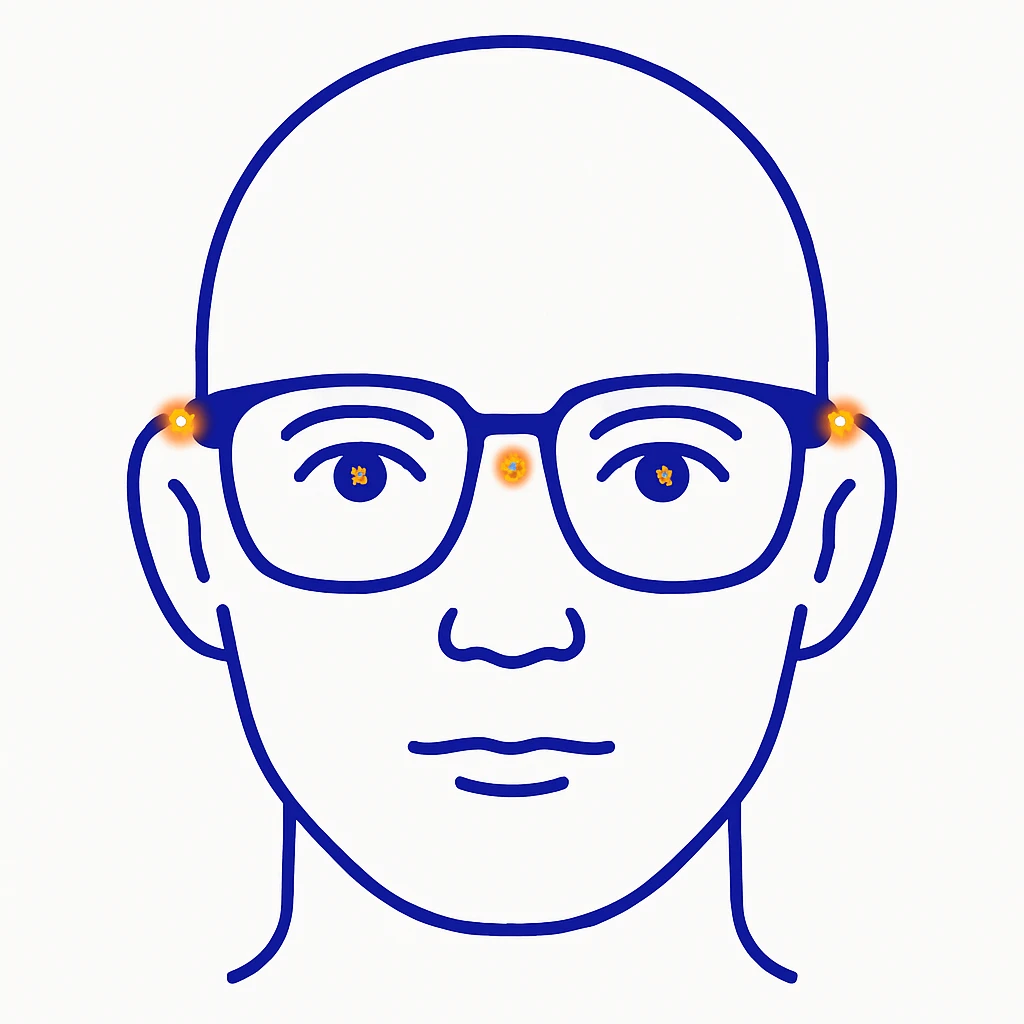
The Bridge: How It Should Sit on Your Nose
The bridge bears the majority of the frame’s weight and sets the vertical position of everything else. A bridge that fits correctly rests on your nose with steady pressure on both sides. You should not have to push your glasses up more than occasionally, and you should not see soreness or marks where the nose pads contact the skin after a short wearing period.
Frames with adjustable nose pads, typical on metal frames, give an optician room to work: the pad angle can be widened or narrowed, raised or lowered, to distribute pressure more evenly. Acetate and plastic frames use a fixed saddle bridge, where only the bridge width matters. If the bridge is too wide for the nose, the frame has no shelf to rest on and slides regardless of other adjustments. For the full set of parameters an optician can modify, see Frame Adjustment: 4 Parameters That Prevent Remakes.
Your Eyes in the Lens: Centering Affects What You See
Looking straight ahead, your pupils should fall at or just slightly above the horizontal center of each lens. This centering is not just comfort: it is where the optical center sits.
Research published in the journal Eye & Contact Lens (PMC) explains it directly: “The optical centre of a lens is the point at which the wearer will experience the clearest vision,” and “if the optical centre is not correctly aligned, light rays that pass through the lens are refracted, or bent, which leads to blurred or distorted vision.” The result is eye strain and headaches, even when the prescription itself is correct.
For single-vision lenses, a small centering error is often tolerable. For progressive lenses, the near, intermediate, and distance zones are stacked in specific vertical positions, so a frame sitting too low or too high shifts those zones out of reach.
The Temples: Holding the Frame Without Squeezing
The temples (the arms that run from the hinges to behind the ears) should extend straight back from the hinge, then curve gently downward to hook behind the ear. They should feel like they are holding the frame in position, not gripping the sides of your skull.
Pressure or pain at the temples after an hour of wear usually means the bend starts too early, or the angle at the ear hook is too steep. An optician can heat acetate temples to reshape them or adjust the bend angle on metal ones. Temples that stay flat rather than curving behind the ear provide little retention, which causes the frame to slide and tilt when you look down.
Frame Width and Weight Distribution
Stand in front of a mirror and look straight ahead. The outer edge of each lens should roughly align with the outer edge of your face at the temples. If the frame extends noticeably past your face, it is too wide. If the frame corners cut inward, it is too narrow.
Width is not adjustable beyond small tweaks: it depends on the frame size. Weight distribution is linked to width. A too-wide frame shifts all the weight to the nose because the bridge is the only contact point left. A too-narrow frame pushes weight onto the temples. A correctly sized frame shares the load between the bridge and the temples over the ears.
Common Fit Problems and What They Mean
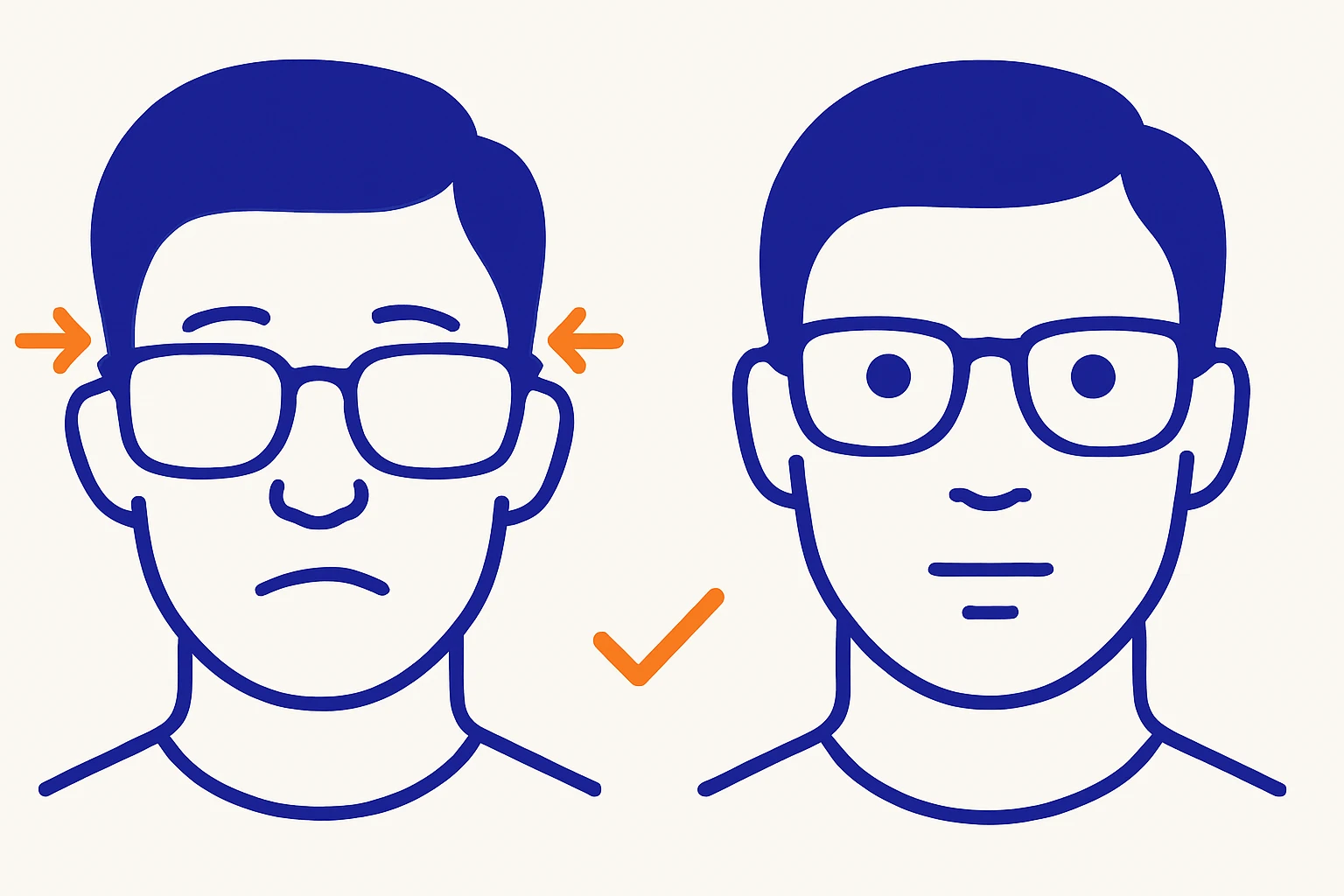
Glasses Sliding Down Your Nose
Sliding glasses are frustrating but usually come from one of three causes:
- Frame too wide for the face. When the frame is oversized, the bridge does not maintain firm contact with the nose. No pad adjustment fully compensates.
- Bridge width too large. A bridge number larger than your nose’s width leaves the frame without a solid resting point.
- Nose pad angle too wide. Pads angled outward lower the contact force and allow the frame to creep down over time.
A quick self-check: push your glasses up to the correct position and shake your head gently side to side. Immediate sliding points to frame width or bridge size. Sliding that develops slowly over the course of a day is more often a nose pad or temple adjustment issue.
For an optician, common solutions include closing the nose pads inward, adjusting the pantoscopic tilt (the forward angle of the frame front), and reshaping the ear hooks on the temples. The full breakdown of each parameter is in Frame Adjustment: 4 Parameters That Prevent Remakes.
Glasses Too Tight: Pinching, Pressure, and Marks
Pressure behind the ears, a headache at the temples, or red marks on the nose bridge all mean something is too tight at a specific contact point.
Behind-the-ear pain usually comes from temple tips or the ear hook bend pressing too hard. An optician can widen the bend or move it further back so the hook clears the ear comfortably.
Nose pad marks generally mean the pads are angled too steeply inward, or that the frame weight is concentrated on a small pad surface. Wider silicone nose pads spread the load and switching from rigid metal pads to softer silicone often resolves persistent marking.
Pressure at the sides of the head means the frame is narrower than the face, and no adjustment changes that: a wider frame size is needed.
Low Bridge Fit: What It Is and Whether You Need It
Standard frame design assumes a nose bridge that rises above the pupil level, creating a natural shelf where the frame rests. If your bridge sits level with or below your pupils, a standard frame slides forward because it has no shelf to sit on. The lenses end up resting on your cheeks instead of the frame resting on your nose.
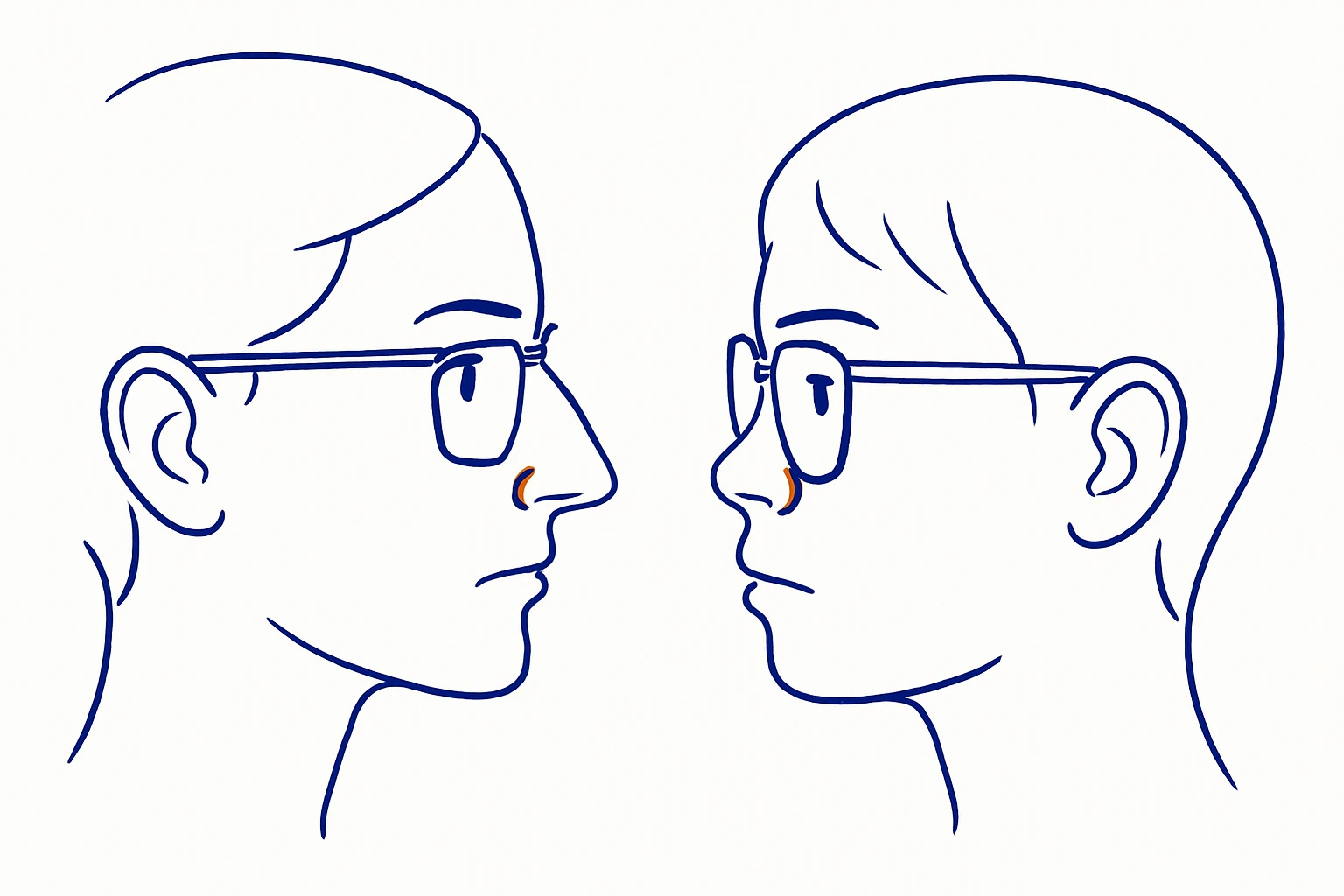
Low bridge fit addresses this directly. According to American Optical, “a low bridge fit refers to glasses designed specifically for individuals with a flatter nose bridge, which sits closer to the face.” These frames use wider, lower-set nose pads or a broader saddle bridge, and a reduced pantoscopic tilt so the frame sits flush against a flatter nasal profile without the lens bottom resting on the cheeks.
| Feature | Standard Fit | Low Bridge Fit |
|---|---|---|
| Bridge design | Average saddle bridge or standard-angle nose pads | Wider, lower-set pads or a broad saddle bridge |
| Nose bridge level | Rises above pupil level | Sits level with or below pupil level |
| Without the right fit | Frame slides; lenses rest on cheeks | Frame holds position stably |
| Frame tilt | Standard pantoscopic tilt | Reduced pantoscopic tilt |
How to tell if you need low bridge fit: Take off your glasses and press one finger gently to the top of your nose where the bridge of the frame would normally rest. Look in a mirror straight ahead. If that contact point sits at the same level as your pupils or below them, you likely have a low nose bridge and low bridge fit frames will serve you better.
You may also see this design category called “Asian fit” on older product listings. Low bridge fit is the current industry term: it describes the anatomical need, not an ethnicity.
Reading the Numbers on Your Frame
Most frames have three numbers stamped on the inside of one temple, such as 52 □ 18 − 140. These follow the boxing system defined in ISO 8624:2020, the international standard for spectacle frame measurement:
- 52 (lens width): the horizontal width of each lens in millimeters, measured across the widest point of the boxed lens shape.
- 18 (bridge width): the gap between the two lenses in millimeters.
- 140 (temple length): the arm length from the hinge to the tip.
A wider bridge number suits a wider nose. A longer temple suits a greater hinge-to-ear distance. If you have a pair that fits well, matching these three numbers when buying a new frame gives you a strong starting point. For a deeper explanation of how each measurement is calculated and what the numbers actually mean, see Eyeglass Frame Measurements: The Boxing System Explained.
Your pupillary distance (PD) is a separate measurement. Adult PD typically falls between 54 and 74 millimeters, with most adults in the low to mid-60s. This number tells the lab where to set the optical center of each lens so it lines up with your pupil when you look straight ahead. For a full guide on PD, segment height, and how to get accurate measurements for in-person or online orders, see Online Eyewear Measurement: PD, SH, and Frame Sizing Explained.
Frame fit (the mechanical numbers) and optical centering (PD) work together. A frame that fits the face correctly but uses an incorrect PD still causes visual discomfort, especially with progressive lenses where even one millimeter of PD error can shift the reading and distance zones out of their intended position.
When an Optician’s Assessment Makes a Difference
Some fit issues are fixable through careful frame selection: matching the three frame numbers to a pair that already fits, choosing low bridge fit if needed, checking the bridge width against your nose width. Many are not, particularly the angular adjustments that require specialized tools and trained hands.
An optician’s fitting adds several things a self-assessment cannot:
- Pantoscopic tilt and face-form adjustment. The slight forward and sideways angle of the frame front affects where your line of sight passes through the lens. These angles are set precisely for each wearer, not by the frame manufacturer.
- Monocular PD measurement. An optician measures each eye separately to account for facial asymmetry. Most people’s pupils are not equidistant from the center of the nose, and using the wrong monocular value places each optical center off from where it should be.
- Frame shaping to the individual face. No two faces are identical. A professional fitting shapes the frame to the specific bridge width, nose pad angle, temple length, and ear geometry of the person wearing it.
Fit (mechanical) and style (aesthetic) are separate decisions. A frame can fit correctly and still suit your face shape better or worse. If you are choosing a frame for both fit and style, the guides on best glasses for round faces and best glasses for heart-shaped faces cover the style side.
Frequently Asked Questions
How do I know if my glasses fit correctly?
Check four points: (1) the bridge rests on your nose with even pressure and does not slide during normal movement; (2) your pupils sit at or just above the horizontal midpoint of each lens when looking straight ahead; (3) the temples run straight to the ear and curve gently behind it without pressing into the skull; (4) the outer lens edges roughly align with the outer edges of your face. If all four are correct and the frame feels stable after a full day of wear without soreness or marks, the fit is good.
Why do my glasses keep sliding down my nose?
The three most common causes are a frame too wide for the face (the bridge loses contact with the nose), a bridge width larger than the nose’s width, or nose pads angled too wide. An optician can angle the pads inward and adjust the pantoscopic tilt and temple bends to improve retention. If the frame itself is oversized, no adjustment fully compensates and a frame in the correct measurements will hold position better.
What is low bridge fit and do I need it?
Low bridge fit glasses are designed for people whose nose bridge sits level with or below the pupils. Standard frames rest on a bridge that rises above the pupils; when the bridge is flat or low, the frame slides forward and the lens bottoms rest on the cheeks. Low bridge fit frames use wider, lower-set nose pads and adjusted angles to stay in place on flatter bridges. A simple check: touch the bridge of your nose where glasses would rest and look straight ahead in a mirror. If that point is at or below your pupils, low bridge fit is likely the right design for you.
How tight should glasses be on my face?
Glasses should feel secure but not tight. The temples should hold the frame without gripping the sides of the head, and the nose bridge should distribute weight without leaving marks after normal wear. Pressure at the temples, pain behind the ears, or clear red indentations on the nose after an hour or two of wear all signal that an adjustment is needed at the specific contact point causing the problem. None of these should be accepted as normal.
Can an optician fix glasses that don’t fit right?
Yes, in most cases. An optician can adjust nose pad angles, reshape temple bends, change the pantoscopic tilt of the frame front, and widen or narrow the frame front to better match the face. Metal frames are the most adjustable; acetate frames can be heat-formed. The main limits: if the frame is structurally too wide or too narrow for the face, or the bridge width is wrong for the nose, adjustments can only go so far. A frame in the correct measurements will fit better than an oversized or undersized one that has been forced.
How do I measure my face for glasses at home?
The useful measurements are your face width at the temples (use a flexible tape measure or a ruler against a mirror) and your pupillary distance. For face width, compare it to the sum of the frame’s lens width plus bridge width plus the two lens-to-face distances to estimate how well a frame will fit. For PD, a ruler and mirror method gives an approximate figure, though professional measurement is more accurate, particularly for progressive lens orders. A full walkthrough of what to measure and how to use those numbers is in Online Eyewear Measurement: PD, SH, and Frame Sizing Explained.

I grew up inside an optical shop. My mother likes to tell how, as a kid, I would watch eyeglasses being assembled, play with the tools, and draw on the back of service order slips. The family business taught me early what a precise measurement and work done right are worth.
I went on to spend more than twenty years as a software engineer, always keeping an eye on the optical world. Optogrid was born where the two meet: digital measurement technology (pupillary distance and fitting heights) built by someone who knows the dispensing counter from the inside.