
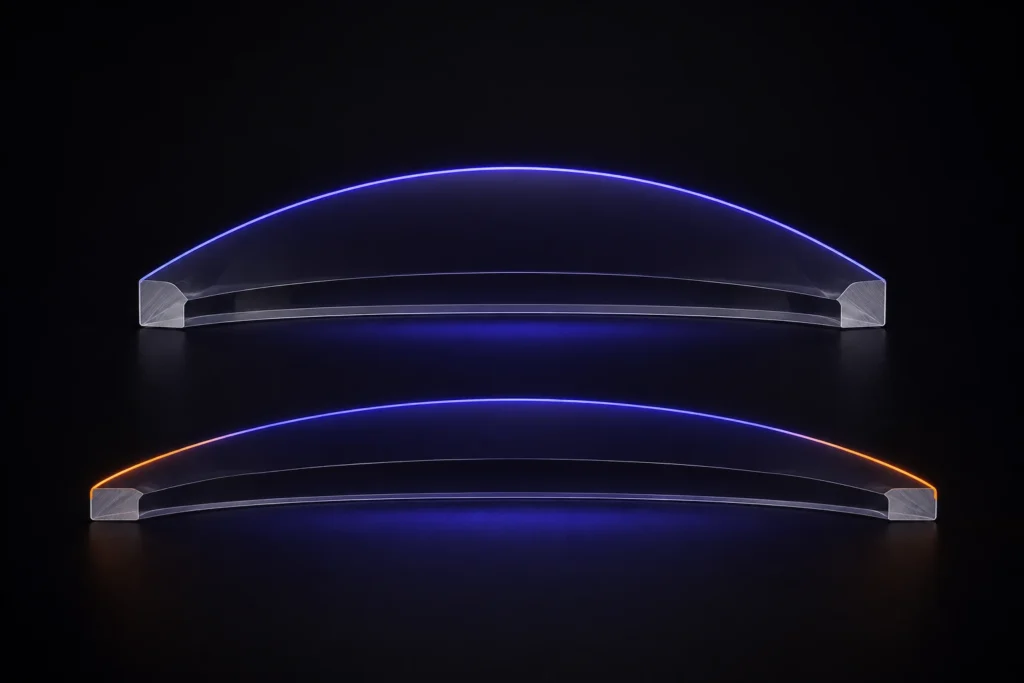
“Aspheric” describes the curvature of a lens surface, not what the lens is made of. A spherical lens holds one constant radius of curvature from the optical center to the edge, like a slice cut from a ball. An aspheric lens flattens that curvature progressively toward the periphery, closer to the shape of an ellipse than a sphere. For moderate-to-high prescriptions, the practical payoff is a thinner lens, less “coke-bottle” eye magnification in plus powers (and less eye minification in minus powers), and clearer vision when the wearer looks off-center rather than straight through the optical center. Below roughly moderate power, the visual difference from a well-made spherical lens is small, and the aspheric option mostly buys cosmetics. Above it, asphericity is one of the more useful upgrades an optician can recommend, provided the lens is centered and dispensed correctly.
What “Aspheric” Actually Means
A spherical surface has the same radius of curvature at every point, the way a ball has the same curvature everywhere on its surface. Optically, that constant curvature is easy to manufacture but produces uneven results at the edge of a lens, since points far from the optical center see a steeper effective curve than points near the center.
An aspheric surface is deliberately not spherical. According to the College of Optometrists, spectacle lens design exists to keep “off-axis aberration” to a minimum so that “the image presented to the eye by this zone of the lens” (the periphery) stays close to the image quality at the optical center, addressing “oblique astigmatism, curvature of field and distortion” as the eye rotates behind the lens (College of Optometrists, Optometry in Practice). Aspheric surfaces do this by changing curvature across the lens, most commonly flattening in plus lenses and steepening in minus lenses as the surface moves outward, according to a peer-reviewed comparison of aspheric and freeform lens designs published in a clinical optics journal: aspheric surfaces use “a front surface other than a spherical shape…that increasingly flattens towards the periphery, resulting in a reduction of lens thickness and its corresponding oblique astigmatism and mean power error” (Freeform vs. Aspheric Spectacle Lenses: A Comprehensive Review).
In one line: asphericity is a surface-shape choice made independently of what the lens is made of, and it exists specifically to correct the optical penalty that a constant-radius spherical surface imposes away from the optical center.
For a hands-on sense of how much thinner an aspheric surface can make a specific prescription, the lens thickness calculator estimates edge and center thickness across materials and lets you compare the aspheric and standard spherical result for the same Rx.
Why Flattening the Curve Reduces Thickness and the “Coke-Bottle” Look
In a plus (farsighted) prescription, a spherical lens is thickest at the center and thinnest at the edge, which magnifies the wearer’s eyes to anyone looking at them and can make eyes look larger than they are through thick glass. In a minus (nearsighted) prescription, the effect reverses: the lens is thinnest at the center and thickest at the edge, which minifies the wearer’s eyes and produces the classic “coke-bottle” ring of concentric thickness at high powers.
Aspheric design directly targets that curve. As 20/20 Magazine‘s dispensing reference explains, aspheric lenses “improve the cosmetics of a pair of glasses by using surface curves that are flatter centrally and progressively flattened (in plus prescriptions) as one moves from lens center to edge,” and “the result is lenses that are thinner overall than the same prescription in standard spherical lenses with steeper curves” (20/20 Magazine, Aspheric and Double Aspheric Lenses). The magazine is specific about the cosmetic mechanism: “this thinning and flattening reduces the magnification of the wearer’s eyes as seen through the lens by others, as well as the world the wearer sees.”
Manufacturers describe the same effect from the design side. HOYA’s technical description of its Nulux TrueForm design notes that “the flatter curves used as a template to create this lens design result in a thinner and flatter lens, improving aesthetic appeal,” and the design is “specially recommended for patients with higher power corrections” (HOYA Vision Care, Nulux TrueForm). That last point matters for chairside conversations: manufacturers position aspheric upgrades for higher-power patients specifically, not as a universal upgrade.
Aspheric Design and Lens Material Are Two Separate Levers
A common mix-up on the dispensing floor is treating “aspheric” and “high-index” as the same upgrade. They are not. Lens material (CR-39, polycarbonate, Trivex, mid-index, high-index) determines the index of refraction, which controls how much the lens bends light and, independent of surface shape, how thin a given prescription can get. Surface design (spherical vs. aspheric vs. double aspheric) determines how that curvature is distributed from center to edge. A patient can order a spherical CR-39 lens, an aspheric CR-39 lens, a spherical 1.67 high-index lens, or an aspheric 1.67 lens; all four exist, and the thinnest, flattest result comes from combining a high index with an aspheric surface, not from either one alone. For the tradeoffs specific to each material family, including impact resistance, Abbe value, and typical Rx ranges, see the lens material comparison.
Spherical vs. Aspheric: Quick Comparison
| Attribute | Spherical | Aspheric |
|---|---|---|
| Front curve | Constant radius, same curvature center to edge | Curvature flattens (plus) or steepens (minus) toward the periphery |
| Edge/center thickness | Thicker at the extreme (center for plus, edge for minus) at a given index | Thinner at the extreme for the same index |
| Cosmetic eye magnification/minification | More pronounced at higher powers | Reduced, closer to natural eye size |
| Off-axis (peripheral) clarity | More oblique astigmatism and power error away from center | Reduced oblique astigmatism in the sphere power meridian |
| Astigmatism (cylinder) correction off-axis | Same limitation as aspheric in the cylinder meridian | Standard aspheric does not aspherize the cylinder meridian; double aspheric or freeform designs are needed for that |
| Dispensing tolerance for decentration | More forgiving of small optical-center misalignment | Less forgiving; centration accuracy matters more |
| Typical cost | Lower | Moderate premium over spherical in the same material |
| Best fit | Low prescriptions, budget-driven dispensing | Moderate-to-high prescriptions, cosmetic or peripheral-clarity priority |
Which Prescriptions Actually Benefit
Asphericity is a bigger win the higher the prescription goes, because that is where a spherical surface’s curvature penalty away from the optical center is largest. The same Freeform vs. Aspheric review notes that standard aspheric designs “are cost-effective for moderate prescriptions and standard fits,” positioning them as the practical, affordable option once a patient’s Rx is high enough that a spherical lens would be visibly thick, without requiring the added customization and cost of a fully personalized freeform design.
At low powers (roughly plano to low plus or minus), a spherical lens is already thin and the curvature penalty at the edge is minor. An aspheric upgrade at that Rx level buys little beyond a marginally flatter cosmetic profile, which is why the honest recommendation for a low-Rx patient on a budget is usually a standard spherical lens. As the prescription climbs into moderate and high plus or minus territory, the aspheric curve reduction becomes visible both in the mirror and in how comfortable peripheral vision feels, which is the range where the upgrade earns its premium.
Peripheral Optics and the Astigmatism Caveat
Beyond cosmetics, asphericity changes how the eye sees when it rotates to look through the edge of the lens rather than straight ahead. Reducing oblique astigmatism and mean power error at the periphery is the optical justification for aspheric design, not just an appearance benefit.
The caveat is that a standard aspheric surface only aspherizes one meridian. 20/20 Magazine is direct about this limit: “for patients with astigmatism, the resulting areas of clear vision are improved most significantly in the sphere power meridian of the prescription.” A patient with meaningful cylinder correction gets the aspheric benefit in one direction but not fully in the other, unless the lab uses a double aspheric design, which has “two different amounts of asphericity on the same surface, located 90 degrees apart” so that both the sphere and cylinder meridians get flattened. Beyond double aspheric, fully customized freeform (digital surfacing) designs go further still: per the same clinical review, freeform lenses “demonstrate consistently lower peripheral astigmatism and mean power error, wider usable fields of view” than standard aspheric surfaces, at the cost of more customization and typically a higher price.
Dispensing Aspheric Lenses: Centration Accuracy Matters More
Aspheric surfaces are less forgiving of small dispensing errors than spherical ones. Because the curvature itself changes across the lens, an aspheric lens that is decentered even slightly no longer presents the prescription the lab calculated; the wearer looks through a different point on a curve that was never spherical to begin with. As one CPD reference for opticians puts it, aspheric lenses “place greater demands upon the optician” and the lens power “must be checked with the optical centre exactly aligned on the focimeter, as moving away from the geometric centre of an aspheric surface causes the prescription to alter” (Optician Online CPD Archive).
In practice, that means the monocular PD and, for progressive or other multifocal aspheric designs, the segment height used to place the optical center in the frame need to be accurate, not just “close enough.” A spherical lens tolerates a small horizontal miscentration reasonably well; an aspheric lens starts introducing avoidable blur and eye strain at the same decentration. This is one of the reasons digital PD and segment height measurement tools, including Optogrid, exist: they reduce the manual measurement error that an aspheric or double-aspheric lens is specifically less able to absorb. It is a dispensing-accuracy point, not a reason to avoid aspheric lenses; it is simply a reason to measure carefully when recommending one. Aspheric and double-aspheric surfaces are also common in progressive lens designs, where getting the fitting height right compounds with the surface’s own centration sensitivity.
Common Myths About Aspheric Lenses
Myth: Aspheric means high-index. They are independent choices. A lens can be aspheric in CR-39, Trivex, or any index; “aspheric” is a statement about surface curvature, “high-index” is a statement about the material’s refractive index. Ordering “aspheric” does not automatically mean the lens is also high-index, and vice versa.
Myth: An aspheric lens fully corrects the distortion of astigmatism. A standard aspheric lens only aspherizes the sphere power meridian. Patients with significant cylinder correction still see some residual peripheral distortion in the cylinder meridian unless the lab uses a double aspheric or freeform design.
Myth: Aspheric is always worth the upgrade. At low prescriptions, a spherical lens is already thin, and the cosmetic and optical difference from an aspheric version is minor. The upgrade earns its premium at moderate-to-high powers, where the curvature penalty of a spherical surface is largest.
Frequently Asked Questions
What does “aspheric” mean in a spectacle lens?
It describes the shape of the lens surface, not the material. A spherical surface has one constant radius of curvature everywhere; an aspheric surface flattens (in plus lenses) or steepens (in minus lenses) progressively from the optical center toward the edge, reducing thickness and off-axis distortion.
Is an aspheric lens the same as a high-index lens?
No. Material index (CR-39, polycarbonate, Trivex, mid- and high-index) and surface design (spherical, aspheric, double aspheric) are separate choices. A lens can combine any material with any surface design; the thinnest, flattest result comes from pairing a high-index material with an aspheric surface.
Which prescriptions benefit most from an aspheric design?
Moderate-to-high plus and minus prescriptions, where a spherical lens would otherwise be noticeably thick at the center (plus) or edge (minus). At low prescriptions, a spherical lens is already thin, so the aspheric upgrade adds cosmetic and optical benefit but not much of it.
Do aspheric lenses correct astigmatism better than spherical lenses?
A standard aspheric lens improves clarity mainly in the sphere power meridian of the prescription, not the cylinder meridian. Patients with significant astigmatism see the full benefit only with a double aspheric design (which aspherizes both meridians) or a fully customized freeform lens.
Do aspheric lenses need special dispensing care?
Yes. Because the curvature changes across the surface, an aspheric lens is less tolerant of decentration than a spherical lens. Accurate PD and, for multifocal designs, segment height measurements matter more with aspheric lenses, since even small centration errors alter the effective prescription the wearer sees through.
What is a double aspheric lens?
A double aspheric lens has two different amounts of asphericity on the same surface, positioned 90 degrees apart, so both the sphere and cylinder meridians of the prescription get flattened. It is a step up from standard (single) aspheric design for patients with meaningful astigmatism.
Are aspheric lenses more expensive than spherical lenses?
Typically yes, aspheric designs carry a moderate premium over an equivalent spherical lens in the same material. The premium is generally easiest to justify at moderate-to-high prescriptions, where the visible thickness and cosmetic difference from a spherical lens is largest.

I grew up inside an optical shop. My mother likes to tell how, as a kid, I would watch eyeglasses being assembled, play with the tools, and draw on the back of service order slips. The family business taught me early what a precise measurement and work done right are worth.
I went on to spend more than twenty years as a software engineer, always keeping an eye on the optical world. Optogrid was born where the two meet: digital measurement technology (pupillary distance and fitting heights) built by someone who knows the dispensing counter from the inside.