
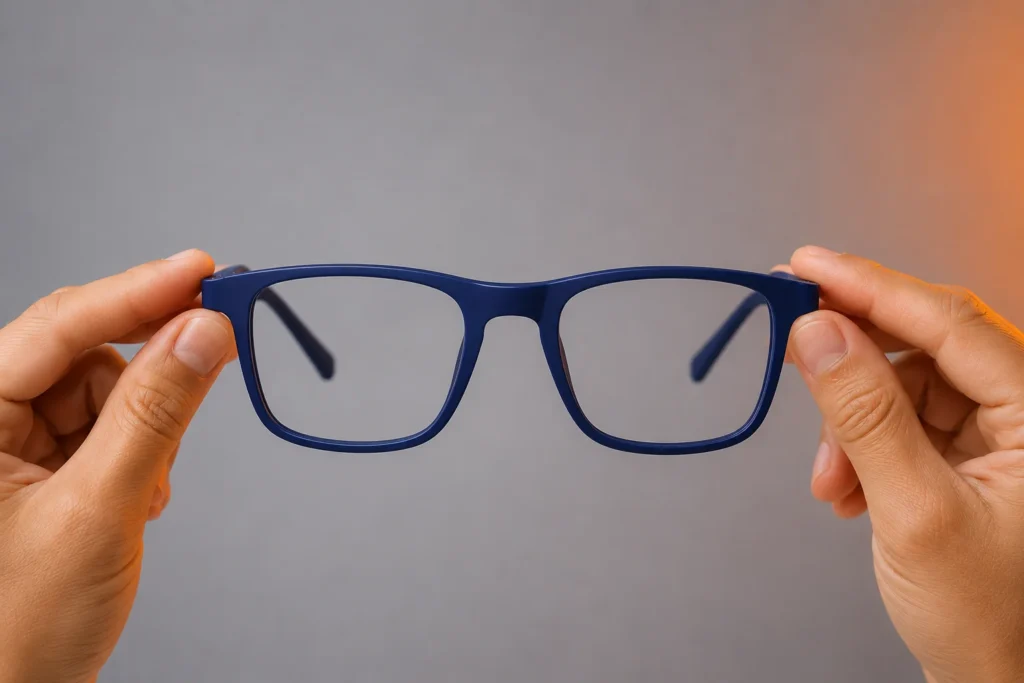
TR90 is the trade name most opticians use for Grilamid TR 90, a transparent polyamide (nylon) resin developed and manufactured in Switzerland by EMS-Grivory, which describes itself as “world market leader for transparent polyamides with Grilamid TR 90.” At a density of 1.00 g/cm³ per the manufacturer’s technical data sheet, it is one of the lightest frame plastics on the market, and it earned the nickname “memory plastic” because it flexes under stress and springs back to its original shape instead of holding a bend. That combination of low weight and high flex is exactly why TR90 dominates sport eyewear, kids’ frames, and budget-to-midrange plastic frames, and exactly why it behaves so differently from acetate on the dispensing table.
What TR90 Actually Is
Chemically, TR90 is not the same nylon used in fishing line or rope. EMS-Grivory’s technical data sheet describes Grilamid TR grades as “transparent thermoplastic polyamides based on aliphatic and cycloaliphatic blocks,” a chemistry that gives the resin clarity most nylons cannot achieve while keeping the toughness typical of the polyamide family. The official product nomenclature under ISO 1874 is listed as “PA MACM12,” which is closer to a specialty cycloaliphatic copolyamide than the generic PA12 pellets used in industrial nylon parts, though both belong to the same broad polyamide family opticians casually call “nylon.”
EMS-Grivory is a Swiss chemical company, and Grilamid TR has been supplied into the eyewear industry for decades as one of the standard resins for injection-molded frame fronts and temples. Because the resin is a single molded color rather than a laminated stack of pigmented sheets, TR90 frames come out flatter and more uniform in color than acetate, which is the main visual trade-off buyers notice first.
The Properties That Matter at the Chair
TR90’s numbers explain why it holds up the way it does in daily wear. In Charpy impact testing at both 23°C and minus 30°C, the manufacturer’s data sheet lists the result simply as “no break,” meaning standard specimens survive the test intact at room temperature and in cold conditions alike. Heat deflection temperature runs from 115°C to 135°C depending on test load, and the material’s rated maximum long-term usage temperature is 80°C to 100°C, with short bursts tolerated up to 120°C. Moisture absorption at room temperature and 50 percent humidity is only 1.5 percent, which is part of why TR90 frames keep their shape and fit through humid climates and sweaty workouts better than materials that swell.
That heat tolerance is the sharpest practical contrast with acetate. Acetate frames begin to soften once ambient temperature exceeds 60°C, a threshold a car dashboard in direct sun clears within the hour. TR90 shrugs off that same environment because its usable range starts well above where acetate already deforms. The flip side is adjustment: acetate softens on purpose with a gentle frame warmer, while TR90 mostly does not, so the flex that protects it from a hot car also makes it resistant to the kind of controlled reshaping an optician relies on with acetate.
TR90 vs Acetate vs Titanium
No single material wins on every axis. The honest comparison depends on what a specific wearer needs from a frame.
| Material | Weight | Adjustability | Feel | Price Tier | Repairability |
|---|---|---|---|---|---|
| TR90 (nylon) | Very light (1.00 g/cm³) | Limited (flexes back rather than holding a bend; resists heat-adjustment) | Springy, slightly rubbery, uniform color | Low to moderate | Good for stress cracks; poor for permanent reshaping |
| Cellulose Acetate | Moderate to heavy | Very good (softens with gentle heat for fitting) | Rigid, glossy, layered color depth | Moderate to high | Good; softens for repair but needs periodic re-adjustment |
| Titanium | Light to moderate | Good to excellent (CP titanium holds precise adjustments) | Cold, rigid, metallic | Moderate to high | Requires specialized soldering; not heat-adjustable |
TR90 wins decisively on weight and impact resistance. Acetate wins on color depth and the ability to fine-tune fit with routine chairside heat. Titanium sits closest to TR90 on weight while offering the precise, repeatable metal adjustment TR90 cannot match. None of the three is a strict upgrade over the others; each solves a different wearer’s priority.
Who TR90 Frames Actually Suit
TR90’s flex-and-recover behavior makes it the default recommendation for a handful of specific situations rather than a universal answer.
Active and sport wearers benefit most directly. A frame that survives being sat on, stepped on, or bent during a workout without a permanent crease is a real advantage over acetate or metal, which is why running, cycling, and wraparound sport styles lean on TR90 and similar nylon resins so heavily.
Kids are a close second, for the same reason: a child’s frame gets more accidental stress in a year than most adults apply in a decade, and TR90’s low weight also means less pressure on a smaller nose bridge during a full school day.
Wearers with metal sensitivity have a reasonable option in TR90, since it is a plastic and contains no nickel or chromium, the two metals a study in the Annals of Dermatology identified as “the most common ACD metal allergens” in frame-related contact dermatitis. That puts TR90 in the same metal-free category as acetate, though anyone with a known plastic or dye sensitivity should still be patch-tested regardless of resin type.
Budget-conscious buyers also land on TR90 more often than not, since it typically prices below hand-finished acetate and well below titanium while still delivering better impact resistance than either. That value combination is also why TR90 and related nylon blends show up so often in rimless and semi-rimless designs, where the frame material has to flex at drilled mounting points without cracking.
What TR90 Means at the Dispensing Table
The adjustment limits are the detail that catches new dispensers off guard. Because TR90 wants to spring back to its molded shape, standard frame-adjustment techniques built around acetate’s gentle heat-softening do not translate directly. Some TR90 frames tolerate brief, controlled warming for minor nose pad or temple tweaks, but pushing the material past its comfortable flex range risks stress-whitening or a fracture rather than a clean permanent bend. When in doubt, a smaller adjustment done twice is safer than one aggressive bend.
None of that changes what actually determines fit. A TR90 frame that flexes back to a slightly wrong position is no better than an acetate frame warmed into the wrong shape if the pupillary distance and fitting height behind the lenses were off to begin with. Frame material affects comfort and durability; measurement accuracy is what keeps the optical centers where the prescription needs them, regardless of what the frame is made of.
Frequently Asked Questions
What is TR90 made of?
TR90 is short for Grilamid TR 90, a transparent polyamide (nylon) resin made by the Swiss company EMS-Grivory from aliphatic and cycloaliphatic monomers. Its official ISO nomenclature is PA MACM12, a specialty cycloaliphatic copolyamide, not the plain PA12 pellets used in generic industrial nylon parts, though both fall under the same polyamide family.
Is TR90 the same thing as nylon?
TR90 belongs to the nylon (polyamide) family, but it is a specific transparent grade engineered for clarity, flex, and impact resistance rather than the opaque nylon used in rope or industrial parts. Opticians commonly call it “nylon” as shorthand, which is accurate at the family level but glosses over the specialty chemistry that makes it suitable for eyewear.
Are TR90 glasses hypoallergenic?
TR90 is a plastic and contains no nickel or chromium, the two metals most commonly linked to allergic contact dermatitis from eyeglass frames. That makes it a reasonable choice for wearers with metal sensitivity, in the same category as acetate. It is not a guarantee against every possible reaction, since some wearers react to plastic dyes or additives regardless of the base resin.
Can TR90 frames be heat-adjusted like acetate?
Not in the same way. Acetate is designed to soften with a gentle frame warmer so an optician can reshape it for fit. TR90’s manufacturer rates its usable temperature range well above where acetate already deforms, and the resin’s memory behavior means it tends to spring back toward its molded shape rather than holding a new bend. Small, controlled adjustments are usually fine; aggressive reshaping risks stress marks or a fracture.
Is TR90 or titanium the better choice?
Neither is universally better. TR90 is lighter, cheaper, and more impact-resistant, which suits active wearers, kids, and budget-conscious buyers. Titanium costs more but allows precise, repeatable metal adjustments and a more rigid, premium feel, which suits wearers who need fine-tuned fit or prefer a metal aesthetic. The right choice depends on whether flex-and-recover durability or adjustment precision matters more to the wearer.

I grew up inside an optical shop. My mother likes to tell how, as a kid, I would watch eyeglasses being assembled, play with the tools, and draw on the back of service order slips. The family business taught me early what a precise measurement and work done right are worth.
I went on to spend more than twenty years as a software engineer, always keeping an eye on the optical world. Optogrid was born where the two meet: digital measurement technology (pupillary distance and fitting heights) built by someone who knows the dispensing counter from the inside.