
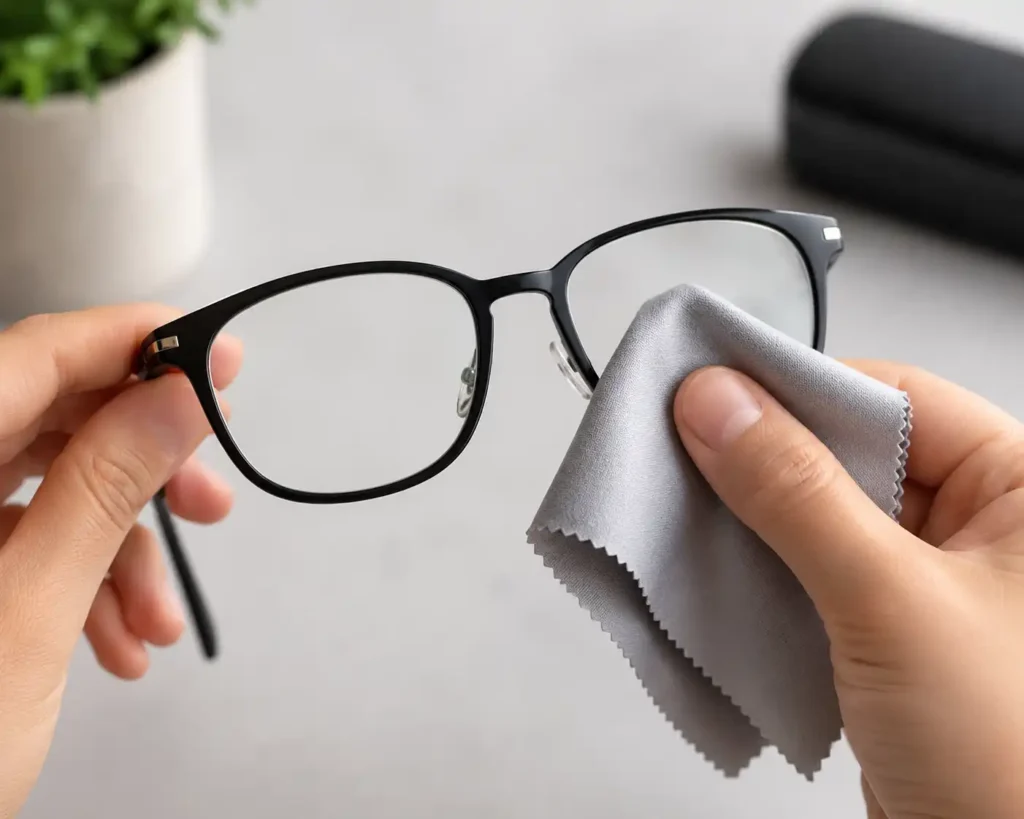
In most cases, no. Visible scratches on modern eyeglass lenses run through the anti-reflective (AR) coating stack, which cannot be polished out without removing the rest of the coating and creating optical haze worse than the original scratch. The practical options are: leave a shallow scratch outside the visual axis alone; order new lenses for the existing frame; or replace the glasses entirely. DIY scratch-removal kits, toothpaste, and car wax do not repair scratches. They strip coatings and reduce optical clarity.
The one narrow exception: a very shallow surface scratch on an uncoated CR-39 lens, with no AR or hard coat, polished by a professional with a felt wheel and cerium oxide. This scenario describes roughly 5% of glasses in circulation today. For the other 95%, the answer is replacement.
What the American Academy of Ophthalmology Actually Says About Repair
The AAO has not published a position on whether a scratched lens can be repaired. Its two Q&A answers on scratched eyeglasses, both from the Academy’s Ask an Ophthalmologist series, address a narrower question: whether a scratch threatens your eye health, not whether the coating can be fixed.
On the health question, ophthalmologist Gary S. Hirshfield, MD, writes for the AAO: “Looking through a scratched lens may be annoying and could distract your eye’s gaze, but it won’t harm the eye’s optical system.” He adds that while a scratch can be distracting enough to cause eye strain, “there’s no long-term harm in continuing to use them.” A second, separately answered AAO page draws the line at severity: “Light scratches will not change the prescription or protective features of the lens, although they can be annoying if near your visual axis. Extensive scratches or loss of coatings can impair your clarity of vision and possibly decrease protection from UV light.” That second answer also tells patients to show the lenses to the optician who dispensed them rather than attempt anything themselves; the first answer gives no such instruction.
Put plainly, the AAO’s position is a health verdict, not a repair verdict: a scratch alone is not dangerous, and replacing it is optional right up to the point where it blurs vision or compromises UV protection. Neither AAO answer discusses polishing, recoating, or scratch-removal products, because that is a lens-manufacturing question outside ophthalmology’s scope. That manufacturing question is what the rest of this guide covers, starting with why the coating stack cannot be repaired once it is cut.
Why Scratches on Modern Lenses Cannot Be Polished Out
A modern prescription lens is not a simple piece of plastic. It is a substrate with three to five coatings bonded to its surface, each deposited at the nanometer scale in a specific sequence:
- Substrate (CR-39, polycarbonate, Trivex, or high-index plastic): the optical material that carries the prescription. Typically 1.5 to 8 mm thick.
- Hard coat (scratch-resistant coating): a liquid polymer, UV-cured onto the substrate, roughly 3 to 5 micrometers thick. Its purpose is to give the AR coating something durable to bond to, and to reduce surface abrasion on the raw plastic.
- AR multilayer (anti-reflective coating): the most critical layer for optical performance. Applied by physical vapor deposition (PVD) inside a vacuum chamber, it consists of multiple alternating layers of metal oxides, each 50 to 150 nanometers thick. These layers work by destructive interference: each layer is tuned to cancel a specific reflected wavelength. Premium AR coatings reduce total lens reflectance from roughly 8% (uncoated) to under 1%. Laramy-K, a US independent optical lab, describes it accurately: “AR coatings consist of several layers of metal oxides of varying refractive indices.”
- Hydrophobic top coat: a fluoropolymer layer, typically 10 to 20 nanometers thick, that causes water to bead off. This is the layer that makes lenses easier to clean.
- Oleophobic coat (on premium lenses): reduces oil and fingerprint adhesion.
A visible scratch almost always runs through all these layers at once, from the oleophobic top coat down through the AR stack and into the hard coat, and often into the substrate. The AR stack is only a few hundred nanometers thick in total, so any force sufficient to create a scratch you can see with the naked eye has already cleared every coating above the substrate.
Polishing the scratch out is therefore not possible without destroying everything around it. Leveling the surface to the scratch’s depth would mean removing all surrounding coatings from the entire lens, leaving a bare optical blank with no AR performance and no protective layers. The coating stack cannot be re-applied at home, and commercial AR re-coating services for eyeglass lenses are effectively unavailable in the US market. How coatings are applied via vacuum deposition requires industrial equipment and a clean-room environment that no local optician possesses.
The DIY Methods: What Each One Actually Does
The internet is full of articles suggesting household remedies for scratched glasses. Here is what each method actually does to the coating stack.
| Method | What People Claim | What Actually Happens | Recommendation |
|---|---|---|---|
| Toothpaste | Mildly abrasive, fills scratch | Abrasive particles grind through hard coat and AR layers. Creates thousands of micro-scratches surrounding the original one. Results in cloudy haze across the lens. | Never use on coated lenses |
| Baking soda paste | Gentle abrasive, “natural” | Same mechanism as toothpaste. Optometrists.org notes: “Baking soda can actually cause a warp to your lenses and also erode away any previous lens treatments.” | Never use on coated lenses |
| Car wax / paste wax | Fills scratch temporarily | Wax fills the scratch channel with a semi-transparent material, reducing its visibility momentarily. Effect lasts days. Wax residue degrades AR performance and leaves a hazy film. | No lasting effect, creates smear |
| Brass polish / Brasso | Polishes metal surfaces | Contains stronger abrasives than toothpaste. Strips the entire coating stack within seconds. Leaves the substrate bare and often etched. | Never use on any lens |
| Armor Etch (glass etching cream) | “Removes AR coating to fix cracks” | Hydrofluoric acid compound. Dissolves the AR layer entirely, leaving bare, unprotected substrate with no AR performance. This actually works as advertised, but leaves a worse lens. | Only if intentionally stripping a damaged AR coat from an uncoated lens underneath |
| Commercial “scratch repair” kits | Fills and seals scratch | Fill-in compounds temporarily reduce scratch visibility. Do not repair the coating. Wears off in weeks. Most include abrasive pads that damage surrounding coating. | Not recommended for coated lenses |
| Windex / ammonia-based cleaners | “Wipes away the scratch” | Ammonia breaks down the AR layer over repeated use. Accelerates coating delamination. Not a scratch repair, but a coating destructor. | Never use on coated lenses |
Optometrists.org states it directly: “Do not use toothpaste, baking soda or any other home remedies to try to remove scratches off your lenses. Toothpastes contain abrasive chemicals that will not only not remove the scratch but will also damage any protective coatings such as hard coat, UV coating, anti-glare treatments or tints.”
The Decision Framework: What to Actually Do
Not all scratches require the same response. Use this framework to assess your situation.
| Scratch Type | Location | Depth | Best Option | Approximate US Cost |
|---|---|---|---|---|
| Hairline surface scratch | Outside visual axis (edge zone) | Coating only | Leave it alone | $0 |
| Visible scratch | Peripheral zone, not in direct line of sight | Coating + hard coat | Monitor; replace at next lens change | $0 now |
| Visible scratch | Central vision zone (within ~15 mm of optical center) | Coating + hard coat | New lenses in existing frame | $60-$250 (lenses only) |
| Deep gouge | Anywhere | Into substrate | New lenses in existing frame | $60-$250 (lenses only) |
| Multiple scratches / coating crazing | Central zone | Coating delamination | New lenses or full replacement | $60-$250 (lenses only) |
| Scratch on uncoated CR-39 | Any location | Surface only (no hard coat, no AR) | Professional cerium oxide polish (rare case) | $20-$50 (if available) |
| Scratched safety glasses | Any location | Any depth | Mandatory replacement | $30-$150 (safety frames) |
Step 1: Identify the scratch location
Hold the lens up at arm’s length and look through it with one eye closed, focusing your gaze on a distant point. A scratch in your visual axis will blur or ghost your line of sight. A scratch in the periphery will not affect your vision in normal use. Peripheral scratches can often be left alone indefinitely.
Step 2: Check whether the lens has any coating
Tilt the lens under a single lamp. If you see a green, blue, or purple reflection across the lens surface, AR coating is present. If the lens reflects white light uniformly (like a window), it is uncoated. Almost all lenses dispensed in the past 20 years have AR coating.
Step 3: Choose the appropriate action
Shallow peripheral scratch on a coated lens: No action needed. The AAO confirms: “Looking through a scratched lens may be annoying and could distract your eye’s gaze, but it won’t harm the eye’s optical system.”
Central scratch or coating crazing on a coated lens: Order new lenses for the existing frame. This is the most cost-effective path if the frame is structurally sound and the prescription has not changed. Online lab services (such as Overnight Glasses or LensDirect) offer single-vision lens replacement starting around $60 to $100; in-office replacement at a dispensing optician typically runs $100 to $250 for standard AR, depending on the lens material and design.
Scratch on an uncoated CR-39 lens (rare): This is the one case where professional polishing with cerium oxide is worth attempting. A professional can use a soft felt wheel with cerium oxide compound to level a shallow surface scratch. Limitations apply: some refractive power loss occurs (the lens surface changes curvature slightly), the scratch must be no deeper than the substrate surface layer, and the result is never optically identical to the original. This service is uncommon and most dispensers do not offer it. If you need it, ask a lab that handles glass polishing or camera lens restoration.
Scratched progressive lenses: The calculus changes here because the progressive corridor is typically 3 to 5 mm wide. A scratch anywhere in or near the corridor disrupts the optics of the intermediate and near zones. For a deep-dive on how corridor position affects daily use, see our post on progressive lenses: types, fitting, and how they work.
The Optician’s Workflow: Handling the Conversation
From the dispensing side: a patient will come in holding a pair of glasses with a diagonal scratch across the left lens, asking if it can be fixed. They have often already tried toothpaste. Here is how to handle it efficiently.
1. Assess before committing to anything
Look at the scratch under a loupe or bright light. Is the AR coating peeling at the edges of the scratch? If so, the delamination will spread and the lens is already past saving. In practice, this is the most common failure pattern at the counter: the patient has already tried toothpaste or a rough cloth at home, and by the time the glasses reach the dispensary the coating is peeling in a ring well beyond the original scratch, which settles the “can it be fixed” question before you even quote a price.
2. Confirm the prescription is still current
A lens remake is pointless if the Rx has changed. If the patient is overdue for an eye exam, note it now. This is also a natural opportunity to schedule a comprehensive exam.
3. Confirm the frame is worth relensing
Frames with cracked bridges, heavily worn hinge screws, or distorted temples will not hold a new lens correctly. If the frame is marginal, recommend a full replacement.
4. Preserve the measurements for the remake
For any lens remake, verify the pupillary distance (PD) and, for progressive lenses, the segment height (SH) before ordering. Do not assume the new lens will position identically to the old one just because you are using the same frame. Blank selection and surfacing can shift the optical center slightly, and for progressive designs the corridor placement depends on the fitting cross recorded at the time of original dispense. If those records are more than a year old, re-measure. Tools like Optogrid let you capture remote PD and SH measurements digitally, which is useful when ordering replacements for patients who are not physically present in the office. For the full details on why measurements must be re-verified, see our guide on segment height for progressive lenses.
5. Set clear expectations about cost
A lens-only remake is not free. Walk the patient through the realistic price. If they have vision benefits remaining, check coverage before quoting out-of-pocket.
6. Document the cause
Ask how the scratch happened. This matters for warranty claims (see FAQ below) and for patient education. The most common causes are: setting glasses lens-down on hard surfaces, wiping dry with a rough fabric, and grit accumulating in the case or on the cloth. Proper eyewear maintenance prevents the majority of scratches before they start.
Understanding “Scratch-Resistant” Coating
A common source of patient frustration: “I paid for scratch-resistant lenses and they still scratched.”
“Scratch-resistant” is defined by ISO 8980-5:2005, which specifies the minimum requirements for spectacle lens surfaces claimed to be abrasion-resistant. The standard establishes an abrasion test and requires coated lenses to show meaningfully less haze than an uncoated reference lens after a standardized steel-wool or eraser abrasion sequence. The keyword is “resistant,” not “scratch-proof.”
What scratch-resistant hard coat actually does: it raises the surface hardness of the plastic lens substrate from a level comparable to soft rubber to something closer to hardened glass. This dramatically reduces scratches from light contact (dust particles, clothing fibers, gentle wipes with a dry cloth). It does not protect against sharp point contact, grit between the lens and a hard surface, or the kind of forces involved in setting glasses down lens-face on a countertop with sand on it.
The hard coat and the AR coating are separate layers with separate functions:
- Hard coat: bonds to the substrate, provides scratch resistance to the surface, serves as the adhesion layer for AR coating
- AR coating: deposited on top of the hard coat, provides anti-reflective and anti-glare performance, is inherently softer than the hard coat
This means a lens can have a scratched AR coat with an intact hard coat underneath, or a scratched hard coat that has reached through to the substrate. From the outside, both look like a scratch. Only depth matters for the repair calculus: if the scratch reaches the substrate in an optical zone, replacement is the only option regardless.
For how lens material affects inherent scratch resistance before any coating is applied, polycarbonate and high-index plastics are softer substrates than CR-39 and benefit more from quality hard coat, which is why premium AR packages include hard coat as standard.
What Scratch-Removal Kits Actually Provide
Commercial scratch-removal products marketed for eyeglasses typically contain:
- A polishing compound (abrasive, similar to toothpaste but labeled “optical”)
- A fill compound (similar to clear nail polish or a resin)
- A microfiber cloth
The fill compounds can temporarily reduce the visible depth of a scratch by filling the channel with a transparent material. This helps cosmetically for a short time. It does not restore any coating performance. It does not restore optical clarity in the way the original AR coating did. The abrasive compounds included in these kits carry the same risks as toothpaste on coated lenses: more micro-scratches, not fewer.
The abrasion resistance built into a coated lens is established through the ISO 8980-5:2005 test protocol, a standardized abrasion sequence run under lab conditions before the coating ever reaches a dispensary. No consumer scratch-removal kit is tested or certified against that standard, so none of them can replicate the abrasion resistance the original coating provided. A $12 kit from a pharmacy shelf is not a substitute for the manufacturing process it is trying to patch over.
Quotable Summary
On repair: Visible scratches on coated lenses cannot be repaired because the coating stack, applied by vacuum deposition in a multilayer sequence, cannot be partially polished without destroying all surrounding layers. Repair = replacement.
On DIY methods: Toothpaste, baking soda, car wax, and commercial scratch kits do not repair scratches. They strip coatings, create additional micro-scratches, and reduce optical clarity. The only outcome is a worse lens.
On scratch-resistant coatings: ISO 8980-5:2005 defines abrasion resistance as a measurable improvement over an uncoated lens. It does not mean scratch-proof. Hard coat raises surface hardness; it does not make the lens immune to sharp contact or grit.
On cost: Lens-only replacement in the US ranges from approximately $60 for basic single-vision lenses (online) to $250 and above for premium progressive designs with AR coating, in-office. Full replacement of frame and lenses is typically $200 to $600 for standard designs. The $20 scratch-removal kit is not a cheaper alternative; it is money spent before the replacement you will need anyway.
On safety glasses: OSHA 1910.133(a)(1) requires employers to ensure each employee “uses appropriate eye or face protection when exposed to eye or face hazards,” and a scratched, cracked, or cloudy lens no longer meets that bar. Per esafetysupplies.com: “Safety glasses should be replaced when lenses become scratched, cloudy, cracked, or when frames no longer fit securely.”
Frequently Asked Questions
Does toothpaste remove scratches from eyeglass lenses?
No. Toothpaste contains abrasive particles that are too coarse for optical surfaces. Rubbing toothpaste onto a lens, even gently, creates thousands of micro-scratches in the coatings surrounding the original scratch, resulting in a hazy, cloudy zone that is optically worse than the scratch alone. Optometrists.org states: “Toothpastes contain abrasive chemicals that will not only not remove the scratch but will also damage any protective coatings such as hard coat, UV coating, anti-glare treatments or tints.”
Will my optician polish a scratched lens for me?
Most dispensing opticians do not offer polishing services for prescription lenses. The coating stack applied by vacuum deposition cannot be reproduced in-office, so polishing a coated lens destroys the coatings without restoring them. The rare exception is a shallow scratch on an uncoated CR-39 lens, which some labs can professionally polish with cerium oxide. Ask your optician directly; they will tell you whether your specific lens is a candidate.
How much does it cost to replace just the lenses in my existing frame?
In the US, lens-only replacement (keeping your frame, installing new lenses) typically costs $60 to $100 for basic single-vision lenses through online lab services, and $100 to $250 at a dispensing optician for standard single-vision with AR coating. Progressive lens replacement with AR coating runs $150 to $400 depending on design tier and location. These figures assume the frame is in good condition and the prescription is current.
Are scratched safety glasses still OSHA-compliant?
No. OSHA 1910.133(a)(1) requires employers to ensure each employee “uses appropriate eye or face protection when exposed to eye or face hazards,” and that requirement covers the condition of the eyewear at time of use, not just at time of purchase. Per current safety guidance, “safety glasses should be replaced when lenses become scratched, cloudy, cracked, or when frames no longer fit securely.” Using scratched safety glasses on a job site creates both a safety and a compliance risk. See our full guide on Z87.1 compliance for employer obligations and replacement procedures.
What does “scratch-resistant coating” actually protect against?
Scratch-resistant (hard) coating, regulated under ISO 8980-5:2005, raises the surface hardness of the plastic lens to resist light abrasion from dust particles, clothing fibers, and routine handling. It significantly reduces micro-scratching under normal daily use. It does not protect against sharp point contact, grit caught between the lens and a hard surface, or setting glasses down face-first on rough surfaces. “Scratch-resistant” is a measurable improvement over uncoated lenses, not a guarantee against all scratches.
Can I claim scratched lenses on my eyewear warranty?
It depends on the warranty type. Most optical manufacturers offer a 1-year coating warranty that covers premature coating delamination (peeling, crazing) resulting from a manufacturing defect, not from physical damage. A scratch from dropping your glasses or wiping them with a rough cloth is wear and tear, not a defect. Some retailers (Warby Parker, Zenni, Costco Optical) offer “scratch protection” plans that cover one or two replacements per year regardless of cause, typically for an added fee. Check your purchase documentation. If the coating is peeling outward from a small area without a corresponding physical impact, that is likely a manufacturing defect worth a warranty claim.
Can scratched lenses damage my eyes?
No. The AAO states that “looking through a scratched lens may be annoying and could distract your eye’s gaze, but it won’t harm the eye’s optical system.” Scratched lenses can cause eye strain and headaches if the scratches fall in the visual axis, because the eye constantly works to compensate for the distorted light path. This is fatiguing, but it does not cause permanent damage. Replace scratched lenses for comfort and optical performance, not from medical necessity.
Is there any coating service that can re-apply AR to existing lenses?
Commercial AR re-coating services for ophthalmic lenses are effectively unavailable for retail consumers in the US. The process requires industrial vacuum deposition equipment, clean-room conditions, and precise surface preparation. While some camera lens restoration services will re-coat glass photographic optics, plastic ophthalmic lenses have different chemistry and geometry. For virtually all patients, the correct path is new lenses, not re-coating of old ones.
Sources
- American Academy of Ophthalmology: Do Scratched Eyeglasses Have to Be Replaced?
- American Academy of Ophthalmology: Do Scratched Lenses Affect Your Prescription and/or the Blue Light Coating?
- Optometrists.org: Scratched Lenses – What Can I Do?
- Laramy-K Independent Optical Lab: Principles of AR Coatings
- ISO 8980-5:2005 – Minimum requirements for spectacle lens surfaces claimed to be abrasion-resistant
- OSHA 1910.133 – Eye and Face Protection
- eSafety Supplies: Safety Glasses Standards Explained – ANSI Z87.1 (2026 Guide)
- Optogrid: Eyewear Maintenance Guide

I grew up inside an optical shop. My mother likes to tell how, as a kid, I would watch eyeglasses being assembled, play with the tools, and draw on the back of service order slips. The family business taught me early what a precise measurement and work done right are worth.
I went on to spend more than twenty years as a software engineer, always keeping an eye on the optical world. Optogrid was born where the two meet: digital measurement technology (pupillary distance and fitting heights) built by someone who knows the dispensing counter from the inside.