

There is a published answer to how accurate a pupillary distance has to be, and it is written into the lens standards. ANSI Z80.1 (in the United States) and ISO 21987 (internationally) define the tolerances a finished pair of spectacles must meet, including how far the optical centers may sit from where they were ordered. Optical-center placement is the part a PD error affects, and the standard controls it through induced prism: a centration error of 1 mm produces roughly (lens power ÷ 10) prism diopters per eye. So the answer is power-dependent. At low powers a millimeter or two is harmless; by about 6.7 D a single 1 mm error already reaches the manufacturing tolerance, and beyond that you need sub-millimeter accuracy.
These are manufacturing tolerances for finished lenses, not the prescriber’s clinical limits. They define when a lab-made pair passes inspection. A patient may notice errors smaller than these, or tolerate larger ones, depending on the prescription and their own fusional reserves.
The Standards That Define an Acceptable Lens
Two documents govern finished-lens accuracy. ANSI Z80.1, the American National Standard for prescription ophthalmic lenses, is the reference most US labs verify against. ISO 21987, Mounted Spectacle Lenses, is the international equivalent. The values in this guide are the long-standing ANSI Z80.1 tolerances, which are consistent across the 2010, 2015 and 2020 editions; the current edition is Z80.1-2025, and labs verify to whichever edition applies to them.
Both standards work the same way: they state the largest difference allowed between what was ordered and what was delivered, parameter by parameter.
How Accurate Does PD Need to Be?
PD accuracy is really optical-center accuracy. When the optical center is not directly in front of the pupil, the wearer looks through a prism, and the amount follows Prentice’s rule: prism (in prism diopters) equals the centration error in centimeters times the lens power. A 1 mm error is 0.1 cm, so each millimeter induces power ÷ 10 prism diopters per eye. Use the Prentice’s rule calculator to check any specific power and decentration against these tolerances directly.
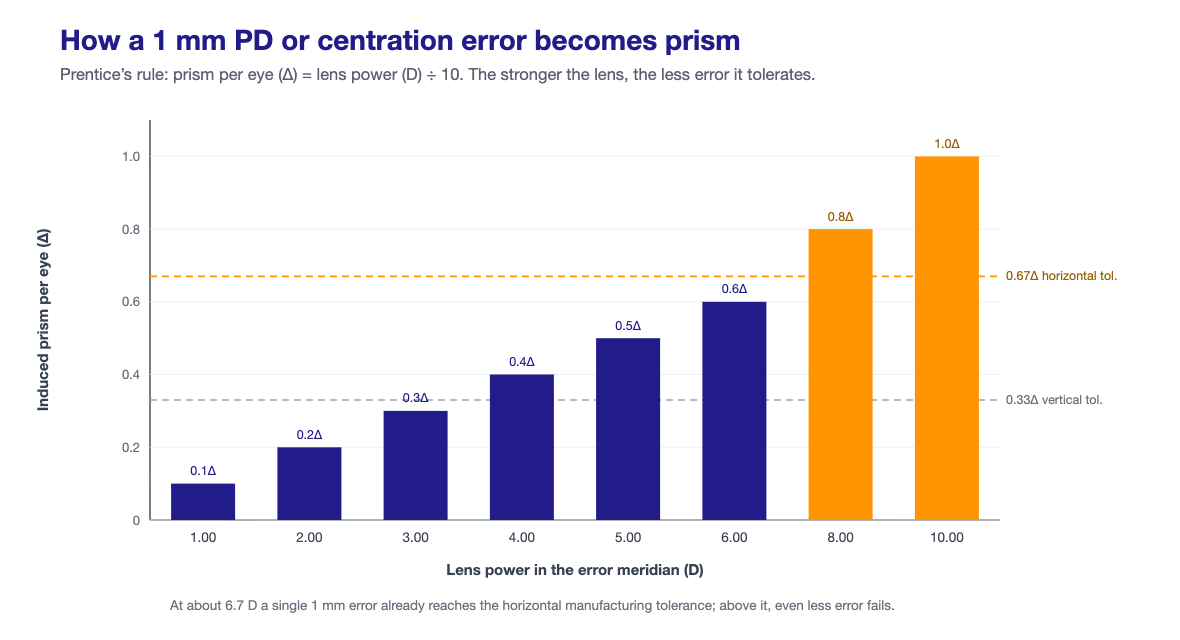
That single relationship explains why a fixed PD tolerance does not exist. The same 1 mm error is trivial on a +1.00 D reading lens and out of tolerance on a -8.00 D myope.
| Lens power (error meridian) | Prism per eye from a 1 mm error |
|---|---|
| 1.00 D | 0.10 Δ |
| 2.00 D | 0.20 Δ |
| 3.00 D | 0.30 Δ |
| 4.00 D | 0.40 Δ |
| 6.00 D | 0.60 Δ |
| 8.00 D | 0.80 Δ |
| 10.00 D | 1.00 Δ |
Against the ANSI prism tolerances below (0.33 Δ vertical, 0.67 Δ horizontal), a 1 mm error reaches the vertical limit at about 3.4 D and the horizontal limit at about 6.7 D. For progressive lenses, ISO 21987 is stricter still and asks for the fitting cross to be within 1 mm of the specified monocular PD regardless of power. The practical target most dispensers work to is monocular PD accurate to about half a millimeter, which is below the repeatability of a handheld ruler and the reason PD measurement method matters as power climbs.
Power Tolerances: Sphere, Cylinder, Axis and Add
The power tolerances are the most frequently checked numbers in any lab. These apply to single vision and multifocal lenses; progressive lenses carry slightly looser power tolerances and the same centration rules.
| Parameter | Range | Tolerance |
|---|---|---|
| Sphere / meridian power | up to ±6.50 D | ±0.13 D |
| Sphere / meridian power | stronger than ±6.50 D | ±2% |
| Cylinder power | up to 2.00 D | ±0.13 D |
| Cylinder power | over 2.00 to 4.50 D | ±0.15 D |
| Cylinder power | over 4.50 D | ±4% |
| Cylinder axis | 0.12 to 0.25 D cyl | ±14° |
| Cylinder axis | over 0.25 to 0.50 D cyl | ±7° |
| Cylinder axis | over 0.50 to 0.75 D cyl | ±5° |
| Cylinder axis | over 0.75 to 1.50 D cyl | ±3° |
| Cylinder axis | over 1.50 D cyl | ±2° |
| Add power | up to 4.00 D | ±0.12 D |
| Add power | over 4.00 D | ±0.18 D |
Two points opticians miss. First, the axis tolerance tightens as the cylinder grows, because a few degrees of axis error on a strong cylinder produces far more blur than the same error on a weak one. A 0.25 D cylinder can be off by 14 degrees and still pass; a 2.00 D cylinder may only be off by 2 degrees. Second, the power tolerances are verified on a calibrated lensmeter, so a lensmeter that drifts out of calibration will quietly pass bad lenses and fail good ones. These figures come from the ANSI Z80.1 quick reference maintained by The Vision Council. When the order and the lensmeter reading are written in opposite cylinder forms, run them through a transposition calculator first so you are comparing the same notation.
Prism and Optical-Center Tolerances
This is where PD and centration accuracy are enforced. ANSI expresses the limits as prism, computed through Prentice’s rule, rather than as a millimeter figure, because prism is what the eye actually experiences.
| Meridian | Power range | Tolerance |
|---|---|---|
| Per lens, at the prism reference point | any | within 0.33 Δ, or center within 1.0 mm of specified |
| Vertical imbalance (pair) | up to ±3.375 D | 0.33 Δ |
| Vertical imbalance (pair) | over ±3.375 D | 1.0 mm difference in center height |
| Horizontal imbalance (pair) | up to ±2.75 D | 0.67 Δ |
| Horizontal imbalance (pair) | over ±2.75 D | within 2.5 mm of specified PD |
Vertical is held tighter than horizontal (0.33 versus 0.67 Δ) for a clinical reason: the eyes have almost no ability to fuse a vertical difference between the two images, while they comfortably compensate for horizontal differences. That asymmetry, explained in the Eyecare Business breakdown of unwanted prism, is the same reason a small vertical centration error causes more complaints than a larger horizontal one.
Segment Height and Fitting-Cross Tolerances
For multifocals and progressives, the vertical placement of the segment or fitting cross has its own tolerance:
- Multifocal segment height: within 1.0 mm per lens, and the two lenses within 1.0 mm of each other.
- Progressive fitting-cross height: within 1.0 mm per lens, and within 1.0 mm of the specified monocular PD horizontally.
A 1 mm error here is enough to measurably degrade the usable corridor of a progressive lens, which is why fitting height is held to the same millimeter standard as horizontal centration.
Verifying a Finished Pair
Inspection turns these tolerances into a pass or fail at the lensmeter. The verifier reads sphere, cylinder, axis and add against the order, locates the optical center and checks it against the prescribed PD, measures any prescribed prism, and confirms segment or fitting-cross height. If every value sits inside its tolerance, the pair passes. If one is outside, the job is a remake. Because a systematic lensmeter error flows into every check, the instrument’s own calibration is the foundation the whole standard rests on.
What This Means for Measurement at the Chair
The tolerances are tight, and most of them come back to two measurements taken before the lens is ever cut: the monocular PD and the fitting height. A power error is a lab problem; a centration error usually starts at the dispensing desk, with a PD that was a millimeter or two off. As prescriptions get stronger, the margin disappears, and the difference between an accurate and an approximate PD becomes the difference between a pass and a remake. Photo-based tools such as Optogrid capture monocular PD and height directly from the patient in the chosen frame, which is the level of precision these standards quietly assume.
Frequently Asked Questions
How accurate does PD need to be?
There is no single millimeter figure, because the effect of a PD error depends on lens power. A 1 mm centration error induces about (power ÷ 10) prism diopters per eye. Against the ANSI Z80.1 tolerances, that reaches the vertical limit near 3.4 D and the horizontal limit near 6.7 D. Most dispensers aim for monocular PD within about 0.5 mm, and progressive lenses require centration within 1 mm under ISO 21987.
What is the ANSI tolerance for sphere power?
ANSI Z80.1 allows ±0.13 D for any meridian power up to ±6.50 D, and ±2% of the power for stronger lenses. So a -3.00 D lens passes between -2.87 and -3.13 D, while a -8.00 D lens is allowed about ±0.16 D.
What is the cylinder axis tolerance?
It depends on the cylinder power. ANSI Z80.1 permits ±14° for a 0.25 D cylinder, ±7° up to 0.50 D, ±5° up to 0.75 D, ±3° up to 1.50 D, and ±2° above 1.50 D. The stronger the cylinder, the tighter the axis must be held.
Are ANSI tolerances the same as what the patient will notice?
No. ANSI Z80.1 and ISO 21987 are manufacturing tolerances that decide whether a lab-made pair passes inspection. They are not the threshold at which a patient becomes symptomatic. Some wearers detect errors smaller than the tolerance, particularly vertical prism, while others adapt to larger ones.
What is the difference between ANSI Z80.1 and ISO 21987?
ANSI Z80.1 is the US standard for prescription lenses and ISO 21987 is the international standard for mounted spectacle lenses. The power tolerances are similar in magnitude. The main structural difference is in how each expresses centration and prism limits, and ISO 21987 specifies a 1 mm monocular centration tolerance for progressive lenses.
Why is vertical prism held to a tighter tolerance than horizontal?
Because the eyes cannot fuse vertical differences well. Horizontal differences are absorbed by the wide horizontal fusional range, so a horizontal error has to be larger before it causes symptoms. ANSI reflects this by allowing 0.67 Δ of horizontal imbalance but only 0.33 Δ of vertical imbalance.

I grew up inside an optical shop. My mother likes to tell how, as a kid, I would watch eyeglasses being assembled, play with the tools, and draw on the back of service order slips. The family business taught me early what a precise measurement and work done right are worth.
I went on to spend more than twenty years as a software engineer, always keeping an eye on the optical world. Optogrid was born where the two meet: digital measurement technology (pupillary distance and fitting heights) built by someone who knows the dispensing counter from the inside.