

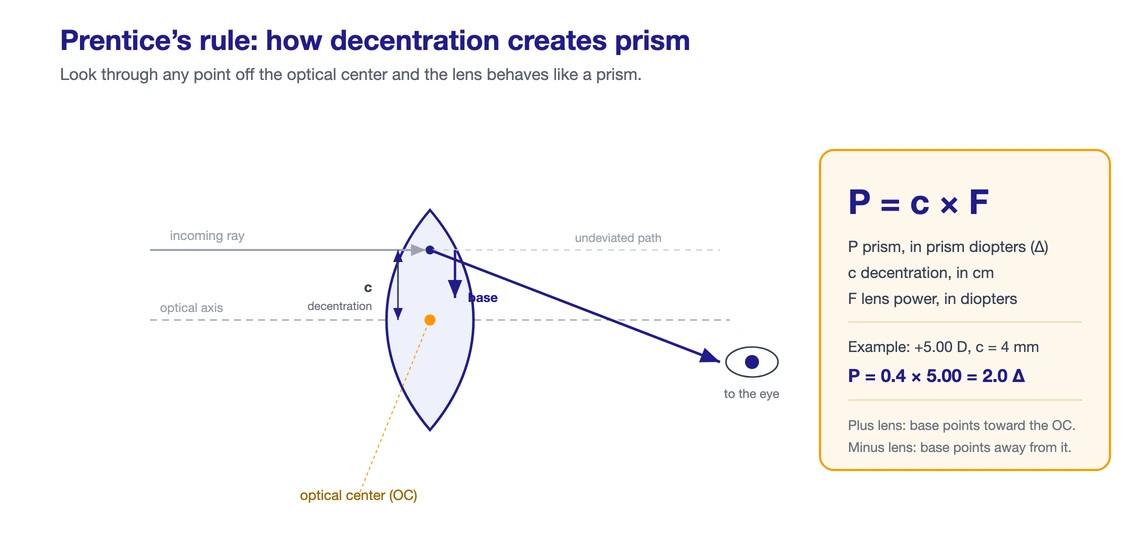
Prentice’s rule states that the prism a lens produces at any point equals the distance of that point from the optical center, in centimeters, times the lens power in diopters: P = c × F. It is the equation that turns a millimeter of decentration into a measurable optical error. Whenever the optical center is not directly in front of the pupil, whether from a PD measurement that was a touch off, an optical center placed wrong, or a fitting height that drops the eye below center, the wearer looks through a prism, and Prentice’s rule tells you exactly how much. Use the Prentice’s rule calculator to solve for prism, power, or decentration directly.
What Prentice’s Rule Says
The three terms are simple, but the units matter. P is the prismatic effect in prism diopters (Δ), c is the decentration in centimeters, and F is the lens power in diopters in the meridian you are measuring. Because decentration is usually noted in millimeters, the everyday form is:
P = (decentration in mm × power in D) ÷ 10
A prism diopter is the unit on the left. As the StatPearls optics reference defines it, “one prism diopter represents the deviation of light by 1 centimeter … on a plane placed 1 meter away.” So 1 mm of decentration on a 1.00 D lens produces 0.1 Δ, the base unit everything else scales from.
For a sphero-cylindrical lens, use the power in the meridian along which the decentration occurs: vertical decentration uses the vertical-meridian power, horizontal decentration uses the horizontal-meridian power. There is no prism along a meridian that carries no power.
Which Way the Prism Points
Magnitude is only half the answer. The base direction decides whether the induced prism helps, harms, or cancels between the two eyes. The clean rule, which avoids the nasal-versus-temporal confusion that trips people up:
Plus lens: the base points toward the optical center. Minus lens: the base points away from it.
A plus lens is thick in the middle, like two prisms base to base, so light bends toward that thick center. A minus lens is thin in the middle, like two prisms apex to apex, so the base sits at the edge. From there, every case follows.
| Lens | Optical center sits… | Induced prism base |
|---|---|---|
| Plus | nasal to the pupil | Base in |
| Plus | temporal to the pupil | Base out |
| Plus | above the pupil | Base up |
| Plus | below the pupil | Base down |
| Minus | nasal to the pupil | Base out |
| Minus | temporal to the pupil | Base in |
| Minus | above the pupil | Base down |
| Minus | below the pupil | Base up |
This is also why decentering a plus lens inward gives base-in prism, the trick sometimes used to build a small amount of prescribed prism into a lens without grinding it.
Worked Examples
The arithmetic is quick once the form is in hand.
- A +5.00 D lens, line of sight 4 mm from the optical center: P = 0.4 cm × 5.00 = 2.0 Δ.
- A -4.00 D lens with the optical center 2 mm off the pupil: P = 0.2 cm × 4.00 = 0.8 Δ per eye.
- A +2.00 D lens decentered 3 mm: P = 0.3 cm × 2.00 = 0.6 Δ.
The full grid shows how fast prism grows with both decentration and power:
| Decentration | 1.00 D | 2.00 D | 4.00 D | 6.00 D |
|---|---|---|---|---|
| 1 mm | 0.10 Δ | 0.20 Δ | 0.40 Δ | 0.60 Δ |
| 2 mm | 0.20 Δ | 0.40 Δ | 0.80 Δ | 1.20 Δ |
| 3 mm | 0.30 Δ | 0.60 Δ | 1.20 Δ | 1.80 Δ |
| 4 mm | 0.40 Δ | 0.80 Δ | 1.60 Δ | 2.40 Δ |
| 5 mm | 0.50 Δ | 1.00 Δ | 2.00 Δ | 3.00 Δ |
The Link to PD and Centration Errors
A horizontal PD error and a misplaced optical center are the same thing: the visual axis falls a few millimeters off the optical center. Prentice’s rule is therefore the physics behind every centration tolerance. A 5 mm PD error on a +4.00 D lens, the example used in the Eyecare Business prism guide, induces 0.5 cm × 4.00 = 2.0 Δ, well past the ANSI manufacturing tolerance. It is also why the frame’s decentration demand has to be matched to the wearer’s PD: every millimeter of mismatch that is not corrected becomes prism. Pantoscopic tilt produces the same effect vertically when the optical center is not dropped for the gaze angle, as covered in the guide to pantoscopic tilt.
Anisometropia: Where Prentice’s Rule Bites Hardest
The most clinically important application is vertical imbalance in down-gaze. When the two eyes have different powers (anisometropia) and the wearer reads below the optical centers, each eye gets a different amount of vertical prism, and the difference pulls the eyes apart.
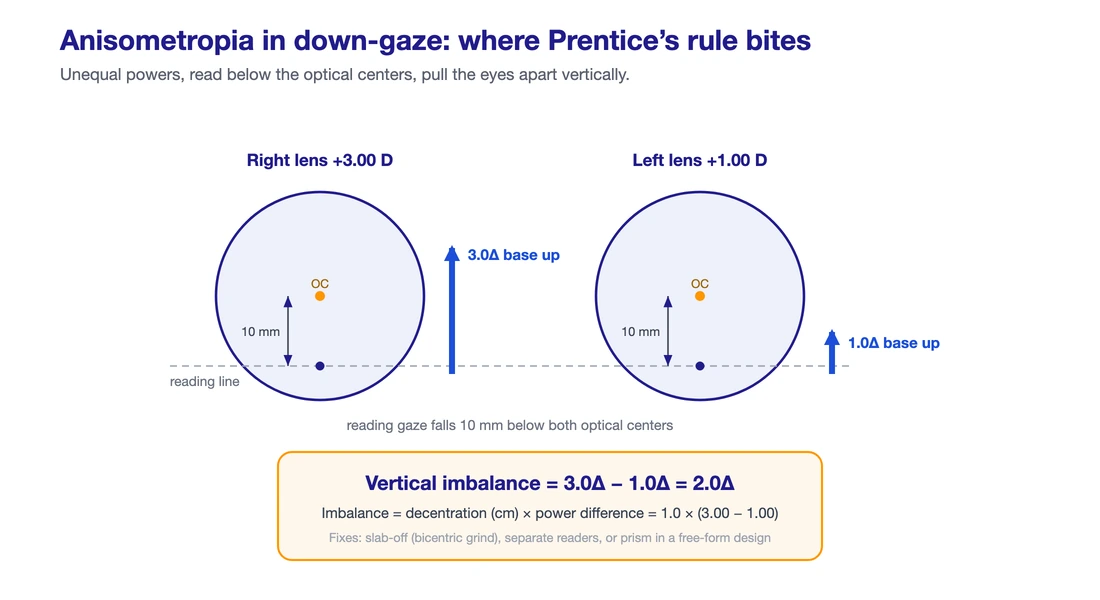
Take a right lens of +3.00 D and a left of +1.00 D, with the reading point 10 mm (1.0 cm) below each optical center. The right eye sees 1.0 × 3.00 = 3.0 Δ base up; the left sees 1.0 × 1.00 = 1.0 Δ base up. The imbalance is the difference, 2.0 Δ. A shortcut for same-sign lenses: imbalance equals the reading decentration in centimeters times the difference in power. When the two lenses have opposite signs, the prisms point opposite ways and add, which makes antimetropia the most disruptive case of all.
The standard fixes are slab-off (bicentric grinding) on the more-minus or least-plus lens, a separate pair of single vision readers, or prism built into a free-form design. Slab-off is typically considered once the vertical imbalance reaches roughly 1.25 to 1.5 Δ.
When Induced Prism Actually Matters
Not all induced prism causes symptoms. The eyes fuse horizontal differences easily but vertical differences barely at all. The 20/20 Magazine clinical reference notes that “most patients can adjust to about .5 prism diopters of vertical imbalance,” with larger amounts leading toward discomfort, blur, and diplopia. Horizontal imbalance is far better tolerated.
| Direction | Practical comfort threshold | ANSI manufacturing tolerance |
|---|---|---|
| Vertical imbalance | symptoms common above about 0.5 Δ | 0.33 Δ (up to ±3.375 D) |
| Horizontal imbalance | tolerated to several Δ | 0.67 Δ (up to ±2.75 D) |
The manufacturing tolerances sit below the symptom thresholds on purpose, leaving a safety margin so an in-tolerance pair is comfortable for nearly everyone.
Where Prentice’s Rule Breaks Down
Two limits are worth knowing. For an oblique cylinder, the simple meridional approach loses accuracy: research in Ophthalmic and Physiological Optics found the approximation diverges from the true prism once the cylinder axis is more than about 20 degrees from horizontal or vertical, so the full oblique-power calculation is needed. And at very low powers, where a lens is made of two curved surfaces rather than behaving like a thin prism, the rule slightly overstates the effect. For the powers and decentrations that drive real dispensing errors, above roughly 1.00 D, Prentice’s rule is the accurate, standard tool, and it is the reason a precise PD and fitting height are worth measuring properly. Photo-based tools such as Optogrid capture monocular PD and height to the accuracy these numbers demand.
Frequently Asked Questions
What is Prentice’s rule?
Prentice’s rule gives the prism a lens induces away from its optical center: P = c × F, where P is the prism in prism diopters, c is the decentration in centimeters, and F is the lens power in diopters. In millimeters it is P = (decentration in mm × power) ÷ 10. It quantifies the unwanted prism created when the optical center is not in front of the pupil.
How do you calculate induced prism from a PD error?
Convert the PD error to centimeters and multiply by the lens power. A 3 mm error on a -5.00 D lens gives 0.3 cm × 5.00 = 1.5 Δ per eye. Because the effect scales with power, the same error matters far more in a strong prescription than a weak one.
Which way does the induced prism base point?
For a plus lens the base points toward the optical center; for a minus lens it points away from it. So a plus lens whose optical center sits above the pupil induces base-up prism, while a minus lens in the same position induces base-down.
What is a prism diopter?
A prism diopter (Δ) is the unit of prismatic power. One prism diopter deviates a ray of light 1 centimeter measured at a distance of 1 meter. It is the standard unit for both prescribed prism and the unwanted prism that Prentice’s rule calculates.
Why does anisometropia cause problems when reading?
When the two eyes have different powers and the wearer looks below the optical centers, each lens induces a different amount of vertical prism. The difference, the vertical imbalance, pulls the eyes apart vertically, which they cannot fuse well. A 2.00 D power difference read 10 mm below center produces about 2.0 Δ of imbalance, often enough to need slab-off or separate readers.
How much induced prism is too much?
Vertical imbalance tends to cause symptoms above about 0.5 Δ, while horizontal imbalance is tolerated to several prism diopters. The ANSI Z80.1 manufacturing tolerances are tighter than the symptom thresholds, at 0.33 Δ vertical and 0.67 Δ horizontal, to keep a finished pair comfortable.

I grew up inside an optical shop. My mother likes to tell how, as a kid, I would watch eyeglasses being assembled, play with the tools, and draw on the back of service order slips. The family business taught me early what a precise measurement and work done right are worth.
I went on to spend more than twenty years as a software engineer, always keeping an eye on the optical world. Optogrid was born where the two meet: digital measurement technology (pupillary distance and fitting heights) built by someone who knows the dispensing counter from the inside.