
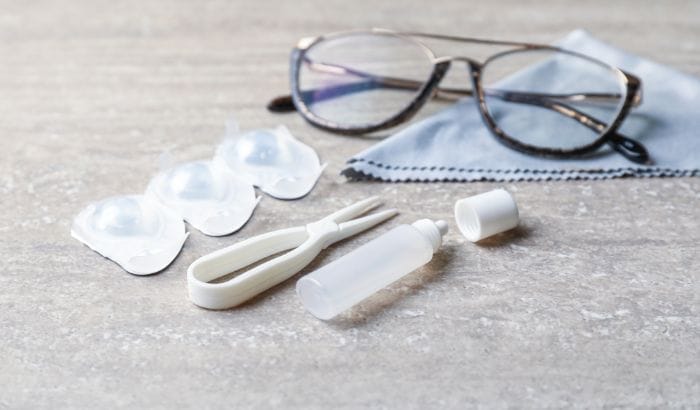
Prescription lenses correct four refractive errors (myopia, hyperopia, astigmatism, and presbyopia) by reshaping how light enters the eye so it focuses on the retina. The four main lens types are single vision, bifocal, progressive, and toric. Material selection between CR-39, polycarbonate, Trivex, and high-index plastics determines the weight, thickness, and optical clarity of the finished eyewear. For progressive lenses, the fitting point must be positioned within 1.0mm of the specified monocular PD per ANSI Z80.1, making accurate pupillary distance measurement critical.
How Prescription Lenses Correct Vision
Prescription lenses compensate for refractive errors: conditions where the eye cannot focus light directly onto the retina. According to the American Academy of Ophthalmology, a refractive error occurs when “the shape of your eye prevents light from bending properly, so that light is aimed in front of your retina instead of on your retina.”
The lens adjusts the point where light converges before it enters the eye, so the final image forms sharply on the retina. Depending on the refractive error, the lens may be diverging (for myopia), converging (for hyperopia), or cylindrical (for astigmatism).
See also: Visual Acuity: What It Is, How It Is Measured, and What the Numbers Mean
The 4 Refractive Errors That Prescription Lenses Correct
A systematic review published in the Journal of Current Ophthalmology (Hashemi et al., 2018) analyzed data from populations worldwide and found that astigmatism is the most prevalent refractive error in adults (40.4%), followed by hyperopia (30.9%) and myopia (26.5%). Understanding each condition is the first step toward selecting the right lens.
Myopia: Blurred Distance Vision from an Elongated Eyeball
Myopia (nearsightedness) occurs when the eyeball is too long or the cornea has excessive curvature, causing light to focus in front of the retina instead of on it. The result is clear near vision and blurred distance vision.
- Symptoms: blurry distance vision, difficulty reading road signs, headaches, and frequent squinting
- Correction: diverging (minus) lens, which spreads light before it enters the eye, shifting the focal point back to the retina
- Lens type: single vision minus; toric minus when astigmatism is also present
To learn about slowing myopia progression in younger patients, see: Myopia Control in Children: A Guide for Opticians
Hyperopia: Near Objects Blur When the Eyeball Is Too Short
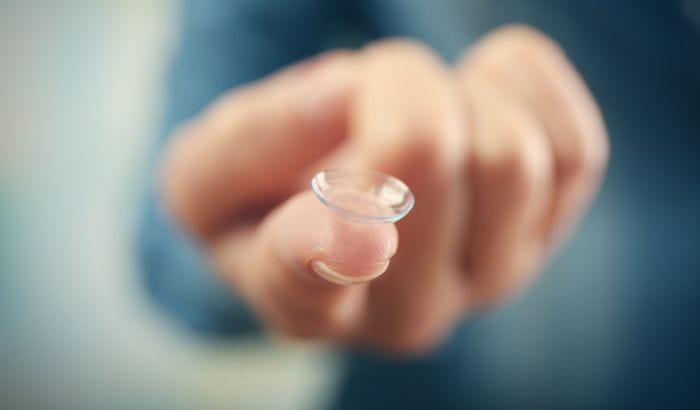
In hyperopia (farsightedness), the eyeball is too short or the cornea has insufficient curvature. Light converges behind the retina, making near objects blurry. Younger people with moderate hyperopia can often compensate through accommodation (the eye’s ability to increase its focusing power), but this extra effort leads to eye strain and headaches.
- Symptoms: blurred near vision, fatigue while reading, frequent headaches
- Correction: converging (plus) lens, which brings the focal point forward to the retina
- Lens type: single vision plus; bifocal or progressive when presbyopia is also present
Astigmatism: Distorted Vision from Irregular Corneal Curvature
Astigmatism results from an irregular curvature of the cornea or crystalline lens. Instead of a single focal point, light forms two distinct focal planes, producing distorted images at both near and far distances.
- Symptoms: distorted or ghosted vision, difficulty driving at night, eye strain
- Correction: cylindrical (toric) lens, which compensates for the difference in curvature between the two principal meridians of the eye
- Lens type: single vision toric, toric contact lens, or progressive toric in combined cases
Presbyopia: Age-Related Loss of Near Focus After 40
Presbyopia is the progressive loss of elasticity of the crystalline lens, making it harder to focus on near objects. It affects virtually every adult beginning around age 40. A study published in Archives of Ophthalmology (Holden et al., 2008) estimated that 1.04 billion people worldwide had presbyopia in 2005, with 517 million lacking adequate correction.
- Symptoms: needing to hold text farther away to read, fatigue when focusing on near objects, blurred near vision
- Correction: lens with addition power (ADD) for near vision
- Lens type: reading glasses (single vision plus), bifocal, or progressive
Prescription Lens Types Compared
| Lens Type | Vision Zones | Primary Condition | Advantage | Limitation |
|---|---|---|---|---|
| Single vision | 1 (distance OR near) | Myopia, hyperopia | Maximum optical clarity, lowest cost | Requires switching glasses for different distances |
| Bifocal | 2 (distance + near) | Presbyopia + myopia/hyperopia | Practical for two working distances | Visible dividing line; no intermediate vision |
| Progressive (multifocal) | Continuous (distance, intermediate, near) | Presbyopia in general | Natural vision at all distances; no visible line | Adaptation period; peripheral distortion in narrow corridors |
| Toric (cylindrical) | 1 or more (depends on design) | Astigmatism | Corrects irregular curvature of the eye | Precise angular positioning required; higher cost |
Single Vision Lenses
Single vision lenses have one corrective power across the entire surface. They are the standard solution for myopia alone, hyperopia alone, or astigmatism without presbyopia. They offer the best edge-to-edge optical clarity because the entire lens is dedicated to a single focal distance.
Bifocal Lenses
A bifocal lens divides the surface into two segments: the upper portion corrects distance vision, and the lower portion (typically a D-segment or straight-top) corrects near vision. The transition between zones is marked by a visible line, which some wearers find cosmetically undesirable.
Best for: adults with presbyopia who also have myopia or hyperopia and cannot adapt to progressives.
Progressive Lenses (Multifocals)
Progressives eliminate the dividing line found in bifocals and offer a continuous gradient of power from distance to near, passing through an intermediate zone useful for computer screens and objects at arm’s length. Most wearers adapt within one to three weeks, though adaptation timelines vary depending on corridor width, prescription strength, and prior lens experience.
Accurate measurement of the naso-pupillary distance (near PD) is critical for progressive lens success. The usable corridor on progressive lenses can be as narrow as 2mm in some designs, so even a 1mm centration error shifts the eye into a peripheral distortion zone. This makes PD accuracy the single most important dispensing variable for progressive wearers.
Learn more: Why Accurate PD and SH Measurements Are Crucial for Prescription Eyewear
Toric Lenses (Cylindrical)
A toric lens has two different radii of curvature in perpendicular meridians. This creates a cylindrical effect that cancels out the irregular curvature of the cornea or crystalline lens caused by astigmatism. Each toric lens has a specific cylinder axis (0 to 180 degrees) that must be aligned with the meridian of least curvature in the eye.
Toric lenses are available in single vision, bifocal, and progressive designs, allowing correction of astigmatism alone or in combination with other refractive errors.
Lens Materials: How Refractive Index, Weight, and Abbe Value Compare
The lens material directly affects the weight of the eyeglasses, the thickness (especially at higher prescriptions), and the optical quality.
The Abbe value (also called V-number or constringence) measures a material’s dispersion relative to its refractive index. A higher Abbe value means less chromatic dispersion and sharper vision across the full lens surface, particularly at the edges. According to a StatPearls review on chromatic aberration, polycarbonate has an Abbe value of 30, while Trivex reaches 43, a difference that influences lens selection for higher prescriptions where edge chromatic fringing becomes noticeable.
| Material | Refractive Index | Abbe Value | Weight | Impact Resistance | Best For |
|---|---|---|---|---|---|
| CR-39 | 1.50 | 59 | Medium | Moderate | Low to moderate Rx; best optical clarity |
| Polycarbonate | 1.59 | 30 | Light | Very high | Children’s, sports, and safety eyewear |
| Trivex | 1.53 | 43-45 | Lightest | High | Alternative to polycarbonate with better clarity |
| High-index (1.60-1.74) | 1.60-1.74 | 32-42 | Light to very light | Moderate | High Rx (above +/-4.00 D); thinnest lenses |
CR-39 is the most widely used plastic lens material in the world. It has the highest Abbe value among plastic materials (59.3), resulting in the least chromatic aberration and the sharpest images across the entire lens. Recommended for prescriptions between -2.00 and +2.00.
Polycarbonate is up to 10 times more impact-resistant than CR-39. Under FDA regulation 21 CFR 801.410, all prescription lenses sold in the United States must pass a drop ball impact test, but polycarbonate far exceeds these minimums, making it the material of choice for prescription safety glasses and children’s eyewear. Its Abbe value of 30 (the lowest among common plastics) can produce slight chromatic fringing at the edges, and it requires a scratch-resistant coating because it scratches easily.
Trivex offers impact resistance comparable to polycarbonate but with an Abbe value of 43-45, noticeably higher. It is the lightest lens material available, making it a strong choice for wearers who prioritize both comfort and optical quality in thin frames.
High-index materials (1.60, 1.67, 1.74) allow significantly thinner lenses for higher prescriptions. Anti-reflective coating is strongly recommended for high-index lenses, as the higher refractive index generates more surface reflections. For a deeper look at how material choice affects lens thickness, see: The Science Behind Lens Thickness
Choosing a Material by Prescription Strength
| Prescription Range | Recommended Material | Why |
|---|---|---|
| -2.00 to +2.00 D | CR-39 | Best optical clarity (Abbe 59); thickness is minimal at low powers |
| -2.00 to -4.00 D or +2.00 to +4.00 D | Polycarbonate or Trivex | Good balance of thinness, weight, and impact protection |
| Above +/-4.00 D | High-index 1.60 or 1.67 | Noticeably thinner and lighter than CR-39 at these powers |
| Above +/-6.00 D | High-index 1.74 | Thinnest possible profile; anti-reflective coating essential |
| Children or sports use (any Rx) | Polycarbonate or Trivex | Impact resistance is the priority regardless of prescription |
This table provides general guidance. Frame size, patient lifestyle, and occupational requirements also influence the final material choice. You can explore how different parameters affect edge thickness using a lens thickness calculator.
Why PD Accuracy Determines Progressive Lens Success
For any prescription lens, the optical zone must be positioned in front of the pupil. In single vision lenses, the optical center aligns with the pupil. In progressives and bifocals, the pupillary distance (PD) and segment height (SH) determine where each vision zone sits relative to the eye.
The stakes are highest for progressive lenses. Under ANSI Z80.1, the horizontal fitting point location must fall within +/-1.0mm of the specified monocular PD. ISO 21987:2009 sets the same 1mm monocular centration tolerance regardless of lens power. These tight tolerances exist because progressive corridors can be as narrow as 2mm, leaving almost no margin for measurement error.
How reliable are the common measurement methods in practice? A comparative study by Jung and Chu (2024) measured the accuracy of PD rulers, digital pupillometers, and mobile apps against a reference standard. The results show meaningful differences:
| Method | Mean Error (Distance PD) | Mean Error (Near PD) | Key Limitation |
|---|---|---|---|
| PD ruler | +0.54 +/- 0.74 mm | +1.08 +/- 0.99 mm | Parallax error; depends on practitioner skill |
| Digital pupillometer | Reference standard | Reference standard | Requires dedicated hardware |
| Mobile app | -0.59 +/- 1.17 mm | +0.52 +/- 1.16 mm | Higher variability; caution for complex cases |
The PD ruler overestimated distance PD by an average of 0.54mm and near PD by 1.08mm. Research from Optician Online paints a starker picture of real-world practice: in a controlled workshop, measurements from over 100 dispensing opticians varied by as much as 11mm on the same patient, and opticians “may be outside tolerance in as many as 50% of cases” for high-powered or progressive prescriptions.
Digital photo-based measurement tools like Optogrid address the two primary sources of error: parallax (the optician’s line of sight not aligning with the patient’s pupil center) and subjective judgment in reading ruler markings. Optogrid measures PD and segment height directly from a patient photograph, with accuracy to 0.5mm, well within the ANSI Z80.1 tolerance for progressive fitting.
For a detailed comparison of all four major measurement approaches, see: Comparing 4 Pupillary Distance Measurement Methods
Interested in seeing how digital measurement works for your practice? Explore Optogrid’s measurement platform.
FAQ: Common Questions About Prescription Lenses
What is the difference between bifocal and progressive lenses?
A bifocal lens has two vision zones separated by a visible line: the upper portion for distance and the lower portion for near. A progressive lens has no dividing line and offers a continuous gradient of power from distance to near, with an intermediate zone in between. Progressives provide more natural vision but require an adaptation period and depend on precise PD and segment height measurements for proper fitting.
Is a toric lens the same as an astigmatism lens?
Yes. “Toric” and “cylindrical” are interchangeable terms in clinical practice. Both describe lenses with two different radii of curvature in perpendicular meridians, designed to correct astigmatism. Toric lenses are available in single vision, bifocal, and progressive configurations.
Which lens material has the best optical clarity?
CR-39 has the highest Abbe value (59.3) among plastic lens materials, meaning the least chromatic dispersion and the clearest optics across the full lens surface. For high prescriptions that need thinner profiles, high-index with anti-reflective coating offers the best combination of thinness and clarity.
Are polycarbonate lenses safe enough for children?
Polycarbonate is up to 10 times more impact-resistant than CR-39 and blocks UV light inherently, making it the preferred material for children’s eyewear and safety glasses. Although it has lower optical clarity than CR-39 (Abbe value of 30 vs. 59), the protection it provides justifies its use for active children. Trivex (Abbe 43-45) is an alternative that offers comparable impact resistance with better optical quality.
Why is pupillary distance so important for progressive lenses?
In progressive lenses, each vision zone (distance, intermediate, near) is positioned along a corridor that can be as narrow as 2mm. Under ANSI Z80.1, the fitting point must be within 1.0mm of the monocular PD. If the measurement is off by more than this tolerance, the eye looks through a peripheral zone instead of the intended corridor, causing distortion and making adaptation very difficult.
Can the same lens correct myopia and astigmatism at the same time?
Yes. When a prescription includes myopia (or hyperopia) and astigmatism, the lens is called sphero-cylindrical. It combines the spherical component (correcting myopia or hyperopia) with the cylindrical component (correcting astigmatism) in a single design.
Do high-index lenses need anti-reflective coating?
It is strongly recommended. High-index materials reflect more light than standard CR-39 due to their higher refractive index, which can cause bothersome glare and reduce optical clarity. Anti-reflective coating compensates for this effect and maximizes light transmission through the lens.
How accurate is a PD ruler compared to a digital pupillometer?
A 2024 comparative study by Jung and Chu found that PD rulers overestimate distance PD by an average of 0.54mm and near PD by 1.08mm compared to a digital pupillometer. The ruler method is prone to parallax error, which increases with higher prescriptions and progressive lenses. Digital measurement tools, whether pupillometers or photo-based systems, consistently achieve tighter accuracy.
References
- Hashemi H, et al. Global and regional estimates of prevalence of refractive errors: Systematic review and meta-analysis. Journal of Current Ophthalmology. 2018;30(1):3-22. PubMed
- Holden BA, Fricke TR, Ho SM, et al. Global vision impairment due to uncorrected presbyopia. Archives of Ophthalmology. 2008;126(12):1731-1739. PubMed
- Jung G, Chu BS. A Comparative Analysis of Interpupillary Distance Measurement Techniques Evaluation in Modern Times: From Rulers to Apps. PMC. 2024. PMC
- Gantz L, et al. Agreement and inter-session repeatability of manual and automatic interpupillary distance measurements. PMC. 2021. PMC
- American Academy of Ophthalmology. Myopia: Nearsightedness. AAO
- American Academy of Ophthalmology. Astigmatism Explained. AAO
- U.S. Food and Drug Administration. Impact resistance requirements for prescription lenses. 21 CFR 801.410. eCFR
- World Health Organization. Blindness and visual impairment fact sheet. WHO
- ANSI Z80.1. Prescription Ophthalmic Lenses: Recommendations. OptiCampus Summary
- ISO 21987:2009. Ophthalmic optics: Mounted spectacle lenses. Referenced via Optician Online
- StatPearls. Chromatic Aberration. NCBI Bookshelf. NCBI

I am a seasoned software engineer with over two decades of experience and a deep-rooted background in the optical industry, thanks to a family business. Driven by a passion for developing impactful software solutions, I pride myself on being a dedicated problem solver who strives to transform challenges into opportunities for innovation.