
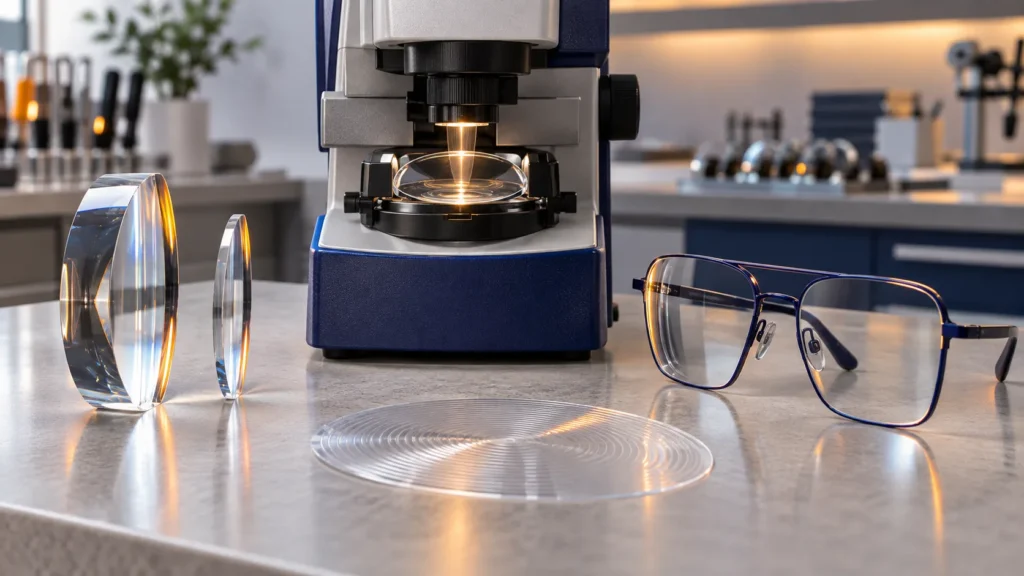
High Rx, prism, and occupational prescriptions need verification that standard dispensing skips: vertex compensation above roughly ±4.00 D, prism split between the lenses and checked against ANSI Z80.1 tolerances, and precise segment height with enough frame depth for the intermediate corridor. Getting any of these wrong causes remakes, eye strain, or failed adaptation.
Who This Guide Is For
This is a reference for opticians and dispensing optometrists handling complex prescriptions in clinical practice. It does not cover standard single-vision dispensing. The conditions addressed here (high refractive errors, binocular vision disorders requiring prism, and near/intermediate occupational lenses) each have distinct fitting requirements that deviate significantly from routine procedures.
High Rx Fitting: What Changes Above ±4.00 Diopters
Once a prescription crosses these thresholds, vertex distance, lens material, and decentration errors start affecting the outcome enough to require extra steps.
Clinical definitions for high prescriptions:
| Category | Threshold |
|---|---|
| High myopia | −6.00 D or stronger sphere |
| High hyperopia | +4.00 D or higher sphere |
| High astigmatism | 3.00 D or above cylinder |
When Vertex Distance Compensation Changes the Order
Vertex distance is the distance from the back surface of the spectacle lens to the front of the cornea, typically 12–14 mm in clinical refractions. When a patient’s fitting vertex distance differs from the trial frame vertex distance used during the refraction, the effective power the eye receives changes. The vertex distance measurement and compensation guide covers the step-by-step calculation for converting refraction power to the actual fitting distance.
The relationship is described by the formula: power change ≈ D²/1000 per millimeter of movement.
For a −8.00 D prescription, a 4 mm difference in vertex distance produces approximately a 0.25 D effective power shift. At lower prescriptions (below ±4.00 D), this effect is clinically insignificant. Above ±4.00 D, it can cause blurred vision, adaptation failure, and unnecessary remakes. According to 2020mag’s clinical guide on high Rx and vertex distance, “for low powers, it’s not usually an issue for central powers but for high powers, it can make a difference.”
Key fitting steps for high Rx patients:
- Record the trial frame vertex distance during the refraction
- Measure the patient’s fitting vertex distance with the chosen frame
- Apply vertex compensation if the difference is clinically significant (especially above ±7.00 D in either principal meridian)
- Communicate compensated power to the lab: do not assume they will calculate it without instruction
- Verify the finished lens at the delivery visit using a lensometer at the correct measurement point
Lens Material Selection for High Rx
High prescriptions produce thick lenses in standard materials. Lens material selection directly affects center thickness, edge thickness, weight, and optical quality.
| Material | Index | Best For |
|---|---|---|
| CR-39 | 1.50 | Low to moderate Rx only |
| Polycarbonate | 1.586 | Impact resistance; lowest Abbe value (30) of common materials |
| High-index plastic | 1.60–1.74 | High myopia and high hyperopia; reduces edge and center thickness |
| High-index glass | 1.8–1.9 | Extreme high Rx; heavy but optically excellent |
For patients with high myopia in minus lenses, edge thickness is the main concern; high-index materials reduce this significantly. For high hyperopia in plus lenses, center thickness is the issue. At 1.74 index, a +8.00 D lens is substantially thinner than at 1.50. Polycarbonate’s Abbe value of 30 is the lowest among common lens materials, which raises the odds of visible chromatic aberration at higher powers. According to iCare Labs’ explainer on Abbe value, “a higher percentage of patients have issues with chromatic aberration in poly (Abbe of 30) than with CR39 (Abbe value of 58).”
Frame selection matters equally. For high minus prescriptions, smaller frames reduce edge thickness proportionally. For high plus prescriptions, smaller frames reduce center thickness. Opticians should work with patients on frame selection before finalizing the order, not after.
Accurate PD Measurement Is Especially Critical for High Rx
In a standard prescription, a 1–2 mm PD error produces mild prismatic effect that most patients adapt to. In a high prescription, the same error produces a much larger prismatic effect because the lens power is higher. The induced prism from a decentration error equals the power multiplied by the decentration in centimeters (Prentice’s Rule).
For a −10.00 D lens, a 2 mm decentration error produces 2.00 prism diopters of unwanted prism, enough to cause diplopia or significant asthenopia. This makes accurate PD measurement non-negotiable for high Rx patients. Photo-based measurement tools such as Optogrid reduce this risk compared to manual ruler methods by removing observer parallax. For a full comparison of PD measurement options, see Comparing 4 Pupillary Distance Measurement Methods.
Prism Prescriptions: Fitting and Verification
Prism lenses correct ocular alignment problems, not refractive errors. They are prescribed for patients with symptomatic binocular vision disorders, including heterophoria, convergence insufficiency, and strabismus, where the goal is reducing diplopia, headaches, and asthenopia associated with the effort to maintain single binocular vision.
Understanding the Prism Prescription
A prism prescription specifies:
- Amount: measured in prism diopters (Δ), which deflect light 1 cm per meter of distance
- Base direction: base-in (BI), base-out (BO), base-up (BU), or base-down (BD)
When horizontal prism is prescribed, it is typically split between both eyes to reduce cosmetic thickness. When vertical prism is involved, it is generally placed in the hyperphoric eye (base-down) and the hypophoric eye (base-up) in equal halves.
According to Optometric Management’s clinical guide on prescribing prism: “If the prism contains a large vertical disparity, it is better to divide the amount of prism in half and apply BD to the hyperphoric eye and base-up (BU) on the hypophoric eye.”
When Fresnel Prism Is Indicated
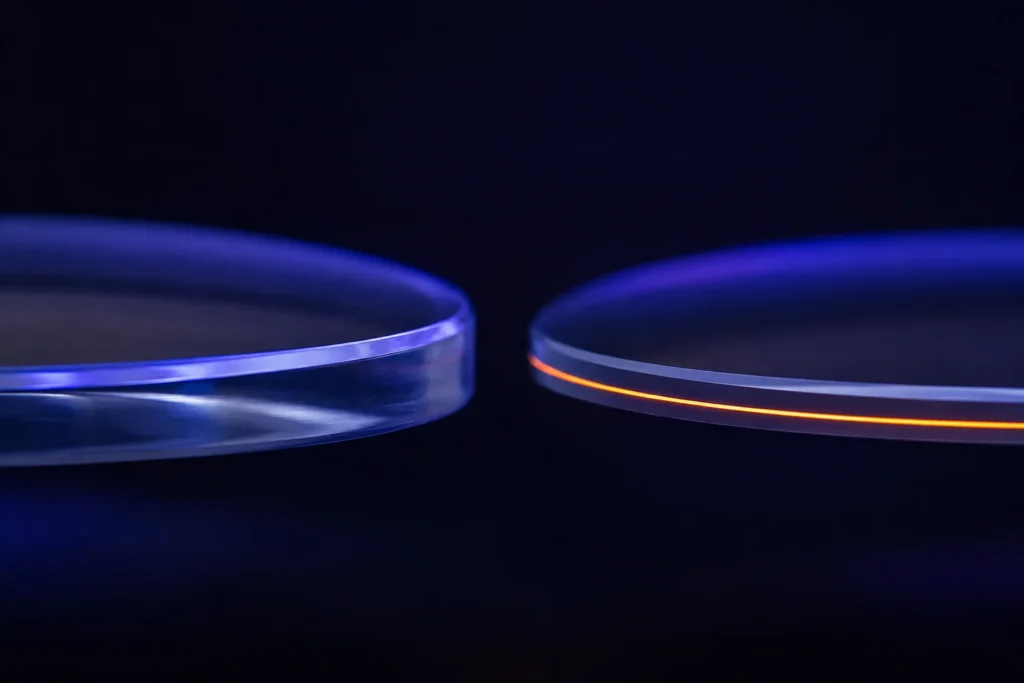
For prism magnitudes above six prism diopters, ground-in prism creates lens thickness that is cosmetically problematic and heavy. Fresnel prism (a thin plastic membrane with fine prismatic ridges applied to the lens surface) is an alternative for temporary or high-magnitude cases. As noted in the Optometric Management guide: “For larger magnitudes of prism (greater than six prism diopters), Fresnel prism can be applied.”
Fresnel prism reduces optical clarity compared to ground-in prism, consistent with published research showing greater acuity loss with Fresnel prisms than with conventional ground-in prisms of equivalent power (Cheng et al., Ophthalmic and Physiological Optics, 2001). It is typically used for diagnostic trials or when the prism prescription is expected to change (such as during recovery from strabismus surgery).
ANSI Z80.1 Prism Tolerances
All finished prism lenses must be verified against ANSI Z80.1 tolerances before dispensing. The table below covers the tolerances most relevant to special-condition fitting. For the complete tolerance tables across every lens type and power range, see Eyeglass Prescription and Lens Tolerances Explained, or run a finished job through the ANSI Z80.1 Lens Tolerance Checker.
| Parameter | Power Range | Tolerance |
|---|---|---|
| Vertical prism imbalance | 0.00 to ±3.375 D | ≤ 0.33 Δ; above that range, ≤ 1.0 mm difference in PRP height |
| Horizontal prism imbalance (single vision/multifocal) | 0.00 to ±2.75 D | ≤ 0.67 Δ; above that range, ≤ 2.5 mm from the specified distance PD |
| Horizontal prism imbalance (progressive) | 0.00 to ±3.375 D | ≤ 0.67 Δ; above that range, ≤ 1.0 mm from the specified monocular PD |
| Progressive fitting cross height | Any power | ±1.0 mm per lens; ≤ 1.0 mm difference between the mounted pair |
Source: The Vision Council’s ANSI Z80.1 Quick Reference Guide.
A fitting cross ordered at 12 mm and measured at 11.5 mm is within tolerance: ANSI Z80.1 allows each lens’s fitting cross height to vary by up to 1.0 mm from the ordered value, and the 0.5 mm difference here is well inside that limit.
Verification checklist for prism lenses:
- [ ] Confirm prism amount with a lensometer at the prism reference point (PRP) of each lens
- [ ] Verify base direction matches the prescription for each eye
- [ ] Confirm split prism is correctly distributed between lenses
- [ ] Check that prism does not exceed ANSI Z80.1 tolerance limits
- [ ] Assess for unwanted prism from decentration in strong prescriptions
- [ ] Confirm that lens thickness and edge profile have been discussed with the patient
Patient Communication Before Dispensing
Prism lenses, particularly high amounts, are visually distinct: edges are noticeable. The Optometric Management guide recommends: “Show the patient an example of the edge of prisms, utilizing one from your trial lenses sets or loose prisms, and get their approval before processing the order.”
Occupational Lenses: Fitting for Work-Specific Visual Demands
Occupational progressive lenses are designed for intermediate and near vision at the workstation. Unlike standard progressive lenses, which provide distance, intermediate, and near zones, occupational designs sacrifice the distance zone to expand the intermediate and near corridors. This makes them unsuitable for driving but highly effective for patients whose work requires extended time at computer monitors, reading documents, or operating equipment at arm’s length.
Who Benefits from Occupational Lenses
| Patient Profile | Occupational Lens Advantage |
|---|---|
| Heavy computer users (presbyopes) | Wider intermediate corridor reduces neck strain |
| Architects, lab technicians, musicians | Optimized for work-distance viewing |
| Patients who read below standard progressive near zone | Larger near area than standard progressive |
| Patients with poor adaptation to standard progressives | Simplified design with fewer swim/distortion issues |
According to HOYA Vision Care’s occupational lens brochure, occupational lenses are “specifically designed to provide better focus and a wider field of vision for close to intermediate range distances,” with an “ergonomic position during near and intermediate distance activities” listed as a patient benefit, consistent with research on computer vision syndrome in presbyopic digital-device users (Sánchez-Brau et al., 2021).
Segment Height Is the Critical Fitting Parameter
Segment height (SH) determines where the progressive addition begins vertically in the lens. For occupational lenses, this placement directly controls whether the patient sees clearly at their primary work distance.
SH measurement protocol for occupational progressives:
- Have the patient sit in their natural working posture, not upright as for standard progressive fitting
- Position the frame as it will be worn during work tasks
- Mark the pupil center while the patient looks straight ahead at a target at their normal working distance
- Measure from the mark to the bottom edge of the lens (not the frame)
- For standard progressive designs, confirm there is at least 10 mm of distance-vision clearance above the fitting cross; for occupational designs, follow the specific lab’s minimum fitting height instead (see below)
According to iCare Labs’ segment height guide: “Make sure there is at least 10mm of distance vision above the fitting cross in a progressive lens. Less than 10mm may not provide enough distance vision and could lead to non-adaptation.”
Occupational designs compress or eliminate the distance zone entirely, so the 10 mm distance-vision rule above does not apply to them. Instead, follow the specific lab’s minimum fitting height for the design ordered, since working range varies widely (HOYA’s SUPEREADER, for near tasks, tops out around 1.2 m; its WorkStyle 3 design reaches 6 m).
Frame Selection for Occupational Lenses
Occupational progressives require adequate lens height to fit the near and intermediate corridors without compression. Standard practice calls for a minimum B-dimension (vertical lens height) of 28 mm, and occupational designs often need more; confirm the specific lab’s minimum for the design being ordered. Short frames produce a compressed reading zone that eliminates the ergonomic benefit of the occupational design.
Frame recommendations:
- B-dimension: minimum 28 mm (confirm with the specific lens design specifications)
- No excessive wrap angle: wrap distorts power in progressive designs
- Lightweight materials (titanium, TR-90) reduce nose and ear fatigue during full-day wear
Add Power and Working Distance
The Add power in an occupational lens is set based on the patient’s presbyopic correction. However, the target working distance affects whether the Add should be at, above, or below the prescribed near Add.
A patient whose primary work distance is around 70 cm (intermediate) may not need the full near Add at that distance; some occupational and computer-lens designs are built to provide a reduced Add through the primary working zone instead of the full near power. Confirm the working distance and the patient’s actual visual needs during the consultation; not all presbyopic computer users need their full Add at the primary occupational zone.
Patients Who Wear VR Headsets for Work
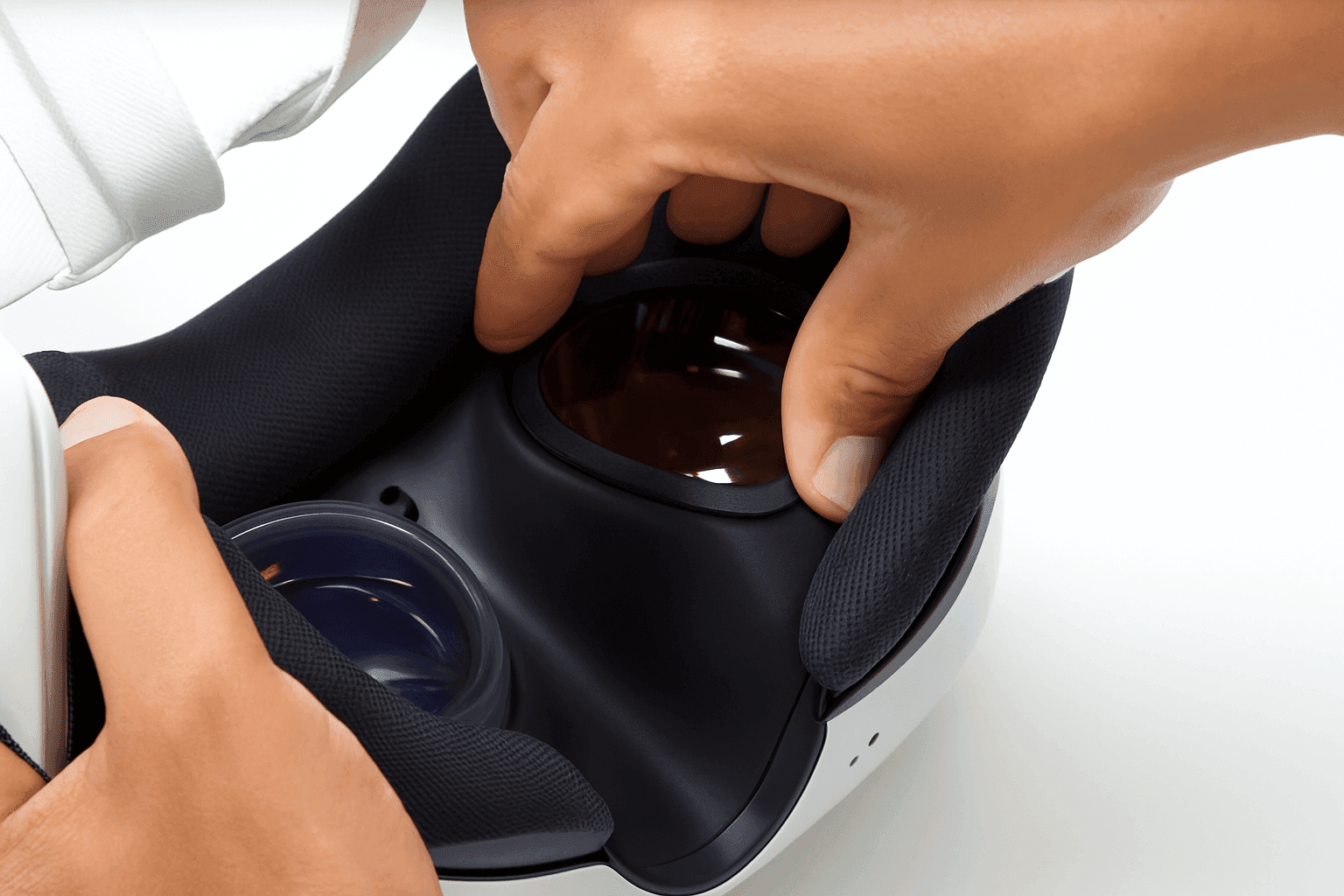
A growing number of patients use VR headsets for simulation training, design review, or remote collaboration. Their own glasses often will not work inside the headset: many frames are too wide for the lens housing, and those that do fit can press against the face or scratch the headset’s internal optics. The usual fix is a prescription lens insert that mounts inside the headset in place of the stock lenses. Before recommending one, confirm the patient’s sphere and cylinder fall within the insert maker’s supported range, ask whether the design supports prism at all (most inserts are ground for spherical and cylindrical power only), and check that the patient’s PD sits within the headset’s built-in IPD adjustment. Reloptix makes prescription VR lens inserts for headsets including Meta Quest, Valve Index, and HTC Vive.
Accurate Measurements Across All Special Condition Lenses
The higher the prescription or the more specialized the design, the larger the downstream error from a measurement mistake. Three measurements carry the most weight in complex dispensing:
| Measurement | Recommended Measurement Precision | Why It Matters More in Special Rx |
|---|---|---|
| Pupillary Distance (PD) | ±1 mm | High Rx amplifies prismatic effect of decentration |
| Segment Height (SH) | ±1 mm | Progressive and occupational designs are sensitive to vertical placement |
| Vertex Distance | ±1 mm | High Rx requires compensation for differences from refraction |
These are practical measurement targets rather than ANSI tolerances. ANSI Z80.1 governs how closely the finished lens matches the order (see the tolerance table above); it does not set a standard for the accuracy of the practitioner’s initial physical measurement.
For high Rx patients in particular, photo-based PD measurement tools that reduce parallax error lower the risk of decentration-related complaints. See Why Accurate PD and SH Measurements Are Crucial for Prescription Eyewear for the evidence base on measurement tolerances.
Correct frame adjustment (pantoscopic tilt, vertex distance, and temple fit) is as important as measurement precision: a well-measured order delivers poor results if the frame shifts out of the adjustment parameters at dispensing.
For safety-critical prescriptions, including prescription safety glasses, see Prescription Safety Glasses Guide: ANSI Z87.1 & OSHA Compliance.
FAQ: Prescription Lens Fitting for Special Conditions
When does vertex distance compensation become clinically required?
For prescriptions exceeding ±4.00 D, changes in vertex distance begin to affect the effective power the eye receives. For prescriptions above ±7.00 D, compensation is generally required. The standard formula is: power change ≈ D²/1000 per millimeter of vertex distance change.
Can prism be incorporated into progressive lenses?
Yes. Ground-in prism can be incorporated into progressive lenses. The lens lab needs both the prism specification and the progressive fitting parameters. Opticians should confirm with the lab that the design they are ordering supports prism incorporation, as some progressive designs have restrictions.
What is the difference between an occupational progressive and a standard progressive?
Standard progressives provide three zones: distance, intermediate, and near. Occupational progressives reduce or eliminate the distance zone to expand the intermediate and near zones. This makes them better for extended computer and desk work but unsuitable for driving.
Why do some high Rx patients report peripheral distortion in progressive lenses?
High prescriptions combined with progressive lens geometry produce more peripheral aberration than lower prescriptions. Free-form (digitally surfaced) progressive lenses optimize peripheral optics using patient-specific data including vertex distance, pantoscopic tilt, and wrap angle, reducing but not eliminating this effect for high Rx patients.
What frame characteristics matter most for high minus lenses?
Smaller frames reduce edge thickness proportionally. Eye size (the A-measurement, or lens width) has the largest single impact on edge thickness in minus lenses. A 2 mm reduction in eye size can reduce edge thickness meaningfully at high prescriptions.
When is Fresnel prism preferable to ground-in prism?
Fresnel prism is preferred for prism amounts above 6 prism diopters, during diagnostic trials before committing to ground-in prism, or when the prism prescription is expected to change. Ground-in prism provides better optical clarity but becomes very thick and heavy at higher amounts.
How does astigmatism axis affect occupational lens fitting?
High cylinder power at an oblique axis (around 45° or 135°) can interact with progressive lens design corridors to create additional peripheral distortion. For patients with significant oblique astigmatism and presbyopia, free-form progressive designs that account for axis position during surfacing generally produce better outcomes than conventional progressive designs.
What should an optician communicate to the lab for high Rx orders?
At minimum: compensated sphere power (if vertex distance differs from refraction), cylinder and axis, monocular PD values, segment height, vertex distance used for compensation, lens material and index, and any special coatings. For prism orders, add prism amount and base direction for each eye.
Key References
- ANSI Z80.1 Quick Reference Guide (The Vision Council)
- ANSI Z80.1-2025: Prescription Ophthalmic Lenses (The Vision Council)
- Prescribing Prism (Optometric Management)
- High Rx, Adds, and Vertex Distance (2020 Magazine)
- How to Take a Proper Segment Height (iCare Labs)
- Understanding How Abbe Value Can Affect Chromatic Aberration (iCare Labs)
- HOYA Occupational Lenses Brochure (HOYA Vision Care)
- Computer Vision Syndrome in Presbyopic Digital Device Workers and Progressive Lens Design (Sánchez-Brau et al., Ophthalmic and Physiological Optics, 2021)
- The Effect of Conventional CR-39 and Fresnel Prisms on High and Low Contrast Acuity (Cheng et al., Ophthalmic and Physiological Optics, 2001, PubMed)

I grew up inside an optical shop. My mother likes to tell how, as a kid, I would watch eyeglasses being assembled, play with the tools, and draw on the back of service order slips. The family business taught me early what a precise measurement and work done right are worth.
I went on to spend more than twenty years as a software engineer, always keeping an eye on the optical world. Optogrid was born where the two meet: digital measurement technology (pupillary distance and fitting heights) built by someone who knows the dispensing counter from the inside.