
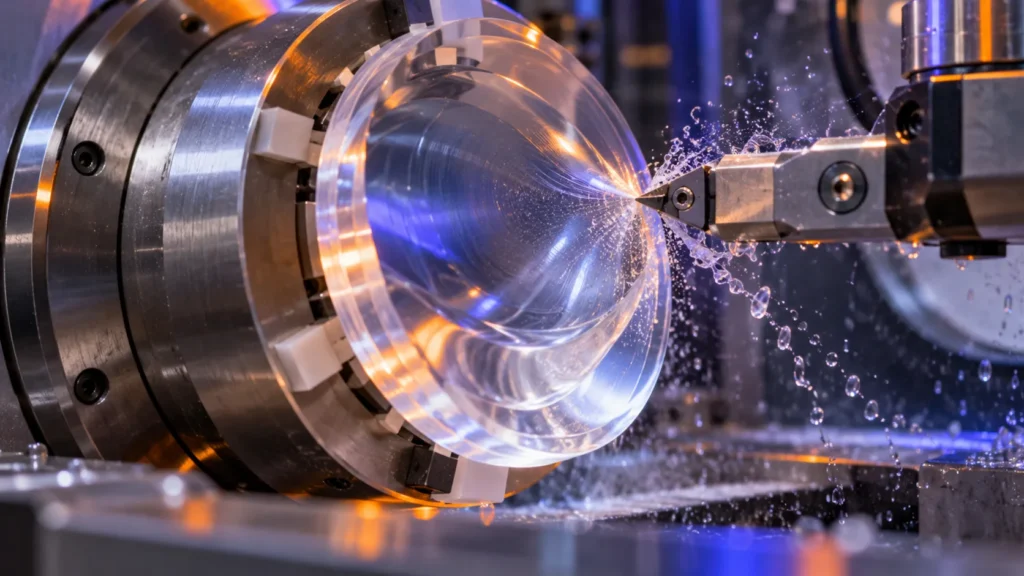
Free-form is a manufacturing method, not a lens type. A computer-controlled generator with a diamond cutting tool carves the lens surface point by point, so the surface can take any shape instead of being limited to a sphere or a toric. That freedom lets the lab place the lens design (the progressive corridor, for example) on the lens itself, optimize it for the exact prescription, and optionally calculate it for how the frame sits on this patient’s face. “Digital” is mostly a marketing label for the same process. The label on the box does not tell you how much of that potential was actually used.
If you are new to dispensing and keep hearing “free-form” and “digital” from lab reps, this guide explains the mechanism, sorts the terms into tiers, and covers what changes when the job arrives on your bench. For the wider picture of how a lens goes from blank to finished prescription, start there and come back.
How a conventional lens is made
A conventional lens starts as a semi-finished blank. The front surface is molded at the factory and is fixed. For a conventional progressive, the entire progressive design is molded into that front surface.
The lab only works on the back. It picks the blank whose base curve (and, for a progressive, add) suits the prescription, generates a sphere or a toric (sphere plus cylinder) on the back, and then fines and polishes it with tooling that has set curves. The progressive lens types and fitting guide covers how those molded designs differ.
Two consequences matter for everything below:
- The front design was made for an average prescription within that blank’s base-curve range, not for this patient.
- A simple spherical or toric back surface leaves off-axis errors, such as oblique astigmatism and power error, in the periphery of the lens.
How free-form surfacing works
Free-form still starts from a semi-finished blank, usually with a simple spherical front. What changes is the machine and the software. Per one review of the literature, “specialized computer numerical control (CNC) generators and polishers, which have the ability to curve the lens in three dimensions (x, y, and z), produce these surfaces” (Ladopoulos, Pateras and Ninos, Cureus, 2026). Hoya describes the same idea as “complex computer algorithms to control a diamond tip lathe that carves the prescription into the back surface of the lens” (Hoya).
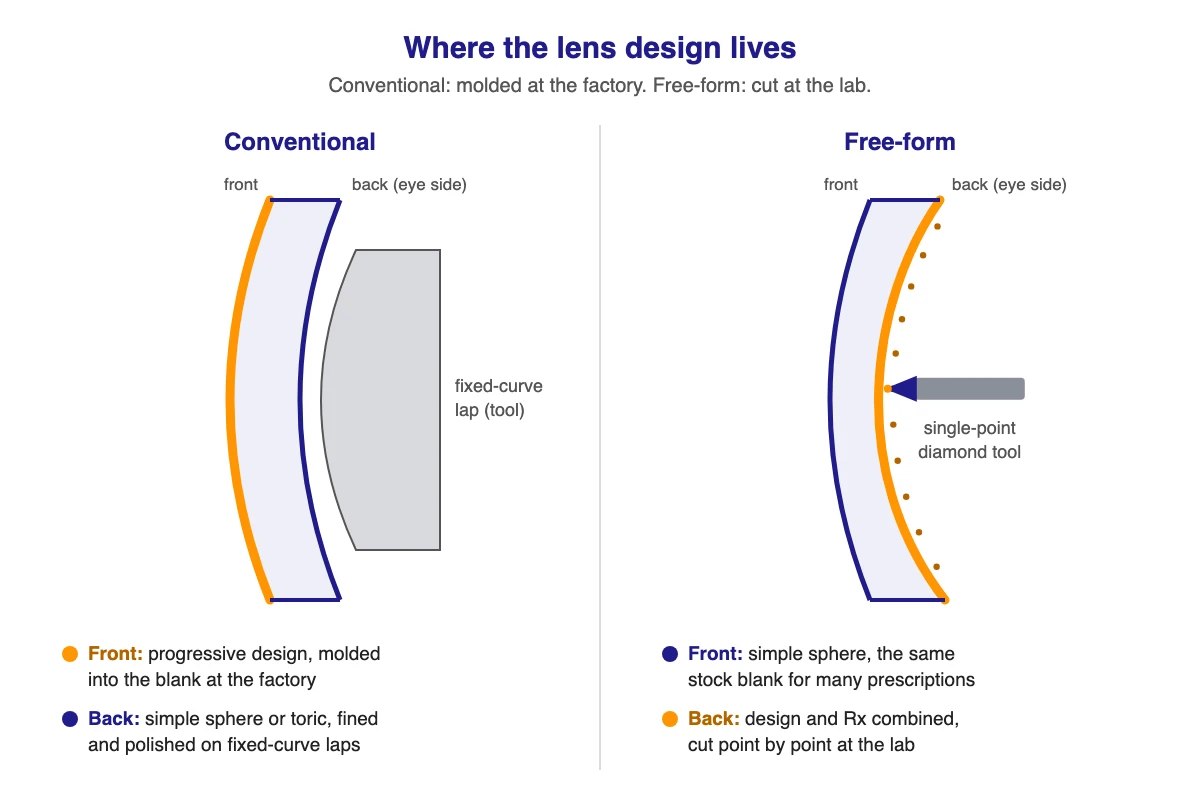
Most free-form progressives put the complex surface on the back. Some designs split the work between front and back. Hoya says some of its premium designs are “free form surfaces, both on the front and back sides of the lens”. Free-form also reaches stock lenses: Zeiss says the design of its ClearView finished single vision lens is “transferred into mould designs required in the FSV manufacturing process” (Zeiss), so the free-form step happens at the mold, not at your lab.
That machine and software combination makes three things possible:
- The design is made at the lab, not in the blank mold. The lab can place the progressive design on the back surface and shape it around the prescription.
- Point-by-point optimization for the exact prescription. This is why digital single vision exists at all. Sheedy et al. (2006), as cited in the Cureus review, showed that free-form lenses “can reduce peripheral astigmatism by as much as 50% when compared to standard” aspheric lenses.
- Position-of-wear calculation. The software can account for how the lens will actually sit in front of the eye.
Position of wear: what the lab can calculate
Position of wear (POW) is the 3D position of the lens relative to the eye. The parameters are:
- Vertex distance: back of the lens to the front of the eye. See vertex distance compensation and the vertex distance calculator.
- Pantoscopic tilt: the tilt of the lens plane from vertical.
- Face form (wrap): the curvature of the frame front seen from above.
- Sometimes near working distance and frame shape.
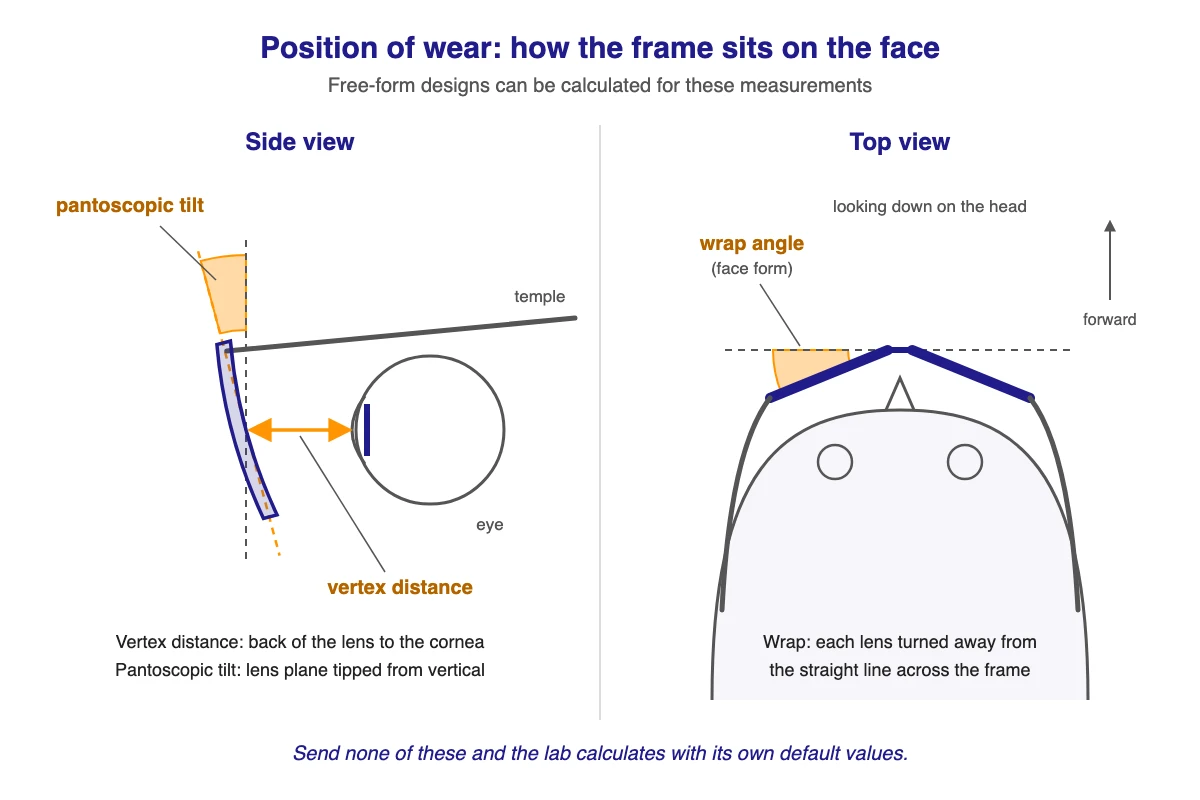
The review’s list of what the optimization accounts for is longer: prescription, monocular PD and fitting height, vertex distance, pantoscopic tilt and wrap angle, and it concludes that “personalization of position-of-wear parameters (vertex distance, pantoscopic tilt, wrap) is key to FFL advantages.”
If you send none of these, the lab does not skip the step. It falls back on defaults. Hoya, for example, lists its own defaults as wrap angle 4.4°, pantoscopic tilt 8.3° and vertex distance 12.3 mm (Hoya Compensated Lenses FAQ); other manufacturers use their own. Barry Santini wrote in 20/20 that “still less than 10 percent of all lab orders include custom values for vertex distance, pantoscopic tilt and frame wrap angle,” and that averaged defaults “are often not accurate enough with most of today’s frames” (20/20 Magazine).
Frame fit feeds the calculation directly, so eyeglass nose pads and frame adjustment matter. Hoya’s Compensated Lenses FAQ tip is to adjust the frame to fit the patient before taking position-of-wear measurements.
Free-form, digital and personalized: a tier table
The trade uses these words loosely. The table below is a working framework, not an industry standard, and manufacturers name their tiers differently. Its purpose is to show that a budget “digital progressive” and a premium personalized lens can come off the same generator.
| Tier | Where the design lives | Optimized for this Rx? | Uses measured POW? | What you send | Typical use |
|---|---|---|---|---|---|
| Conventional | Molded front, simple back | No, made for a range of prescriptions | No | Rx, monocular PD, fitting height | Stock and basic surfaced lenses |
| Free-form, generic design, default POW | Generated back surface | Limited | No, manufacturer defaults | Rx, monocular PD, fitting height | Often sold as “digital” |
| Rx-optimized free-form | Generated back surface, tuned per Rx | Yes | No, manufacturer defaults | Rx, monocular PD, fitting height | Mid-range digital designs |
| Personalized free-form | Generated back surface, tuned per Rx and frame | Yes | Yes | Rx, monocular PD, fitting height, vertex, tilt, wrap, frame shape | Premium designs, wrap frames, higher powers |
The practical lesson: the word “free-form” or “digital” tells you how the lens was cut. It does not tell you what data went into the design. Ask the lab which inputs the design actually uses, and send those inputs.
Higher prescriptions gain the most from personalization. The Cureus review says free-form lenses “are preferable for higher prescriptions (hyperopia > +4.00, myopia < -4.00, astigmatism > 2.00)” and that “custom FFLs are essential for occupational lens designs.” If a patient needs a design for computer or desk distances, see the occupational lenses guide.
What changes on the bench
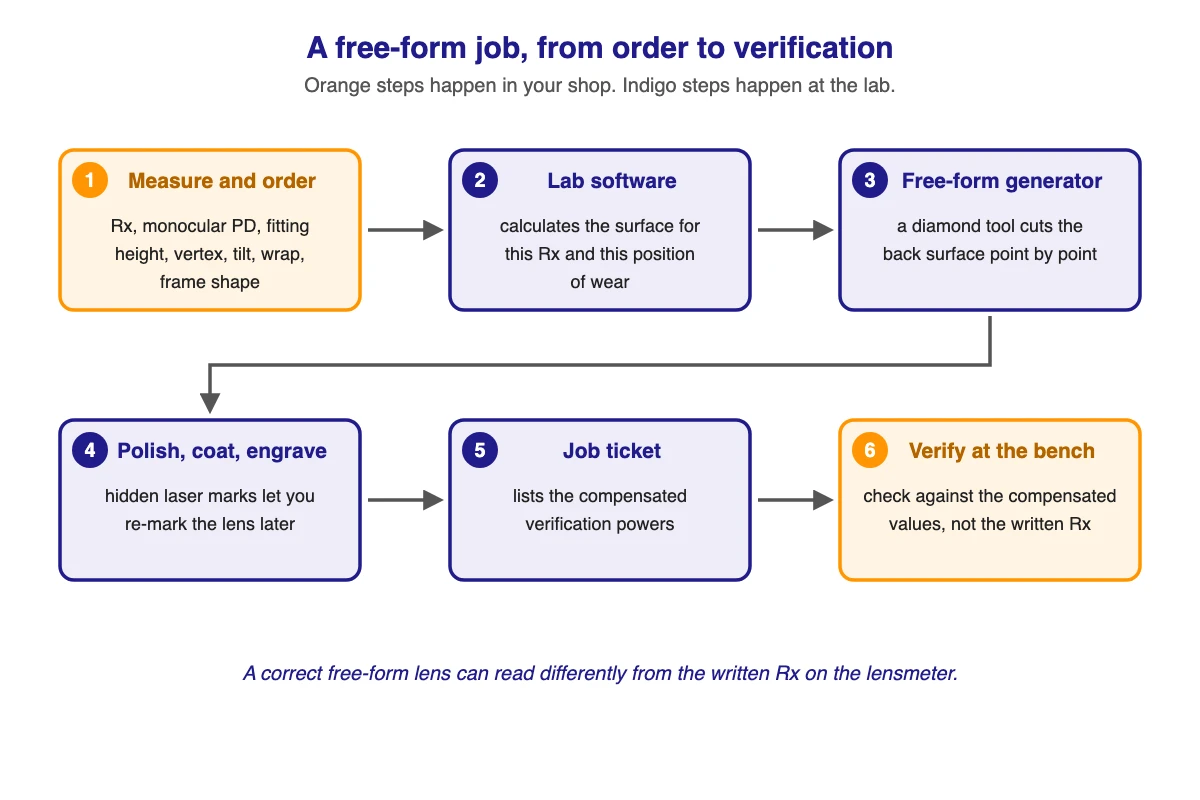
The workflow above is where most dispensing errors and most wrongly rejected jobs come from. The surface is calculated from the numbers you send, and the finished lens is checked against numbers the lab sends back.
Compensated powers: verify against the lab’s values, not the written Rx
When a lens is calculated for position of wear, the lab may change the surfaced power so the eye receives the prescribed power as worn. The refraction is done through a phoropter with no wrap, no pantoscopic tilt and a fixed vertex distance. A lens in a frame is tilted, wrapped and at a different distance, and that changes what the wearer perceives. The lensmeter reads the lens flat, so it reads the compensated power, not the written prescription.
Verify compensated free-form lenses against the compensated (verification) values on the job ticket, not the original prescription. Comparing against the written Rx will make you reject correct lenses.
Hoya puts it this way: premium lens designs that have been compensated “should be verified against the compensated prescription on the invoice, not the prescription that was ordered” (Hoya). 20/20 describes the paperwork: “The lab sends two forms, one with the doctor’s prescribed power listed and the other indicating the compensated verification values” (20/20 Magazine). And iCare Labs says small shifts in sphere, cylinder or axis “are expected and are part of the design, not a defect.”
A worked example from 20/20: a +4.00 sphere with 10 degrees of pantoscopic tilt and 8 degrees of face wrap would be surfaced as +3.87 sphere with -0.12 cylinder to deliver the correct power at the eye (20/20 Magazine). On the lensmeter that lens “reads wrong” against the Rx and is correct. The same effect explains why a patient’s clear and sun pairs can be compensated differently: the sun frame usually has more wrap.
Tolerances need care. Hoya notes that ANSI tolerances are typically tighter for higher prescriptions, so the compensated power “may exceed standard tolerance when compared directly to the written prescription”. Apply tolerances to the compensated values instead. A lensmeter reading is only as useful as the reference you compare it to.
Double compensation
Never send a pre-compensated prescription (a vertex-compensated power, for example) together with position-of-wear data to a lab that compensates automatically. The lab would compensate a second time and the lens would be wrong. If a lab’s workflow does not accept position-of-wear data, or you are unsure, ask before calculating anything. The vertex distance guide covers the details of vertex distance compensation and when the lab handles it.
Measurements carry more weight
Monocular PD and fitting height define where the calculated optics sit in front of the eye. Tilt, vertex and wrap feed the power and astigmatism calculation. The Cureus review is direct: “Inaccurate measurements can eliminate the benefit associated with an FFL,” and “the loss of benefit associated with an FFL can be attributed exclusively to measurement error.”
Hoya also notes that increasing pantoscopic tilt makes the fitting height feel higher, and that increasing wrap makes the pupil distance feel wider. Both are reasons to measure with the frame adjusted and on the patient. A fitting height calculator helps you check a number, but the number still has to come from the frame as worn.
Laser engravings
Free-form progressives carry hidden laser-etched marks used to re-mark the lens and identify the design and add. They are how you find the fitting point again after the temporary marks are cleaned off. The details are in the guide to laser-etched progressive lens markings.
Bench checklist for a free-form job
- Compare the job ticket with the original order. Confirm the lab used the measurements you sent.
- Find the compensated verification values on the ticket or lens packet. If there are none, ask the lab.
- Re-mark the engravings and confirm the fitting point.
- Read sphere, cylinder and axis in the lensmeter and compare them with the compensated values, not the written Rx.
- Check the add and, if there is prism, prism at the reference point.
- Check monocular PD and fitting height against the frame on the patient.
- Glaze, then adjust the frame to the fitting you measured. A frame that sits differently from the measurement invalidates the calculation.
- Keep a copy of the compensated values in the patient record. It saves the next remake conversation.
What free-form does not do
“Accurate to 0.01 D.” Hoya’s article says free-form lenses “can be refined to 1/100 of a diopter.” That is a manufacturer claim about surfacing resolution. Prescriptions are still written in quarter-diopter steps. The finer resolution matters because optimization and compensation produce powers that are not quarter-diopter values, as the +3.87 example shows. The benefit comes from the shape of the surface, not from a more precise prescription.
It does not remove vertical imbalance from anisometropia. When the eyes look down through the reading area of a progressive or bifocal, unequal lens powers still create different vertical prism at the two lenses. Prentice’s rule still applies. The traditional fix is slab-off (bicentric grinding). Some free-form labs can produce the slab-off prism digitally. 20/20 notes that digital surfacing lets a lab build the slab-off into the lens during production, and advises to “consult your lab for their ability” (20/20 Magazine). Availability and limits vary by lab and design, so ask before you promise it.
It does not rescue a bad measurement or a bad frame adjustment. A perfectly calculated surface centered on the wrong point is a perfectly calculated wrong lens.
“Hard” versus “soft” is not conventional versus free-form. Hard and soft describe design philosophy, how a progressive distributes its unwanted astigmatism. Both philosophies exist in conventional and free-form products. Do not use them as synonyms for either manufacturing method.
When free-form is worth it
Progressives. Most modern progressive designs are made with free-form surfacing, so the useful question is which tier the lens belongs to and which inputs its design uses. The Cureus review reports that free-form lenses “are associated with shorter adaptation time, especially in first-time PAL wearers.”
Single vision. The benefit grows with higher powers, significant cylinder, larger or wrapped frames, and patients who complain about edge blur. For low prescriptions in small, flat frames the benefit is small, and the same review notes that aspheric lenses are “still a reasonably acceptable, cost-effective solution for moderate spherical aberration.” The review also states: “the cost and value of FFLs compared to ASLs typically include a significant price premium,” so the price has to match the patient’s need. For the baseline comparison, see standard vs digital single vision and aspheric and double aspheric designs.
Two patients show the split. A -1.00 D myope in a small flat metal frame will notice little difference between a good aspheric and a digital single vision lens. A -6.00 D patient with 2.50 D of cylinder in a wrapped sport frame is the case where position-of-wear calculation can change what they see at the edges.
Frequently Asked Questions
What is the difference between free-form and digital lenses?
Free-form describes how the lens surface is cut: a computer-controlled generator carves it point by point. “Digital” is usually a marketing label for the same process. Neither word tells you whether the design is optimized for the prescription or calculated with measured position-of-wear data, so ask the lab which inputs the design uses.
Are free-form lenses worth it for single vision?
They are worth it mainly for higher powers, significant cylinder, larger or wrapped frames and patients with edge blur. A review in Cureus reports that free-form lenses are preferable for hyperopia above +4.00, myopia beyond -4.00 and astigmatism above 2.00, and that aspheric lenses remain a cost-effective choice for moderate spherical aberration.
Why doesn’t my free-form lens read the same as the Rx on the lensometer?
Because the lab compensated the power for position of wear. The lensmeter reads the lens flat, so it shows the compensated power, while the wearer gets the prescribed power once the lens is tilted and wrapped in the frame. Verify against the compensated values on the job ticket, not the written prescription.
Do free-form lenses need special measurements?
They work without them, using the manufacturer’s default values, but they do more with them. Monocular PD and fitting height are always needed. Vertex distance, pantoscopic tilt, wrap and frame shape let the lab personalize the calculation. Measure with the frame adjusted and on the patient.
Are all progressive lenses free-form now?
Most modern progressive designs are made with free-form surfacing, but conventional progressives with a molded front still exist. Two free-form progressives can also differ a lot in what the design uses: generic design and default position of wear at one end, measured position of wear and frame data at the other.
Can any frame take free-form lenses (wrap)?
Frame choice still matters. Wrap frames change the tilt of each lens and induce astigmatism that the compensated design can offset when you supply the wrap angle. Very high wrap or very large shapes may be outside what a particular design or blank supports, so check the lab’s limits before you order.
Do free-form lenses fix anisometropia problems?
No. Vertical prism imbalance at the reading level still follows Prentice’s rule, and free-form does not remove it. Slab-off prism is the traditional correction, and some free-form labs can produce it digitally. Ask your lab whether it offers this and within what limits.

I grew up inside an optical shop. My mother likes to tell how, as a kid, I would watch eyeglasses being assembled, play with the tools, and draw on the back of service order slips. The family business taught me early what a precise measurement and work done right are worth.
I went on to spend more than twenty years as a software engineer, always keeping an eye on the optical world. Optogrid was born where the two meet: digital measurement technology (pupillary distance and fitting heights) built by someone who knows the dispensing counter from the inside.