
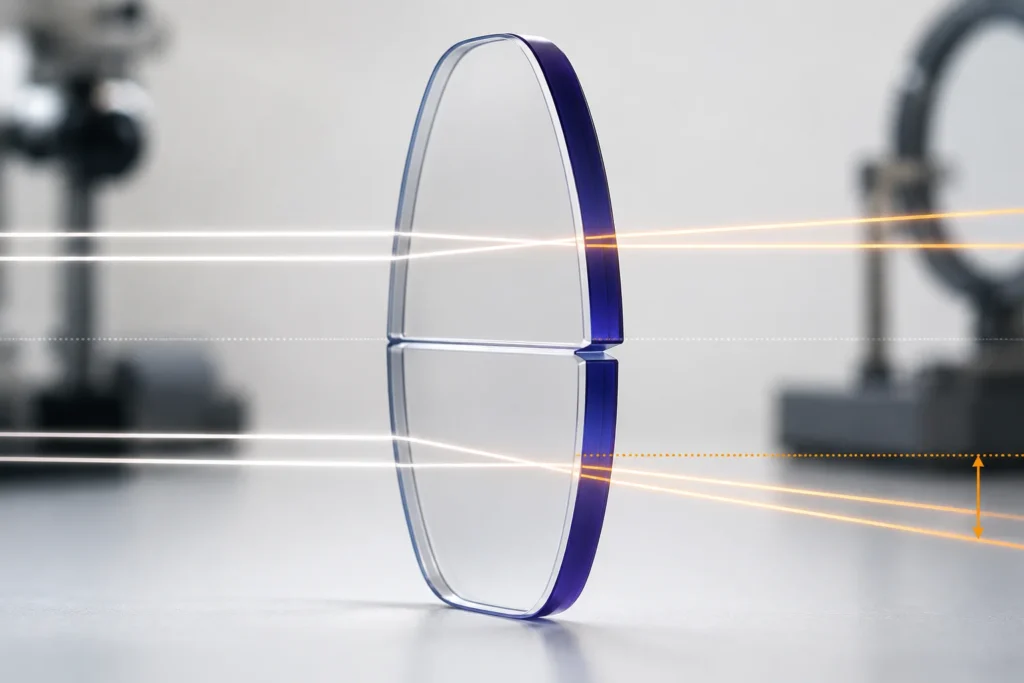
Slab-off lenses, also called bicentric grinding, fix a specific dispensing problem: an anisometropic wearer reading through a multifocal gets a different amount of vertical prism in each eye, and the mismatch causes double vision or discomfort at near even though the distance Rx is correct. The fix is to grind extra prism into the lower half of one lens so both eyes see roughly the same vertical prism at the reading level. Regular slab-off adds base-up prism to the lower half of the more-minus (or least-plus) lens; reverse slab-off adds base-down prism to the lower half of the more-plus (or least-minus) lens. Most labs treat roughly 1.5 prism diopters of vertical imbalance at near as the point where ordering slab-off is worth it.
Why Anisometropia Creates Vertical Prism at Near
The imbalance is a direct consequence of Prentice’s rule: P = c × F, where c is the distance from the optical center in centimeters and F is the lens power in diopters. When two eyes have different powers, and the wearer drops gaze to read below the distance optical centers, each lens induces a different amount of prism at that reading point, because the power term in the equation is different for each eye even though the decentration is the same.
For a wearer with equal powers this is a non-issue: both eyes get the same prism, so there’s nothing to fuse against. Anisometropia breaks that symmetry. The bigger the power difference and the lower the reading point sits below the optical centers, the larger the imbalance grows.
Not every anisometrope needs correcting. The 2020 Magazine reference on bicentric grinding notes that slab-off “can be used to correct for imbalance amounts ranging from 1.5D to 6D,” and an optician’s clinical notes on anisometropia put the same figure more precisely: “Slab off starts at 1.5ΔBU and progresses by half-diopters to 6ΔBU,” according to opticiannotes. Below that, most wearers fuse the difference without symptoms; above it, expect complaints of double vision, a “see-saw” sensation, or eye strain when reading.
Regular vs Reverse Slab-Off
Both techniques correct the same problem. The difference is which lens gets worked and which direction the added prism points.
| Regular slab-off | Reverse slab-off | |
|---|---|---|
| Ground into | The more-minus (or least-plus) lens | The more-plus (or least-minus) lens |
| Prism added at near | Base up | Base down |
| What it offsets | Excess base-down building up in that lens at the reading level | Excess base-up building up in that lens at the reading level |
| Manufacture | Ground into the lower half of a standard lens (bi-centric grinding) | Usually molded or cast into the lens blank with base-down already built into the lower segment |
| Typical range | About 1.5 Δ to 6 Δ | Same range, opposite lens |
A peer-reviewed description in the Journal of AAPOS puts it plainly: the correction is “ground into the stronger minus or weaker plus lens, and reverse slab ground into the weaker minus or stronger plus lens.” The Laramy-K lab notes describe the mechanics: the process involves “grinding base-up prism on half of the most minus or least plus lens,” which leaves a visible line across the lens where the ground surface changes, the reason it looks like a slab of material was removed.
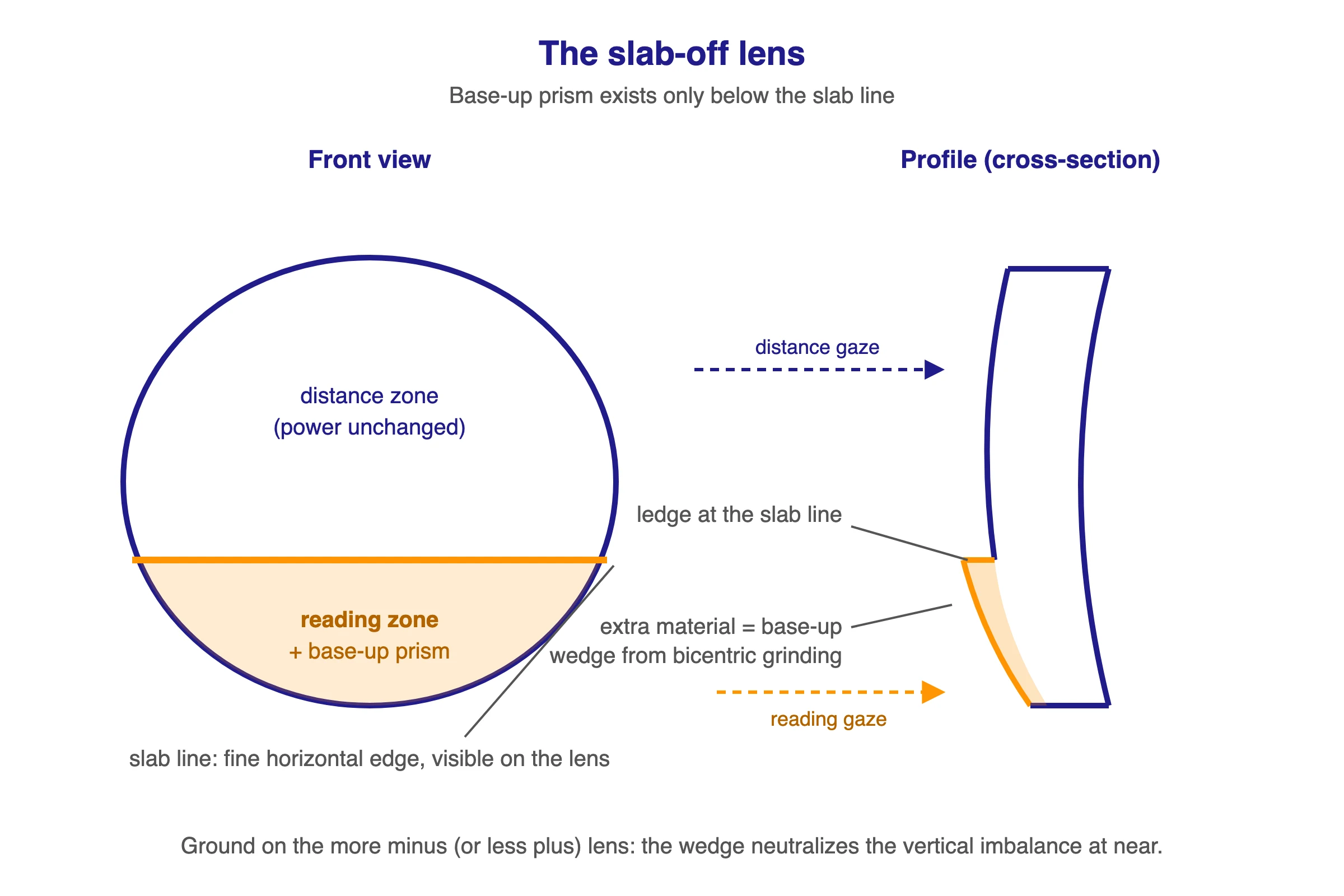
Reverse slab-off exists because the correction can be built into either lens. Instead of adding base-up to the weaker eye, a lab can add base-down to the stronger-plus (or least-minus) eye and land on the same balanced result. Which one a lab reaches for often comes down to the specific lens design, material, and blank inventory available for that Rx.
Worked Example: Calculating the Imbalance
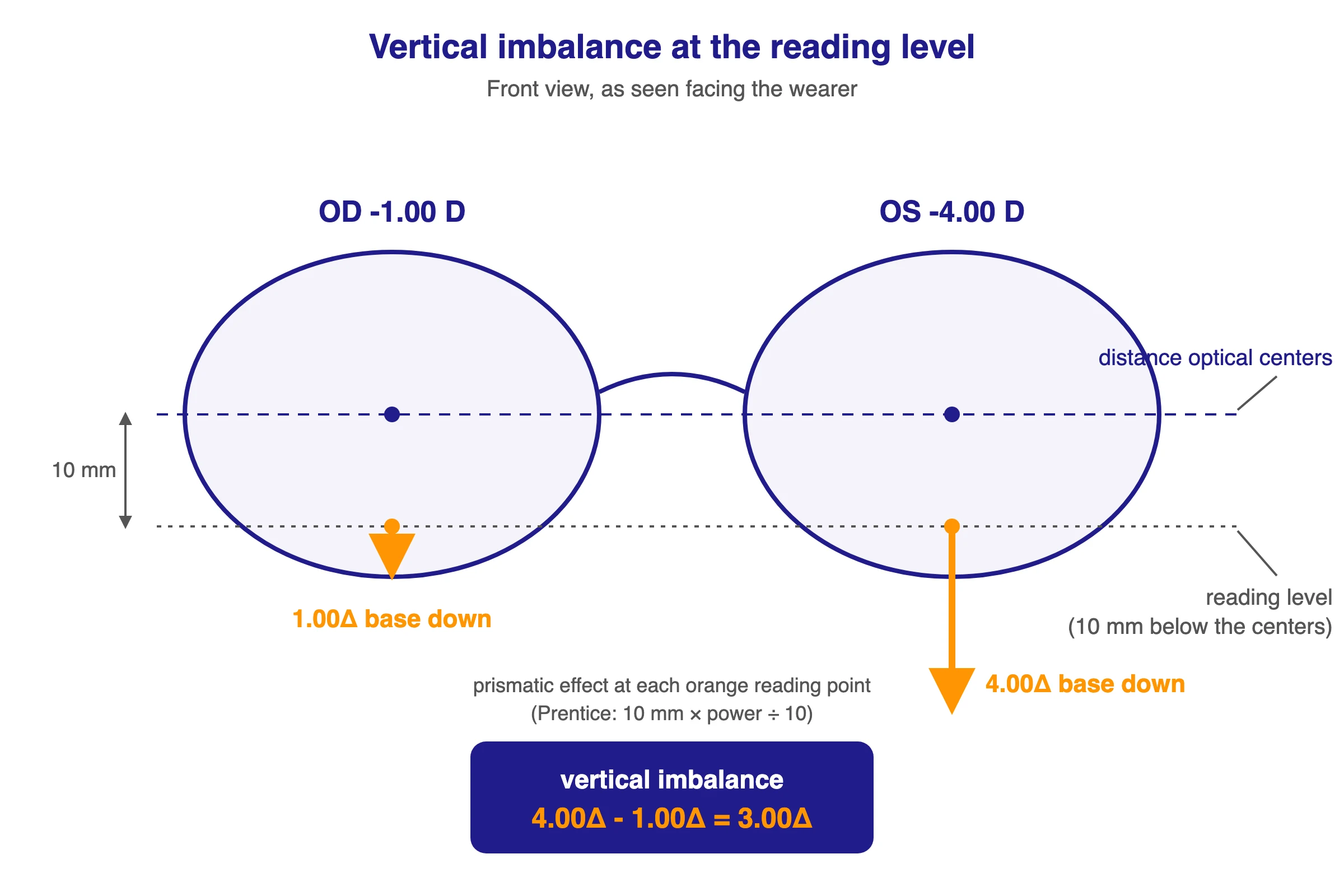
Take a wearer with OD -1.00 DS and OS -4.00 DS, a 3.00 D anisometropia with no astigmatism, so the vertical-meridian power equals the sphere power in each eye. Using the commonly assumed reading position of about 10 mm (1.0 cm) below the distance optical centers:
- OD: 1.0 cm × 1.00 D = 1.00 Δ base down (a minus lens with the optical center above the point of regard induces base-down prism)
- OS: 1.0 cm × 4.00 D = 4.00 Δ base down
The vertical imbalance is the difference between the two: 4.00 Δ − 1.00 Δ = 3.00 Δ. That’s double the roughly 1.5 Δ threshold where slab-off is typically ordered, so this Rx is a clear candidate. The Prentice’s rule calculator runs the same math for any power and decentration if you want to check a different Rx.
OS is the more-minus lens, so regular slab-off is ground into OS, adding 3.00 Δ base-up to its lower half. That brings OS down from 4.00 Δ base down to a net 1.00 Δ base down at the reading level, matching OD exactly and eliminating the imbalance. The amount ordered from the lab is the imbalance itself, 3.00 Δ BU, not the full prism induced in either lens on its own.
Alternatives to Slab-Off
Slab-off isn’t the only fix, and it isn’t always the first choice.
- Dissimilar segment heights. Per opticiannotes, correcting vertical imbalance can also be done “ordering dissimilar seg heights,” fitting the two segments at slightly different heights so the near reference points sit at different distances from each optical center, changing the decentration term in Prentice’s rule until the induced prism matches. It’s cheaper than slab-off but can look uneven if the seg tops aren’t matched cosmetically.
- Franklin (split) bifocals. A split bifocal is built from separate distance and near lens pieces cemented together rather than ground or molded as one lens. Chadwick Optical’s lab notes explain that “Franklins are separate lenses that are cut and glued together,” and that they are “most often… used for Rx’s where there is a different amount of prism from distance to near,” which makes them useful when the imbalance is large enough that ordinary slab-off ranges (up to about 6 Δ) fall short.
- Contact lens on one eye, or two pairs of glasses. Fitting a contact lens on the more anisometropic eye removes the vertex-distance-driven power difference that drives the imbalance in the first place, since contacts sit at the cornea rather than roughly 12 mm in front of it. A separate reading-only pair, worn instead of a multifocal, avoids the problem entirely for near tasks. Opticiannotes lists both as ways “to avoid vertical imbalance.”
Ordering and Verifying Slab-Off From the Lab
On the lab order, specify the amount and direction (for example, “3.00 Δ BU slab-off, OS”) along with which eye it goes on. Most labs default to regular slab-off unless the Rx or lens design calls for reverse; if you need reverse slab-off specifically, say so on the order, since the two corrections aren’t interchangeable once ground.
When the lenses come back, check the finished pair on a manual lensmeter before the wearer picks them up: read the vertical prism through the upper (distance) portion of each lens, then read it again through the lower (reading) portion. The difference between the two readings on the slabbed lens should match the ordered amount, and the reading-level prism on both lenses should be close once the correction is in. A lens with no slab-off shows the same vertical prism reading in both zones; a properly ground slab-off shows a step between them. This check belongs on the same pre-dispense pass covered in the progressive lens fitting errors checklist, since a bad reading position or a missed prism check surfaces the same way at pickup: a wearer who can’t get comfortable at near.
Getting to the right slab-off order starts with an accurate reading position, since the whole calculation depends on how far below the distance optical centers the wearer actually reads. Photo-based segment height and fitting height measurement tools, including Optogrid, reduce the guesswork in that starting number compared to a manual seg-height ruler.
Frequently Asked Questions
What is a slab-off lens?
A slab-off lens has extra base-up prism ground into its lower half to correct vertical prism imbalance between the two eyes at near. It’s used when anisometropia causes each eye to receive a different amount of induced prism while reading through a multifocal, and it’s also called bicentric grinding because the lens ends up with two effective optical centers, one for distance and one for near.
When is slab-off indicated?
Slab-off is typically ordered once the calculated vertical imbalance at the reading level reaches roughly 1.5 prism diopters. Below that, most wearers fuse the difference without symptoms. The correction covers a range of about 1.5 Δ to 6 Δ; imbalances larger than that usually need a different approach, such as a split (Franklin) bifocal.
What’s the difference between regular and reverse slab-off?
Regular slab-off is ground into the more-minus (or least-plus) lens and adds base-up prism at near. Reverse slab-off is ground into the more-plus (or least-minus) lens and adds base-down prism at near instead. Both correct the same imbalance; which lens a lab works depends on the Rx and the lens design being used.
How do you calculate how much slab-off to order?
Use Prentice’s rule (P = c × F) to find the induced prism in each eye at the reading position, then take the difference between the two. For a right lens of -1.00 D and a left of -4.00 D with a 10 mm reading depression, the induced prism is 1.00 Δ and 4.00 Δ base down respectively, an imbalance of 3.00 Δ. That difference, 3.00 Δ, is the amount of slab-off ordered on the more-minus lens.
What are the alternatives to slab-off?
The main alternatives are dissimilar segment heights (fitting the two near segments at different heights), a Franklin or split bifocal built from separate cemented lens pieces for large imbalances, and avoiding the problem altogether with a contact lens on the more anisometropic eye or a separate pair of reading-only glasses.

I grew up inside an optical shop. My mother likes to tell how, as a kid, I would watch eyeglasses being assembled, play with the tools, and draw on the back of service order slips. The family business taught me early what a precise measurement and work done right are worth.
I went on to spend more than twenty years as a software engineer, always keeping an eye on the optical world. Optogrid was born where the two meet: digital measurement technology (pupillary distance and fitting heights) built by someone who knows the dispensing counter from the inside.