
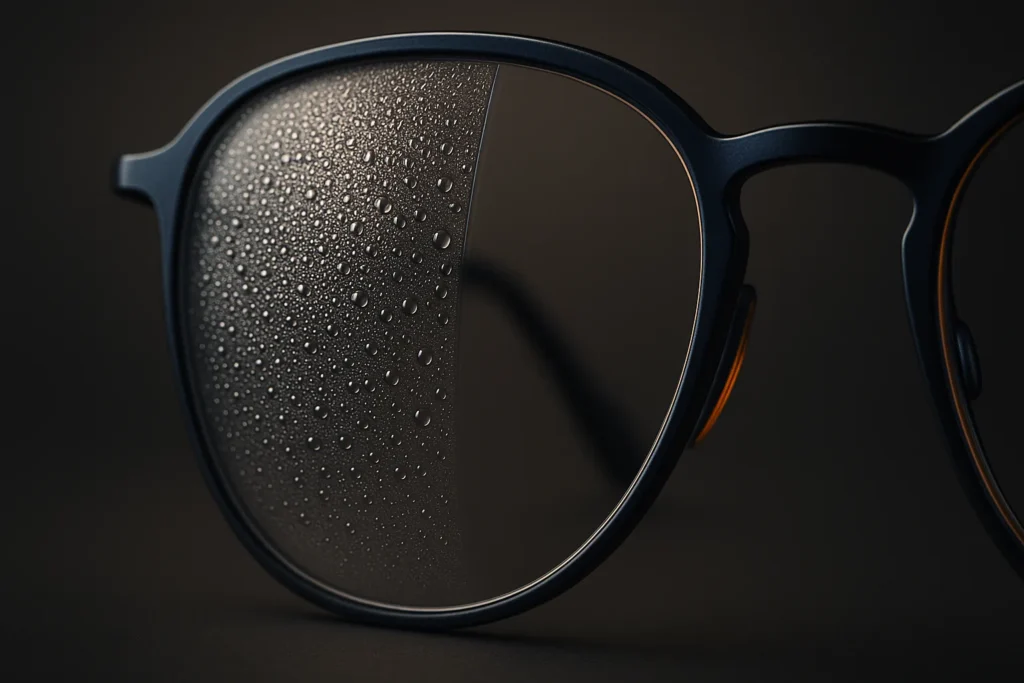
Fogging happens when warm, humid air meets a lens surface that has cooled below the dew point, the temperature at which water vapor starts to condense into liquid. Those condensation droplets scatter light in every direction, turning a clear lens into a white haze. The most reliable fix is a permanent hydrophilic anti-fog coating integrated into the lens at manufacture. If you already own glasses without that coating, a surfactant-based anti-fog spray or wipe is the next best option. DIY household remedies (dish soap, shaving cream) can work for a few hours but carry real risks for coated lenses. The right choice depends on your lens substrate, the coatings you already have, and how frequently fogging affects you.
Why Glasses Fog Up
The physics are straightforward. Air holds water vapor in proportion to its temperature. When eyeglass lenses cool below the dew point of their surrounding air, water vapor immediately adjacent to the lens substrate (the base lens material, whether polycarbonate, CR-39, or high-index plastic) condenses directly onto the surface. This produces a field of microscopic water droplets.
A thin continuous film of water is largely transparent, but hundreds of separate tiny droplets are not. Each one bends and scatters light differently, creating the familiar opaque haze. Vision clears again once the lens rewarms and the droplets evaporate.
Common fogging triggers:
- Wearing a face mask (exhaled breath rises behind the lens, warm and nearly saturated with water vapor)
- Moving from cold outdoor air into a heated or humid indoor space
- Holding a hot beverage close to the face
- Vigorous exercise in cool or damp conditions
- Steam-heavy environments such as a kitchen or bathroom
Permanent Anti-Fog Coatings: Hydrophilic Technology
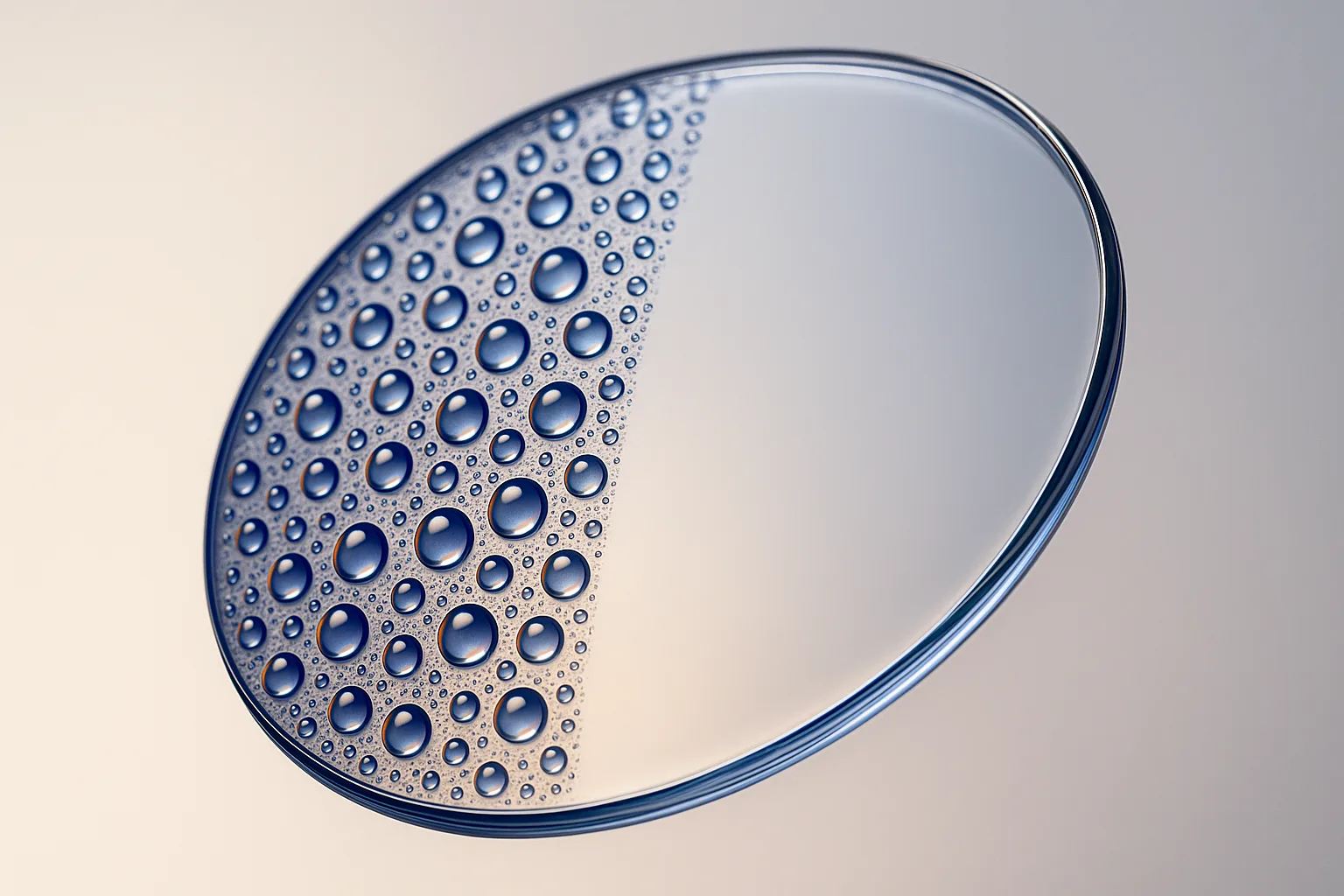
Hydrophilic means “water-attracting.” A hydrophilic anti-fog coating does not repel water; it pulls incoming water molecules flat across the lens surface rather than allowing them to cluster into droplets. Hydromer describes the mechanism precisely: the coating “reduces the surface tension of water, allowing the moisture to spread evenly across the surface” into “a transparent thin layer, which does not alter the optical properties of the substrate.” A continuous film this thin is effectively invisible, so optical clarity is maintained even when condensation is present.
Essilor’s Optifog system is one of the most widely available factory-applied anti-fog products. According to Essilor Pro, it uses “specific molecules in a smart textile microfiber dry cloth that activate fog repellent properties in the Optifog lens hydrophilic top layers.” The activation step (wiping with the proprietary cloth before wearing) primes the hydrophilic layer. This is typical of premium anti-fog AR packages: performance is strong but depends on following the prescribed care routine.
Lab-applied anti-fog coatings can sometimes be added after a lens is already made, though adhesion is generally less durable than factory application. Durability varies widely by product and usage, ranging from several months to a few years with proper care. Ask your optician whether a lab-applied option is compatible with your existing anti-reflective (AR) coating stack; some combinations reduce optical clarity or compromise the AR layer’s performance.
The choice of lens material can also influence fogging frequency. Different substrates have different thermal properties that affect how quickly a lens cools to the dew point in a changing environment.
Anti-Fog Sprays, Wipes, and Gels
Commercial sprays and pre-moistened wipes use a different mechanism than coatings. McGill University’s Office for Science and Society explains that “most commercial anti-fog agents are surfactants that minimize the surface tension of water, with ethoxylates and polysiloxanes being typical examples.” A surfactant molecule has one water-attracting end and one water-repelling end. It inserts between water molecules, breaking the cohesive force that lets droplets hold their shape. The result: water spreads into a nearly invisible continuous film rather than forming light-scattering droplets.
The core limitation is durability. A spray film wears off with cleaning, humidity, and handling, typically within hours to a few days depending on the product and conditions. Reapplication becomes routine maintenance, not a one-time fix.
When selecting a spray, choose formulas explicitly labeled safe for coated lenses. Products containing ammonia, acetone, or high concentrations of alcohol can degrade AR layers permanently, leaving cloudiness that no cleaner will remove.
DIY Methods: What Works and the Risks
The most common DIY approaches exploit the same surfactant chemistry used in commercial products:
Dish soap: A small amount of mild, fragrance-free dish soap diluted in water, applied to the lens and left to air-dry without rinsing, leaves a thin film that temporarily lowers surface tension. Effective for roughly one to four hours.
Shaving cream: Works on the same principle. Apply, allow to dry slightly, then buff off with a clean microfiber cloth. Effect duration is comparable to dish soap.
Baby shampoo: Gentler than regular formulas and still surfactant-based. A diluted film on the lens exterior can reduce fogging for a short period.
Saliva: Contains proteins that slightly reduce surface tension, which is why SCUBA divers have used it on dive masks for decades. On prescription eyeglasses, the anti-fog effect is marginal, and introducing bacteria and debris to the lens surface is an obvious hygiene concern.
What to avoid entirely: toothpaste, undiluted alcohol, vinegar, and any abrasive material including paper towels. These can strip or micro-scratch existing coatings, including anti-reflective layers, causing permanent haze. Damaged coatings rarely recover without lens replacement (see Can Scratched Lenses Be Repaired? for a full breakdown). Some premium lens warranties are also voided by unauthorized cleaning agents, so check the terms before experimenting.
Anti-Fog and AR Coating Compatibility
Modern premium AR stacks typically include four to six coating layers: a hard coat for scratch resistance, multiple anti-reflective layers, and a hydrophobic or oleophobic outermost layer. Hydrophobic means “water-repelling” and oleophobic means “oil-repelling.” These outermost layers resist fingerprints and shed rain, but they actively oppose anti-fog performance because they promote droplet formation rather than film spreading.
Hydromer notes that hydrophilic and hydrophobic coatings rely on fundamentally different strategies. Applying a hydrophilic anti-fog spray over a hydrophobic AR top coat creates competing effects and may partially neutralize the hydrophobic layer’s smudge resistance over time. For lenses where anti-fogging is a persistent concern, an integrated anti-fog AR package applied at manufacture is a better long-term approach than layering products designed for opposing purposes.
Caring for Coated Lenses
Proper care directly affects how long any coating, including an anti-fog layer, continues to perform. ZEISS recommends rinsing lenses under lukewarm water before wiping to dislodge grit (grit wiped dry acts as an abrasive), then cleaning with a lens-safe solution and a microfiber cloth. Paper towels, tissues, and clothing fabrics are abrasive at the microscopic level and introduce hairline scratches to precision coating surfaces over time. For material-specific cleaning routines, the eyewear maintenance guide covers the full process.
Key practices for preserving anti-fog coatings:
- Rinse before wiping; never dry-wipe a lens
- Wash your microfiber cloth weekly in cold water with a small amount of dish soap and no fabric softener
- Avoid leaving glasses in a hot car; heat can delaminate thin coating layers
- Apply anti-fog spray to a clean, dry lens after your regular cleaning routine, not before, so residual moisture does not dilute the surfactant film
- Store glasses in a protective case rather than face-down on a surface
Comparing Anti-Fog Solutions
| Solution | Durability | Effectiveness | Relative Cost | Risk to Existing Coatings |
|---|---|---|---|---|
| Permanent factory or lab anti-fog coating | Months to years with proper care | High, consistent | Higher (applied at lens order) | Minimal; integrated into the AR stack |
| Commercial anti-fog spray, wipe, or gel | Hours to a few days per application | Moderate; reapplication required | Low per product; recurring expense | Low with AR-safe formula; higher with incompatible solvents |
| DIY surfactant (dish soap, shaving cream) | One to four hours | Low to moderate | Negligible | Moderate; may void warranty; avoid any abrasive application method |
Frequently Asked Questions
What causes glasses to fog up when wearing a face mask?
A face mask directs exhaled breath upward toward the lenses. That breath is warm and nearly saturated with water vapor. When it reaches the cooler lens surface and the air drops below the dew point, condensation forms directly on the lens. Redirecting airflow with a better-fitting mask or nose wire helps, but an anti-fog coating or spray addresses the root cause on the lens itself.
How long does an anti-fog coating last on glasses?
Durability varies by product and care routine. Factory-applied permanent anti-fog coatings such as Essilor Optifog can perform for months to years when cleaned with the prescribed activator cloth and proper lens solution. Lab-applied coatings tend to be less durable. Commercial anti-fog sprays need reapplication every few hours to a few days depending on conditions.
Can I use anti-fog spray on glasses with an anti-reflective coating?
Yes, provided you choose a formula explicitly labeled compatible with coated lenses. Avoid sprays containing ammonia, acetone, or high concentrations of alcohol, as these can degrade AR layers permanently. Also note that hydrophilic anti-fog sprays and hydrophobic AR top coats work against each other; repeated application may gradually reduce the smudge-resistance of the outermost AR layer.
Does dish soap work as an anti-fog treatment for glasses?
A thin film of mild, fragrance-free dish soap applied to the lens and left to air-dry without rinsing reduces surface tension temporarily, typically for one to four hours. It works as a short-term fix. Check with your optician or lens manufacturer before using it regularly on premium coated lenses, as some warranties prohibit unauthorized cleaning agents.
Will a hydrophobic coating prevent fogging?
No. Hydrophobic coatings cause water to bead and roll off, which works well in rain but not in fogging conditions where condensation forms directly on the lens and has nowhere to go. Preventing fog requires the opposite approach: hydrophilic properties that spread condensation into a thin, invisible film. Premium AR packages that include anti-fog function combine both technologies through multiple separate coating layers.
Is saliva safe to use on eyeglass lenses?
Saliva contains proteins that slightly reduce surface tension, which is why SCUBA divers have used it inside dive masks for decades. On prescription eyeglasses the anti-fog effect is minimal. There are no known coating-safety issues from saliva itself, but it introduces bacteria and debris to the lens surface. A purpose-made anti-fog wipe is a more hygienic and effective alternative.

I grew up inside an optical shop. My mother likes to tell how, as a kid, I would watch eyeglasses being assembled, play with the tools, and draw on the back of service order slips. The family business taught me early what a precise measurement and work done right are worth.
I went on to spend more than twenty years as a software engineer, always keeping an eye on the optical world. Optogrid was born where the two meet: digital measurement technology (pupillary distance and fitting heights) built by someone who knows the dispensing counter from the inside.