
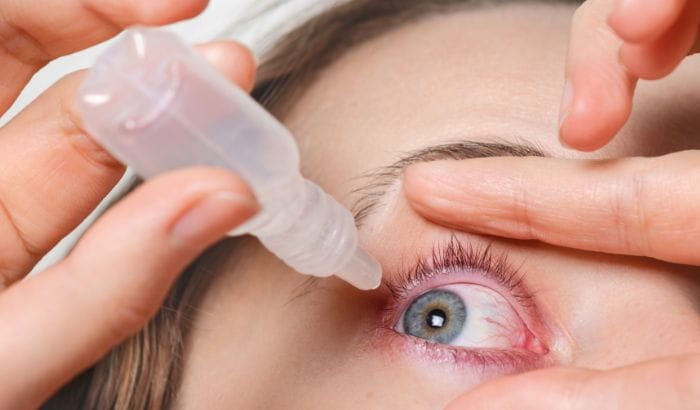
Quick Answer
Dry eye syndrome (also called dry eye disease, or DED) is a multifactorial condition of the ocular surface in which tear film instability disrupts vision and causes chronic discomfort. For dispensing opticians, it matters because it is the top reason contact lens patients stop wearing lenses and a hidden driver of fitting complaints in spectacle wearers. Recognizing its symptoms during a fitting conversation, steering patients toward better-tolerated materials and coatings, and knowing when to refer are the practical skills this guide covers.
Why the Tear Film Matters: Three Layers, Three Jobs
The tear film is a thin fluid layer spread across the cornea with each blink. According to the StatPearls dry eye reference on NCBI Bookshelf, it comprises three main components:
- Lipid layer (outermost): Produced by the meibomian glands in the eyelid margins. Its job is to slow evaporation and prevent the aqueous layer from dissipating between blinks. A thin or absent lipid layer is the hallmark of meibomian gland dysfunction (MGD).
- Aqueous layer (middle, thickest): Secreted by the lacrimal glands. It carries oxygen and nutrients to the cornea, flushes debris, and provides the bulk of tear volume. When lacrimal output drops, aqueous-deficient dry eye develops.
- Mucin layer (innermost): Produced primarily by goblet cells in the conjunctiva. Mucin anchors the tear film to the corneal surface and allows it to spread uniformly. Without adequate mucin, the aqueous layer beads off the cornea rather than wetting it evenly.
These layers are interdependent. Dysfunction in any one of them destabilizes the entire film.
What Causes Dry Eye? Two Subtypes Opticians Should Know
The TFOS Dry Eye Workshop II (DEWS II) defines dry eye disease as “a multifactorial disease of the ocular surface characterized by a loss of homeostasis of the tear film, and accompanied by ocular symptoms, in which tear film instability and hyperosmolarity, ocular surface inflammation and damage, and neurosensory abnormalities play etiological roles.” Published in 2017, TFOS DEWS II remains the global reference framework for classifying and managing the condition.
The two primary subtypes:
Evaporative dry eye (EDE): The lipid layer is too thin, so tears evaporate faster than the lacrimal gland can replace them. The most common underlying cause is MGD, a blockage or dysfunction of the meibomian glands. EDE has been identified as the most common subtype in both clinic-based and population-based studies, according to the TFOS DEWS II Epidemiology Report. Patients often report symptoms that worsen across the day and flare in air conditioning, wind, or low-humidity environments.
Aqueous-deficient dry eye (ADDE): The lacrimal gland produces insufficient tear volume. Sjögren’s syndrome, autoimmune conditions, and certain medications are common drivers. Less prevalent than EDE.
Most patients show a mix of both. A patient with MGD-driven EDE who also takes a daily antihistamine often has overlapping aqueous-deficient features. This overlap is why management is rarely one-size-fits-all and why referral to an optometrist or ophthalmologist is sometimes the right call.
How Dry Eye Presents During a Fitting Appointment
Patients rarely walk in and say “I have dry eye disease.” They describe symptoms in ordinary language. The phrases opticians hear most often:
- “My eyes burn by afternoon.”
- “My contacts feel fine in the morning, but by 3pm I have to take them out.”
- “My vision goes blurry and then clears when I blink.”
- “My eyes feel gritty, like there’s sand in them.”
- “My eyes water constantly.” (Paradoxical reflex tearing is a well-documented dry eye symptom — chronic irritation triggers overflow tearing as a reflex response, even though the underlying problem is tear film instability.)
- “My glasses feel fine but my eyes still feel dry and red.”
Timing is a diagnostic clue. MGD-type patients typically feel worse later in the day, when meibomian secretions have thinned and cumulative evaporation has taken its toll. Aqueous-deficient patients sometimes feel worse in the morning because their lacrimal output was already low overnight.
Environment triggers are another pattern to listen for: symptoms that worsen on airplanes, in offices with forced-air heating, at outdoor events, or on windy days all point to evaporative causes. Intermittent blurry vision that clears with blinking is particularly characteristic — it reflects a momentary break in tear film stability over the cornea, not a refractive error.
Who Is Most Likely to Have Dry Eye in Your Patient Population
Risk factors relevant to the typical optical shop patient mix:
Age. Tear production and meibomian gland function decline with age. Dry eye incidence rises sharply after 50 and is nearly universal in patients over 65.
Sex. Women are disproportionately affected, particularly post-menopause. Hormonal changes reduce both aqueous production and meibomian gland output, making estrogen and androgen shifts a significant driver.
Screen use. During concentrated screen work, blink rate drops from a resting rate of roughly 15 to 20 blinks per minute down to 5 to 7 blinks per minute, according to research on blink frequency and digital eye strain. Incomplete blinking — where the eyelid does not fully close — compounds the problem by preventing adequate lipid layer spread. Any patient who works on screens for more than four hours a day is at elevated risk.
Contact lens wear. The lens surface alters the tear film’s layered structure, disrupts lipid spread, and reduces blink-triggered tear exchange. This is the single most common modifiable dry eye trigger in the dispensing optician’s clinical universe (more on this below).
Medications. Antihistamines, antidepressants (SSRIs and tricyclics), antihypertensives (beta blockers, diuretics), and oral contraceptives all reduce aqueous production. When a patient says “my eyes have felt drier since I started a new medication,” take it seriously.
Autoimmune conditions. Sjögren’s syndrome causes severe ADDE through lymphocytic destruction of lacrimal and salivary glands. The red flag: a patient who reports both dry eyes and persistent dry mouth. That combination warrants prompt referral.
Recent LASIK. Laser refractive surgery severs corneal nerves, which reduces reflex tearing. LASIK-related dry eye typically peaks in the first 3 to 6 months post-op but can persist longer. If a patient mentions recent laser surgery, their dry eye complaints are almost certainly related.
Low-humidity environments and smoking. Both accelerate tear evaporation and increase ocular surface inflammation.
What Opticians Can Recommend at the Fitting Desk
This is where dispensing opticians have real leverage. Most consumer content about dry eye focuses entirely on eye drops and doctor visits. The fitting desk offers something different: the ability to choose materials, coatings, and frames that reduce the patient’s daily tear film burden before they ever open a bottle of drops.
Contact Lens Material and Modality
Dry eye and contact lens discomfort are deeply connected. Research by Dumbleton and colleagues surveying more than 4,000 lens wearers found that “discomfort” (24.4%) and “dryness” (19.9%) were the two most frequently cited reasons for contact lens dropout. Lens material is a lever.
Conventional hydrogel lenses have high water content — typically 55 to 75% — which sounds beneficial but creates a problem: the lens draws moisture from the tear film to maintain its own hydration, leaving less available for the cornea. Silicone hydrogel (SiHy) lenses have substantially lower water content (generally 20 to 55%) but far higher oxygen transmissibility (Dk/t). The result is a lens that relies less on tear-film moisture and delivers more oxygen to the corneal surface. For dry-eye-prone patients, lens material matters.
Daily disposable lenses eliminate deposit accumulation entirely. A fresh lens on day one has a cleaner, more wettable surface than a two-week or monthly lens at day 10. For patients who can tolerate dailies economically, the upgrade from a reusable lens to a daily disposable SiHy often meaningfully extends comfortable wearing time.
Anti-Reflective Coatings
Patients with dry eye frequently report that glare is worse for them than for their peers — partly because a disrupted tear film scatters light less uniformly across the cornea. Premium anti-reflective coating on spectacle lenses reduces photopic glare and also minimizes the effort required to maintain clear vision, which translates to more relaxed eyes during screen use. Many premium AR coatings also carry oleophobic and hydrophobic surface treatments that resist deposits and clean more easily, reducing a secondary source of visual degradation.
Frame Fit
A frame that seals reasonably close to the face reduces airflow across the ocular surface. For patients whose dry eye symptoms are triggered by wind or air movement (outdoor workers, cyclists, skiers), a fitted wrap-style frame offers a practical improvement that no eye drop can replicate. Even for everyday wear, adjusting pantoscopic tilt so the lens sits at the correct vertex distance keeps the lens close enough to the eye to moderate air exposure across the lower cornea.
Photochromic Lenses
UV-induced ocular surface inflammation is one documented trigger for dry eye flares, particularly in patients who spend significant time outdoors. Photochromic lenses reduce UV exposure to the ocular surface, which may reduce this trigger in susceptible patients. This is not a primary treatment for dry eye, but it is a clinically plausible reason to recommend a photochromic upgrade when a patient spends time outdoors and reports seasonal symptom worsening.
OTC Lubricating Drops
Dispensing opticians in the US can recommend (not prescribe) over-the-counter lubricating drops. The practical guidance for patients:
- Preservative-free single-dose units are preferable for anyone using drops more than four times per day. Benzalkonium chloride (BAK), the preservative in most multi-dose drops, can itself cause ocular surface irritation with frequent use.
- Thicker gel formulations provide longer contact time but blur vision temporarily; recommend them for overnight or evening use rather than during the workday.
- The 20-20-20 rule (every 20 minutes, look at something 20 feet away for 20 seconds) gives the blink cycle time to redistribute the tear film and reduces evaporative stress from screen-induced blink suppression.
What Opticians Cannot Do and When to Refer
Dispensing opticians in the US do not perform eye examinations, diagnose disease, or prescribe medications. That scope boundary matters in the context of dry eye.
Refer to an optometrist (OD) or ophthalmologist (MD) when:
- Symptoms are severe, persistent, or not responding to lens changes and OTC drops after a reasonable trial period.
- A patient reports both dry eyes and dry mouth — Sjögren’s syndrome workup is warranted.
- Symptoms include photophobia or significant light sensitivity. Light sensitivity in a dry eye context can indicate corneal surface involvement.
- Vision loss or pain is present (rule out corneal erosion or ulcer).
- A patient’s medications appear to be driving the condition — their prescribing physician or OD should be involved.
- The patient mentions blepharitis, ocular rosacea, or has visible lid margin disease. Meibomian gland expression, warm compresses, lid hygiene, and prescription-level therapies (cyclosporine, lifitegrast, IPL) require clinical management.
What Opticians Can Know About Clinical Tests (Without Administering Them)
Patients sometimes arrive having already seen an eye doctor and mention their test results. Understanding the terminology helps opticians have an informed conversation:
- Tear break-up time (TBUT): Fluorescein dye is applied and the time until the first dry spot appears is measured. Normal is 10 seconds or more; below 5 seconds is diagnostic for EDE. Opticians don’t perform this test, but knowing it explains why a patient’s vision is intermittently blurry between blinks.
- Schirmer test: A paper strip is placed in the lower lid to measure aqueous output over five minutes. Normal is 10mm or more. A patient who mentions “the paper strip test” has been screened for ADDE.
- Meibomian gland evaluation: A practitioner assesses gland openings, lipid quality, and gland morphology (sometimes via infrared meibography). If a patient mentions “blocked oil glands” or “MGD,” they have an evaporative-dominant picture and their fitting choices should prioritize lipid-layer stability.
Eyewear Maintenance and Dry Eye
Clean lenses matter more for dry-eye patients than for others. Deposits on spectacle lenses increase glare and scatter, compounding the visual effects of an unstable tear film. Oily meibomian secretions also deposit on lens surfaces faster in MGD patients. Point dry-eye patients toward proper lens cleaning habits and a mild surfactant cleaning spray rather than dry-wiping, which smears lipid deposits across the lens.
Frequently Asked Questions
What is the difference between dry eye and eye allergies?
Both cause red, irritated eyes, but the patterns differ. Allergic conjunctivitis typically presents with intense itching, watery discharge, and a clear seasonal or environmental trigger (pollen, pet dander, dust). Dry eye produces burning, grittiness, and blurry vision that fluctuates with blinking, and tends to worsen across the day regardless of season. Some patients have both. If antihistamine drops relieve symptoms completely, allergy is the primary driver; if symptoms persist despite antihistamines, dry eye is more likely involved.
Can dry eyes affect vision permanently?
In mild to moderate cases, dry eye causes temporary visual blurring that resolves with blinking or lubricating drops. Severe or chronic untreated dry eye can cause corneal surface damage, including epithelial erosions or scarring, which may have longer-lasting effects on vision. This is one reason persistent or severe symptoms warrant referral to an eye care practitioner rather than continued self-management.
Does screen time cause dry eye?
Screen use is a major dry eye trigger rather than a root cause. During concentrated screen work, blink rate drops significantly, reducing the frequency of lipid layer redistribution and allowing tears to evaporate faster. This does not create dry eye in patients with a healthy tear film, but it substantially worsens symptoms in patients who already have borderline meibomian gland function or reduced aqueous output. The 20-20-20 rule and conscious blinking exercises help manage screen-related flares.
Can contact lenses make dry eye worse?
Yes. Contact lens wear disrupts the tear film’s layered structure, accelerates evaporation, and reduces the rate of tear exchange with each blink. Conventional high-water-content hydrogel lenses can also draw moisture from the tear film to maintain their own hydration. Silicone hydrogel lenses and daily disposable modalities are generally better tolerated in dry-eye patients, but some patients with significant dry eye may need to reduce wearing hours or switch to spectacles as a primary correction.
What kind of eye drops help with dry eye?
Preservative-free lubricating drops are the first-line recommendation for frequent use, since the preservative benzalkonium chloride (BAK) in multi-dose bottles can irritate the ocular surface when used more than three to four times daily. Thicker gel formulations provide longer relief but temporarily blur vision and are best used at night. Prescription treatments — cyclosporine (Restasis, Cequa), lifitegrast (Xiidra), and varenicline nasal spray (Tyrvaya) — require a prescription from an OD or ophthalmologist and address the inflammatory component of the disease.
When should a patient with dry eyes see a doctor?
A patient should see an optometrist or ophthalmologist when OTC drops and lens adjustments have not provided adequate relief after a few weeks, when symptoms are severe or painful, when vision is significantly affected, when both dry eyes and dry mouth are present (possible Sjögren’s syndrome), or when light sensitivity or eye pain is part of the picture. Dispensing opticians can recognize these red flags and direct patients to the appropriate level of care.
Does dry eye affect how glasses should be fitted?
Yes, in a few practical ways. A frame that sits close to the face reduces air movement across the ocular surface, which is particularly helpful for patients with evaporative dry eye. Adjusting pantoscopic tilt and vertex distance to bring the lens close to the eye also reduces the area of cornea exposed to airflow. Patients with dry eye benefit from premium anti-reflective coatings on their spectacle lenses, since glare is amplified by the scattered light transmission through an unstable tear film.
This content is intended for optical professionals and is educational in nature. It does not substitute for a clinical eye examination. Patients with persistent or severe dry eye symptoms should be referred to a licensed eye care practitioner.

I grew up inside an optical shop. My mother likes to tell how, as a kid, I would watch eyeglasses being assembled, play with the tools, and draw on the back of service order slips. The family business taught me early what a precise measurement and work done right are worth.
I went on to spend more than twenty years as a software engineer, always keeping an eye on the optical world. Optogrid was born where the two meet: digital measurement technology (pupillary distance and fitting heights) built by someone who knows the dispensing counter from the inside.