
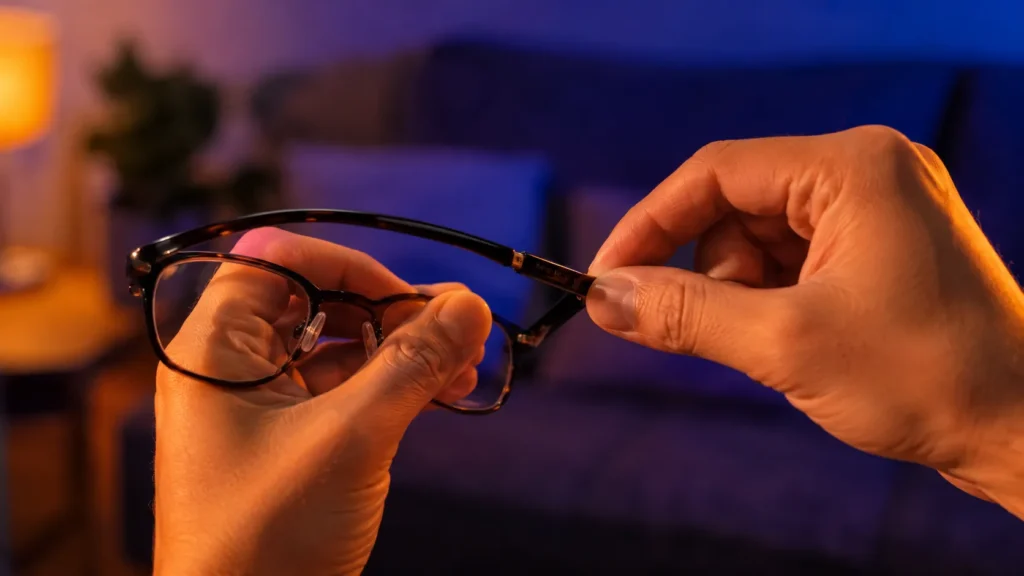
Most glasses that slide down your nose, sit crooked, or dig into the sides of your head can be fixed at home in a few minutes with basic household items. The one rule that prevents most DIY mistakes: plastic (acetate) frames are rigid at room temperature and can crack if you bend them cold, so warm them first and adjust in small increments, checking the fit after each change. Metal frames flex without heat, but rimless, titanium, and drilled-lens frames are the exceptions where a professional adjustment is the safer call.
Diagnose the Problem Before You Adjust Anything
Pin down what is wrong before reaching for a screwdriver or hair dryer. The fix depends on the symptom.
| Symptom | Likely cause | At-home fix |
|---|---|---|
| Slides down the nose | Nose pads too wide, or temples too loose | Bend nose pads inward (metal frames); warm and gently tighten the temple curve (plastic) |
| Sits crooked on the face | One temple bent lower than the other at the hinge | Check on a flat surface, then bend the higher side down |
| Pinches or leaves marks on the nose | Nose pads set too close together or pressing too hard | Bend nose pads outward slightly |
| Hurts or digs in behind the ears | Temple tip bent too tight, or the arm is too short | Warm plastic and ease the bend open; on metal, widen the curve behind the ear |
If none of these match, or the glasses still feel off after an adjustment, the problem may be the original fit or measurement, not the frame itself. See how glasses should fit for what correct fit actually looks like.
Warming and Bending Plastic (Acetate) Frames
Acetate, the most common plastic frame material, will not bend at room temperature and can crack at the hinge if forced cold. Payne Glasses’ frame care guide puts it plainly: “acetate frames aren’t pliable at room temperature, you need to add heat,” and you can “either run your frames under hot water or heat with a hair dryer for 20 seconds.”
- Warm the area. Point a hair dryer on low or medium heat at the temple or bridge for 20 to 30 seconds, held a few inches away, or run that section under hot (not boiling) tap water for 30 seconds, keeping the lenses dry. It should feel warm and pliable, not hot.
- Bend gently, in small steps. Apply steady, light pressure with your fingers rather than force. The same guide warns that “if you press on plastic too hard, the frames are likely to snap.”
- Hold and let it cool. Keep the frame steady for about 30 seconds, then let it air-cool before putting the glasses on.
- Re-check the fit. Repeat the cycle only if needed; small adjustments beat one large bend.
Adjusting Metal Frames: Temples and Nose Pads
Metal frames flex at room temperature, but small increments still apply: over-bending a temple or nose pad arm can snap it.
Tightening the Temples
If the arms feel loose at the hinge, a small screwdriver, the kind included in most glasses repair kits, can tighten it. Warby Parker’s guide to adjusting glasses at home describes turning the screw “counterclockwise,” then gently bending “the temple end down” to snug the fit behind the ear.
Moving the Nose Pads
On metal frames with separate pads, moving them closer together and slightly higher raises the frame and stops it from sliding; moving them farther apart and lower loosens a tight bridge. Warby Parker’s guidance is direct: “gently bend the nose pad inwards” if the glasses feel loose or sit too low on your face.
Fixing Crooked Glasses with the Flat-Surface Trick
To check whether glasses sit crooked, place them upside down on a flat surface with the lenses facing up; whichever temple arm lifts higher needs to come down at the hinge. Healthline, medically reviewed by optometrist Ann Marie Griff, O.D., recommends the same check: “set your glasses down so that the bottom of the rims sit evenly on a flat surface.”
On a metal frame, gently bend the high side down just past the hinge. On plastic, warm that section first using the method above. Recheck on the flat surface after each small bend; overcorrecting just creates the opposite problem.
Relieving Pressure Points Behind the Ears
If the arms dig into your skin behind the ears or leave marks by the end of the day, the temple tip is usually bent too tight, or the arm is too short. On metal frames, gently widen the curve where the arm hooks behind the ear; on plastic, warm just the tip section and ease the curve open before letting it cool. Work in very small increments: a curve opened too far will let the glasses slide forward instead.
If pain persists after a couple of careful adjustments, or happens on only one side, stop. That usually means the frame’s overall alignment is off, not just the ear tip, and is worth a professional look.
When to Stop and See an Optician Instead
Some frames and situations are not good DIY candidates. Bring the glasses to an optician instead of adjusting them yourself if any of the following apply:
- The frame is rimless or has drilled lenses. There is no rim to absorb bending force, so pressure transfers straight to the lens and can crack it. See our guide to rimless frames for why they need special handling.
- The frame is titanium or another memory-metal alloy. These materials spring back to shape, so a hand-bend will not hold, and forcing it further can damage the temper. Our guide to titanium frames covers how the material behaves.
- A screw has fallen out or a temple has detached. As Warby Parker puts it, “if a screw falls out or an arm is detached, don’t try to fix your glasses at home.”
- The glasses are high-value, still under warranty, or recently purchased. A shop adjustment protects the warranty and any return window.
- Vision feels off after adjusting, not just the fit. That points to a shift in lens position relative to your eyes, not comfort. Our professional frame adjustment guide covers the parameters opticians check, like pantoscopic tilt and vertex distance.
Most optical shops, including large chains, adjust glasses free of charge even if you did not buy them there, so there is little downside to asking first.
Between adjustments, a well-fitted pair still needs cleaning, safe storage, and periodic screw checks. See our guide to caring for your glasses for the basics.
Frequently Asked Questions
How do I stop my glasses from sliding down my nose?
Check the nose pads first. On metal frames, gently bend them inward and slightly higher to add grip. On plastic frames without separate pads, warm the bridge and tighten the curve slightly, then retest.
Can I adjust plastic (acetate) glasses at home?
Yes, but only after warming them. Acetate is rigid at room temperature and can crack if bent cold. Warm the area with a hair dryer or hot tap water for 20 to 30 seconds, bend gently, then let it cool before wearing the glasses.
Why do my glasses hurt behind my ears?
Usually the temple tip is bent too tight, or the arm is too short. Ease the curve open slightly behind the ear, in small steps, and recheck after each one. If the pain is only on one side or does not improve, the overall alignment may be off.
How do I fix glasses that sit crooked on my face?
Place the glasses upside down on a flat surface with the lenses facing up. Whichever temple arm sits higher needs to bend down slightly at the hinge. Recheck on the flat surface after each small adjustment rather than making one large bend.
Is it safe to adjust my own glasses?
For small bends on standard metal or plastic frames, yes, as long as you work slowly and warm plastic before bending it. It is not safe for rimless, drilled-lens, or titanium frames, or if a screw has fallen out. When in doubt, an optician can usually make the adjustment in a couple of minutes.
Do opticians charge to adjust glasses?
Most optical shops and chains adjust glasses free of charge, even if you bought them elsewhere, especially for minor fixes like nose pads or temple bends. Some charge only if replacement parts are needed.

I grew up inside an optical shop. My mother likes to tell how, as a kid, I would watch eyeglasses being assembled, play with the tools, and draw on the back of service order slips. The family business taught me early what a precise measurement and work done right are worth.
I went on to spend more than twenty years as a software engineer, always keeping an eye on the optical world. Optogrid was born where the two meet: digital measurement technology (pupillary distance and fitting heights) built by someone who knows the dispensing counter from the inside.